I Became the Emperor’s Prisoner - Reviews

I Became the Emperor’s Prisoner
+Add to Custom List
Sort
Add review
... Read More
The stakes in these chapters are absolutely ferocious and I need to process this. On the surface level, Elze is physically injured — she's scratched her throat raw, she's weak, she needs medical attention. Simple. But the REAL stakes are so much higher. She possesses poison. She knew something at the banquet that she couldn't share. She sacrificed her voice, likely for reasons that implicate Kelta himself. And now she's traveling with the person she's most afraid of discovering the truth, unable to defend herself verbally, while he's slowly realizing that everything he thought he understood about their relationship has holes in it. Kelta's internal conflict is where the tension really lives. He's torn between his nature — which is to cling to her, to protect her, to stay by her side 'like yesterday' — and his instinct that something is deeply wrong. When he says 'So it's not me who made you hurt yourself,' that's not just suspicion, that's a man terrified that his love is the weapon being used against the person he cares about most. The external threats are also mounting — the griffins, the political situation, the knights being demoted (which Elze witnesses and clearly feels responsible for), the poison she's carrying, the returning Foundation Festival that serves as both deadline and pressure cooker. But the most terrifying stakes are the interpersonal ones. Every carriage ride, every shared glance, every time his knees touch hers — these moments that should be tender are instead fraught with the knowledge that one of them is hiding something that could destroy everything. The author has built this incredible pressure cooker and I am genuinely terrified of what happens when it explodes. Who will break first? And when they do, will there be anything left to rebuild from?
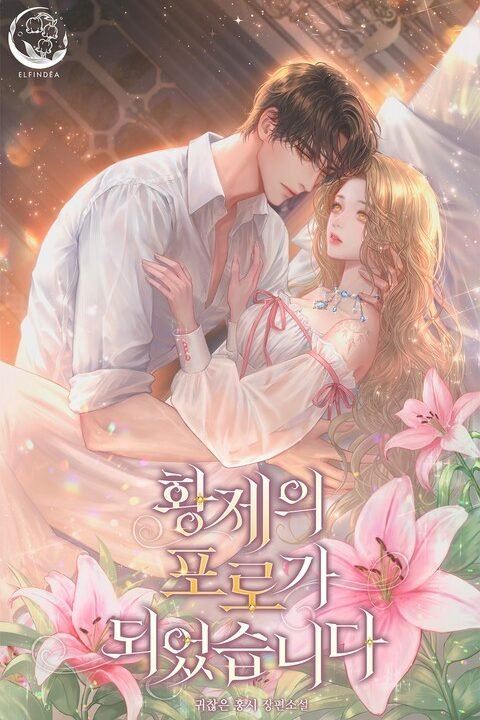
... Read More
The forest campsite sequence is one of the most atmospheric passages I've read in recent fantasy romance. The author doesn't just describe a setting—they build a sensory world that you can literally feel. Let me start with the tree scene. Kelta leads Elze behind a large tree, takes off his cloak, and wraps it around her shoulders. The visual contrast alone is striking: her pale, trembling form against the dark bark, his tanned skin glistening in the sunset light as he kneels before her. The setting sun coloring his bent nape—this is painted like an oil painting. You can almost see the gold and amber light shifting across his skin. Then there's the camp. Three tents twice the size of the others. Soldiers cooking in the central space. The crackling bonfire casting shadows that move with the wind. The moon appearing through the trees, described as feeling “cozy” despite the darkness—a perfect reflection of Elze's own contradictory emotional state. She is exhausted and terrified, yet finding moments of peace. The morning after brings rain. “It rained overnight, so the air is cold.” The nearby stream flowing vigorously. Cool morning air touching Elze's fever-warm cheeks. The author has this incredible ability to use weather and temperature as emotional barometers—the cold hands, the warm milk, the chill of autumn nights, the fever that makes everything burn. Every sensory detail serves the mood. And that ending image: Kelta's face looking pale despite his indifferent expression, checking her forehead while she struggles to keep her eyes open. The firelight, the fur blankets, the steam rising from the medicine cup—all of it creates a world that feels lived-in and real.
... Read More
The Lemos arc has been building toward this moment and I feel like the tension here operates on at least three levels simultaneously. First, the external stakes: they're in hostile territory. The Margrave is a known threat. Elze is technically a captive being used as political leverage. Kelta is a military commander operating in territory where one wrong move could get them both killed. The lord practically screams this—"don't be intimidated by the word 'captive'! If you're the only woman by His Majesty's side... well, you'd be the empress, wouldn't you." He's literally spelling out the political chess game they're trapped inside. Every interaction between Kelta and Elze carries the weight of territorial diplomacy. Second, the interpersonal stakes: Elze has survived twenty years of isolation and her instinct is still to obey, to anticipate, to make herself small. Kelta has spent his life building armor and his instinct is to push people away while simultaneously needing them desperately. When he asks "Did you live so carelessly in Talis?"—he's not just asking about her behavior. He's asking about the trauma that made her who she is. And when she shakes her head frantically, wondering if her carelessness will make him leave? That's the core conflict right there. She doesn't trust that she'll be kept. He doesn't trust that he won't be abandoned. Third, and this is the one that keeps me up at night—the romantic stakes. They're not even admitted to themselves yet what's happening between them, but the narrative is screaming it. The bathtub scene isn't just intimate; it's a collision point. She breaks his boundary. He responds with concern disguised as irritation. She touches his scar and he can't maintain the glare. These two are orbiting each other so closely that the gravitational pull is becoming visible to everyone EXCEPT them. And that dramatic irony? It's going to make everything SO much worse before it gets better. Because when the external world forces them apart—or when one of them finally admits what they feel—the collision is going to reshape both of them.
... Read More
I just need a moment. A full moment. Because what the author did in these few pages is genuinely devastating in the best possible way. Let me start with Elze's internal monologue earlier — she's literally rehearsing how she'll earn his affection by being useful. Washing sheets. Finding sunspots. If she's good enough, maybe he'll help her in return. This girl has survived abandonment and isolation and her immediate instinct is still to make herself smaller, more useful, more bearable. And Kelta? He saw right through it. "The thought of another man seeing you like this makes my teeth grind." Read that again. That's not possessiveness. That's terror. He is terrified someone else will see her and take her, so he preempts it by keeping her close. But he frames it as annoyance. The bathtub scene though—oh god. Her face burning, trying to hide in his collarbone, him going completely still. "It hurts my pride to be the only one constantly swayed." THIS LINE. It's the most honest thing either of them has said. He's admitting she affects him. That he loses composure around her. And she thinks she's the rainbow? Please. He's the one who built walls and then watched her walk right through them without even trying. I can't stop thinking about the scarf moment too. He gives it to her publicly with zero ceremony, like it's nothing. But we both know it's everything. He used to be a person who couldn't even express gratitude without sarcasm. Now he's quietly weaving himself into her life thread by thread.
... Read More
Let's just… process what happened in these chapters because my hands are still trembling. Elze walks into that forest completely unprepared. She's a nobody—literally a former slave with no political power—and she stumbles upon the Queen having an affair with Count Malrid, a member of the old royalist faction. Do you understand what that means? If this gets out, it's not just scandal. It's potentially a coup catalyst. The old faction has a secret alliance with the current Queen. That's treason-level shit. And she tries to use the only leverage she has—the wartime religious prohibition against bloodshed—to negotiate her life. She's clutching at straws, literally quoting theology to a woman who has every reason to kill her, and for a moment it almost works. The Queen hesitates. But then she offers the alternative: cut her wrists instead. And then the bottle. Oh god, the bottle. The liquid that burns and stabs and turns her voice into scratches and rasp. The Queen isn't just silencing her—she's systematically destroying the one thing that might help Elze survive: her ability to speak, to tell the story, to be heard. The external stakes (war, political conspiracy, assassination attempts) and the internal stakes (Elze's voice, her identity, her autonomy) are colliding and the author is not letting up. Every chapter raises the temperature. Elze went from drunkenly nuzzling into Kelta's chest to fighting for her very voice in under fifty pages. I am emotionally spent and I have no regrets.
... Read More
"You're exactly like my memory." I need a minute. This line absolutely wrecked me. Because think about what's happening underneath — Kelta is carrying this woman who is literally supposed to hate him, who is a prisoner from the kingdom he conquered, and yet he keeps finding reasons to protect her. The cloak moment. Carrying her when she's too scared to walk. His hands trembling when he holds her. All of it reads as genuine care mixed with confusion about why she won't accept it. And Elze? She's torn. She needs to kill him to save her mother, but every time he touches her, every time he acts like he knows her — it throws her completely off balance. The physical closeness isn't just dangerous because it reminds her she CAN'T do it, it's dangerous because part of her wants to believe him when he says he'll make her love the Empire. The most devastating part is when he says "I suppose I feel like a punishment you must endure." That's not the words of a conqueror talking to a prisoner. That's someone who thinks he's failed her. And she just... takes it. Pretends she didn't hear. Meanwhile she's clutching her stomach, heart racing, poison bottle somewhere on the ground. I'm not okay with this slow burn.
... Read More
This chapter is a masterclass in controlled pacing. The author understands something most writers miss: tension doesn't come from constant action—it comes from the spaces BETWEEN actions. Consider the opening. We drop into a scene that is already at maximum emotional intensity—Elze is panicked, Kelta is desperate, and they haven't even begun to resolve anything. But instead of escalating immediately, the author pulls back. Kelta kneels. He rubs her hands. He apologizes. The pace SLOWS down deliberately, and this deceleration actually INCREASES the tension because we are forced to sit with these characters in their rawest moment. The transition from the forest clearing to the campsite to the tent interior follows a natural rhythm—each location shift represents a deepening of intimacy. They move from public space (soldiers, horses) to semi-private (the tree with the cloak) to private (the tent where she must change). Each step forward is met with Elze's resistance, creating a push-pull pattern that never lets the reader breathe. “Hurry and change so you can rest.” Then the misunderstanding about her trying to avoid him. Then his unexpected retreat: “I'll wait outside, so change comfortably.” This beat of miscommunication and resolution is perfectly paced—it gives us both comedy and warmth without slowing the narrative. The chapter ends on a quiet note—her fever, his worried face, the sleeping draught. After all the emotional turmoil, this stillness is almost more powerful than any dramatic climax. The author trusts us to sit with the uncertainty. Excellent structural choices throughout.
... Read More
'Stay by my side for a long time.' Three words. So gentle. So utterly devastating. The Emperor says this while holding her chin, after he's just torn her from everything she knows, after his armies have destroyed her home, after she's been branded a prisoner. And yet—the contrast between his rough hands and his soft voice, the way he rubs the rain from her eyes like she's something fragile instead of a political object, the heat of his hand against her cold skin—it creates this horrifying tenderness that I can't stop thinking about. She's terrified. She should hate him. And maybe she does. But he's also the only one in this entire scene who touches her with anything resembling care. The scene where she feels pain in her shoulder before she even knows why, the tingling that climbs up her arm like it's alive—that moment where her body reacts to him before her mind can catch up? Chills. Actual chills. There's something primal and undeniable between them, even though she's a hostage and he's her captor. I'm not okay with this.
... Read More
The imagery in this text is doing SO much heavy lifting and I need to unpack it. First—the dragon. The Talis king says 'I've heard a dragon sleeps beneath this country, but I suppose this commotion wasn't enough to wake it.' A sleeping dragon beneath the land. Is this literal? Metaphorical? A prophecy? The way he says it—with such cold contempt—makes me think there's something ancient and dangerous about this kingdom that's been deliberately hidden. Then there's the Emperor's empty ring finger. He brushes it absently, again and again, like a habit, like a phantom sensation. Something was there before. Something significant. And Elze's eyes—golden, the same as the Emperor's—keep coming back like a motif. Eyes are always windows to the soul in literature, but here they feel like something more. Portals. Markers of identity. Proof that Elze might be connected to this empire in ways neither of them fully understand yet. The poison itself—dark red, sloshing in a vial—is also loaded symbolism. It represents the king's betrayal in liquid form, beautiful and deadly, something she's handed to her as a gift. Every object in this story feels like it's holding a secret.
... Read More
“Do you think His Majesty and I don't know about your habit of secretly taking one silk fabric each time you visit the imperial palace?” This line alone is worth the price of admission. Roah delivers it with such calm, devastating precision. He's been SILENT the entire banquet, and the second the Margrave starts his whole “my dress, my dress” meltdown, Roah drops this nuclear fact like he's commenting on the weather. The Margrave's reaction is comedy gold. He opens his eyes wide, realizes for the first time that yes, he has, in fact, been stealing imperial silk, and then immediately pivots to asking if ALL the gifts now belong to Elze. The man has zero shame. Zero. I couldn't stop laughing. But then there's Kelta's dialogue, which is a completely different flavor. His voice in this section is all low, controlled urgency. “Give me just a small gap, and I'm quickly forgotten in your mind.” That line is devastating because it's so vulnerable coming from someone who otherwise acts like he owns the room. He's basically begging without saying the words. And Elze's few lines—she's mostly silent in this section (on the nose, thematically), but when she does speak, especially that formal, trembling address to the Queen about the Ixion forces and Goddess Neker—it shows how desperately she's trying to use words as weapons even as they slowly fail her. The contrast between the comic relief dialogue and the razor-thin tension in every other exchange is what makes this section sing.
... Read More
The recurring motif of temperature in this chapter is not accidental—it is the emotional thesis of the entire passage. Elze's hands are cold. Kelta's breath is hot. The milk rises in steam. Her body burns with fever. The autumn night is chilly. Every physical sensation maps directly onto the emotional landscape: she is emotionally frozen, terrified, withdrawn—and he is persistently, almost annoyingly warm. He doesn't force his heat onto her; he offers it gradually, letting her choose whether to accept it. The cloak is another powerful symbol. It begins as something practical—a covering for her modesty—but becomes a vessel of trust. She grips it with both hands like a shield. He wraps it around her like armor. When he ties it meticulously, he is literally and figuratively securing her safety. And when she later tries to change in it, drowning in its excess fabric, it becomes a symbol of how ill-equipped she is to navigate this world he has brought her into. But my favorite symbolic moment is the ring finger. “Kelta fidgeted with his ring finger for a long time.” This small gesture—touching a ring that likely signifies his royal status—while he is vulnerable before her. He is a king who rules a country, yet here he is, unable to speak his feelings, unable to bridge the gap between them. The ring is his identity, and he is nervously anchoring himself to it while admitting: “I have no idea how to handle you.” Even the medicine bottles carry symbolic weight—the painkiller versus the sleeping draught. One addresses her physical suffering; the other addresses his emotional need for control. She drinks both without full understanding, just as she is beginning to accept pieces of him without fully comprehending his intentions.
... Read More
The symbolism in this chapter is so layered I could write a whole essay. Orange blossoms - traditionally flowers of marriage and purity, used by brides. When Elze sees them on the circlet, her first thought is that she's being given as a concubine. But what if that's not what they represent in THIS context? What if Kelta is actually trying to give her something that symbolizes honor and worth, and she's so conditioned to seeing herself as disposable that she interprets it as transactional? The poison is another huge symbol. It represents her last resort, her only weapon, her willingness to die rather than submit. And Roah - the dangerous swordsman - is the one who offers to help her keep it. The irony is thick. The person who seems most like a threat is actually the one offering protection, while the person offering safety (Kelta) seems like he might be selling her. "A single leaf sprouted" - this imagery of growth, however small, is so important. After everything, her body still responds to kindness. She's not fully broken. The fact that Kelta noticed her disheveled hair and immediately started fixing it, brushing off dirt, tucking hair behind her ears - he's literally trying to help her bloom, and she's waiting for the other shoe to drop. The setting sun at the end is also doing heavy lifting. "When autumn came, might her cool premonition become certainty?" The changing seasons mirror her changing emotional state - summer safety giving way to autumn dread.

Leave a comment

You must be logged in to leave comments. or
