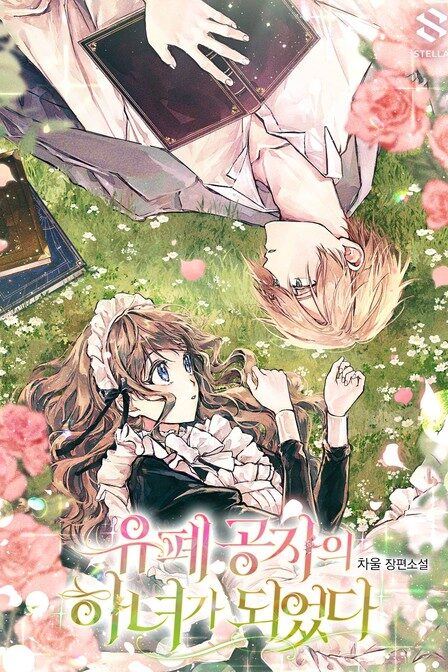
I Became a Maid to the Exiled Young Lord
+Add to Custom List
Novel Info
  • Author:
  • Status:Ongoing

Summary

... Read More

Cordelia Green, a twelve-year-old mute girl from the Therion Kingdom, endures daily discrimination after immigrating to the Rihardt Empire. Haunted by traumatic nightmares of an execution she witnessed as a child, she seeks escape from her guilt-ridden routine at her mother’s fruit shop. Catherine, the head maid of the Obenhart ducal family, hires Cordelia as a personal maid for the young master, Caspian, at their isolated villa in the port city of Asteris. Caspian is a sickly fourteen-year-old noble who has not left the villa in seven years. He is cold, suspicious, and deeply resigned to his fate as an outcast within his powerful family.

Upon arrival, Cordelia and Caspian clash immediately. He assumes she is a fraud or a servant sent to exploit his low status, while she struggles to understand his harsh words. When Caspian falls ill with a high fever, Cordelia cares for him diligently, an act that momentarily softens his hostility. However, he reverts to his defensive posture, attempting to bribe her into leaving with a year's wages. The turning point arrives when Cordelia offers him a white rose given to her by the gardener, Jack. In a fit of irritation, Caspian crushes the flower, causing Cordelia to flee in tears. She leaves a drawing of the mansion for Catherine and departs, believing she has failed. Caspian is left staring at the broken petals, feeling an uncharacteristic pang of regret.

The next morning, Cordelia returns, determined not to lose her first opportunity for independence. She presents Caspian with written notes explaining that this job represents her first choice in life and her desire to move forward. Moved by her resilience, Caspian allows her to stay. Their relationship begins to shift from hostility to a tentative partnership. Caspian provides her with a fountain pen and a proper notebook, facilitating their communication through writing. He also assigns her the care of his canary, a bird that cannot sing because his father, the Duke, dislikes noise. This shared burden of a silenced creature mirrors their own trapped existences.

As Cordelia learns the Imperial language and improves her duties, she integrates into the household. She befriends Jack, the eccentric gardener, and reconnects with Gideon, an interpreter from Therion who teaches her advanced language skills. Meanwhile, the servants at the villa, particularly a maid named Becky, harbor resentment toward Cordelia due to her Therion heritage and her unexpected favor with the young master. Becky and two other maids conspire to sabotage Cordelia by releasing the canary from its cage and opening the window. Cordelia discovers the empty cage in despair and frantically searches the entire mansion and garden.

Caspian finds Cordelia devastated in the garden. Learning of the lost bird, he does not reprimand her but instead joins the search. The incident reveals the underlying tensions within the household and the dangers Cordelia faces as an outsider. Despite the loss, their bond strengthens. Caspian begins to leave his room more frequently, influenced by Cordelia’s presence. He starts dining in the dining room and walking in the garden, activities he had abandoned years ago. The narrative highlights how Cordelia’s determination and kindness slowly break through Caspian’s isolation, offering both characters a path toward healing and agency within their constrained lives.

Latest Release
DateGroupRelease
2026-10-03dusk blossoms c41
2026-10-03dusk blossoms c40
2026-10-03dusk blossoms c39
2026-10-03dusk blossoms c38
2026-10-03dusk blossoms c37
2026-10-03dusk blossoms c36
2026-10-03dusk blossoms c35
2026-10-03dusk blossoms c34
2026-10-03dusk blossoms c33
2026-10-03dusk blossoms c32
2026-10-03dusk blossoms c31
2026-10-03dusk blossoms c30

Community Reviews

Rating(0 / 5.0, 41votes)
5 stars
0(0%)
4 stars
0(0%)
3 stars
0(0%)
2 stars
0(0%)
1 stars
0(0%)

Popular reviews

... Read More
There's this one moment that absolutely ruined me — or made me, you know, feel something I wasn't expecting. Caspian, who never leaves his room, who lives in this hermit existence, starts going out. Just to eat in the dining room. Just to walk in the garden. And the narrative explicitly tells us these are ordinary moments for other people but extraordinary for him. But here's what struck me: he doesn't leave for any dramatic reason. He leaves BECAUSE Cordelia is there. That's it. That's the whole catalyst. Catherine notices it and comments on it, and Caspian internally bristles at her suggestion that Cordelia is some kind of emotional crutch or spiritual companion. He calls it a lie. But then — and this is the devastating part — he supports Cordelia's head when she dozes off at the desk. He doesn't wake her harshly. He doesn't tell her to focus. He just... catches her. And afterward he asks if she wants a break and shows her the canary. Every single action reveals more about him than any direct statement ever could. Cordelia, on the other hand, is this complete opposite in her approach to him. She's obsessed with becoming useful, with getting everything right, with measuring her worth against his silent standards. When she lies about searching the house and says she was cleaning, she flinches — not because she's caught, but because the idea of disappointing him physically pains her. "One part of her heart felt like it was being pricked by needles." That line. That's not servant loyalty. That's something else entirely forming underneath.
... Read More
The imagery in these chapters is genuinely stunning and I need to talk about how the author uses setting as a mirror for the characters' inner lives. Let's start with that opening scene — white flowers taking on a "strange reddish hue, as if dyed by the twilight." From the very first line, we're in this dreamy, liminal space. The garden is beautiful but it's evening, the light is dying, everything is slightly off-kilter. This is Cordelia's world: beautiful, foreign, tinged with something she can't quite name. Jack's garden is described with such vivid specificity. The perfectly rounded trees, the roses he treats like babies, the flowers that couldn't grow in the cold northern land. Jack himself is almost a cartoon — the mustache, the rapid-fire monologue, the careless scissors. But he's also the only person in this mansion who treats Cordelia like a human being. He doesn't care that she's mute. He doesn't care that she's from Therion. He asks her opinion on his trees and waits for an answer she can't verbally give. When she claps, he reads it as genuine appreciation. Their interaction is one of the most touching scenes in the whole book and it happens entirely without words. Then there's Caspian's room — the closed windows, the tightly covered curtains, no light visible. He hasn't left this villa since he was seven. The garden is beautiful but he can only watch it from behind glass. Cordelia notices this. She looks up at his window and wonders if he loves the garden the way Jack does. The contrast between the two spaces — the sun-drenched garden where Jack flourishes, the darkened room where Caspian withers — is basically the thesis statement of the novel. The scene where Cordelia enters Caspian's room is shot like a film. The quiet corridor, the knock, his voice telling her to leave without even looking at her. She holds out the rose and he doesn't take it — his gaze goes PAST the flower, past her, to whatever wall he's been using as armor. Then the violence of it all: the rose falling, petals scattering across the floor like something dead. The silence after. Her running. The image of her collapsed face-down on her bed, sobbing into a pillow. And later, the broken rose on the side table. Caspian deliberately looks away from it. He can't even bear to see what he destroyed. The scattered white petals against whatever surface they're on — it's such a simple image but it carries the weight of every failed connection in this story. The world itself feels alive in a way that serves the story. The south is warm, full of flowers that can't survive in the north. The north is cold, harsh, where Therion people face discrimination. Asteris is this gilded cage — beautiful gardens, grand mansion, but everyone inside is trapped by circumstances they can't control. Caspian by his health and birthright. Cordelia by her status and silence. Jack by his obsession. Even the Duke, never seen but pulling all the strings from somewhere far away.
... Read More
The stakes here are so quietly devastating. Caspian's birthday. The entire mansion is preparing some elaborate meal. The chefs, the maids—all working, all treating this like something worth celebrating—and he ate almost nothing because he had a nightmare and is already in a bad mood. The conflict isn't some grand battle or betrayal. It's a boy lying back on his bed covering his eyes while food goes cold around him. Meanwhile Cordelia ran out into the freezing cold to find a gift for him. That's the real tension: she keeps trying to reach him and he keeps building walls, and neither will admit the other matters. The nightmare itself—running through darkness, voice blocked, a child with blue eyes running away from him screaming 'Don't go. You too should be in this hell with me'—is the internal conflict laid bare. He knows she'll leave. He knows he's broken. And he's right.
... Read More
There's a question in these chapters that I can't stop thinking about: WHY does Caspian not name his canary? 'What's the point of giving a name to something that could die at any moment?' On the surface, this is practicality. The bird is sickly, fragile, mortal—why attach identity to something temporary? But read in context, this line is SO much larger than a pet. Caspian has spent fourteen years in that villa. Fourteen years of being called 'the sickly young lord' by people who will never look at him as a person. Fourteen years of building a reputation as either angel or monster because those are the only labels safe enough to survive in Asteris. He doesn't name the canary because naming is an act of claiming, and Caspian von Obenhart has spent his entire life being claimed BY OTHERS—for his bloodline, for his title, for his body, for his silence. The canary leaving and returning is the first time something chooses HIM. Not because he commanded it, not because it was trained to obey, but because somewhere in those three weeks, the bird decided this place—and by extension, Cordelia, who was there—was safer than freedom. And Cordelia herself is almost nameless in this world. She's 'the mute child,' 'the new personal maid,' 'that person.' She communicates through a notebook because her voice was taken from her. And yet she's the one who NAME'S the canary in her own head—she gives it meaning, she gives it purpose, she calls it friend. The recurring imagery of birds—caged, escaped, returned—is the thesis statement of this entire arc. Freedom and captivity are not opposites here. Sometimes the cage is the safest place. Sometimes the bird flies away because it's terrified, and comes back because it recognizes where it belongs. And sometimes the person who seems most trapped is the one holding the key, whether they know it or not.
... Read More
'Use me.' That's it. That's the line that broke me. Not a grand declaration, not some poetic vow—just two words, flat and direct, and somehow that's the most vulnerable thing Caspian von Obenhart has ever said. Think about who he is. A boy who hides in a southern villa because the world would eat him alive. A young lord people gossip about like he's a myth. He doesn't do tender. He doesn't do soft. And yet here he is, looking at this child who's been trembling in the garden and basically saying: I am yours to command if it helps you survive. And Cordelia—oh, Cordelia. The fact that she received this offering and just... internalized it. Didn't push him away, didn't make it awkward. She filed it away in her heart and carried it with her like a secret weapon. Later when she's replaying '' in her head, wondering WHY he would offer something like that, and the answer she lands on is 'Perhaps in his eyes, the young child being insulted had looked pitiful.' But I don't think it was pity. Not really. I think he saw himself in her. Both of them are trapped in this body and this role and this house, and neither of them knows how to escape. The dynamic between them is becoming something extraordinary. He watches her while she reads. He notices when she's learning the language from someone else. He says 'Return before sunset' and it sounds so casual but it ISN'T casual—it's protectiveness disguised as routine. And then 'Sleep well' after three weeks of silence? That man doesn't know how to be human and he's TRYING, right in front of her. Meanwhile, I need to talk about Dr. Hugo. The man literally looks Cordelia up and down like she's livestock and asks 'Did you notice anything suspicious about the young master?' Suspicious. As in—what, does he look sick? Or does he look like a MONSTER? That gaze made my skin crawl and I have every expectation he's going to be a problem.
... Read More
Okay so I need to talk about the white rose because this imagery is doing SO MUCH heavy lifting in these chapters. Caspian finds this pitiful, drooping rose that Cordelia brought him and he literally heals it with a wave of his hand—petals reattaching, vitality returning. But here's the thing that got me: the text says 'How long had it been since he'd seen a flower up close?' This isn't just a decorative flower, friends. This is a symbol of the one character in this entire mansion who actually KNOWS what it means to be preserved but not alive. The rose was brought by Cordelia, given back by Caspian, and somehow each of them sees something different in it. For him, it's beauty he can restore but doesn't understand. For her, it becomes proof—tangible, physical proof—that she has a place here. The moment she walks out of his room clutching that white rose is basically the most important scene in the whole book so far. And then there's the whole silence thing. Cordelia can't speak, and yet the narrative keeps emphasizing that her silence carries MORE weight than words. Every note she writes is described as having 'crooked letters' that somehow convey 'desperation.' There's this beautiful irony where the person who can't speak is the one communicating the most honestly, while everyone around her is full of rumors and unspoken judgments about Caspian. The imperial language itself is another symbol I can't stop thinking about—Cordelia deciding to LEARN it isn't just practical, it's an act of defiance against the world that told her her voice didn't matter. She's essentially saying 'I will find a way to be heard even if I have to write every word.' That hit me really hard.
See all reviews

Custom lists

See all custom Lists