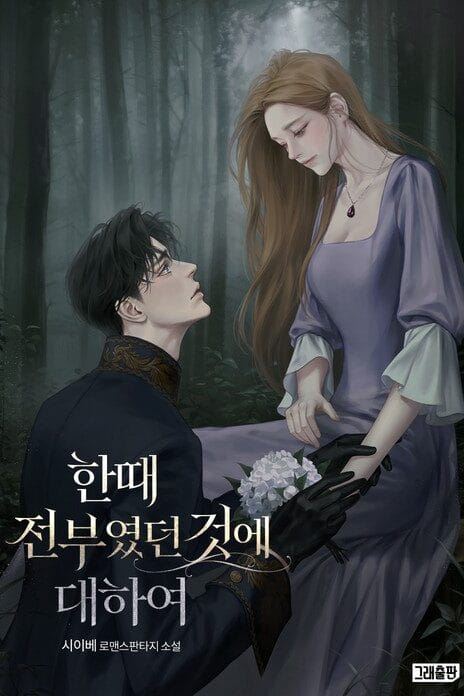
Give Me Back My First Love!
Novel Info
  • Author:
  • Status:Completed

Summary

... Read More

Hazel Hoover is a twenty-eight-year-old professor at the Empire's most prestigious academy, a position she secured four years ago after being inspired by a mentor in her youth. Her daily existence is defined by a harsh reality that contrasts sharply with her initial idealism; she is burdened with endless paperwork, student management duties, and the tedious evaluations that senior professors delegate to her. Despite the heavy administrative load, Hazel remains dedicated to her students, though she recently experienced significant distress after uncovering inappropriate behavior among them in the library. Her primary goal is to maintain an ordinary, quiet life, free from scandal or dramatic entanglements.

The status quo of Hazel's life is shattered when Enoch Meyer arrives to temporarily take charge of the fencing club for a year. Enoch is the heir to the influential Meyer Marquis family and an aide to the Imperial Knights Commander, a man renowned for his impeccable appearance, noble lineage, and outstanding abilities. To Hazel, Enoch represents her first love from ten years prior, a romantic ideal she cherished deeply during her adolescence. At seventeen, she had confessed her feelings courageously, but the rejection was silent and absolute, leaving her with memories that she had carefully preserved as beautiful fragments of her youth. Their unexpected reunion is initially marked by awkward politeness, though Hazel finds herself inexplicably drawn to the matured man before her.

The narrative takes a pivotal turn when Hazel arrives at the fencing department faculty office late at night to hand over materials. She discovers Enoch in the midst of masturbation, a moment of shocking vulnerability that strips away her idealized image of him. Rather than fleeing or reporting him, Enoch uses the incident as leverage, coercing Hazel into becoming his accomplice under the guise of maintaining silence. The power dynamic shifts drastically as Enoch, displaying a depraved and dominant nature, forces Hazel into a sexual encounter. Despite her initial horror and internal conflict, the physical intimacy reveals a devastating compatibility that Hazel had never experienced before, complicating her feelings further.

In the aftermath, Hazel is left physically sore and emotionally turmoil-stricken. She resolves to avoid Enoch for the remainder of his one-year tenure, clinging to the hope that their paths will naturally diverge once he returns to the Imperial Family. However, Enoch's presence becomes increasingly inescapable. He attends her lectures, invades her personal space under the pretext of academic collaboration, and engages in psychological games that highlight his obsessive interest in her. The situation is exacerbated by a strange encounter with a fortune teller who gives Hazel a phallic-shaped talisman, which bizarrely reappears in her home and later in her office, symbolizing the uncontrollable nature of her entanglement with Enoch.

The core conflict revolves around Hazel's struggle to reconcile her professional dignity and desire for an ordinary life with her lingering attraction to Enoch and his aggressive pursuit. Enoch, seemingly aware of his own depravity, acts with a mix of shamelessness and unexpected gentleness, often checking in on Hazel's well-being while simultaneously pushing her boundaries. The story explores the tension between Hazel's internalized shame regarding her lost virginity and her undeniable physical response to the man who ruined her pristine memory of him. As Hazel navigates these interactions, she is forced to confront the reality that her first love was not the perfect figure she imagined, yet she cannot deny the intense connection they share.

As the chapters progress, the dynamic between the two evolves from coercion to a complex interplay of dominance and submission. Enoch's behavior ranges from disturbing to caring, leaving Hazel confused about his true intentions. He makes it clear that their relationship is not over, using the secret of their encounter to bind them together. Meanwhile, Hazel faces additional pressures from her colleagues, including unfair treatment from senior professors who exploit her workload. The narrative sets the stage for a prolonged struggle where Hazel must decide whether to remain a passive victim of circumstance or assert her agency in a relationship that threatens to consume her identity. The story ends with Hazel trapped in a cycle of fear and desire, unable to escape the grip of the man who holds her secrets and her body.

Latest Release
DateGroupRelease
2026-10-03dusk blossoms c73
2026-10-03dusk blossoms c72
2026-10-03dusk blossoms c71
2026-10-03dusk blossoms c70
2026-10-03dusk blossoms c69
2026-10-03dusk blossoms c68
2026-10-03dusk blossoms c67
2026-10-03dusk blossoms c66
2026-10-03dusk blossoms c65
2026-10-03dusk blossoms c64
2026-10-03dusk blossoms c63
2026-10-03dusk blossoms c62

Community Reviews

Rating(0 / 5.0, 46votes)
5 stars
0(0%)
4 stars
0(0%)
3 stars
0(0%)
2 stars
0(0%)
1 stars
0(0%)

Popular reviews

... Read More
What I love about the conflict here is how layered it is. On the surface, it's simple: Hazel just slept with her first love and now she has to see him every day at work and pretend nothing happened. But the stakes keep escalating with every paragraph. First it's the internal conflict—her body betrayed her, her mind is confused, she's attracted to a man she's decided is a pervert. Then it's the external conflict—Vivian is circling like a shark, clearly suspicious, clearly protective, clearly about to make things worse. And then the biggest conflict of all: the one-year deadline. Enoch is going back to the Imperial Family in a year. A year of this tension, this pretending, this unbearable proximity. But here's the thing that makes the stakes so high—Hazel thinks she's just going to endure it. She thinks she can survive a year of avoiding him and then it's over. But the reader can see what she can't: that she's already completely entangled. The stakes aren't just about surviving the next year. The stakes are about what happens when she realizes she doesn't WANT to survive it—she wants more. And what happens when Enoch Meyer, the man who seemed so casually destructive, starts showing signs of actually caring? That's the real suspense. That's the thread pulling at me.
... Read More
Let's talk stakes, because this text makes you CARE about outcomes in ways I didn't expect. On the surface, the conflict is straightforward: Hazel vs. Enoch, victim vs. predator, morality vs. desire. But the brilliance is in how the author complicates every single layer of that binary. Hazel is NOT a passive victim here, even when she's being physically dominated. She's making choices—tiny, terrified choices, but choices nonetheless. And that changes everything about the stakes. The internal conflict is where the real tension lives. Every time Hazel says she wants to stop, her body says something else. Every time she surrenders to pleasure, a voice in her head screams betrayal. That war between mind and body isn't resolved—it's amplified. And the author makes us feel every single volt of that voltage. But here's what I found most compelling: the stakes aren't just about whether Hazel will "win" or "lose." They're about who she becomes in the process. Will she remain the girl who clings to idealized memories? Or will she accept that desire is messier and more complicated than any first love fantasy ever promised? The answer to that question matters more to me than any traditional plot outcome. The external stakes are present too—the risk of discovery, the public nature of their act, the violation of social norms. But honestly? Those feel secondary to the internal stakes. The real danger isn't getting caught by other students. It's getting caught by HERSELF. Seeing yourself clearly for the first time, even when that clarity is devastating. What keeps me gripped throughout is the uncertainty of Hazel's agency. Is she choosing this? Is she being chosen FOR? The text refuses to give us a straight answer, and that refusal IS the conflict. Every reader will land somewhere different on that spectrum, and I respect that deeply. The tension never drops because the fundamental question never resolves: can something be simultaneously violating and liberating? The text doesn't answer—it makes you feel the impossibility of answering.
... Read More
Vanessa's dialogue alone is worth the price of admission. This woman walks into her sister's home and within three lines has already seen through every lie Hazel tells. "You're bad at hiding things, so stop trying." And Hazel's response—pretending she's just tired from overtime at work, the Academy excuse that's so transparent Vanessa doesn't even push further. Their dynamic is effortless. You can tell these two have known each other since birth and there's a whole language built between them that needs no translation. "Anyone would think you raised me." / "I practically did." I screeched. That exchange is so casual but it carries decades of history. Vanessa isn't just Hazel's sister; she's a co-conspirator in her upbringing, someone who shaped her and still checks on her despite pretending not to care. And the Enoch mention—Vanessa brings him up casually through her husband's gossip network. "I heard from my husband that Lord Meyer is working as a professor at the Academy." That's how she operates. Information flows through her like water. She tests Hazel with a simple "Is there anyone you're seeing?" and when Hazel shuts her down, Vanessa drops it without missing a beat. Meanwhile Enoch's dialogue is this cold, flat monotone that contrasts perfectly. "I'm doing it because I want to." / "I'm doing it because I'm turned on." He speaks like he's stating facts about the weather, not confessing sexual aggression. The voice distinction between these characters is razor-sharp and it makes every interaction crackle.
... Read More
I need to talk about how the author controls time in these chapters because it's genuinely brilliant. Chapter 17 starts with physical comedy - Hazel spilling juice everywhere, getting lost in her own hometown, the whole absurd sequence of pride keeping her from admitting she doesn't know where she's going. Fast pace. Snappy dialogue. Then Chapter 18 slows to a crawl at the sunset spot. Minutes stretch into what feels like hours. The author makes us sit in that silence with them. Lets the ordinary conversation about the view carry the weight of everything unsaid. Then BAM - Chapter 19 drops us into a pub and the pacing shifts again. Drinking scene. Emotional unraveling. Hazel's breakdown about students that's really about something else entirely. The author knows we're hungry for more so they give us... more drinking. More frustration. More inability to communicate directly. What keeps me hooked isn't plot movement. It's the micro-tensions. That moment when Enoch looks at Hazel's lips without her noticing. The server placing drinks and both of them missing the clink. The three-finger order that Enoch immediately shuts down. Each beat is a small explosion of almost. The chapter break at the end of 19 with Hazel suddenly leaning in and Enoch leaning back is a cliffhanger that doesn't need drama. It's just two people hovering at the edge of something and the reader screaming at them to just do it already. The author trusts us to sit with that ache. Doesn't rush to resolve it. Just ends on the moment before everything changes.
... Read More
What happened to Enoch between the Academy and now?? Okay first of all, the man walked in wearing casual clothes with his shirt slightly open and UNKEPT HAIR and somehow that made Hazel's heart beat faster??? Like hello, she's falling for him AGAIN and I am witnessing it in real time. The contrast between his usual sharp, composed knight demeanor and this softer, almost vulnerable version he's showing here is fascinating. He's still the same flirtatious guy who enjoys flustering Hazel, but there's something gentler underneath now. His line 'Maybe spend some time together while we're at it' with that sly smile is giving MAJOR 'I know exactly what I'm doing and I'm enjoying this' energy. The man is shameless and I love it. But here's what got me — when Emily glared at him suspiciously, he didn't flinch. He just calmly pulled out his golden badge like it was nothing. Not defensive, not aggressive. Just... confident. The kind of confidence that comes from knowing your worth. But honestly? The most revealing moment was Hazel realizing her own heart was racing and immediately attributing it to his looks. '...It seemed his looks were indeed the main reason.' Liar. We all know it's not just his face. It's the history. The unspoken tension between them that's been building since the Academy. And Vanessa, bless her chaotic soul, has been patiently waiting for this moment to finally snap.
... Read More
“First loves are only beautiful when they remain as good memories.” I need to sit with this line for a moment because it completely destroyed me. Hazel says it to herself like a mantra, like if she repeats it enough times she will actually believe it. But the novel does not let her — and more importantly, it does not let me — off the hook that easily. The fact that she still watches him train with the sword makes my chest ache in a way I did not expect. She tells herself he is just her former love, but the novel shows us a woman who cannot look away. Her instinct and her reason are at war every single time he appears, and losing feels like the default state. When she sees him in the training yard, she forgets about work. She steps closer to the window. She lets herself remember the girl she used to be, the one who found quiet corners just to watch him without being seen. And then he turns his head. And smiles. The way she ducks, bangs her knee, curls into herself — that is not just fear. That is the violent collision between the girl who adored him and the woman he has become capable of harming. The physical pain of the knee slam is almost secondary to the emotional whiplash. She wanted to be seen by him as something tender, and instead he saw her watching him like a pervert — which of course ties back to the object on her shelf, which of course he uses to further mock and destabilize her. What haunts me most is the tenderness hiding underneath all of this. Enoch is abusive and manipulative, absolutely. But Hazel's love for him has not simply vanished. It has been corrupted, twisted into something painful, and yet it persists. That is what makes this emotional arc so devastating to read. It is not a clean story of victim and villain. It is a story about how love lingers long after it should leave, how memory and trauma braids together so tightly you cannot tell them apart anymore. The scene in the office — him locking the door, telling her no one will come, saying he'll “let her go” before her next lecture with that predatory smile — that is the kind of moment that stays with you. It made me physically uncomfortable in the best and worst way. I wanted to shake her. I wanted to hug her. I wanted to throw the book across the room.
See all reviews

Custom lists

See all custom Lists