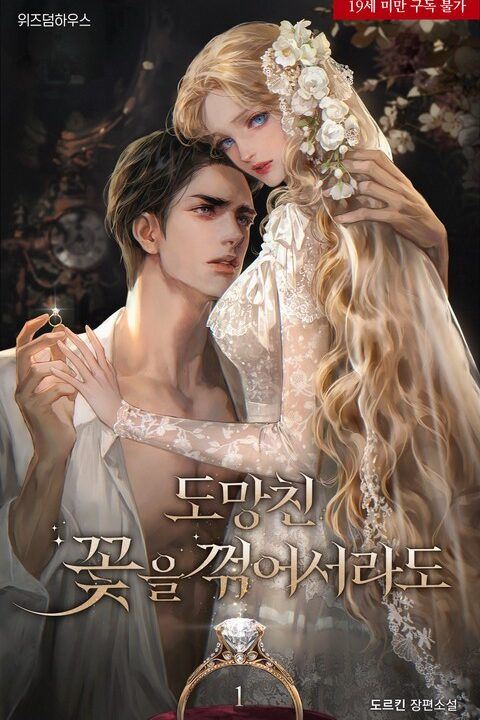
Even If I Have to Pluck the Runaway Flower
+Add to Custom List
Novel Info
  • Author:
  • Status:Ongoing

Summary

... Read More

Eight years after the conclusion of a devastating twelve-year war across the Ardalea continent, Charlotte, an eighteen-year-old woman with a bright and optimistic outlook, travels north from the Southernmost Western Empire to begin a new chapter in her life. Despite the material poverty affecting much of the population, Charlotte remains buoyant, driven by the substantial inheritance left by her parents who died during the bombing of Dalteum a decade prior. Her journey is marked by a sudden shift in fortune when she receives an unexpected summons from Earl Edmund Roimond, a great noble who has identified Charlotte as his only living blood relative and seeks to adopt her as his heir following the death of his own son and the recent passing of his wife. This opportunity promises to elevate Charlotte from her modest middle-class status into the highest echelons of the empire's nobility, a prospect that excites her guardians but leaves her feeling a complex mix of duty and detachment from her late mother’s anti-noble sentiments.

On the passenger ship transporting her toward the capital, Charlotte encounters Chris, a towering, scarred, and fiercely intense man who behaves with unsettling erraticism. Chris appears to be suffering from the psychological aftermath of the war, displaying a vacant expression and movements that are precise yet unhinged. He fixates on Charlotte with an intensity that initially terrifies her, claiming to detect the scent of freesia on her despite her not wearing perfume. As he invades her personal space and pursues her with an obsessive gaze, Charlotte attempts to maintain her composure and dignity, viewing him as a dangerous war casualty rather than a suitor. Her initial interactions are fraught with tension, as she tries to ignore his presence while he systematically dismantles her attempts to retreat, culminating in a confrontation where he reveals he was once an officer under Duke Christian Eponhart, the legendary hero who ended the war.

The dynamic between them shifts drastically when Charlotte encounters Fred, a starving ten-year-old war orphan from Dalteum who attempts to pickpocket her. Chris intervenes, revealing his sharp tactical mind and protective nature beneath his rough exterior. He correctly identifies the boy’s heritage and warns him of the severe consequences of being suspected of espionage, displaying a ruthless practicality that contrasts with Charlotte’s compassionate instinct to help. Charlotte gives her savings to the boy, an act that Chris observes with a mixture of disdain and grudging respect. This shared experience breaks down some of Charlotte’s fears, leading her to accept Chris’s insistence on dining together at an upscale restaurant in the port city of Biorettia. During their meal, the barrier between them begins to crumble as they discover a surprising kinship; both are orphans who lost their parents at the age of eight due to Dalteum raids, and both have endured profound isolation. Chris, who has suffered a traumatic loss of his senses of smell, touch, and taste, finds that his connection to Charlotte momentarily restores his ability to feel and perceive the world vividly, particularly through the scent of freesia that surrounds her.

The narrative reaches a critical turning point as Chris and Charlotte ascend to an observatory during a sudden, violent rainstorm. Seeking shelter in a small hut, the physical proximity and intense emotional undercurrents lead to a passionate and desperate encounter. Chris, who has never experienced such overwhelming sensory and emotional responses, loses his self-control and kisses Charlotte with a hunger that reflects his deep-seated loneliness and trauma. The interaction escalates from a kiss to an intimate union, marking Charlotte’s first sexual experience and Chris’s first moment of genuine human connection since the war. Throughout the night, they grapple with their vulnerabilities; Charlotte fears the societal consequences and the potential for heartbreak, while Chris struggles against his conditioned emotional numbness. Despite the chaotic and rushed nature of their relationship, a profound bond forms, driven by mutual recognition of their shared losses and the unique solace they find in each other’s company. As the story progresses, they navigate the complexities of their newfound closeness against the backdrop of a recovering empire and the looming political intrigue surrounding the Roimond title and Chris’s former commander, Duke Eponhart.

Latest Release
DateGroupRelease
2026-10-03dusk blossoms c4
2026-10-03dusk blossoms c3
2026-10-03dusk blossoms c2
2026-10-03dusk blossoms c1

Community Reviews

Rating(0 / 5.0, 30votes)
5 stars
0(0%)
4 stars
0(0%)
3 stars
0(0%)
2 stars
0(0%)
1 stars
0(0%)

Popular reviews

... Read More
So here's the thing that got me the most—there are essentially two plot threads running in parallel, and they're both about people desperately trying to reach someone. Charlotte wants to get to Biorettia to find Chris. Christian wants to escape his life and go to Mary Robinson. Neither of them knows the other is literally already there, or close to being there. The dramatic irony is almost unbearable in the best way possible. I loved how the Earl's subplot weaves in—on the surface it's just a family reunion story, but really it's the Earl actively engineering the circumstances so that Charlotte can't run off on her own. He invites Chris to come to Roimond instead. It's a clever move because he genuinely believes he's protecting her, not manipulating her. The reader sees both layers simultaneously, which makes every warm exchange between them sting a little. And then Christian shows up a full day early. 'In case Mary Robinson had gotten the day wrong.' That detail broke me. He's so eager, so restless, and his sensory torment is literally driving him to the port. Two people, same destination, completely unaware. I can practically hear the universe cackling.
... Read More
The Earl's dialogue is genuinely fascinating because nearly everything he says is a performance. 'You may call me Father.' 'I am always on your side.' 'Rather than meeting in Biorettia, bring him to Roimond.' On the surface, this is the warm, generous patriarch. But the narration constantly undercuts him—we're always inside his head, watching him 'quietly despair,' 'inwardly rejoiced,' calculating that Chris 'would still be no match.' Every tender line is also a strategic move. Compare that to Charlotte's speech patterns, and you get this brilliant asymmetry. She stammers through lies badly—'Unfortunately, she had never been very good at spinning out lies at length.' Her sentences trail off, she hesitates, she can't quite commit to the fiction. The Earl, meanwhile, speaks in complete, polished paragraphs of manipulation disguised as care. 'If he truly was an officer in Duke Eponhart's direct unit, then I too would welcome him.' What a line. It sounds like acceptance but it's actually a trap. Christian's internal voice is a totally different register entirely—short, clipped, almost brutal in its honesty. 'Women are even worse.' 'Christian is in his prime, so it cannot be helped.' The Emperor's drunken vulgarity ('Should they not be fanning themselves under their skirts') provides this grotesque comedic counterpoint that makes Christian's suffering feel even more isolated. Three distinct voices, zero overlap.
... Read More
I keep coming back to this single line from Harrison: 'Bring the lady with you as well.' It's delivered almost casually, like an afterthought, but it detonates everything. Because in that moment, Christian's entire internal world shifts. The nausea, the fury, the thought of placing his woman inside the 'hateful shackles of the Imperial Family' — it's not just jealousy or possessiveness. It's trauma. His parents died because of this system. He survived ten years as a political hostage. The Imperial Palace isn't a place of honor for him; it's a tomb that wears a crown. So when Harrison casually suggests hauling Charlotte into that world, Christian doesn't just feel anger — he feels sick. His body physically rejects the idea. And this raises the stakes SO much. Before this scene, the conflict was abstract: the Emperor wants Christian back, Christian wants freedom. But now? Now there's a person the Emperor could use as leverage. A person Christian would burn the world down to protect. That's the moment the story shifts from political tension to genuine emotional danger. Charlotte's storyline amplifies this even further. She's weak, physically broken from the night before, emotionally unsteady, and she's about to board a ship to meet a man who may not show up — all while her only living relative, Earl Roimond, waits with what seems like genuine love but whose true intentions we haven't fully seen yet. The layers of risk are stacking up. Every decision Charlotte makes from here is made with incomplete information. And Christian? He's walking back into a den of vipers with nothing but a letter and a pocketful of stolen hair. The stakes aren't just personal anymore — they're existential.
... Read More
I need to just sit with this for a minute. The way this author writes Chris losing his senses—smell, taste, touch—during the war and then slowly getting them back through Charlotte is some of the most devastating romance writing I've ever read. "A strange sensation, as if a colorless world were being dyed with yellow paint." That line. That single line made me actually pause my phone and stare at the wall. Two years of his life, gray and numb, and then one whiff of freesia from Charlotte's hair and suddenly he's FEELING things again. The heat of her skin, the pounding of his own heart, the dryness in his mouth. His body is remembering what it means to be alive through her. And the tragedy of it is—he doesn't see it as loss. He never let himself grieve what he lost. "A romantic sentiment like having lost something precious from his life was not the kind of emotion he dared feel." He's been surviving, not living, for two whole years. And Charlotte walks in smelling like spring and his mother's memory and suddenly the color comes back to his world. The scene where she puts food on HIS plate—lobster claw, eggplant, mushrooms—and says "you should hurry and eat too" when she thinks he can't taste anything... she doesn't know about his condition but she treats him like a normal person anyway. Like someone worth feeding. And he responds by eating everything she offers while pretending he's just being difficult. Classic Chris.
... Read More
The stakes in this passage operate on at least three levels simultaneously and the author never lets you forget any of them. Level one: survival. Fred the pickpocket is stealing because he and his sister are starving on a ship. If Chris reports him as a Dalteum spy, the punishment is torture - not discipline, not jail, torture. The stakes are literally life and death for a child who made one bad choice. Charlotte risks her own social standing by shouting at Chris to stop, and she does it without thinking. That's character revelation through conflict. Level two: class and power. Chris could have just taken the bag back and walked away. He had every right to. Instead he uses the spy accusation as leverage, not to actually harm the kid but to force him to comply. Then he flips it and offers practical help. Charlotte sees all of this and understands that Chris's cruelty and his compassion come from the same place - he knows how the world works and he's been surviving it. Level three: the interpersonal tension between Charlotte and Chris. Every exchange is a power struggle disguised as casual conversation. “You're more mischievous than I expected” vs “You're the most mischievous man I've seen in my life.” They're boxing with words and neither will concede. But then her stomach growls and suddenly the power dynamic shifts because she can't even maintain the facade of not needing anything. The Biorettia stop adds another layer - what happens when they're forced off the ship together? The confined space of a docked port, a day to kill, and two people who can't stop provoking each other. The suspense isn't “will they or won't they” - it's “how much longer can they keep this up before something breaks?”
... Read More
I need to talk about this one moment because I genuinely teared up. Charlotte is standing there, exhausted, half-dead from seasickness, and the Earl takes her face in his hands and strokes her cheek. And suddenly she remembers her mother's scent—'the smell of a dense forest, the smell of clean cold water.' It's not just nostalgia, it's like her body remembers safety before her mind does. She's been alone for so long and in this one gesture from a man she just met, she accesses something ancestral, something deep in her bones. But then the chapter cuts to Christian, right? Who is sitting at a banquet surrounded by women who want him, feeling nothing, unable to even eat because everything tastes like rotting flesh. And all he can think about is 'Mary Robinson'—replaying her scent, her touch, her face 'like a rose.' The parallel is so exquisite it hurts. Two people who have lost something fundamental about how they experience the world, both driven by an almost physical need to find the one person who makes it bearable again. And the Earl remembering his sister Katrina leaving in the dead of night for some lawyer—how he reads that letter and feels that 'tearing pain in his chest'—that generational echo is what makes this emotional thread so rich. He's not just preventing Charlotte from repeating his sister's mistake. He's trying to save her from the kind of heartbreak that echoes through families.
See all reviews

Custom lists

See all custom Lists