Summary

... Read More
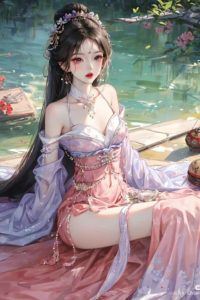
Ran Nannan was born into the Zhou family in Yangzhou, where her exceptional beauty became a commodity rather than a blessing. From the age of ten, she was secluded in a remote courtyard and subjected to rigorous, abusive training by an old matron to prepare her for a life in the Qinghong Pavilion. Her days were filled with painful posture drills, forced floral baths, and beatings for any perceived clumsiness. The matron constantly reminded her that her face was an asset capable of ruining a man's fortune, and the Zhou family viewed her as a bargaining chip to secure financial and political alliances. Despite the physical and emotional torment, Ran Nannan endured in silence, believing that her suffering might eventually bring glory to her family or herself. At thirteen, her beauty had matured to a dangerous level, and her father openly discussed selling her to the highest bidder. The central conflict crystallized when Assistant Magistrate Cheng, a powerful official with influence over the salt trade, attended a banquet hosted by the Zhou family. Ran Nannan was forced to perform a dance for the guests, enduring their lewd comments and predatory gazes. During the event, she shared a fleeting, pitying glance with a mysterious young man in blue robes, a moment that offered her a brief sense of human connection before he vanished. Shortly after, Cheng declared his intention to take her into his household. The Zhou family eagerly agreed, viewing the alliance as a path to prosperity. Ran Nannan was dressed in elaborate bridal attire, unaware that she was being sent not as a wife, but as a concubine or entertainer to a man who saw her merely as a prized possession. On the eve of her transfer, Ran Nannan attempted to escape but was blocked by guards. Trapped and despairing, she fell ill with a high fever. In her delirium, she dreamed of the young man in blue robes, who promised that in her next life, she would not have to suffer. She died alone in her room, her face frozen in a faint smile of relief. The Zhou family mourned briefly, but their primary concern was the lost alliance with the Cheng family. Ran Nannan’s body was prepared for burial, and the festive decorations were torn down, symbolizing the end of her tragic existence. Ran Nannan awoke in a modern high school classroom, realizing she had been reborn in the body of a girl with the same name. The Gaokao had just concluded, and she found herself in a world free from the constraints of feudal patriarchy. Initially disoriented, she quickly recognized the freedom she now possessed. She had no masters, no matron with a cane, and no family seeking to sell her. Instead, she had friends, a loving mother, and the autonomy to shape her own destiny. She resolved to live this second life for herself, rejecting the passive victimhood of her past. Drawing on the memories of her previous life, Ran Nannan began to reclaim her beauty for her own sake rather than for male approval. She recalled ancient skincare formulas involving safflower, lotus pollen, and chrysanthemum dew, which she had been forced to use only to enhance her market value. She recreated these remedies in her modern home, using traditional methods to restore her skin and posture. As she practiced the graceful movements and postures she had once learned under duress, she transformed them into acts of self-empowerment. Her appearance improved dramatically, drawing attention from her classmates, but she remained focused on her new goal: independence. Her friends, particularly her deskmate and Ah Miao, noticed her transformation and expressed interest in her skincare creations. When Ah Miao’s mother offered to pay for a batch of the cream, Ran Nannan experienced a profound emotional shift. For the first time, she was earning money through her own skills rather than being traded as a commodity. She began producing and selling her handmade beauty products, finding fulfillment in the honest labor and the genuine appreciation of her customers. However, her journey was not without challenges. When she attempted to expand her business by connecting with a posture management center, she encountered a scheme involving drugging and coercion. Recognizing the tactics from her past life, she escaped unharmed, reinforcing her resolve to never again be trapped or exploited. The story follows her transition from a victim of systemic abuse to an independent woman building a life on her own terms, using the skills and resilience forged in her previous suffering to navigate her second chance.

Latest Release
DateGroupRelease
2026-08-11shanghai fantasy c3
2026-08-11shanghai fantasy c2
2026-08-11shanghai fantasy c1

Community Reviews

Rating(4.3 / 5.0, 6votes)
5 stars
3(50%)
4 stars
2(33%)
3 stars
1(17%)
2 stars
0(0%)
1 stars
0(0%)

Popular reviews

... Read More
"If one day you want to marry, that's fine. And if you don't—that's fine too. You're living better now than I ever did." I need a moment. That's it. That's the entire emotional climax of these chapters and I am still recovering. The author builds to this so slowly and so carefully. We get the firecrackers outside, the red paper scraps being tidied up, the brazier crackling inside. It's domestic, it's warm, it's everything Ran Nannan has been fighting for. And then her mother says this thing—not as advice, not as pressure, but as an observation from someone who has lived hard enough to recognize when her daughter has finally won. What struck me most was the contrast with everything that came before. Remember how at Qing Fragrance Manor the wet nurse scrutinized her coldly? Remember the Cheng Estate rejection—"No matter how lovely, you won't enter our gates"? All that rejection, all that being told she wasn't enough, and now here she is with 243,000 yuan and a mother who looks at her and says you're living better than I ever did. The scene with Third Aunt and her cousin was also doing important emotional work—showing that Ran Nannan has entered a new social tier, but the real heart is between mother and daughter. When Ran Nannan holds her mother's hand and says this money feels more real than any she's made before, that's not just about finances. That's about dignity. That's about the deep, aching relief of finally being seen as worthy. And then back in her room, the ledger again, the crabapple tree whispering against the eaves. She built this. Piece by piece. Brighter than any fireworks.
... Read More
I keep coming back to the ledger. It appears in almost every major moment across these chapters, and I think it's the most important symbol the author has given us. First we see it on the second floor under amber light, Ran Nannan pressing her finger against the calligraphy "Ruchulian" on the cover. Then she hugs it to her chest on the train. Then she opens it at home for her mother and Third Aunt to see. Then she's back in her room at night, fingertips tracing those little entries. The ledger isn't just a record of her income—it's a record of her transformation. Every number inside it represents a choice, a risk taken, a formula perfected, a customer trusted. The author even describes it physically: "just opening it released a faint scent of paper and ink." It has weight. It has presence. And then there's the contrast with the Qinghong Parlor money. That was money without a ledger, without records, without ownership. This money has a paper trail. It has her name on every transaction. The ledger is her proof of existence in a world that kept telling her she didn't belong. Other symbols I noticed: the red lanterns (New Year, warmth, community), the brass bell tinkling in the wind (her little world responding to change), the crabapple tree branches tapping against the eaves like whispering secrets. Even the overnight cream itself is symbolic—something that works while you sleep, that transforms you quietly, that no one sees happening but everyone notices the results of. The deepest theme here, I think, is about visibility. Ran Nannan spent her life being scrutinized and found wanting. Now she creates things that people willingly pay for, that she records openly, that she can hold in her hands and prove to herself.
... Read More
Okay so let me just say this: the moment Ran Nannan saw 243,000 yuan in her ledger was one of the most satisfying plot beats I've read in a while. The author doesn't just tell us she succeeded—we see it step by step. First the hiring, the three women she kept, the overnight cream formula she finally cracked after reading those old notes. Then the rush of customers coming back before five days were up. And THEN the train ride home, ledger open on her lap, numbers glowing in the snowy light. But here's what really got me—the parallel the author draws between that money and the money she used to make at Qinghong Parlor. Same number, completely different weight. One was given for her looks, held loosely. The other was earned with her own hands. That's not just a plot detail, that's the entire arc of her character right there in one comparison. And then Chapter 27 hits like a truck. She goes to register for a finance course because she wants to understand contracts and risk, and the professor walking in is Shen Yuchen. The author sets this up so perfectly—she'd seen him at a bookstore half a year ago, he'd said those three words about not wearing out a book, and she thought it was over. But the class roster? He had access to it. He KNEW she was in his class before she even sat down. That moment when he calls her name and looks at her like he's weighing whether she deserves a place in this world—chills. Absolute chills.
... Read More
Shen Yuchen's line about markets not compensating fear is the thematic key to everything, and I think the author is setting up a conflict that goes far beyond romance. On the surface, Ran Nannan's stakes are clear: she's built a business, she has 243,000 yuan, she's hired people who depend on her. But the deeper conflict is internal—she's still operating in a world where she expects to be rejected, where she needs to prove she belongs. The Cheng Estate said she wouldn't enter their gates. The wet nurse scrutinized her. Those wounds don't heal just because the bank account grows. And then Shen Yuchen appears, and he embodies that same brutal market logic. "Markets don't compensate your fear. Only the risks you've truly borne." He's not being cruel—he's stating a fact. And the terrifying thing is, he's right. The world Ran Nannan is entering (capital markets, business expansion, higher social circles) doesn't care about her past suffering. It only cares about what she can deliver. But here's what gives me hope: she ALREADY bore the risks. She built the studio from scratch. She recalibrated her formula after reading old notes. She hired the right people. She showed up to class prepared. The question isn't whether she can handle this new world—it's whether she'll finally internalize that she already belongs in it. The stakes are rising because Shen Yuchen knows about her studio. He's been watching. He called on her by name. What happens when he decides to test her? What happens when the market logic he teaches collides with the personal history he seems to carry? I'm not ready for this to end.
... Read More
Let me just say: the structural choice to split this into two chapters with a seasonal shift is really smart. Chapter 26 is entirely winter. It's warm inside the workshop, cold outside. The pacing is deliberate, almost meditative—we watch the women work, we watch Ran Nannan pack, we watch her count her money. The author takes her time here. There's a scene where she just sits under an amber lamp pressing her finger against the calligraphy on her ledger cover. Nothing dramatic happens. That's the point. The drama is in the accumulation. Then Chapter 27 opens with spring coming late to Nanchuan, and the pacing immediately accelerates. She's walking into a lecture hall, the classroom is packed, whispers are flying, and then HE walks in. The sentence structure changes too—shorter lines, sharper descriptions, more action. "The door pushed open. Someone walked in." vs. the slower, flowing prose of the workshop scenes. The transition from the intimate, almost domestic New Year scenes back to the studio, and then to the university classroom—this is the author showing us that Ran Nannan's world is expanding. She's not staying in her workshop. She's moving into spaces where Shen Yuchen operates. And the final line of the chapter, with her rubbing cream on her wrist while his voice echoes in her head, is a perfect bridge between her old life and whatever comes next. The only thing I'd question is whether the finance course setup feels slightly convenient—but honestly, it works because it's earned. She chose this course deliberately. She wanted to understand contracts. The universe just happened to deliver the right professor.
... Read More
I need to talk about Shen Yuchen because wow. The author has crafted someone who is genuinely intimidating and I am HERE for it. When he walks into that classroom, the description alone does so much work: charcoal-gray suit, one button undone, steady unhurried steps like the packed room means nothing to him. He doesn't teach like a teacher—he teaches like someone reviewing bids for a tender. And then he says, "Markets don't compensate your fear. Only the risks you've truly borne." That's not just a finance lesson. That's his entire philosophy of life, and the author is planting it right there in chapter 27 like a seed. But the real genius is how he treats Ran Nannan. He calls on her in class, scrutinizes her answer, says "Not bad" with that slight curve of lips that isn't warm at all. Then later in the hallway he says her studio's doing well. How does he know? He's been watching. Not in a creepy way—in a way that suggests he's been tracking her trajectory since that bookstore encounter half a year ago. And Ran Nannan—she's not some damsel here. She answers his question correctly, she builds a business from nothing, she understands that this money feels different from the money she used to make. Their dynamic isn't teacher-student or pursuer-pursued in any simple way. It's two people who operate on the same frequency of calculation and precision, and the tension comes from the fact that neither of them is going to make the first emotional move. He leaves behind a clean cool scent and walks away. She stands in the corridor clutching her textbook. Perfect.
See all reviews

Characters

See all characters

Custom lists

See all custom Lists