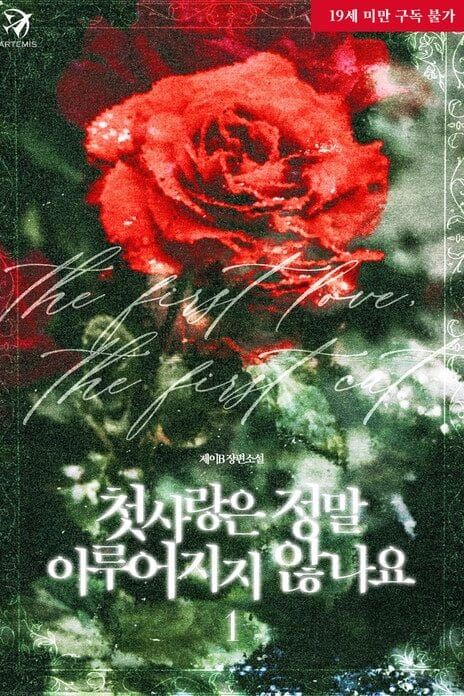
Does First Love Really Never Come True?
+Add to Custom List
Novel Info
  • Author:
  • Status:Ongoing

Summary

... Read More

Wendy Rosewood, the youngest daughter of an Earl, grows up fixated on Lucas Devon, a nobleman she met six years ago when she accidentally threw a snowball at him. While Wendy develops a deep romantic infatuation, Lucas treats her merely as his best friend Jayden's little sister. Despite the clear imbalance in their feelings, Wendy clings to the hope that her status as an adult will allow her to finally confess and be with him.

The story shifts focus to Wendy's debutante ball in September. Dressed in green adorned with roses, she anxiously searches the crowded ballroom for Lucas, ignoring her family's advice to mingle with other potential suitors. Her mother, the Countess, worries that Wendy's childish behavior and singular obsession will damage her marriage prospects, while her sister Karen warns her to broaden her horizons beyond the aloof Duke.

Lucas appears at the ball but maintains a deliberate distance, honoring only a childhood promise to share the first dance with Wendy. During the dance, he is polite but patronizing, patting her head and speaking to her as one would a child. After the dance, he immediately leaves her side to mingle with other guests, reinforcing the boundary between them. Later, Lucas meets with his formidable grandmother, the Dowager Duchess, who explicitly questions whether the Rosewood family is trying to maneuver Wendy into marrying him. Lucas denies any romantic interest, and the Dowager Duchess dismisses Wendy as too immature and spoiled to be a suitable Duchess.

As winter approaches, Wendy's friends Helen and Bestie urge her to give up on Lucas, noting that he has shown no interest in her romantically over the past six years. When Bestie gets engaged, the group discusses the unrealistic nature of Wendy's devotion. Despite their advice, Wendy continues to seek Lucas out, interpreting his polite indifference as mere shyness or busyness.

Wendy receives tickets to a prestigious Christmas market at the Crystal Palace and invites Lucas. He agrees to meet her, leading Wendy to hope for a romantic outing. However, on the day of the event, she waits alone for hours in the freezing cold. When she finally spots Lucas, he arrives with Melinda Person, a close female acquaintance and vassal's daughter. Wendy lies to Lucas, claiming she is with a friend, and watches heartbroken as he walks into the market with Melinda, offering her frozen hands a pair of gloves before leaving.

Wendy falls ill from exposure to the rain and cold. Lucas visits her the next day, bringing a gift of lilies that trigger her severe allergies. He remains unaware of her condition and her deeper feelings, dismissing her silence as shyness. The narrative highlights the tragic irony of Wendy's devotion: she sends letters and gifts that Lucas barely acknowledges, while he casually interacts with others who do not share her history. As the Christmas banquet at the Devon estate approaches, Wendy is forced to confront the reality that her first love is built on a foundation of unreciprocated expectation, setting the stage for a painful reckoning with her own hopes and family pressures.

Latest Release
DateGroupRelease
2026-10-03dusk blossoms c39
2026-10-03dusk blossoms c38
2026-10-03dusk blossoms c37
2026-10-03dusk blossoms c36
2026-10-03dusk blossoms c35
2026-10-03dusk blossoms c34
2026-10-03dusk blossoms c33
2026-10-03dusk blossoms c32
2026-10-03dusk blossoms c31
2026-10-03dusk blossoms c30
2026-10-03dusk blossoms c29
2026-10-03dusk blossoms c28

Community Reviews

Rating(0 / 5.0, 34votes)
5 stars
0(0%)
4 stars
0(0%)
3 stars
0(0%)
2 stars
0(0%)
1 stars
0(0%)

Popular reviews

... Read More
There are so many layers to unpack here and I'm just going to dive in. The flowers. Wendy sends flowers IN LIEU of letters to Lucas. Flowers are beautiful, they arrive with no words attached, they require no emotional risk from the sender. But they're also DEAD things — cut, arranged, displayed, and slowly dying. That's the entire Wendy-Lucas dynamic in botanical form. She gives him something gorgeous that requires nothing of him, and he never reads the message underneath because he doesn't know how to. "Whenever I send letters, you always responds with baskets of flowers or fruits. But the south is too far for that." Lucas's own words betray him. He doesn't engage with her words — he redirects into gifts. The cycle repeats across distance and time. Then at the Earl's house: the GIFT SCENE. Every box represents a suitor's interest, a proposal waiting to happen, a life being offered like merchandise. Wendy sorting through them is like sorting through possibilities she doesn't want. Jayden throwing away James Finet's card like trash — he's not just rejecting a man, he's rejecting the whole system. But Wendy pushes back: "You only talk about the flaws." She wants men evaluated FAIRLY, not because she likes them, but because reducing them to their worst traits is how Jayden (and apparently Lucas) treat anyone who gets near her. It's possessiveness disguised as protection. "Liking the gift doesn't mean liking the sender." This line is Wendy's manifesto. She refuses to let the symbolism of a gift dictate her emotional response. She wants agency over her own reactions. And yet — she CAN'T bring herself to examine the gifts in front of Lucas. Because she KNOWS what the gifts symbolize. She knows what it looks like to a woman surrounded by offerings from other men while her first love watches silently. The deepest symbol though? Charlotte. The energetic niece who exhausts Wendy. A CHILD who represents pure, uncomplicated love. Wendy takes care of her in the south and it SUSTAINS her. Not romance. Not longing. Just a small human being who needs her. That's what healed her — not time, not distance, but PURPOSE.
... Read More
I keep coming back to the scarf. Not just because it's a plot point, but because it's the central symbol of everything this story is about — giving, receiving, miscommunication, and the tragic gap between intention and impact. Lucas gives Wendy a scarf. It's a birthday present, which means it's supposed to carry meaning beyond utility. Wendy gives it to an old lady because she's kind. The Dowager Duchess receives it and thinks, 'Poor thing — she must have liked it a lot as a gift.' She's right, but she's also wrong, because the real tragedy isn't that Wendy cherished it too much. It's that she didn't understand what it meant at all. There's also the snowman hairpin mentioned in passing — cracked because it's old. Another small object, another sign of something precious degrading through use and time. Wendy keeps things. She holds onto them. And yet she keeps losing them anyway. The cherry blossoms work the same way. Beautiful, ephemeral, destined to fall. 'The flowers will fall quickly,' Lucas says, and it's both about the trees and about whatever possibility exists between him and Wendy. The Dowager Duchess's meditation on arranged marriage and habit-love — 'they still believe they love each other like a habit' — is the book's thematic thesis. Love isn't always dramatic. Sometimes it's just... persistence. And Wendy is tired of persisting toward someone who sees her as family.
... Read More
There's a recurring pattern here that I can't unsee: every time something real happens between these characters, someone runs. Wendy flees the villa the morning after. She flees to the south. She flees from his gaze under the cherry trees. And the title of the chapter literally says 'Sometimes, Running Away Is the Answer'—but does it really? I keep thinking about what the cherry blossoms symbolize in this context. They represent beauty that is transient, moments that can't be held onto. Wendy wanted to enjoy them one last time because she knew they wouldn't last. And Lucas mirrors this when he says she might not be able to come back next year because of her mother's marriage plans. The blossoms become a metaphor for their situation—precarious, time-sensitive, potentially destroyed by circumstances beyond their control. The alcohol is another symbol worth sitting with. It's the only thing that gives Wendy permission to speak her truth. Sober she's cautious, compliant, careful. Drunk she's fearless. Lucas notices this too—he's flustered not just by what she said but by the fact that she smelled like roses instead of booze, that her eyes were still sharp despite the drink. The alcohol didn't change who she was; it removed the mask. And then there's the line 'You can't hide your blood.' When Wendy says it, she's talking about her family's resistance to alcohol—but it applies to something much deeper. You can't hide what's truly in you. Lucas knows this. Wendy knows this. That's why running feels like the only option when the truth becomes too visible.
... Read More
Okay, let me just say — this whole scarf thing is the kind of plot device that does SO much heavy lifting without the book ever stopping to explain itself. Wendy gives away the scarf Lucas gave her to a random old lady because she noticed the woman was cold, and the Dowager Duchess ends up wearing it. The timing is just exquisite. Think about it: Lucas gives Wendy a gift meant to signify something personal, Wendy doesn't even realize she's giving away a piece of his affection, and the grandmother figure who supposedly knows best ends up wearing it like some ironic trophy. The Dowager Duchess herself seems to understand the symbolism — 'she must have liked it a lot as a gift. Poor thing' — but she still doesn't connect the dots enough to warn Wendy. And then the cherry blossom chapter hits right after, and the structure is almost cruel in how it juxtaposes warmth and rejection. Everything outside is spring, blooming, alive — and inside Lucas's head, he's already mourning a future where Wendy belongs to someone else. The author doesn't tell us this directly. We're supposed to see it in the way Lucas watches Wendy run through cherry blossoms like she's still a little girl, then immediately laughs at the thought of her married. The plot doesn't need explosions or betrayals here. It just needs one scarf, one cathedral, and a whole lot of unspoken feelings crashing into each other.
... Read More
Let me just say this: the author's control of pacing in these chapters is genuinely impressive and I need to break it down because it's one of those things you only notice when it's done really well. Chapter 1.3 opens with the ball and immediately drops us into this whirlwind of social choreography. We get Wendy's nervousness, Lucas's promise, the dance itself—all flowing together in this almost dreamlike sequence. The author doesn't rush it. We feel every second of Wendy's anticipation, the way her heart pounds, the dizzy moment when Lucas leans in. It's romantic in the way that slow-burn romance should be: patient, immersive, letting you live inside the moment. But then—the cut to the next morning. Breakfast at the Devon household. The silence. The Dowager Duchess's clinical assessment of Wendy. "It was disappointing." And suddenly the romance is over. The fantasy is punctured. We're back in the harsh, structured world where Wendy is just another daughter to be evaluated. This is masterful pacing. The author lets us feel the high of the ball, lets us fall into Wendy's hopeful perspective, and then immediately deflates it. It's the narrative equivalent of waking up from a beautiful dream and remembering your problems. Then Chapter 1.4 takes us to the Rosewood household, which feels almost too warm, too normal after the Devon coldness. The breakfast banter, Jayden's teasing, the Earl's warmth—it's a relief but also a reminder of what Wendy has at home versus what she's chasing. And then she's alone at the reading club, watching autumn leaves fall, processing rejection after rejection. The structure here is really about contrast and rhythm. Highs and lows. Warmth and cold. Community and isolation. And the chapter ends not with a resolution but with the Dowager Duchess asking the Countess the most cutting question possible: "Do you desire the Devon Ducal Household?" It's a perfect cliffhanger—direct, brutal, and it completely shifts the power dynamic. The Countess, who moments ago was worried about Wendy meeting nice boys, is now being interrogated like she's done something wrong. That reversal is everything. The author knows exactly when to accelerate and when to let scenes breathe, and that's why this reads so smoothly.
... Read More
I'm still not over the flashback scene where Wendy first meets Lucas. The author writes it like a movie - the snow falling, the sunlight catching his platinum hair, the way time literally stops when their eyes meet. And Wendy's reaction is so physically described that you can feel her heart pounding. 'Her face felt hot despite the cold weather, and she worried, Is my face turning red?' I related to this SO hard. That moment of crystalline clarity where everything around you fades except this one person - it's captured perfectly. But what absolutely destroyed me was the contrast between that magical moment and what comes after. She spends six years building this enormous feeling, planning to confess as soon as she becomes an adult, imagining it countless times. And then we cut to the present where her best friends are basically telling her to give up. The emotional whiplash is real. There's this one line from Wendy in the carriage that I keep coming back to: 'Love isn't something that vanishes just because you decide to stop. It doesn't work that way, which is why it's so hard, painful, and distressing.' That is perhaps the most honest thing I've read about unrequited love in any book. The author understands that feelings don't have on/off switches. And then - and this is the cruelty of it all - she blames her brother. 'It's all my brother's fault. If he hadn't brought Lucas back then...' You can see her trying to externalize the pain because the alternative is accepting that she's been in love with someone who will never love her back for SIX YEARS.
See all reviews

Custom lists

See all custom Lists