After being forced to marry an ugly husband (BL) - Reviews

After being forced to marry an ugly husband (BL)
+Add to Custom List
Sort
Add review
... Read More
The stakes in this chapter operate on so many levels. On the surface, Qingyan lost money to Wang Yan's scam. But the real conflict is internal. Who is he when nobody's watching? Does he care about fairness, or does he care about results? When he finds out Wang Yan was dying and her family needed the money, does he still see her as the villain? His answer is to help the family instead of pursuing revenge. That's character development through action, not exposition. In the transmigration storyline, the stakes are even higher. Qingyan woke up in a strange body, with a stranger as his 'husband,' with no memory of how he got there. The uncertainty is palpable. Who is Qiu Henian really? The tag on his head says 'unknown identity.' Why does Qingyan's father know him? What happened the night before that Qingyan has fragmented memories of? But the most interesting conflict is the one between Qingyan's modern sensibilities and this historical setting. He's used to independent living, to not depending on anyone, and now he's being told to eat eggs every morning because someone else decided he needs nourishment. The power struggle between them isn't about domination, it's about care. And Qingyan is learning to accept it, one stubborn egg at a time.
... Read More
Okay so I need to talk about how this whole sequence plays out because it is SO good at what it does. On the surface, nothing happens. Nothing explodes. No one dies. But the emotional stakes are quietly ratcheting up the entire time and I love it. Let's start with the core relationship — Qiu Henian and Qingyan. This chapter basically exists to show us what they've built: a life together that feels earned. The sorghum fruit scene? That's not just cute fluff. It's worldbuilding through domesticity. They're not together because of some grand destiny or forced proximity trope. They're together because he counts to three and knows she'll lean in. He kisses her juice-stained fingertips and she pouts for more. That's intimacy. That's a relationship that has history. Then — cut to Liu Fa's house. The tone shifts IMMEDIATELY. The siblings, Liu Yong and Liu Xiang, eat through the entire basket of fruit and leave the rotten pieces. Liu Xiang tells the pregnant sister-in-law to "hurry and eat" while he's already sitting on her kang like he owns the place. This is the kind of detail that makes you want to throw the book across the room, and that's exactly what the author wants. And then the Li Sheng subplot — the muffled crying behind a closed door. Qin Lan finally told her mother something, and we're left outside that room with Qingyan, unable to enter. The narrative deliberately withholds the resolution. This is plotting at its most confident: the author knows we're desperate to know what was said, and instead of giving it to us, just lets us sit with the sound of crying. The plot here isn't about dramatic turns. It's about the reader realizing, piece by piece, that the peaceful life Qiu Henian and Qingyan have built is surrounded by people who don't respect boundaries, who take what isn't offered, who cry in rooms you can't enter. The contrast IS the point.
... Read More
I need to sit with the sorghum fruit for a moment because I think it's the central symbol of this entire section, maybe the whole novel. Qingyan picks the fruit. He washes it. He coats it in sugar. He chills it in well water. He shares it — with his partner, with Qiuniang and Autumn Lady, with Li Sheng. The fruit represents care made edible. It's labor transformed into generosity. Then at Liu's house, the same fruit becomes something else entirely. Liu Xiang and his brother devour it, pick through it, leave only the过熟 (overripe) pieces. Liu Xiang claims he "saved the best ones" for Qi Yinglan — but the best ones are gone. What he's offering is an afterthought dressed up as kindness. The contrast is brutal and deliberate. Qingyan's fruit-making is an act of love. Liu Xiang's fruit-eating is an act of consumption. One creates value; the other destroys it. And then there's Li Sheng's crying behind the door. This is another kind of fruit — something private, something nourishing, something that has been opened and spilled its contents for everyone to hear but no one to touch. Qin Lan has told her mother something, and now that secret is floating through the thin walls like the smell of sugar water through an open window. The novel keeps asking: who gets to receive care, and who only knows how to take? Qiu Henian and Qingyan build a life where care circulates — cooking, sharing, counting to three and leaning in. The world outside their door is full of people who treat care as a resource to be depleted. The blacksmith's shop has reopened. The forge is lit. But the question hanging over all of this is: can warmth be forged, or is it only ever taken?
... Read More
There's something deeply symbolic about that scene where the garment is torn open and the bundle is found hidden against the young worker's abdomen. Right there, pressed against his skin, wrapped and concealed. What does it mean? Money? Valuables? Something else entirely? The placement is deliberate—the body becomes a hiding place, intimacy transformed into concealment. And then there's the water imagery: Aunt Li bringing Qingyan hot water to drink slowly, helping him recover. Water as comfort, water as cleansing, but also water as something that can drown you if you're not careful. The whole chapter plays with surfaces versus depths—what you see versus what's hidden, the meal everyone shares versus the theft that destroys it. Even the young worker's fantasies about being noticed by Young Master Yu, despite being poor, speak to these themes of desire and appearance. Nothing is what it seems, and everyone is hiding something.
... Read More
Let me just say this: the moment where Qiu Henian picks Qingyan up and carries him is one of the most effortlessly romantic things I have ever read and I am not okay. Think about it. They're walking home, everyone else is ahead, Qingyan is being stubborn about not getting on the cart because it would be embarrassing given that Qiuniang can't even get on, and Qiu Henian just—gestures, picks him up, and starts walking. No big speech. No dramatic music. Just: he knew Qingyan was tired, he knew Qingyan wouldn't admit it, and he decided to carry him anyway while pretending it was nothing. "Before Qingyan could react, he bent down and picked him up." The sheer decisiveness of it. And then Qingyan, in his head, is all flustered and whispering "No, Qingyan wants to be held!" when Qiu Henian adjusts his posture. That internal monologue is everything. He's trying so hard to play it cool but his body is already settled into the warmth and he's not letting go. And Qiu Henian? He's laughing. Low laughter, rumbling through his chest. The sensory detail of feeling those tremors and then hearing the laugh—how do you not melt at that? "His Adam's apple moved as his face tensed, and his voice, low and hoarse as if resonating from deep within his chest." This is the author showing us that Qiu Henian is affected too, not just the caretaker. He's touched, he's affected, his composure is cracking slightly. That whispered "Qingyan, does it hurt, my love?"—I'm not ready for where this goes but my heart is not prepared. The intimacy here isn't in grand declarations. It's in the secret carrying, the shared silence, the laugh in the dark.
... Read More
Everyone's talking about the romance (fair) but can we talk about the STAKES here?? Qingyan has thirty acres of mountain-adjacent land with shallow soil and poor fertility, and he's about to learn the hard way that planting season isAlmost Over. The old worker basically delivers the news: if he'd prepared since last autumn, things would be fine. Now? He's behind. Even if the seedlings grow tall, the grain won't be plump. This isn't just background flavor—this is a survival-level problem dressed up as agricultural detail. What's fascinating is how the author layers this against the intimate scenes. While Qiu Henian is getting tied up (metaphorically and then literally), Qingyan is also mapping out crop rotation strategies. The stakes are MULTIPLE LAYERS: emotional (will their relationship survive the transition from secret lovers to domestic partners?), economic (will the harvest actually sustain them?), and social (what happens when the outside world learns about their relationship?). The hired workers calling them 'the most considerate' employers—they seem established and secure, but I'm suspicious. Why does this feel like the calm before something? Also, the image of Qingyan groaning about his lower back on the walk home while Qiuniang teases him? Physical vulnerability + emotional vulnerability + economic vulnerability all in one chapter. This author doesn't let up.
... Read More
Let me just say this first: the dialogue in this chapter is so sparse it almost doesn't look like dialogue on the page, and that's exactly why it works. These two characters don't do long speeches. They do silences that stretch across dinner tables and bedsheets and empty rooms. "Because I was impatient." "Yes." "I'm not worthy." Three lines. That's it. Three lines of dialogue and I am absolutely wrecked. Qiu Henian's voice throughout this chapter is barely above a whisper—short, clipped acknowledgments, no elaboration, no defense. Every time Qingyan pushes for more, Qiu Henian gives him less. And yet, when he does speak at length—"I think about it every night"—it cuts so deep because it's the only moment he lets himself be honest without armor. Qingyan's voice, by contrast, builds. He starts controlled, almost clinical in his confrontation about the medicine, then gradually unravels: "You were worried that I only cared about your body..." His questions aren't really questions—they're accusations wrapped in love, and that's where the voice distinction becomes so sharp. Qingyan talks in paragraphs even when he's trying to be brief. Qiu Henian talks in fragments even when he's trying to be vulnerable. The author has given them genuinely different linguistic DNA and it shows in every exchange.
... Read More
These four chapters are a masterclass in pacing manipulation. Let me walk through the structure because it's deliberate and effective. Chapter 74 opens at maximum emotional intensity — Yu Qingxi is sobbing, Qingyan is delivering cold truth bombs. High drama, right away. Then instead of staying there, the author pivots sharply to the shopping trip, which is low-key and almost slice-of-life. We get the hairpin moment (tender, quiet), then noodles (domestic comfort), then couplet-writing (community building). Each scene is shorter, softer, more grounded than the last. The reader is being lulled into this warm feeling of 'okay, this is a cozy transmigration romance now.' And then the very last paragraph — 'Qingyan had no time to think about Mrs. Chen's feelings. He was in trouble.' — snaps the tension back to maximum. It's like the author took us on a rollercoaster, let us enjoy the calm middle section, and then drops the loop-de-loop right at the end. The subplots are also distributed smartly. The Yu Qingxi thread is introduced early and never fully resolved — it hangs over Qingyan's head. The wife's identity secret is introduced through the couplet scene (everyone knows he's a scholar) and escalates naturally. Mrs. Chen's jealousy is seeded as background flavor but clearly set up for future conflict. Nothing feels rushed; nothing drags. The chapter transitions are clean — we move from street to home to kitchen to yard to the final looming threat without any jarring jumps. This is how you write web novel chapters that keep people hitting 'next'.
... Read More
There's so much layered meaning packed into these chapters if you're willing to look for it. Let me start with the jade hairpin — it's described as having 'uneven light green color' but 'decent water quality and craftsmanship,' and the narrative specifically notes it's hard to tell which is finer, Qingyan's skin or the jade. Jade in Chinese literature is never just jewelry. It symbolizes virtue, refinement, and in this context, it represents Qingyan's own positioned identity — polished on the outside but carrying the weight of hidden origins. He's trying to pass as ordinary, and the jade mirrors that tension between apparent simplicity and actual depth. Then there's the red paper couplets. Qiu Henian writes them with GOLD POWDER mixed into the ink. This is a man who could be a county clerk writing blessings for farmers' doors. The couplets themselves are beautifully ordinary — 'eat well, sleep well, stay healthy' — which is exactly what Qingyan wants, but he's too shy to say the most important part out loud. The unspoken wish between them becomes its own kind of symbolism: what can't be written on red paper is often the truest thing. And the name question hangs over everything. Too many people now know Qingyan is a scholar. In a society where identity determines fate, being known changes everything. Mrs. Chen's pride in her connection to 'Mr. Zhang' (the real scholar) versus her ignored presence when Qingyan is discussed shows how social standing is performative. The villagers who bring eggs and dried fruit instead of money — that's the community fabric being woven, and it's what Qingyan is fighting to belong to. Beneath the surface, this story is asking: when you change your name and your past, what earns you the right to be seen?
... Read More
I'm still not over this scene. Qingyan wakes up in total darkness, this complete stranger is inches from his face, fingers at his collar, and instead of panicking the way I would've done a hundred times, he reaches out and grabs the man's neck. "His lips brushed against the man's ear, and he caught a faint scent of soapnut. Somehow, this brought a sense of calm to his heart." Can we just pause here? That line hit me like a truck. He was supposed to be terrified, right? This is the man his body remembers being cruel to. But the scent of soapnut—something so ordinary, so grounding—becomes the anchor. And then he says hmm. Just... hmm. Like it's the most natural thing in the world. What broke me was the contrast. The original host repaid kindness with malice, and now this person who never even knew him is choosing to be gentle on instinct. He's not pretending to be someone else, he's just... deciding differently. "If you don't appreciate him, let me cherish him." I literally gasped reading that. And then the aftermath—waking up sore, crying silently in bed because he's never felt this wronged in his life, then hunger overriding his self-pity. The vulnerability here is so raw. He's not some conquering hero, he's a guy who won the lottery at eighteen, whose biggest prior struggle was cutting his finger, now trying to navigate a life where every muscle screams. But the real gut punch is Qiu Henian. This man who walked to the guillotine anyway. Who knows he was betrayed and still chose duty. And now the man in his bed is looking at him in the dark and seeing... what? A husband? A person who deserves better? I need to know what happens next so badly.
... Read More
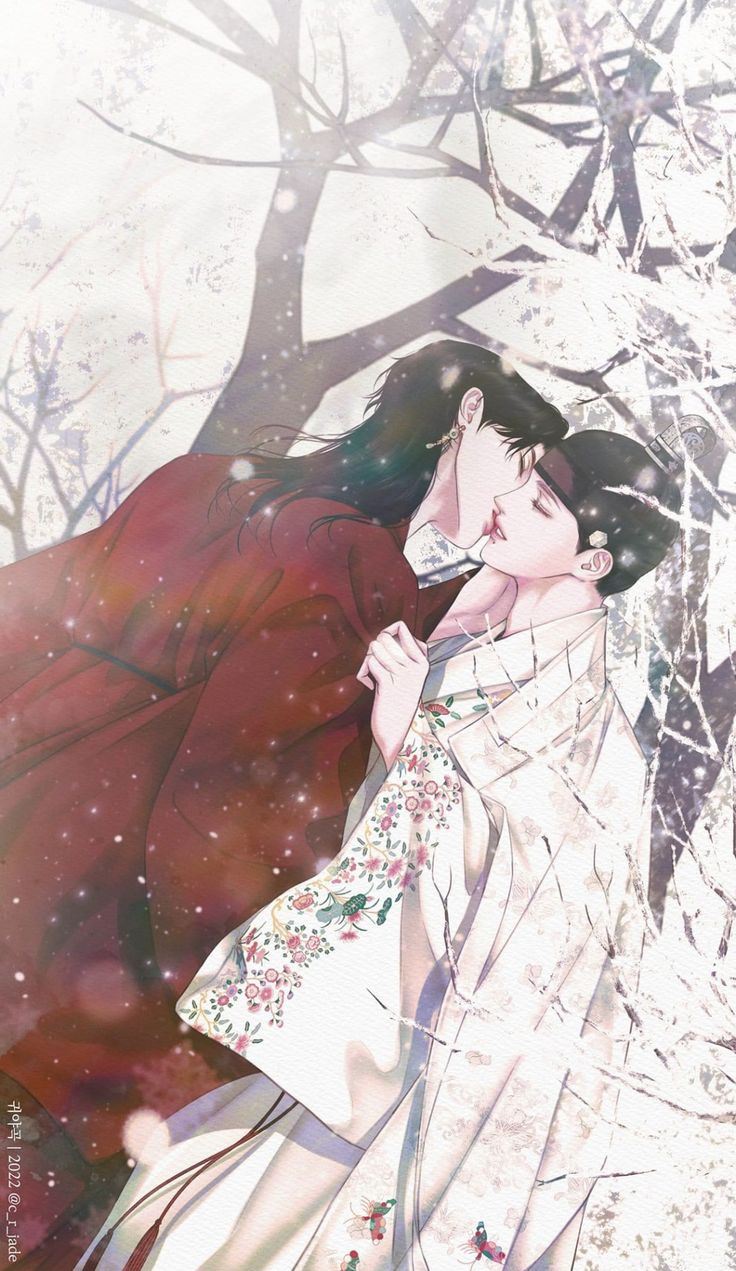
I need to talk about the river scene because I genuinely teared up a little and I'm not embarrassed to admit it. Let me set the scene first. Thunder noise at night. Qingyan wakes up startled, thinks it's an earthquake. What is it? The ice on the river breaking — the river thawing after winter. And Qiu Henian, groggy, warm hand on the back of his neck, pulling him back under the covers, saying: "Don't be afraid." Then Qingyan, half-asleep, murmurs: "I want to kiss you." And Qiu Henian says: "Alright." Leans down, brushes his lips against Qingyan's, and Qingyan falls asleep. This is one of the most tender things I have ever read in this genre and I mean that with zero exaggeration. Let me back up though — because this moment only hits hard if you trace the emotional journey leading to it. Earlier in the chapter, the young wives are gossiping about their husbands' bedroom habits, and Qingyan is blushing furiously. But internally, he's realizing something important: "When Qingyan desired him, Qiu Henian desired him too, which made Qingyan feel relieved that he wasn't the only one enthusiastic about it." That word "relieved" is doing SO much work. Qingyan has been carrying this worry — that he might be the only one wanting this, that his desire might be one-sided or unwelcome. The fact that Qiu Henian wants him just as much is a relief that goes deeper than physical attraction. It's about mutual belonging. And then the river scene. The ice breaking — a natural, inevitable process that can't be stopped. That's what's happening between them. They've been frozen, cautious, dealing with past wounds (Qiu Henian's facial scars, the medicine issue, the distrust from earlier). And now, slowly, like spring thaw, everything is becoming fluid again. Qingyan asking for a kiss while half-asleep is the most vulnerable version of himself — no performance, no guarding. And Qiu Henian's soft response, the brushing of lips, the patting of his back like he's soothing a child — this man who is usually reserved, scarred, quiet, is showing tenderness in the most specific, intimate ways possible. The line "Don't be afraid" before telling him about the river isn't just about the thunder. It's about everything. Stay with me. I'm safe. The cold season is ending. And Qingyan falling asleep right after that kiss — that's the emotional climax of this entire arc. He feels safe enough to drift off in someone else's arms. After everything. How is this not the most beautiful thing? How is this not top-tier romance writing? The author understands that the deepest emotional moments aren't grand declarations — they're half-asleep requests for kisses and groggy explanations about thawing rivers. I am not okay.
... Read More
I've been thinking about the calligraphy sheets nonstop. They're not just a plot device — they're the central symbol of the entire relationship between Qingyan and Qiu Henian. On the most basic level, calligraphy is about discipline, practice, patience. You don't become good overnight. You grind ink, you study structure, you make mistakes and correct them. This is exactly what their relationship is: slow, deliberate, requiring constant effort from both sides. But the annotations are where it gets really interesting. Qiu Henian doesn't just practice alongside Qingyan — he writes in the spaces BETWEEN Qingyan's characters, filling the gaps with his own guidance. He's literally building his presence into Qingyan's work, making himself part of the process without ever having to claim ownership out loud. And then there's the contrast between the two types of paper. Qingyan's sheets are his own handwriting with Qiu Henian's notes between the lines — a collaboration, invisible to anyone but them. The final sheet, however, has NO traces of Qingyan's handwriting at all. It's purely Qiu Henian's work: 'beautiful, neatly written small regular script' with instructions on how to imitate it. That last sheet is significant. It's Qiu Henian offering his best self — not the controlled magistrate or the stoic husband, but the artist who can write with grace and tenderness. And he's giving it to Qingyan as a template, saying: this is what I want you to become, this is how I see you. The Spring Festival couplets work the same way. They're public declarations of goodwill that mask private intentions. Every character written in gold powder is a promise of prosperity, but the real meaning is: I'm providing for you, I'm making sure you're cared for in this village, even when I can't be there myself.

Leave a comment

You must be logged in to leave comments. or
