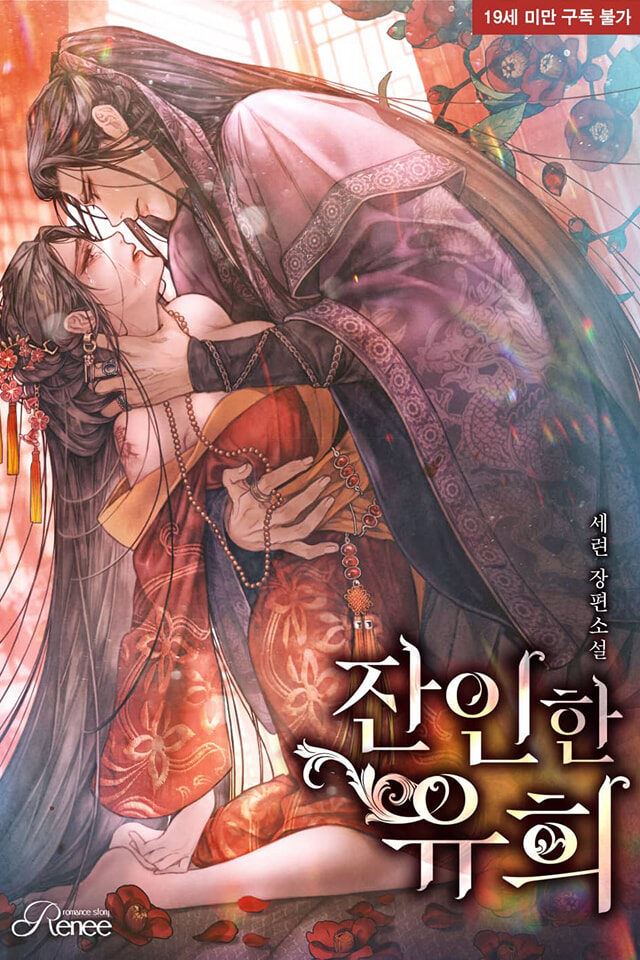
A Cruel Game
+Add to Custom List
Genres:
Novel Info
  • Author:
  • Status:Ongoing

Summary

... Read More
Jin Gahee was destined to become the Queen of Joseon, engaged to the late king as the daughter of the powerful Jin family. However, political treachery orchestrated by Joo Mun-gyeong led to the Jin family being branded as traitors. On the morning of her wedding, Gahee witnessed her family’s destruction. To save her life and the lives of her surviving female relatives, she accepted a grim fate: becoming a government slave and selling her first night in exchange for their safety. She was stripped of her noble identity, branded with the mark of a government slave, and thrown into the pleasure quarter of Hwanghak-dong. There, she was renamed Gahee and subjected to the brutal hierarchy of courtesans, who mocked her fallen status.

Amidst her suffering, Gahee held onto one desperate wish: to see Wi Jeha one last time before she died. Jeha was the man she had loved in secret, a quiet young scholar she had met at his bookstore. In a moment of misguided pride and fear, she had rejected him with cruel words, telling him she desired only a young man and that he was beneath her. She believed he was an ordinary man unaware of her true identity. Now, facing death by starvation or abuse in the pleasure house, she sought closure, hoping to apologize or simply witness his face one final time.

On the night of her debut, the head courtesan informed Gahee that her buyer was none other than Wi Jeha, the Grand Master of the Garyong Merchant Guild. The woman who had once scorned him as insignificant had been purchased for an astronomical sum—one that represented half a year’s profit for the guild. Blindfolded and trembling, Gahee waited in the chamber. When the door opened, she recognized his voice immediately, though it was colder and more languid than she remembered. He ordered her to undress, his tone mocking her lowly status while betraying a turbulent undercurrent of emotion. When he finally revealed his identity by removing her blindfold, Gahee was paralyzed by shock and despair. She had survived the fall from grace only to be handed over to the man she had broken, now the most powerful merchant in the capital.

Jeha’s behavior was a mixture of brutality and intense, conflicted desire. He stripped her of her remaining dignity, claiming her physically in a rough, possessive manner that seemed less about lust and more about a need to reclaim what he had lost. Yet, beneath his harsh exterior, his actions revealed a consuming obsession. He left her battered and bleeding on the bed, telling her to smile like a proper courtesan, before departing at dawn. He then took extraordinary measures to ensure her survival, ordering the head courtesan to provide her with the finest food, medicine, and care. He assigned Madu, his formidable bodyguard, to protect her and explicitly commanded that no other man touch her, warning that any who tried would be killed.

Meanwhile, political tensions rose. Joo Mun-gyeong, the architect of the Jin family’s downfall, sought to deepen his alliance with Jeha by offering his niece, Hye-ryeong, in marriage. Hye-ryeong had admired Jeha from afar and openly declared her feelings. Jeha refused her bluntly, stating he would never marry for convenience or political gain, and that he only desired a love that was all-consuming and painful. His rejection of a powerful alliance signaled the end of his business partnership with the Joo family. He informed Joo that his investments had yielded sufficient profit and that he intended to sever ties once the Jin family’s ancestral grounds were completely erased.

After collapsing from exhaustion and fever, Gahee awoke to find Jeha waiting by her bedside. He had not slept, watching over her with a gaze full of torment. When she woke, he acted coldly again, dismissing her concerns and leaving abruptly. However, after Juju, the young kitchen girl who had remained loyal to Gahee, pleaded with him to leave a token so Gahee would not think the night was a dream, Jeha cut the silk tassel from his own robe with his sword and gave it to her. This small gesture revealed the depth of his hidden concern. Days later, Gahee, recovering in the garden, saw Jeha returning to the pleasure house. He drank heavily, avoiding her gaze, but when she reached out to him, he snapped, grabbing her chin and demanding she smile for her guest. The encounter escalated into another intense, painful union, where Jeha’s physical aggression masked his emotional devastation. He confessed through his actions that he could not stay away, haunted by memories of her. The story establishes a dark, complex dynamic where Gahee is caught between survival and her lingering love for Jeha, while Jeha is trapped between his vengeful pride and his overwhelming, destructive desire for her, all against the backdrop of a kingdom where her family has been erased and her future remains uncertain.

Latest Release
DateGroupRelease
2026-10-03dusk blossoms c23
2026-10-03dusk blossoms c22
2026-10-03dusk blossoms c21
2026-10-03dusk blossoms c20
2026-10-03dusk blossoms c19
2026-10-03dusk blossoms c18
2026-10-03dusk blossoms c17
2026-10-03dusk blossoms c16
2026-10-03dusk blossoms c15
2026-10-03dusk blossoms c14
2026-10-03dusk blossoms c13
2026-10-03dusk blossoms c12

Community Reviews

Rating(0 / 5.0, 40votes)
5 stars
0(0%)
4 stars
0(0%)
3 stars
0(0%)
2 stars
0(0%)
1 stars
0(0%)

Popular reviews

... Read More
Okay so let me just... breathe for a second. The plot moves in TWO completely different directions here and I am NOT okay. On one hand, you have this insane confrontation between Gayu and Hye-ryeong where Hye-ryeong drops these revelations like bombs. Jeha paid an enormous fortune for Gayu's life. He threw away everything he didn't want—the merchant guild inheritance, his whole plan—to save ONE woman. And Hye-ryeong knew this the whole time. She says it so calmly too: "No man would participate in a plan that could bring ruin upon an entire family merely because he was curious about a woman." That line hit me so hard. It reframes everything we thought we knew about Jeha's motivations. And then Gayu's response—oh god. When Hye-ryeong offers to free her, to restore her status, Gayu basically laughs in her face. "His money, his heart, and even his body." She doesn't want freedom. She wants THIS. The moment where one man looks at her like she's the only person in the world. Even if it ends tomorrow. But then—the CUT. Right when we're done with that emotional wreck of a scene, we follow Jeha to DAEJU. A buried corpse. A woman named Jin Gahee. Not THE Jin Gahee. Another one. And this middle-aged woman at the end who looks FAMILIAR. My brain is STILL trying to process what this means. Is this a twin? A sister? A fake? Who is she and WHY was she buried a month ago? The author plays with dramatic irony like a god here. We know Gayu is alive. Jeha does not. He's staring at a dead woman who shares her name and we can't scream at the page fast enough.
... Read More
I need to talk about this scene where Gayu is staring at her reflection in the bronze mirror. The author really understood assignment here. You have all these layers of literal and figurative masking—the white powder on her face, the crimson blusher described as resembling fresh blood, the veil that's about to be placed over her eyes. She looks like a doll. A beautiful, bloodless doll. And the prose makes you feel every cold brush of powder, every tight tug on her hair, every meaningless gesture performed on her body while she watches herself become a stranger. The pleasure house itself is rendered so vividly. The opening scene with all those competing courtesans gossiping through the doorway, their envy and admiration drifting in like incense smoke. The rich scent of perfume that Yeon-hwa brings with her. The lingering musk in the chamber where Gayu is left alone on that crimson bed. Even the sound design is there—the click of the door closing, the rustle of fabric, the steady breathing of the man standing in darkness just feet away. What really sold me though was the visual of that thin veil seeping soft lamplight through it, how it reminded her of moonlight. The author keeps tying light imagery to Gayu's emotional state—pale powder, crimson lips, the blurred glow behind fabric. It's like the whole world has been drained of color except for these sharp, painful highlights, and Gayu is moving through it blind. The sensory details don't just decorate the scenes, they carry the emotional weight. I could literally smell that room.
... Read More
"I want to see her." Those three words from Jeha destroyed me. Not because they're dramatic — but because they're so quiet, so honest, and come from a man who had just learned that every single thing he thought he knew about the woman he was with was a lie. Let's talk about THAT scene where he grabs her throat. Yes, it's violent. Yes, it's frightening. But read closely — the text says what filled his distorted eyes was NOT anger. It was SORROW. Pain. Despair. The eyes of a man who had discovered a truth he should never have known. And Gayu's response? She doesn't resist. She just... looks at him. She struggles to smile because she WANTED to look beautiful for him. She cries because she's been holding this secret alone and now the man she loves is looking at her like a stranger. "Who are you?!" he screams. And the answer, I'm sure, is something like: I'm the one who embroidered a black dragon for you because I wanted to do something ordinary for the man I love. I'm the one who stayed up nights unable to sleep because you were gone. I'm Gayu, not Gahee, and I've been living a lie since the day I was born. But what about the flashback? That's where my heart actually broke. The real Gahee — frail, confined, reading books she'd finished — looking at Gayu through the window and seeing her scrubbing in the sunlight. "Beautiful enough to inspire jealousy. Beautiful enough to draw a sigh of envy." And yet Gahee never envied her sister. She KNEW how precious a healthy body was. Gayu offering to go to the bookstore in disguise. That playful smile. "Just like when we were children." They were sisters who cared for each other before the world turned them into pawns. Before Gayu had to sacrifice herself to save the man she loved. Before the real Gahee collapsed from grief and never woke up. The mother's confession practically gutted me too. "She only begged him to spare that man's life." Gayu agreeing to become queen — to live a "hellish life" — not for power, not for duty, but because her father threatened to kill the person she loved. That is devastating. That is the kind of love that makes you question whether anything in this world is fair.
... Read More
The silk tassel. The branded skin. The cat. Three symbols that I think carry the entire thematic weight of these chapters. The tassel is the most obviously romantic symbol—something beautiful, intricately knotted, cut from Jeha's own person (literally from his waist), offered without a word of explanation. But it's also fragile. It's decorative. It's something you CARRY but not something you WEAR. Juju says "whenever you start wondering whether everything was a dream, just look at this." So it functions as proof of reality—tangible evidence that he was there. But proof for whom? Gayu needs to believe it was real. Jeha needs to leave something behind without having to SAY anything. The tassel is the only language they share. The brand mark operates on a completely different symbolic level. "Government Slave"—two characters burned into flesh. It's permanent, painful, and public (even if only Jeha sees it). But what's haunting is that it represents SYSTEMIC violence rather than personal violence. Jeha didn't brand her. The STATE did. And yet he feels responsible. Why? Maybe because as the richest, most powerful man in the capital, his silence IS complicity. Maybe because he benefits from a system that reduces human beings to marked property. The brand is the story's way of saying: you cannot separate the political from the personal when love enters a room like this. And the cat—"don't encourage stray cats." I'm not sure this is accidental symbolism. A stray cat seeks warmth but belongs to no one. It comes and goes. Feeding it creates dependence without guarantee of return. Gayu watches it leave and then looks at the sky, thinking about HOW LONG it's been since he last came. The cat is her own position reflected—peripheral, unwanted by the world but seeking something to anchor to, and warned not to hope too much.
... Read More
Can we just take a moment to appreciate how well-written the antagonists are in this opening? Yeon-hwa's dialogue is genuinely unsettling because it's so polite. She's smiling the entire time, her tone is almost playful, and yet every single thing she says is designed to cut. "Surely you're not planning to ask the Master of Garyong to take your hairpin tonight?" That's not even an accusation—that's worse. That's mockery wrapped in concern, the kind of thing someone says when they've already decided you're worthless and want everyone else to agree. And the head mistress! "You live as a dog does, obeying whatever its master commands." There's this incredible cruelty in how calm she is while saying it. She's not even angry. She's just stating facts, like she's giving Gayu useful advice. The line "If we were ordered to cover not your eyes but your very airways, we would do that as well" is something I need to process because it's so coldly logical. But the most interesting dialogue work is in the unspoken stuff. When Gayu says "I won't die" and Yeon-hwa responds with actual incomprehension—"Why do you want to live that badly?" It reveals everything about how disconnected these women are from each other. Yeon-hwa genuinely cannot understand survival instinct when you've already lost everything. That's a whole philosophical gap between them in one line. The male lead's dialogue is sparse but devastating. "Take it off." "You'd better hurry. I don't have much patience." He's playing a role, and the tragedy is that Gayu's role-playing with him internally—remembering the cruel words she intended to use—while he's literally speaking them to her now. The dialogue does double duty here: it's characterization AND foreshadowing at the same time.
... Read More
There is SO much going on underneath this scene that most readers will miss if they're not paying attention. Let me break it down. The BITING. This happens THREE times in the scene and each time means something different. First, HE bites HER neck — marking her, claiming her like a predator. This is about power and ownership. Second, she bites HER OWN lip till it bleeds — this is about restraint, about trying to hold onto dignity when everything is being stripped away. Third, HE bites her LIPS during the kiss — this is... complicated. Is it aggression? Passion? A desperate need to taste her, to confirm she's real? I think it's all three. The SCARS. When Gayu traces his jaw and feels "a rough texture" — this is THE most important detail in the entire scene. Why does Wi Jeha have scars? What happened to him? The author deliberately places this moment RIGHT BEFORE he asks "Are you curious about me?" It's like his body is telling a story that his mouth won't. Those scars are physical proof that he has suffered too — that he is not just a cold predator but someone who has been BROKEN. The EYE CLOTH. This is such a brilliant symbolic device. She can't SEE him during the intimate part, which means she's experiencing him purely through touch and sound and instinct. When he finally unties it and she sees his face — "the smile she knew all too well" — that's the moment the abstract becomes REAL. The voice she longed for, the face she remembers. Symbolically, this is about TRUTH vs ILLUSION. She fell in love with a voice and an idea. Now she has to deal with the real man, scars and all. And the HEARTBEAT. Thump. Thump. Thump. It appears again and again like a drumbeat. His controlled exterior vs his racing heart — that's the central metaphor of the entire scene. He says he's cold and merciless but his BODY tells a different story. The heartbeat is the truth his mouth won't speak.
See all reviews

Custom lists

See all custom Lists