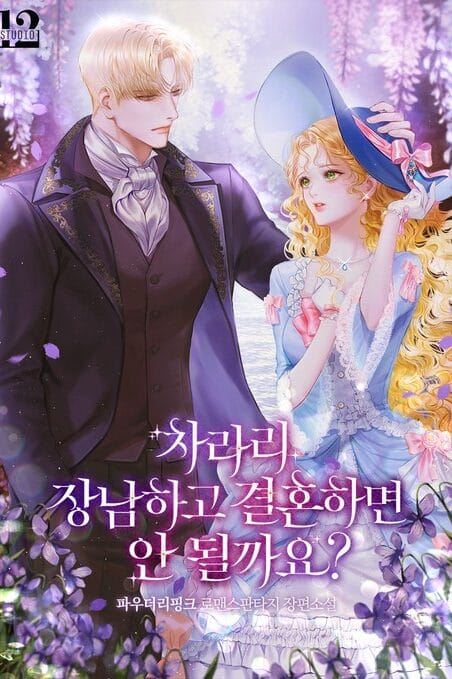
Wouldn't It Be Better to Marry the Eldest Son Instead?
Novel Info
  • Author:
  • Status:Ongoing

Summary

... Read More

Flora Charllon is the youngest daughter of Duke Pascal Charllon, a powerful noble in the western region of the Kingdom of Devilleon. Raised in luxury and warmth, she believes her father holds influence rivaling the king. Her life is upended when the king decrees she marry Emeric Blois, the second son of the Blois family, her family's ancient rivals from the cold eastern region. The marriage is a political maneuver to unify two feuding houses during a time of national hardship and poor harvests. Flora, who has never left the west and idolizes her father, is devastated to learn she must marry into a family she was taught to despise. She discovers that her father’s power was a fabrication; he could not resist the royal command. Flora writes to Emeric, asking to be married to his kind elder brother Mikael instead, but receives a cold refusal. Emeric informs her that the groom will not change, leaving Flora terrified of a future with a man rumored to be cruel and heartless.

The history between the Charllon and Blois families is rooted in tragedy. Decades prior, a Blois daughter married into Charllon but died after three years from an unknown illness, leading to mutual accusations and a bitter rift. Flora fears she will suffer the same fate in the hostile eastern environment. Upon departing for the east, she passes through the central city of Bjorn. There, she accidentally collides with a mysterious, cold-looking man with platinum hair who introduces himself as Eric. He observes her with piercing blue eyes before departing. Later, this man reveals his true identity as Emeric Blois, having recognized her. He intercepts her carriage and forces her to travel in his own, criticizing her light western clothing as inappropriate for the harsh east. Their journey is marked by sharp exchanges and mutual disdain, with Emeric mocking her upbringing and Flora resenting his arrogance.

Upon arriving at Charmant Castle, Flora is met with overt hostility from the Blois family, particularly Emeric's grandmother, who openly insults her. Tanya, a Blois maid, warns Flora that her only value lies in producing an heir, revealing that childless women in the east are often accused of witchcraft and killed. Flora suffers a severe illness, likely from stress and indigestion, the night before the wedding. Emeric visits her room while she sleeps, misunderstanding her illness and Tanya's presence as evidence of infidelity. He accuses her of being unfaithful before leaving abruptly. The next day, Flora meets her father-in-law, Duke Christophe, who reveals that her own father had secretly asked him to discard Flora if she could not adapt, even suggesting she commit suicide to restore family honor. This confirmation of her abandonment deepens her despair. Flora lies to Christophe, claiming she once loved Mikael, which Emeric overhears, further complicating their tense dynamic. As the wedding approaches, Flora remains isolated, caught between a family that wants her dead and a husband who views her with contempt, setting the stage for a perilous existence in enemy territory.

The narrative establishes a stark contrast between the warm, gossipy west and the cold, rigid east. Flora’s journey is one of forced maturation as she confronts the reality that her sheltered life provided no defense against the political brutality of nobility. Her conflict is not merely with Emeric’s personality but with a system that treats women as political pawns and disposable tools. The arrival of Mikael, the eldest son who was absent abroad, adds a layer of complexity, as Flora had briefly fantasized about marrying him. However, the structural constraints of inheritance and family law prevent this, locking Flora into her fateful union. The story traces her transition from a naive girl who believed in her father’s omnipotence to a woman facing the cruel realities of the Blois household, where survival depends on navigating hidden dangers and the whims of a family that views her as an outsider. The initial chapters conclude with Flora standing on the brink of her wedding, uncertain of her future but resolved to endure the hostile environment she has been thrust into.

Latest Release
DateGroupRelease
2026-10-03dusk blossoms c87
2026-10-03dusk blossoms c86
2026-10-03dusk blossoms c85
2026-10-03dusk blossoms c84
2026-10-03dusk blossoms c83
2026-10-03dusk blossoms c82
2026-10-03dusk blossoms c81
2026-10-03dusk blossoms c80
2026-10-03dusk blossoms c79
2026-10-03dusk blossoms c78
2026-10-03dusk blossoms c77
2026-10-03dusk blossoms c76

Community Reviews

Rating(0 / 5.0, 49votes)
5 stars
0(0%)
4 stars
0(0%)
3 stars
0(0%)
2 stars
0(0%)
1 stars
0(0%)

Popular reviews

... Read More
Okay so I need to talk about this moment where Tanya tells Flora that Emeric won't be coming to her room tonight, and Flora's reaction is basically the most relatable thing ever. She's like 'just tell him it's fine, actually I'd be happy to have separate rooms forever.' And Tanya looks at her like she's spoken in tongues. This is the kind of detail that makes the whole plot feel alive because it's not just a political marriage story—it's a woman who is genuinely relieved that her husband isn't going to try anything with her on their first night. But then Tanya drops the bomb that if Flora doesn't produce an heir, she could be branded a witch and executed. And suddenly Flora's entire situation crystallizes: she's not a wife, she's a breeding machine with a death sentence hanging over her head. Later at the banquet, the grandmother calls her a rat and Emeric's father says Flora's own father told him to discard her mercilessly if married life proves difficult. Every single person in this castle wants her gone or dead. The plot is slowly revealing that this isn't just a cold marriage—it's a death trap. Flora is completely isolated, surrounded by enemies, with her only protection being her ability to have a baby. What's brilliant is how the author doesn't explain all this at once—we learn it in pieces through conversation, dream sequences, and social interactions. That dream where she's tied to a stake and accused of witchcraft? That's the plot speaking in symbols before the characters even fully understand the danger themselves.
... Read More
Let me be clear about something the other characters in this book have failed to notice: Flora was being punished from the moment she arrived in Blois, and the punishment wasn't dramatic. It wasn't imprisonment or physical violence. It was *cold*. Deliberately, systemically cold. A room with a fireplace too small for its size. A castle where servants freeze to death in shared quarters because the nobility hoards warmth. This is the real conflict underneath everything—the political, the marital, the personal—and it's hiding in the architecture. Flora figures it out. 'I'm being punished,' she says flatly, and Emeric actually tries to gaslight her into thinking it's just practical—'no one used the room for so long, there was no need to expand the fireplace.' But she *knows*. The reader knows. This is a woman who survived Charllon's political violence and she recognizes cold war tactics when she sees them. And then the stakes escalate from psychological torture to physical danger. She's already fainted once at the dinner table. Her body is literally shutting down under stress. The corset cutting off her breathing, the nausea, the cold sweats—this isn't just nerves, this is her body betraying her because her environment is actively hostile. And yet Emeric is the one who recognizes it first and redirects her to his room specifically because the fireplace is three times bigger. He understood the threat before she did, and he intervened without making it a big deal. The wedding tomorrow raises the stakes to something nearly fatal. If she collapses during the ceremony, it's not just embarrassment—it's a diplomatic incident involving royal authority. Everyone in this castle knows it. That's why Emeric is standing there like a lighthouse checking whether the lamp is still lit. His family's reputation, his political standing, his marriage—all of it hinges on a woman whose body can barely sustain itself in a room designed to make her suffer.
... Read More
The dialogue in these chapters has this wonderful asymmetry. Flora's inner voice is frantic, stream-of-consciousness, full of exclamations and repetitions and questions that spiral. Her nanny's speech is warm but limited—she's doing her best with whatever information she has. And then you have Emeric's letter, which is so coldly precise that it reads like a legal document disguised as correspondence. But the real vocal fingerprint is in the duke-level conversations. When Duke Blois opens with "Let's get straight to the point," you immediately understand this is a man who doesn't waste syllables. Contrast that with Pascal's internal monologue about his wife's sister Jacqueline mocking Blois brides—"they were pitiful." Pascal's voice is performative politeness masking deep anxiety. He's trying to maintain dignity while his daughter's life is being redirected by someone he can't refuse. The dialogue between Flora and her nanny is genuinely funny in a painful way. This exchange: "Sir Emeric, well, at least he doesn't have dirty habits or complicated relationships with women…" "Nanny!" "All right, Miss." I nearly fell out of my chair. The nanny is giving what she thinks is comfort and it comes out as the most devastating roast possible. Flora's "Nanny!" is pure mortified recognition that her mother's helper has just described her future husband's worst qualities as if they're virtues. And the letter itself—four lines, no salutation beyond "Respected Lady Flora," signed "From Emeric Blois" like he's initialing a receipt. The absence of warmth IS the voice. The author communicates Emeric's personality without a single word of narration about him because the letter speaks for itself. That's confident writing. Most authors would add a paragraph explaining how cold Emeric is. This one just lets the dialogue do the work.
... Read More
Okay so this whole journey sequence is doing a lot of heavy lifting plot-wise and I need to talk about how it sets up everything. Flora leaves home, meets the guy who will become her husband under completely different circumstances, he reveals himself, and then they're SHOVING them into the SAME carriage. Like hello, rom-com trope central, but it works because the author makes it feel earned rather than forced. The meeting in Bjorn is the real plot gem here though. Remember when he picked her up by calling her "Ellie"? That moment where she realized she couldn't even trust her own instinct to respond. That's not just drama for drama's sake — that's the author establishing that in THIS world, names are currency and identity is fragile. Flora giving him a fake name and then accidentally revealing herself by calling out to her maid instead of the other way around...chef's kiss. And then Emeric showing up the NEXT MORNING like "oh hello, my future wife." That reveal landed so well. He KNEW who she was from the day before and played along. The betrayal sting is real but also kind of impressive on his part — he's already calculated this entire interaction. Meanwhile Flora is over there trying to survive and he's playing 4D chess. I kept re-reading that scene where he says "you live a double life" and it hit different because he was absolutely right but in the most condescending way possible. The plot moves FAST through these chapters without feeling rushed though, which is rare. Every scene has forward momentum.
... Read More
Let me just say—this plot twist when Flora opened that second letter is something else entirely. I thought she was going to be the rebellious heroine who fights fate, but then Emeric sends back a reply that reads like a death sentence wrapped in polite correspondence. "I hope we meet in Blois while you're still alive." I literally had to stop reading for a second. The author set this up so perfectly: Flora writes one desperate letter thinking she has agency, and the entire plot slams shut around her like a prison door. What's brilliant about the structure here is how the parents' conversation with Pascal and Duke Christophe operates as dramatic irony. We know Flora is trapped, they know it too—but even Pascal's request to "send her away without hesitation" if she struggles isn't protection, it's really just an acknowledgment of inevitability. He's preparing for her death before she's even left home. And that dinner where everyone essentially says goodbye without saying goodbye? Brutal. Her mother telling her to "bear an heir as soon as possible" like it's practical advice instead of sentencing her to a gilded life in enemy territory. The author doesn't waste a single scene—it all builds toward this crushing realization that Flora is a pig fattened for slaughter, as she herself puts it. No deus ex machina in sight. Just fate closing in, inch by agonizing inch.
... Read More
Can we just pause and talk about the FEATHERED HAT scene for a second because this might be the most emotionally devastating object in the entire novel and I am not okay. Flora is having the worst day of her life — leaving her parents, heading into an unknown marriage, traveling through unfamiliar territory — and she gets bumped into, falls down, and starts crying over a HAT. A FEATHERED HAT. And isn't that exactly what happens when you're already drowning? You don't drown in the ocean, you drown in a cup of water because your emotional capacity is already maxed out. "She was supposed to be a happy person who would marry in a few days, yet here she was, crying over a feathered hat." This line is everything. The contrast between expectation and reality is so sharp it cuts. Her entire life has been scheduled bridal lessons, controlled and curated, and now the first moment of autonomy she gets — sneaking around Bjorn, feeling the sunset sky — ends with physical pain and humiliation. And then Emeric picks up that ridiculous hat and holds it for her. The hat she spent so long choosing, the one that looked pretty on her but "utterly ridiculous" in his hands. Who writes that detail? That is a novelist who understands that objects carry emotion. The moment where she feels cold after he walks away — rubbing her arms, shivering not just from weather but from the encounter — that's not just physical discomfort. That's the emotional aftershock of realizing her "future husband" looks at her like she's nothing. And yet somehow she still ends up taking his hand when he offers it. That contradiction, that push-pull between anger and necessity, between wanting to rebel and knowing she needs to survive... I felt that in my chest. The parent farewell scene also hurt more than I anticipated. "Even in death, I'll be buried in Blois" — Flora's self-mockery masking genuine fear. Her father calling out her name like he doesn't understand why she's become this way. Parents who can't see their daughter's pain because they're too busy hoping she'll be happy. The heartbreaking line "trying to detach themselves from her so quickly — it was heartbreaking" tells us everything about what's happening here.
See all reviews

Custom lists

See all custom Lists