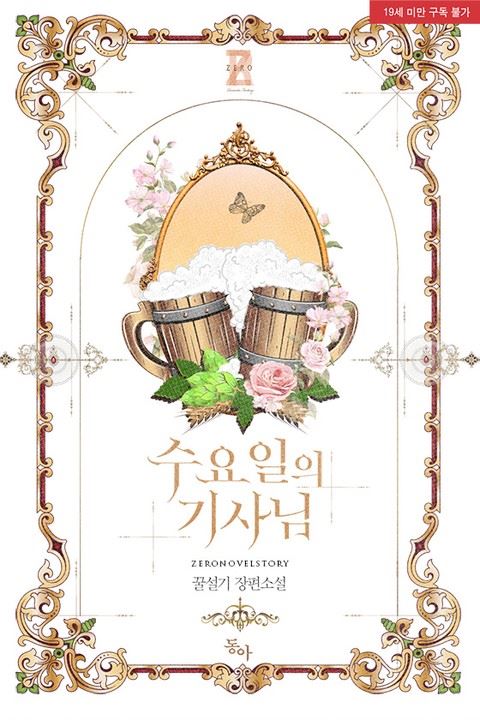
What Should You Do If You're Bitten by a Mad Dog?
+Add to Custom List
Novel Info
  • Author:
  • Status:Ongoing

Summary

... Read More
Windsor Hiddleston is a brilliant and cold Captain in the Wenster Empire's navy, renowned for his impeccable record and noble lineage as the sole heir to the Hiddleston Ducal House. Despite his perfection in all professional and physical aspects, Windsor lacks emotional warmth and has never truly engaged with women, a fact underscored by his recent, loveless divorce after three years. His life is defined by duty and isolation, leaving him indifferent to the social maneuvers of the nobility. Keira Quelsky, the vibrant and confident daughter of the Chief of Naval Staff, Admiral Vernon von Quelsky, lives a contrasting existence filled with romantic conquests and social gambles. She maintains a flawless success rate in seduction, driven by a fierce rivalry with her friend Emilia. The two worlds collide on the Emperor’s birthday, when a intoxicated Keira mistakes Windsor for her target, Ronnie Randolph, a gentle Warrant Officer she intends to seduce. She jumps into Windsor’s carriage, leading to a passionate but confused encounter at the Sheraton Hotel, where Windsor, for the first time in his life, loses control to primal desire, unaware that the woman clinging to him believes she is with Ronnie.The morning after their tryst, Keira wakes alone and misremembers the details due to her hangover, convinced she spent the night with the handsome Ronnie Randolph. She cherishes the note he left, which directs her to Naval Operations Headquarters, Unit 1, viewing it as an invitation for further contact. Meanwhile, Windsor is tormented by a new, unfamiliar obsession. He cannot stop thinking about the woman, whose identity he later discovers is Keira Quelsky. The knowledge that she mistook him for Ronnie Randolph causes Windsor a deep, uncharacteristic sense of humiliation and anger. He begins to investigate Ronnie Randolph, not out of professional duty, but from a jealous impulse he refuses to acknowledge. He grows increasingly erratic, suffering from insomnia and mood swings that alarm his subordinate and only friend, Thompson Collin.As summer approaches, Keira arrives at the Official Residence, the summer home of the naval elite, where she plans to reconnect with Ronnie. She is unaware that Windsor is also stationed there. Their paths eventually cross when Keira visits the Operations Headquarters to find Ronnie, only to be led into Windsor’s office. Windsor, now the owner of the room, confronts the woman who spent the night with him but does not recognize him. He questions her aggressively, checking her credentials and demanding proof of her appointment with Ronnie. Keira, confused by his hostility and cold demeanor, shows him the note she received. Windsor recognizes his own handwriting and realizes she has not yet met Ronnie Randolph. The confrontation highlights the stark difference between them: Keira is warm, expressive, and driven by emotion, while Windsor is icy, guarded, and dominated by logic. The encounter leaves both of them unsettled. Windsor is irritated that she still does not know the truth, while Keira is repelled by his rude attitude. However, the intense chemistry from that night lingers in Windsor’s mind, disrupting his disciplined life. As the story progresses, the tension builds around Windsor’s growing jealousy and Keira’s determined pursuit of Ronnie, setting the stage for a complex love triangle where identities and desires are deeply entangled.

Latest Release
DateGroupRelease
2026-10-03dusk blossoms c114
2026-10-03dusk blossoms c113
2026-10-03dusk blossoms c112
2026-10-03dusk blossoms c111
2026-10-03dusk blossoms c110
2026-10-03dusk blossoms c109
2026-10-03dusk blossoms c108
2026-10-03dusk blossoms c107
2026-10-03dusk blossoms c106
2026-10-03dusk blossoms c105
2026-10-03dusk blossoms c104
2026-10-03dusk blossoms c103

Community Reviews

Rating(0 / 5.0, 40votes)
5 stars
0(0%)
4 stars
0(0%)
3 stars
0(0%)
2 stars
0(0%)
1 stars
0(0%)

Popular reviews

... Read More
There is a moment in Chapter 2.2 — just one sentence, really — that I circled three times. Keira is waiting alone in Windsor's office, and she smells the perfume on her own clothes. The scent from that night. The scent that belonged to the man she spent the evening with, the man she thought was Ronnie Randolph. She closes her eyes and breathes it in, and the text says: "Smelling the familiar fragrance, she felt her excitement double." This is the most honest line in the entire passage. She doesn't know WHO that man was. She thinks it's Ronnie. But her body KNOWS. Her memory knows. That woody fragrance is locked into her nervous system, and just breathing it again in the place where it happened sends her heart racing all over again. This is how attraction works at its most primal — not in grand declarations or dramatic confessions, but in the involuntary response of a body that remembers what the mind hasn't caught up to yet. And Windsor — oh, Windsor. He walks into that same office and catches the same scent. He looks at her and sees someone who has no idea he exists in this context. Someone who is planning a future with another man. The humiliation of it must be absolute. He won the night but lost the war, and he's standing there in his uniform like a fool while she talks about Ronnie Randolph with this bright, hopeful energy. The emotional architecture of these chapters rests on a single devastating fact: both of them want this, but neither of them knows it yet. She's chasing a ghost. He's guarding a secret. And the reader — we're the only ones who can see the whole picture, which makes every polite exchange between them ache with dramatic irony. When she calls him rude and he lets her leave, when he watches her compose herself like a refined lady after rushing at him like a colt — these are moments of pure emotional cruelty, but they're the kind that makes romance feel REAL. Because real love isn't just grand gestures. It's two people standing in a room, surrounded by everything they could have, pretending they don't want it.
... Read More
There's something deeply symbolic about the way this entire encounter unfolds, and I can't stop thinking about it. Windsor represents order—military precision, social status, emotional control, a life mapped out to the smallest detail. And she? She is pure, unfiltered CHAOS. Drunk, unpredictable, invasive, impossible to pin down. The author keeps putting these two opposites in physical proximity, which feels intentional. Like the universe is testing whether order can survive contact with chaos, or whether chaos will eventually consume it. The carriage itself is a symbol—I love that. It's a confined space, moving forward, nowhere to escape. Windsor is trapped in a literal metal box with this woman who dismantles everything he thought he knew about himself. And then there's the alcohol. It's not just a plot device; it's the great leveler. She drinks to find courage. He stays sober to maintain control. But by the end of these chapters, who's really in control? Nobody. That's the point, isn't it? The green eyes—that recurring detail—feel significant too. He recognizes them but can't place them, which suggests some kind of past connection, possibly something buried or forgotten. The manuscript hints at fate, at things that feel predetermined. She says "You wanted this too, didn't you?" as if their encounter was written before either of them knew it was coming. Whether that's romance, destiny, or manipulation remains deliciously unclear.
... Read More
The rain in this chapter is doing SO much work. It's not just weather — it's a symbol of everything Keira is refusing to accept. She walks into a storm because she's determined to see Ronnie, she gets drenched because she refuses Windsor's umbrella (his help/warning), and then she still can't let go of the anger when she gets home. The umbrella is such a perfect symbol too. It's an offer of protection, of kindness, of assistance from someone who's actually trying to help her avoid embarrassment. And she throws it away — or rather, refuses to use it — because her pride won't let her accept anything from a man she finds unpleasant. Meanwhile, Windsor picks up the crumpled note she threw at him and literally tosses it in the trash. Two people, both rejecting something useful, both for pride. That's not coincidence. There's also the note itself — the piece of paper about Ronnie Randolph that Keira doesn't understand. It represents the gap between what she thinks she knows (that Ronnie is her dream guy) and what might actually be true. Windsor knows something she doesn't, and he's trying to warn her, but she's too busy being offended to listen. The Official Residence itself is interesting too — everyone lives like one big family, except Windsor who lives outside. He's an outsider looking in, just like he's an outsider in Keira's narrative right now. But the way he keeps appearing anyway? That's the point, isn't it?
... Read More
Okay, can we talk about how the entire chapter basically operates as a battlefield where two people are trying to dismantle each other without throwing a single punch? Windsor shows up, and the tension is so thick you could spread it on toast. Keira is doing everything in her power to make him invisible, pivoting her entire being toward Ronnie like he's the sun and Windsor is just... bad weather. But Windsor? He's not having it. The moment Esther asks if he's seeing anyone, he doesn't even hesitate. "The woman I'm going to marry is..." And boom. Keira chokes on her wine like it personally offended her. That's not just shock, that's panic. She's terrified he's about to say her name, and she's equally terrified he won't. The way she then tries to shut him up by claiming she knows this mysterious woman well is pathetic and hilarious. She's basically playing house with Ronnie while simultaneously trying to sabotage Windsor's attempt to claim her. It's messy, it's cruel, and I am absolutely here for it. And Esther! Poor, delusional Esther thinks Windsor is staring at Keira with love, but really, he's staring at her with a very specific intensity that has nothing to do with romance and everything to do with possession and confusion. He's a man who's never wanted anything and now he wants this woman who hates him, and it's short-circuiting his entire personality.
... Read More
The pacing in this section is actually really clever when you think about it. We start in media res with Keira already confrontation-with-Windsor-in-progress, which immediately hooks you. Then we get the aftermath at home, the mother-daughter chat that establishes her romantic intentions, and THEN — boom — we're at Thompson's house three weeks later where everything collides again. That time jump is genius because it does two things: it shows Windsor hasn't forgotten about her (he's been absent-minded for a month, which Thompson notices), and it shows Keira has been actively planning to pursue Ronnie while apparently still fuming about Windsor. The fact that she's describing the perfect man she wants to marry right after being traumatized by another man? That's comedic gold. The scene transitions are also smooth. We go from the thunderstorm outside to the calm purple sunset, which is a nice tonal shift. And the description of Windsor sitting at the desk against that watercolor sky — "like seeing an expensive portrait with a perfect figure set against a beautiful background" — that's a beautiful breathing room moment before the tension ramps back up. I was genuinely surprised when Thompson said his name out loud. I had completely forgotten about Windsor by that point, which means the author successfully made me invest in Keira's perspective first, then hit me with the consequences.
... Read More
The recurring metaphor of illness in this section is fascinating and deeply meaningful. Thompson repeatedly frames Windsor's experience as a pathology — 'fatal illness,' 'sick in the head,' 'evil spirit.' Even Windsor himself initially describes it as something being wrong with his heart and head. But the joke, and also the point, is that this 'illness' is literally love. The story is asking us to consider: what if falling in love IS a kind of sickness? Something that bypasses reason, corrupts judgment, makes healthy men act irrationally? Thompson's observation that love is 'a terrible illness with no cure' is both comedic and philosophically sharp. And there's this other layer — Windsor's resistance to the diagnosis mirrors how society tells men not to feel, not to be vulnerable, not to be undone by someone they barely know. His entire identity as a composed, controlled officer is threatened by something he can't fight. The fact that he's neighbors with Keira adds another layer: this illness is inescapable. He can't distance himself. Every day becomes a exposure. The house next door isn't just a comedic reveal — it's a symbol of how love invades your daily life when you think you're safe. Thompson's cozy prison with Violet versus Windsor's freedom that feels increasingly like a cage — that contrast is the theme wearing its heart on its sleeve.
See all reviews

Custom lists

See all custom Lists