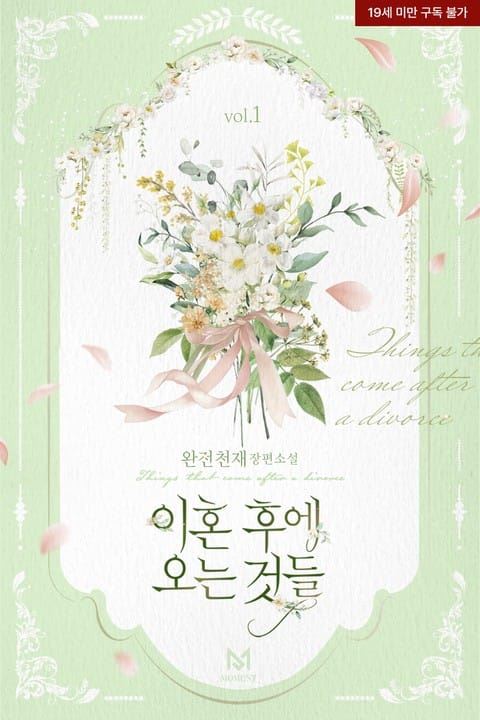
What Comes After Divorce
+Add to Custom List
Novel Info
  • Author:
  • Status:Ongoing

Summary

... Read More

Min Kyungseo is a former painter who, seven years after a passionate divorce from Han Minjun, runs a struggling flower shop called Hwain with her business partner Kim Haejin and employee Young-in. The story opens on Christmas Eve, a date deeply significant to her painful past, when Kyungseo experiences vivid dreams of her intimate life with Minjun. Despite the emotional toll, she rises early to attend an inauguration ceremony for Paragon, a major financial firm where she has secured a critical one-year contract to decorate the venue with floral art. Unbeknownst to her initially, Paragon is now led by Han Minjun, her ex-husband, who recently assumed full control following his father’s death.

Minjun is portrayed as a cold, calculating, and highly successful chairman who views business through a lens of ruthless efficiency. Upon discovering that Hwain Flower is the contractor, he is initially indifferent but becomes increasingly fixated when he learns that Kyungseo is the co-CEO. His investigation reveals a life far removed from the glamorous artist he expected; she lives in a small apartment, carries debt, and works manual labor to survive. This revelation confounds and angers him, as he interprets her choice to leave him as a rejection of his love, only for her to end up in such humble circumstances. Meanwhile, Kyungseo strives to maintain her professional composure, hiding her lingering emotional scars and avoiding any direct confrontation with Minjun.

The core conflict intensifies as Minjun expands the contract, ordering Hwain to decorate the entire Paragon building, including a massive floral installation in the lobby. This directive forces Kyungseo and Haejin into close proximity with Minjun’s world. During a Sunday morning installation, Kyungseo suffers a fall from a ladder while arranging flowers. Minjun, acting on instinct, rushes forward and catches her. This physical collision revives suppressed memories and emotions for both parties, leaving Kyungseo shaken and Minjun visibly agitated by her fragility and their unresolved history. He orders the frame moved to a safer height, revealing a protective instinct he attempts to suppress.

As the narrative progresses, Minjun’s interest in Kyungseo shifts from mere curiosity to a complex mix of resentment, concern, and unresolved desire. He orchestrates situations that keep her within his orbit, such as demanding regular flower maintenance and expanding the scope of her work. Simultaneously, Kyungseo’s business begins to flourish unexpectedly after her social media post of the inauguration unicorn goes viral, leading to a surge in orders. However, this professional success is tinged with the anxiety of her daily interactions with Minjun.

The story navigates the tension between their past intimacy and present estrangement. Kyungseo reflects on the suffocating nature of her marriage and the pain of being perceived as a prize rather than a person, while Minjun grapples with his inability to understand why she left and why her life has not matched his expectations of success. The introduction of Choi Raon, a journalist interested in interviewing Minjun, adds a layer of external pressure, hinting at future professional and personal entanglements. Minjun’s blunt revelation of his marital history to Raon serves as a subtle warning, further complicating the romantic dynamics.

The trajectory of the story moves toward a potential reconciliation or renewed conflict, driven by Minjun’s determination to understand Kyungseo’s current life and her struggle to maintain boundaries. The expansion of their business partnership ensures that their paths will continue to cross, forcing both characters to confront the truths they have buried since their divorce. Kyungseo’s resilience in rebuilding her life alongside her friends contrasts with Minjun’s isolated power, setting the stage for a narrative where professional obligations unravel deep emotional histories.

Latest Release
DateGroupRelease
2026-10-03dusk blossoms c20
2026-10-03dusk blossoms c19
2026-10-03dusk blossoms c18
2026-10-03dusk blossoms c17
2026-10-03dusk blossoms c16
2026-10-03dusk blossoms c15
2026-10-03dusk blossoms c14
2026-10-03dusk blossoms c13
2026-10-03dusk blossoms c12
2026-10-03dusk blossoms c11
2026-10-03dusk blossoms c10
2026-10-03dusk blossoms c9

Community Reviews

Rating(0 / 5.0, 37votes)
5 stars
0(0%)
4 stars
0(0%)
3 stars
0(0%)
2 stars
0(0%)
1 stars
0(0%)

Popular reviews

... Read More
The pacing in these chapters is absolutely deliberate and I respect it so much. We start with this slow, almost languid sequence of Kyungseo alone in her apartment, then cut to Minjun in the shower — two separate scenes that mirror each other like a duet. Then life resumes, mundane and steady, until the Sunday arrival where everything collapses inward. The author builds this incredible tension through what doesn't happen as much as what does. Kyungseo coming into the office, Minjun already there, the polite formal greeting that sounds alien coming from him, her hesitation about whether to leave — these small moments carry the weight of seven years of broken marriage. And then the conversation about her parents where everything changes. The chapter ends with her putting flowers on his desk and leaving, and I'm just sitting there like... what? The pacing is designed to make you feel exactly what these characters feel — the excruciating slowness of pretending nothing happened, the sudden flood of everything returning when the mask slips. Absolutely brilliant structural control.
... Read More
I need a minute. I actually need to sit with this. The way Kyungseo's body betrays her mind in this scene—God, it's written so honestly. Her mind is saying no, this is a mistake, we're not like that anymore—and her body is like, oh honey, you have no idea how long I've been waiting for this. That line about her having pleasured herself thinking of him? I had to put the book down. That's the kind of detail that doesn't just describe desire—it describes YEARS of suppressed longing, loneliness, the kind of ache that becomes a habit. But what really destroyed me was the aftermath. The way the narration goes from this almost feverish, breathless intensity during the encounter to this brutal, clinical return to reality: "Her face stiffened." Three words. That's it. That's the whole emotional collapse. She's sitting up, trying to reclaim control, and the first thing out of her mouth is "It was a mistake. For both of us." And Minjun's reaction—his eyes literally dim. He had just experienced something that made him sob into her shoulder, something he describes as the most intense of his life, and her version of it is a MISTAKE. The cruelty of it isn't malicious; she's trying to protect herself. But it cuts deeper than any intentional wound could. "She was no different from seven years ago, when she had asked for a divorce." Oh. Oh no. That parallel is everything. The body remembers what the heart tried to bury, and neither of them are ready to deal with why. I'm not okay.
... Read More
Okay so I have to talk about this ending because I literally gasped out loud. After seven years of Kyungseo burying this under layers of guilt, pride, and fear, she finally tells Haejin: "I think I still love him." And it's not some grand dramatic declaration—she's lying in bed, feverish, crying, half-delirious. The confession just leaks out of her because she's physically and emotionally overwhelmed. That's such a smart plot move by the author because it means it's REAL. When she's strong and composed, she could lie to herself. But here, stripped bare? That's the truth coming out. What's brilliant about the structure is how the author mirrors Kyungseo's physical collapse with her emotional one. She pushes herself too hard at work, gets a fever, and during that fever, memories of Minjun flood back uninvited. The divorce confrontation plays out in her head—his voice cracking, him grabbing her, begging her not to leave—and then she actually passes out. The plot isn't just moving forward; it's peeling layers. Seven years of repression finally have somewhere to go. And that final line from Haejin—"You're such a fool, Min Kyungseo"—followed by Kyungseo's own "Yeah, I am a fool"—that's the moment the plot shifts from tragic separation to something that could almost be healing. Because now the secret is out. Even if only to one person. What happens next? Does she tell Minjun? Does she ever? The author leaves us right on that precipice. Not a cliffhanger per se, but a door that's been cracked open after being sealed shut for seven years.
... Read More
There are so many layers of symbolism packed into these chapters that I need time to process. The flowers themselves are the most obvious — Kyungseo tending to them, replacing wilted ones, arranging new bouquets. She's nurturing something fragile that needs attention and care, just like her relationship with Minjun. The lilies she's holding when she talks about her mother — lilies are associated with both death and renewal, which feels painfully on the nose but also deeply intentional. And Minjun's body, which the author treats almost like a separate character — it betrays him at every turn. The erectile dysfunction that was supposedly permanent, undone by the scent of his ex-wife. His pupils reddening, his jaw clenching, his hand gripping the showerhead until his knuckles went white. These physical reactions are the truest thing about him because they can't be controlled or lies told through them. The flowers in the small vase on his desk — two flowers, not a bouquet, just enough — feels like an offering or an apology she couldn't bring herself to speak. Every element in this story seems to be working on at least two levels simultaneously.
... Read More
There's something so specific and beautiful about how the author writes the Paragon office scene. The underground parking lot, the flower truck arriving, Hansoo enthusiastically jumping around like a golden retriever, the elevator doors closing and Kyungseo finally letting out the laugh she'd been holding in. It feels so warm and lived-in before the whole mood shifts when she opens the Chairman's office door and there he is. The sensory details are incredible — 'amid the faint scent of flowers, her unique fragrance reached him' and then the clinical description of his physical reaction. The contrast between the warm, almost comedic Hansoo subplot and this icy-tense office encounter is masterful scene direction. I also love the mundane details that make the world feel real — replacing water in the vases, the sound of scissors cutting stems, the clicking of a computer mouse. These small actions become charged with meaning because of what's happening between them. And that final image of Kyungseo placing a small vase with two flowers on his desk before leaving? That's cinema-level visual storytelling right there.
... Read More
This is the part where everything I thought I knew about Kyungseo's motivations gets turned inside out. For seven years, we've been told she wanted a divorce, that she was done, that she needed space. And now we're hearing the truth—or at least, a version of it she's too afraid to speak aloud. The conflict here isn't between her and Minjun anymore. It's between her and her own fear. What she's terrified of isn't Minjun's anger. It's his disbelief. She says it directly: "Do you think he'd believe me?" And Haejin's reaction—sighing, swallowing her own words—tells us everything. Even Haejin, who knows the whole story, doesn't have an answer. Because the antagonist in this story isn't a person standing in front of them. It's a mother-in-law whose manipulation was so thorough that the victim can't even convince her own husband she was victimized. That is genuinely devastating. The stakes keep climbing too. It's not just "will they get back together?" anymore. It's: can Kyungseo survive another interaction with Minjun if he doesn't believe her? What happens if she tells him and he calls her a liar? What happens if he believes her and the damage is already done? Every choice feels impossible because the author has made sure we understand that there is no clean path forward. And then there's the physical stakes—Kyungseo literally collapsing from overwork and stress. Her body is enacting the conflict her mind can't resolve. When she passes out and dreams of Minjun begging her not to leave, that's the author showing us the deepest truth: she doesn't want to have left. The guilt is eating her alive, and it's making her sick in every sense of the word. The most powerful line in the entire passage might be the simplest: "Even knowing it was a blazing fire, even knowing it would burn her entire body, love was something that couldn't be restrained." Haejin says this, and it reframes everything. Kyungseo didn't leave because she stopped loving him. She left despite loving him. And that changes the entire moral landscape of the story.
See all reviews

Custom lists

See all custom Lists