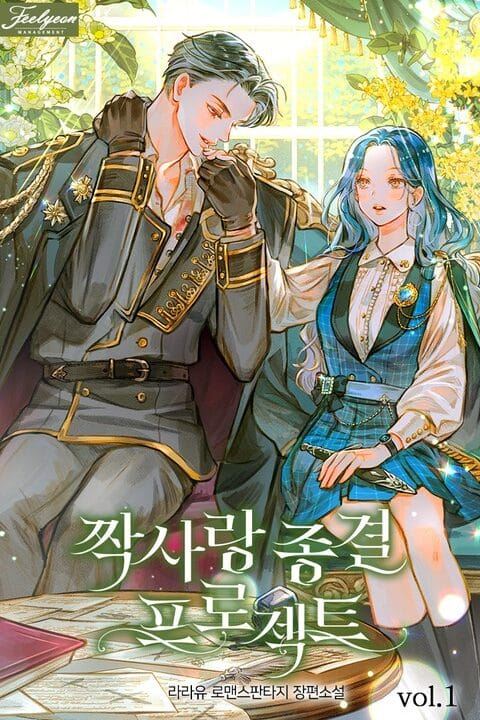
Unrequited Love Ending Project
Novel Info
  • Author:
  • Status:Ongoing

Summary

... Read More

Cielie Ronenfeld is a noblewoman who discovers she has reincarnated into the body of an extra character in a romantic fantasy novel she read in her past life. In the original story, this character dies within a year after pining unrequitedly for the male lead, Dietrian Winter. To survive, Cielie resolves to alter the plot and uncover the secret behind her impending death. Her only advantage is her knowledge of the story, though crucial details about her demise are absent from the book. Complicating matters is her complicated history with Erden, a commoner who consistently outperformed her at the Royal Academy and became her rival. Despite their adversarial relationship, Erden harbors hidden identities and immense power, serving as the Grand Duke of the North and the mysterious mastermind behind the novel's events.

The narrative begins with Cielie testing a theory she has developed regarding her limited lifespan. She realizes that physical contact with Erden, specifically a kiss, causes the numbers on her magical bracelet representing her remaining time to increase. This discovery leads her to propose a contract relationship to Erden, aiming to secure her survival while navigating the dangerous political landscape. Erden agrees to the contract under the condition that she remain by his side and never disappear from his sight. Their arrangement is fraught with tension, as Cielie struggles to balance her genuine desire to live with her growing confusion over her feelings for a man she once despised. Meanwhile, Erden watches her with amusement, aware of the depths of his own emotions and the secrets he keeps from her.

Simultaneously, Cielie attempts to break away from her original role as Dietrian's obsessed admirer. At a charity ball hosted by the Winter Ducal Household, she publicly declares her interest in Erden instead, shocking both Dietrian and society. This act is calculated to dispel rumors and change her public image, but it inadvertently draws more attention to her relationship with Erden. The Seven Famous Young Ladies, a group of gossiping peers, become fascinated by the sudden shift in Cielie's affections, further complicating her attempts to stay under the radar. Dietrian, initially dismissive of her advances, begins to notice her change in behavior, though his reaction remains cold and distant.

The stability of Cielie's new life is shattered when she and her older brother, Yurien, become targets of a secretive organization responsible for causing Gifted Individuals to go on rampages. During a carriage ambush by this group, Cielie experiences a surge of latent power, manifesting as silver hair and supernatural strength. She single-handedly defeats the attackers, protecting her maid Ruby, but the incident leaves her with more questions than answers. The organization's involvement hints at a deeper conspiracy connected to Yurien, whose own past is shrouded in mystery and potential betrayal.

As Cielie returns to the Royal Academy, she finds herself entangled in a web of political intrigue and personal danger. Erden, operating under the guise of an official from the Rampage Control Association, frequently crosses paths with her, their professional interactions masking a complex romantic tension. Cielie must navigate academy politics, investigate the organization threatening her family, and manage her contract with Erden, all while trying to prevent her predetermined death. The story unfolds as a delicate dance between fate and free will, with Cielie's actions beginning to diverge significantly from the original plot, potentially altering the destiny of not just herself, but everyone around her.

The central conflict revolves around Cielie's fight for survival against the constraints of her narrative role. She is caught between her original love for Dietrian, which she seeks to erase, and her growing dependency on Erden, who represents both her salvation and a potential threat. Erden's true motives remain opaque, as he manipulates events from the shadows while maintaining a close proximity to Cielie. Their contract forces them to interact daily, leading to moments of vulnerability and unintended intimacy that challenge their previous definitions of enmity.

Key turning points include the revelation of Cielie's latent power during the ambush, which suggests she is not merely a powerless extra but holds significant potential. This event also exposes the connection between her brother Yurien and the antagonist organization, raising the stakes from personal survival to familial safety. Additionally, Cielie's public rejection of Dietrian at the ball serves as a catalyst, disrupting the original story's trajectory and drawing the attention of key figures who may have their own agendas regarding her fate.

The story direction points toward a gradual unraveling of the novel's mysteries. Cielie is poised to uncover the truth behind the Rampage Control Association, the nature of her own powers, and the real reasons for her shortened lifespan. Her relationship with Erden is likely to evolve from a contractual convenience into a genuine partnership, potentially reshaping the power dynamics of the Empire. As she defies her assigned role, Cielie must confront not only external enemies but also the internal struggle of reconciling her past life memories with her present reality, all while racing against the clock of her fading lifespan.

Latest Release
DateGroupRelease
2026-10-03dusk blossoms c118
2026-10-03dusk blossoms c117
2026-10-03dusk blossoms c116
2026-10-03dusk blossoms c115
2026-10-03dusk blossoms c114
2026-10-03dusk blossoms c113
2026-10-03dusk blossoms c112
2026-10-03dusk blossoms c111
2026-10-03dusk blossoms c110
2026-10-03dusk blossoms c109
2026-10-03dusk blossoms c108
2026-10-03dusk blossoms c107

Community Reviews

Rating(0 / 5.0, 26votes)
5 stars
0(0%)
4 stars
0(0%)
3 stars
0(0%)
2 stars
0(0%)
1 stars
0(0%)

Popular reviews

... Read More
I need to talk about the emotional weight of this chapter because it wrecked me in the best way. 'Green leaves fluttered down like snowflakes.' That image. Right there. The absurdity of their reunion — her falling from a tree in torn clothes, disheveled, while he looks 'perfectly arranged' — and yet the falling leaves seem timed just for him? That's not romance novel nonsense, that's the author showing us how Cielie's perception works even now, three years later. But here's what really got me: the father's study scene. Her dad asking if she's 'sorting out her feelings' and her realizing he looked older than before. Those tears that 'budded' and then dried up when she saw the invitation? That's grief layered over relief layered over determination. So much happening in silence. 'Cielie Ronenfeld' — his full name. The way the narrator makes us feel how distant that sounds now, how formal, how final. She used to chase Dietrian Winter obsessively, and now? Now she's going to the charity party with a completely different purpose. The shift isn't just plot development, it's emotional liberation. And Erden. Oh, Erden. He catches her — 'without showing any sign of strain' — and his first words are 'Three years, isn't it?' Not 'Are you okay?' Not 'I was worried.' Three years. As if time stopped the moment they parted. The intimacy of that observation, the way he knows exactly how long it's been when she 'hadn't noticed' — that's the kind of detail that makes your chest ache. The most emotionally devastating line? 'She knew perfectly well, but the words slipped out instinctively.' She's lying about not noticing the time, and he knows it. They're both performing, both hiding, both pretending this is casual. But the air between them crackles with everything unsaid.
... Read More
Cashel von Ermonne needs his own category because the way this author writes him is genuinely chilling. Let me break down his dialogue, because every line is a small knife. 'I greet the Empire's Little Sun, His Highness the Crown Prince.' — Formal, polite, appropriately deferential. Perfect Cielie behavior for talking to royalty. 'Lady Cielie, you have always treated me casually, haven't you?' — Oh. Oh wow. This single line recontextualizes their entire relationship. He's not accusing her. He's reminding her. 'You were casual with me before. Why the sudden formality? What changed?' It's wrapped in perfect noblesse oblige, but it's basically: stop pretending. 'This book isn't ours.' — The way he notices it immediately and flags it. He's observant, present, paying attention to EVERYTHING. And then when Cielie tries to brush it off, he keeps pushing. 'Should I help you?' 'It looks a bit heavy.' Each line is gentle, each line is polite, each line is completely deliberate. The librarian's response is equally telling. 'Don't we have bags in the library…?' Lies. She'd seen red bags earlier. But Cashel's gaze makes her fold immediately. The power dynamics in this scene are absolutely masterful—the reader understands everything that's happening between three people who are saying vastly different things. And Cielie's internal monologue throughout is a masterpiece of controlled panic. 'I regained my memories from a past life and realized this world is a novel, so I'm trying to change the original plot. I'd be misunderstood as having been cursed by black magic and killed on the spot.' The humor in how casually she considers this option speaks volumes about her stress level. The author balances tension and dark humor perfectly here. Cashel's final line: 'Improving the relationship? More like worsening it.' That's not him speaking out loud—that's Cielie's internal thought about what JUST happened. And it's devastatingly accurate.
... Read More
Let me just say — the pacing in this section is absolutely vicious and I am here for it. We go from: mysterious blank book → Erden being suspicious → Cielie can't sleep → WAKES UP TO DIETRIAN'S LETTER → TROWS IT AWAY → THEN CASHEL'S LETTER APPEARS → BOTH INVITE HER TO THE SAME EVENT → She spends her entire morning drafting rejection letters like a wartime general → EATS DESSERT TO COPP — the narrative never lets her breathe and neither do I. The chapter transitions are also doing heavy lifting. Chapter 2.9 starts with her cursing in her past-life language (immediately establishes she's changed) and ends with her seeing today's date on the calendar with a red star. That red star ending? That's a cliffhanger disguised as a mundane detail. It screams SOMETHING IS HAPPENING TODAY without actually telling you what. And then Chapter 3.1 opens with her arguing with Ruby about going out for dessert — which is both a palate cleanser AND a setup for whatever the red star event is. The author is playing 4D chess with pacing and I am shook.
... Read More
Okay, so this chapter just absolutely shattered my expectations and I need to talk about it. The chain rampage incident? The reincarnation reveal? The way Erden shows up out of nowhere catching her mid-fall? Let me unpack this because wow. The author masterfully layers multiple plot threads here. We have the immediate action scene — Cielie falling from a tree, nearly dying — which immediately hooks you. But then it pivots to this massive revelation that she remembers her past life. Not just remembering, but the whole 'I was obsessed with the wrong guy for years and now I see clearly' angle. That is such a smart way to reintroduce the protagonist. What really got me was the chain rampage incident being tied to both characters. Remember when she thought about how 'Yurien and that organization somehow feel oddly connected'? THAT was a brilliant narrative tease. The author drops these breadcrumbs without explaining everything, letting readers piece things together. It creates this underlying tension that makes every subsequent scene feel charged with hidden meaning. The charity party setup is classic but effective. It gives Cielie a concrete goal — to publicly end her one-sided love — while also positioning the Winter Ducal Household as central to everything happening. And Dietrian being 'in a very foul mood' because she almost died? Classic misdirection. The reader knows he's not angry because he cares, but it still stings. Most importantly, the plot finally has direction. No more aimless pining. She's found something she wants to do. That shift from passive to active is huge for narrative momentum.
... Read More
The contrast between these two settings is insane. First you've got this lavish banquet hall with guests whispering about Lady Cielie's new romance, calling it youthful and impressive. The author paints it with all the opulence you'd expect from aristocratic society. Then—boom—you're in a dark forest with people in red cloths dragging Cielie around like cargo. The genre shift alone is jaw-dropping. But the worldbuilding details don't stop there. The academy description is genuinely beautiful: "the main building, reflecting the blue hue of the academy uniform, resembled the sea of the capital." That metaphor is so fitting it aches. And the lore—the artificial lake tied to a legend of love, the statue of the goddess of love and peace, four white marble columns embedded with magical artifacts from slain monsters. This isn't just pretty decoration. Each element seems to carry meaning that will probably pay off later. The forest scene itself is visceral in the best way. The sound effects—Smack—Smack—as Cielie takes down attacker after attacker. The image of her reflection in a bloodstained blade revealing silver hair. That moment where the sword clangs against the ground and she sees herself changed? Cinematic. Absolutely cinematic. I could see the film adaptation in my head.
... Read More
The stakes in this section are deceptively low-key but they're building something dangerous. On the surface, Cielie just wants to eat dessert and avoid two guys asking her to an event she doesn't want to attend. But underneath? The blank book. The deviations from the original story piling up. Every time she tries to step away from the plot, more mystery crystallizes around her. That's not just inconvenience — that's the narrative itself fighting back. The red star on the calendar is the most chilling detail in this entire passage. It's presented almost casually — she notices it, says "That's right. This is happening today," and that's it. No fanfare. No dramatic music. Just a woman who has memorized the plot of her own life looking at a date and feeling dread. She knows what's coming. She's trying to prepare. And the fact that she still went out for dessert anyway? That's not recklessness — that's agency. She's choosing her moments. The encounter with the strange man at the café — straw-colored hair, thick glasses, stiff greeting — who is clearly watching her despite the café's security? That's the external conflict knocking at the door. The internal conflict ("am I still me or am I becoming the character?") is meeting the external threat ("something is watching me") and the collision is inevitable.
See all reviews

Custom lists

See all custom Lists