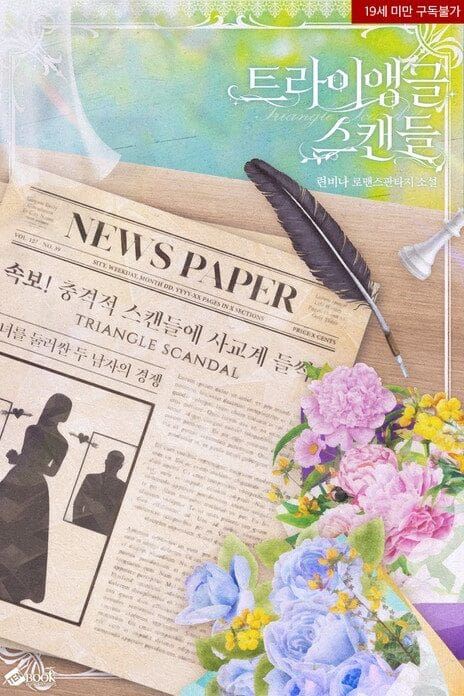
Triangle Scandal
Novel Info
  • Author:
  • Status:Ongoing

Summary

... Read More

Dione Estellon is the sole heir to the Estellon Marquisate in the Essen Empire, a position that carries both immense wealth and heavy responsibility. Following the recent deaths of her parents and her grandmother, she finds herself alone, inheriting not only the family estates but also a conditional will. Her grandmother stipulated that Dione must marry within two years or forfeit the title to the state. To complicate matters, Dione has just been appointed as the chief host for the diplomatic mission from the neighboring Elvirtein Empire, a role that places her in close contact with Raihan Elvirtein, the Fourth Prince.

Raihan arrives in Essen with a reputation for kindness and a straightforward personality. As the only child of a legendary romance between an Elvirtein man and an Essen woman thirty years prior, he shares a deep fascination with Dione’s heritage. The two grow close during the three-week treaty negotiations. They discover surprising compatibility in their tastes, hobbies, and daily routines. Their bond deepens through shared laughter and genuine care, leading to a moment of vulnerability when Raihan accidentally gifts Dione a rare, potent wine called Valduero. After drinking it, Dione becomes intoxicated and initiates a passionate encounter with Raihan in his quarters. The next morning, she flees in embarrassment, leaving behind a scandal that threatens their reputations and diplomatic relations.

The situation spirals when the newspaper Chronicles Weekly publishes an article revealing their secret relationship. Dione rushes to Duke Yurik Schwitz, the newspaper’s largest investor, to have the story suppressed. During their meeting, Yurik reveals that Raihan never actually returned to Elvirtein and confesses his own long-held romantic feelings for Dione. He demands that she not consummate any further relationship with Raihan as the price for withdrawing the article. Confused and overwhelmed, Dione agrees to the condition, unaware that Yurik’s motives are driven by jealousy rather than pure altruism.

Raihan then approaches Dione directly, admitting he stayed in Essen specifically to propose marriage. He cites their compatibility and mutual comfort as reasons why they would make a good match. However, when Dione asks if he loves her, he hesitates and admits that while he cares for her deeply, he does not yet feel love in the romantic sense. Disappointed by his honesty and perhaps recognizing the mismatch between her grandmother’s wish for a genuine partnership and Raihan’s pragmatic approach, Dione declines his proposal. She asks him to pretend he never said it, effectively ending their romantic possibility.

Despite the rejection, Raihan remains in Essen, and tensions rise as Yurik vows to keep Dione away from the prince. The narrative shifts focus to the political undercurrents surrounding the upcoming succession crisis in Elvirtein, where Raihan’s older brother is set to become Crown Prince. Dione finds herself caught between her duty to inherit the marquisate, her lingering affection for Raihan, and the persistent advances of Duke Yurik. The story explores the complexities of love, duty, and political maneuvering as Dione navigates a path that may require her to choose between personal desire and familial obligation.

Latest Release
DateGroupRelease
2026-10-03dusk blossoms c58
2026-10-03dusk blossoms c57
2026-10-03dusk blossoms c56
2026-10-03dusk blossoms c55
2026-10-03dusk blossoms c54
2026-10-03dusk blossoms c53
2026-10-03dusk blossoms c52
2026-10-03dusk blossoms c51
2026-10-03dusk blossoms c50
2026-10-03dusk blossoms c49
2026-10-03dusk blossoms c48
2026-10-03dusk blossoms c47

Community Reviews

Rating(0 / 5.0, 41votes)
5 stars
0(0%)
4 stars
0(0%)
3 stars
0(0%)
2 stars
0(0%)
1 stars
0(0%)

Popular reviews

... Read More
Every chapter in this batch ends with a question mark hanging in the air, and I am HERE for it. Chapter 17 closes with: "Everything seemed to be continuing peacefully, as it should… yet, strangely, this peace felt like the calm before a storm." That's not just foreshadowing, that's a THREAT. The author is telling us directly that the status quo is about to shatter. And what's the stuff we're supposed to be worried about? Oh, just a few things: an inheritance mystery involving a property in a potentially hostile foreign nation, a political marriage that nobody's talking about honestly, the fact that Essen and Elvirtein were basically at war a few hundred years ago and only stopped because of a treaty, and a crown prince who's apparently very interested in opera hall legends and private gardens he has no business knowing about. But the REAL stakes here are smaller and somehow scarier. It's Dione realizing she can't marry Raihan because of duty, and then immediately forgetting that realization because he's standing next to her holding her shoes. It's the gap between what she should feel and what she actually feels—and that gap is where all the tension lives. Because you know what? The political conflict might explode tomorrow, but Dione right now is more threatened by the fact that she's having a genuinely good time with a man she's decided she can't want. That's how the author makes you care. Not just "will war break out?" but "will she let herself be happy before everything falls apart?"
... Read More
'By any chance... Let's just pretend it didn't happen. If you came here to talk about that, I'll have to refuse.' Raihan opening the conversation like THAT. Not 'I missed you' or 'I'm sorry' or any of the normal post-scandal greetings. Just straight into emotional defense mode. And Dione's reaction? She doesn't even engage with it properly because she's already spiraling internally. The dialogue between these two is SO natural — it's full of half-finished thoughts, interruptions, and the kind of awkwardness that only exists between people who know each other intimately. And Yurik's dialogue with Raihan? Perfect. Every line is layered. 'There are many famous things in Essen. Like Crescent Hall.' — casual conversation that's actually him testing the waters. 'It would be nice if I could go with Lady Dione.' — said under his breath, but Dione would've heard it if she were there. The subtext is dripping. The author's narrative voice is also spot-on. Dione's internal monologue is funny and self-deprecating ('Was he sober?... How did things end up like this?'), while Raihan's POV is more contemplative and poetic. They sound like different people thinking, which is exactly how they should sound because they ARE different people.
... Read More
'An awkward silence settled between them—something that had never lingered between them before. There had always been someone who started the conversation first, and after that, not even a minute would pass without talking; it felt like something from years ago.' I need to talk about this scene. The reception room. The ornate doors opening, Raihan entering slowly 'like crawling,' the chandelier above flaunting its presence while he's in the worst mood of his life. The author doesn't describe the room in detail but every sensory beat lands — the quiet door closing, the weight of the silence, the way Dione's internal monologue jumps between panic and humor (the fox tail imagery had me laughing out loud). The Imperial Palace garden she's been staring at, suppressing sighs — this small detail tells us everything about her state of mind without a single word of exposition. She's anxious, guilty, overthinking, and the luxurious surroundings only make the emotional distance between her and Raihan feel sharper. And then later, Yurik throwing himself on Durant's purple sofa, ignoring protocol, sighing loudly — the crown prince's office becomes this intimate space where male friendship and unspoken feelings collide. The settings aren't just backdrops, they're emotional mirrors. Chef's kiss.
... Read More
This story keeps coming back to taste—not just food but the bitterness of truth, the sweetness of connection, the alcohol that dissolves boundaries. It starts with the most basic detail: Dione mentions she likes bitter things, and Raihan says he does too. The narrator explicitly says 'there was a special sense of connection only people with the same taste could share.' This tiny observation about food preference becomes the foundation of everything that follows. Same tastes in opera, same sense of humor, same reluctance to admit feelings. The bitterness is a metaphor for Dione herself—guarded, sharp, not sweet and easy like the other suitors her grandmother apparently wanted. Then the Valduero wine appears, and it's loaded with symbolism. It's the most delicious and expensive wine in Elvirtein, yes, but more importantly, it's THE wine that Vega Aviles and Sicart Estellon (Dione's parents) shared thirty years ago. Raihan bringing this specific wine to the banquet isn't casual—it's a deliberate gesture connecting past and present, mother and daughter, love lost and love potentially found again. The wine becomes a bridge across generations. And then the alcohol itself does its work—dissolving Dione's carefully maintained composure, leading to the kiss she'd never have initiated sober. The wine represents truth emerging from beneath social constraints. That's why the newspaper scandal hits so hard: the private truth, unleashed by alcohol, became public spectacle.
... Read More
There's a scene in here that I keep coming back to visually—the imperial palace terrace, Raihan sitting across from Raymond, tapping his finger rhythmically on the table. Tap. Tap. Tap. The narration tells us this is his habit when he's troubled, and Raymond just quietly enjoys the view without saying a word. This is one of those moments where the author doesn't need to tell us anything about politics or plot. We just sit in this room and feel the weight of Raihan's silence. The social world the author builds around Dione feels extraordinarily lived-in. The gossip machinery operates with such specific realism. We get the full lifecycle of a scandal: it erupts, it spreads, people whisper, there's no solid evidence, and then—crucially—it dies not because of any dramatic revelation but because the Elvirtein delegation stays officially silent and Crown Prince Durant doesn't react. The political hierarchy itself becomes the thing that quashes the rumor. That's worldbuilding through institutional behavior, and it's brilliant. The Estellon marquisate office scenes have this grounded, domestic atmosphere that contrasts nicely with the palace intrigue. Dione taking off her work glasses, folding and unfolding Raihan's letter, flopping onto her bed afterward—that's all so tactile. You can feel the weight of the stationery, the stiffness of the pale green paper she chooses for her reply. The author thinks about texture. And the contrast between Essen and Elvirtein—their physical distance, their different language systems, Raihan's perfect grammar despite being from a distant country—these details make the world feel vast and real. It's not just a generic fantasy court setting. These are two distinct cultures with their own customs, and Dione navigating between them is central to the whole tension. The Cheron family's "free-spirited" atmosphere is another nice touch. A noble house where children are allowed to pursue what they want? That explains Leticia's character in one stroke of worldbuilding.
... Read More
I need to talk about the scene with Nina because it was so perfectly crafted to show Dione's emotional knot. The way Nina brings up the proposal and Dione just casually drops "I rejected his proposal recently" while sipping tea... and then Nina's teacup and saucer make a loud, unpleasant noise. That physical reaction says everything. Dione is trying to play it cool, to treat it as a simple political arrangement, but her own friends can't maintain that facade. And then Nina throws out the line that stops me cold: "Or maybe, who knows, he actually likes you but hasn't realized it yet." Dione's immediate dismissal—"Come on, impossible"—felt so defensive, so self-protective. But then Nina's response, "The impossible is sometimes the truth," hit me right in the chest. It mirrored Dione's own underlying doubt, that little voice inside her that wonders if maybe she's just telling herself he could never like her because it's safer. Dione claims she doesn't believe in lukewarm love, that the Raihan she knows is clear and honest. But is she projecting? Or is she genuinely blind to the possibility of a man like him wanting her for anything other than political gain? The emotional tension here isn't just about who she'll end up with; it's about her own inability to imagine being chosen simply for herself. That's the real heart-wrenching layer.
See all reviews

Custom lists

See all custom Lists