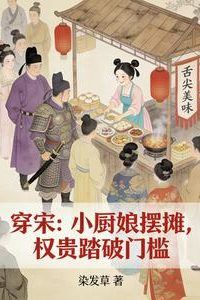
Transmigrated into the Song Dynasty: The Little Female Chef Who Set Up a Stall
+Add to Custom List
Genres:
Novel Info

Summary

... Read More

Su Qingyan, a top-tier private chef from the twenty-first century, transmigrates into the body of a sickly fourteen-year-old girl in the Northern Song Dynasty. The original owner was the daughter of a destitute scholar, Su Xiucai, who had fallen ill during a brutal winter snowstorm. Su Qingyan awakens to find her family on the brink of starvation, with her mother and three younger siblings weak from hunger and her father bedridden. Lacking any resources, she is saved by the sudden activation of a "Private Kitchen Inheritance Space," a supernatural tool that provides ingredients and culinary knowledge. The space grants her a starter pack of flour, brown sugar, and yeast, along with abilities like permanent ingredient preservation and rapid fermentation. Recognizing that her modern cooking skills are her only means of survival, she decides to use the space to feed her family and eventually build a business.

With the help of the space, Su Qingyan bakes brown sugar blossoming buns, the aroma of which revives her freezing family. Realizing that selling food is necessary to buy medicine and grain, she overcomes her mother’s concerns about social stigma and takes her ten-year-old brother, Su Mingxuan, to Shui Gui Street to sell the buns. They face immediate hostility from Liu San-niang, the domineering owner of a nearby bakery who controls the prime spots on the street. Despite being pushed to a remote corner and subjected to verbal abuse, Su Qingyan uses her business acumen to attract customers. She offers free tastings and pairs her sweet buns with Granny Lin’s ginger tea, creating a successful partnership. Her innovative packaging and marketing strategies, including wrapping buns in clean oiled paper to appeal to scholars, catch the attention of Shen Yan, a prominent student at the Imperial Academy. Shen Yan’s endorsement leads to a rapid sell-out, proving that Su Qingyan’s food can compete with established businesses.

As her reputation grows, Su Qingyan introduces new products, including savory meat buns and red bean paste buns, to diversify her offerings. Liu San-niang, threatened by Su Qingyan’s success, orchestrates a sabotage attempt by having an accomplice dump foul-smelling swill on Su Qingyan’s stall and accusing her of using dirty ingredients. The crowd turns hostile, but Su Qingyan remains calm. She publicly demonstrates the cleanliness of her ingredients and equipment, challenging Liu San-niang to find any fault. With the testimony of Granny Lin and the support of her customers, Su Qingyan clears her name, and Liu San-niang is arrested by the local patrol. This victory significantly boosts the fame of her "Su Ji" brand.

Seeking to elevate her business further, Su Qingyan creates a Red Date Egg Cake, a novel pastry that does not exist in the Song Dynasty. She limits production to ten portions per day and sets a high price of twenty wen, later raising it to thirty wen to create exclusivity. Her strategy attracts Xie Hui, the third son of a powerful noble family, who is known for his discerning palate. Impressed by the unique texture and flavor, Xie Hui purchases all ten portions and pays with a silver leaf worth one thousand wen. This transaction brings not only substantial profit but also high social status to the Su family. Su Qingyan continues to expand her menu and maintain her strict quality control, aiming to secure her family’s future and establish "Su Ji" as a renowned name in Bianjing.

Novel Items

More
Arcane Treasure
A mysterious golden finger system that binds to Su Qingyan upon transmigration. It contains a storage room with metal shelves, a virtual panel with functions including ingredient preservation, a culinary knowledge database, taste simulation, and rapid fermentation. It issued a newbie gift package containing 10 jin of premium snowflake flour, 2 jin of handmade brown sugar, and a small packet of high-efficiency active dry yeast.
Food
Su Qingyan's flagship product, large fist-sized steamed buns with brown sugar filling that blossoms on top. They are soft, sweet, and filling, priced at five wen each. Su Qingyan makes ninety of them by dawn. She uses free tasting as a marketing strategy, cutting them into tiny squares for passersby to sample.
Food
Recommended by Dr. Song Huairen to ward off cold after Jiang Mian fell into the lake. Aunt Wang from the kitchen brought two bowls, one for Jiang Mian and one for Shi Jinnian.
Item
A thick cotton cover sewn by Wang Shi from an old cotton jacket to serve as an insulator for the bun basket, keeping the buns warm during transport and sale in the cold weather.
Item
A white cloth with the neatly written characters 'Su Ji' hung by Su Mingxuan behind their stall on Shui Gui Street as a shop sign.
Item
A small wooden board with 'Free Tasting' written in crooked but careful charcoal handwriting, held up by Su Mingxuan to attract customers to sample the buns.
Latest Release
DateGroupRelease
2026-08-11shanghai fantasy c104
2026-08-11shanghai fantasy c103
2026-08-11shanghai fantasy c102
2026-08-11shanghai fantasy c101
2026-08-11shanghai fantasy c100
2026-08-11shanghai fantasy c99
2026-08-11shanghai fantasy c98
2026-08-11shanghai fantasy c97
2026-08-11shanghai fantasy c96
2026-08-11shanghai fantasy c95
2026-08-11shanghai fantasy c94
2026-08-11shanghai fantasy c93

Community Reviews

Rating(4.2 / 5.0, 14votes)
5 stars
5(36%)
4 stars
7(50%)
3 stars
2(14%)
2 stars
0(0%)
1 stars
0(0%)

Popular reviews

... Read More
Okay, so let me just say—Su Qingyan is a marketing genius and I am HERE for it. The way she set up this whole operation was like watching a chess master play against amateurs. She didn't just make a cake; she engineered an entire demand curve. The plot structure here is honestly brilliant. Day one: twenty wen, ten portions, and then Xie Hui—the picky noble who no royal chef could impress—steps off his carriage, buys ALL ten, and drops a silver leaf. That moment? Chef's kiss. The crowd goes from mocking to desperate in literally one scene. And then the escalation the NEXT day is what really sold it for me. Thirty wen, still ten portions, and now people are paying FIFTY. The tension of whether she'd actually sell out again—yes, under thirty wen, under thirty wen, SOLD OUT in the time it takes to steep tea. What I loved most was the strategic patience. She could've made a hundred cakes the next day. Her brother was literally pacing and begging her to scale up. But she said no. 'Things become valuable precisely because they are rare.' That line hit me like a truck. It's not just business advice; it's the philosophical backbone of the entire arc. The author didn't need a big battle or a dramatic confrontation—just a girl with a whisk and a brain, turning egg whites into social currency. The only thing I'd question is whether the speed of the crowd's transformation felt entirely realistic. From 'highway robbery' to 'I'll pay fifty' in one night? Maybe a little fast. But honestly, I was too entertained to care.
... Read More
The pacing in these chapters is absolutely ruthless, and I mean that as the highest compliment. Let me break down the structure. Chapter 34-35: the midnight visit, the negotiation, the deal. This section moves at a deliberate pace—there's tension in every exchange between Su Qingyan and Housekeeper Fu. The author slows down here because this is the turning point. Every line of dialogue carries weight. When Su Qingyan says she'll deliver the cakes herself, the text notes: "Her words froze everyone in place." That's pacing control—making you feel the silence. Then comes the time jump. "Days passed." And suddenly we're in a new rhythm—morning routines, deliveries, the abacus clicking. The pacing accelerates dramatically. Seven days later: debts cleared. Ten strings of cash. And then—no celebration chapter, no resting on laurels. Su Qingyan immediately pivots to the family meeting. The text literally says: "the tight string in her heart did not loosen in the slightest." This is masterful pacing. The author understands that in a story about survival and ambition, there is no finish line—only the next hill. The production scaling from 100 to 500 buns happens almost off-page, summarized efficiently, then we cut to the results: 650 wen net profit. Boom. Done. Move on. The final scene at the stall, with Mingyue's sweet greetings and Mingyao eating her bun, is where the pacing softens just enough to let you breathe—but even there, the undercurrent of urgency remains. Su Qingyan is teaching her sisters to "sell smiles," and the business is growing, but the reader senses this is all building toward something bigger. The author never lets us get comfortable. And honestly? That's exactly how it should be.
... Read More
Okay, I need to talk about this scene because it is ABSOLUTELY cinematic. The contrast between the foul-smelling swill puddle and the pristine white cloth under the morning sun—like, the author really knew what they were doing with the imagery here. I could literally see it. The yellow-brown filth spreading across the ground, the sour pungent odor driving away the delicious meat aroma, and then Su Qingyan lifting that steaming basket with lotus leaves inside. The visual of white cloth and green lotus leaves contrasting with the disgusting mess at their feet? Chef's kiss. But it's not just the main confrontation scene—the whole street feels lived-in. You've got the Taixue students, the laborers, Grandma Lin with her drink cart, Wang Du Head patrolling, Liu Sanniang watching from her shop across the street. The author drops little details everywhere: the clinking of coins as Su Mingxuan's money pouch fills, the oily lips of the students devouring buns, the warm golden glow of the setting sun on Maichaoxiang Lane. These aren't just decorative—they make the world feel like a real place where real people live and compete and survive. And that ending image of the family sitting around the oil lamp counting copper coins, with the mountain of 1,200 wen shimmering under the dim yellow light? That's the kind of domestic warmth that grounds the whole story. It's not just a business rivalry; it's about survival, about a family trying to make it work. The worldbuilding here is subtle but effective—you learn about the economy, the social hierarchy, the food culture, all through what people eat and how they earn their keep.
... Read More
Okay, let's talk stakes because this is where the story really grips you. On the surface, it's a street food rivalry. But the author makes you CARE about what Su Qingyan stands to lose, and that's no small feat. Think about it: she's a young woman trying to support her family. Her father is sick, the medicine costs are bottomless, and this one stall is their lifeline. When Liu Sanniang sabotages her, it's not just about embarrassment—it's about survival. Every coin in that money pouch represents medicine, food, warmth. The author makes this clear when Su Qingyan calculates that 1,200 wen is still "just a drop in the ocean" compared to her father's medical needs. The sabotage scene is where the stakes become visceral. That bucket of swill isn't just an inconvenience—it's a direct attack on her livelihood, her reputation, her family's survival. And the crowd turning on her? That's the real terror. In a world where your word is your currency, being called a fraud is worse than poverty. But here's what I love: the author doesn't let us forget the personal stakes either. Su Mingxuan's reaction—tears in his eyes, trembling hands—shows us what this means to a child who's watching his sister fight for their family. His feeble defense, "It's not... my sister's food is clean..."—that breaks my heart every time. And the ending? She wins the battle but the author immediately reminds us that "chasing away one Liu Sanniang today might mean another Zhang Sanniang or Li Sanniang tomorrow." The stakes aren't resolved; they're escalated. That's smart storytelling. The conflict isn't over—it's just entering a new phase.
... Read More
I need to talk about the sensory details in this section because wow. The author doesn't just describe scenes—they make you smell them, hear them, feel them. Let me start with the Xie Mansion visit. The nanmu carriage. The radishes "thicker than his arm." The whole pigs and sheep being carried in. The live fish in water basins with scales gleaming in the morning sun. This is how you show wealth without a single exposition dump. Su Mingxuan's perspective as a child from Mai Shao Lane seeing all this for the first time makes it even more vivid—you experience the awe through his eyes. Then there's the Su family courtyard itself. The text describes it as "barely enough to shelter from wind and rain" but everything is "orderly, neat, and clean." That quiet diligence Housekeeper Fu notices? That's worldbuilding through detail, not description. The piled-up stove, the clothes hanging out to dry—it's poverty, but it's dignified poverty. And the food scenes! Steam rising from bamboo steamers, the "stimulating, joyful aroma" of pork and scallion baozi filling the courtyard, the musty bitter smell under the eaves being washed away. The transformation of the space mirrors the transformation of the family. I literally could smell those buns. The stall scene on Shui Gui Street is equally vivid. Little Mingyao in her bright red jacket, sitting on a small stool "like a figure from a New Year painting," holding a bun bigger than her face, mouth moving busily, eyes squinting in pure delight. This isn't just a description—it's a living painting. And the gossip hub that forms around it? "Did you hear? The Zhang butcher's family in the west of the city just had a grandson!" That's the texture of a real marketplace, a real community. The world feels alive because every detail serves the atmosphere.
... Read More
I need to be honest with you—I did NOT expect to get emotional over a baking scene. But the moment Su Xiucai saw that silver leaf? I was wrecked. Let me set the context first. This is a family that has been scraping by. The father is sick in bed. The mother is weaving bamboo baskets at night. The kids are watching their sister work herself to the bone, whisking egg whites until her arms go from numb to burning. And then this silver leaf appears—worth one thousand wen, which is described as 'the sum Su Xiucai had painstakingly saved in the past, working year after year, eating little and writing books for others.' The text says: 'Su Xiucai struggled to prop himself up, staring fixedly at the silver leaf. Something surged violently in his cloudy eyes. Wang Shi covered her mouth, tears falling without warning, each droplet striking the rough skin of her hand.' That's it. That's all the author gives us and it DESTROYED me. No grand speech, no dramatic music—just a father who's been failing his family suddenly seeing hope materialize in his daughter's calm hands. And Qingyan's response? 'We're not rich. This is the key to opening our path.' She doesn't get lost in the moment. She immediately frames it as a tool, not an end. That maturity is both heartbreaking and beautiful. The family bond throughout this entire passage is what makes the business strategy land emotionally. This isn't just a girl making money—this is a daughter lifting her entire family out of survival mode with nothing but knowledge and nerve. When Su Mingyue and Su Mingyao are 'poking at the silver leaf, their faces full of curiosity and joy,' I felt this warm ache in my chest. And then Su Mingxuan at the end, dumping three hundred wen on the table and stammering 'Sis... we only sold ten cakes and earned three hundred wen...' like his brain simply cannot process the miracle. I love this family so much.
See all reviews

Characters

See all characters

Custom lists

Oops…There is nothing here.