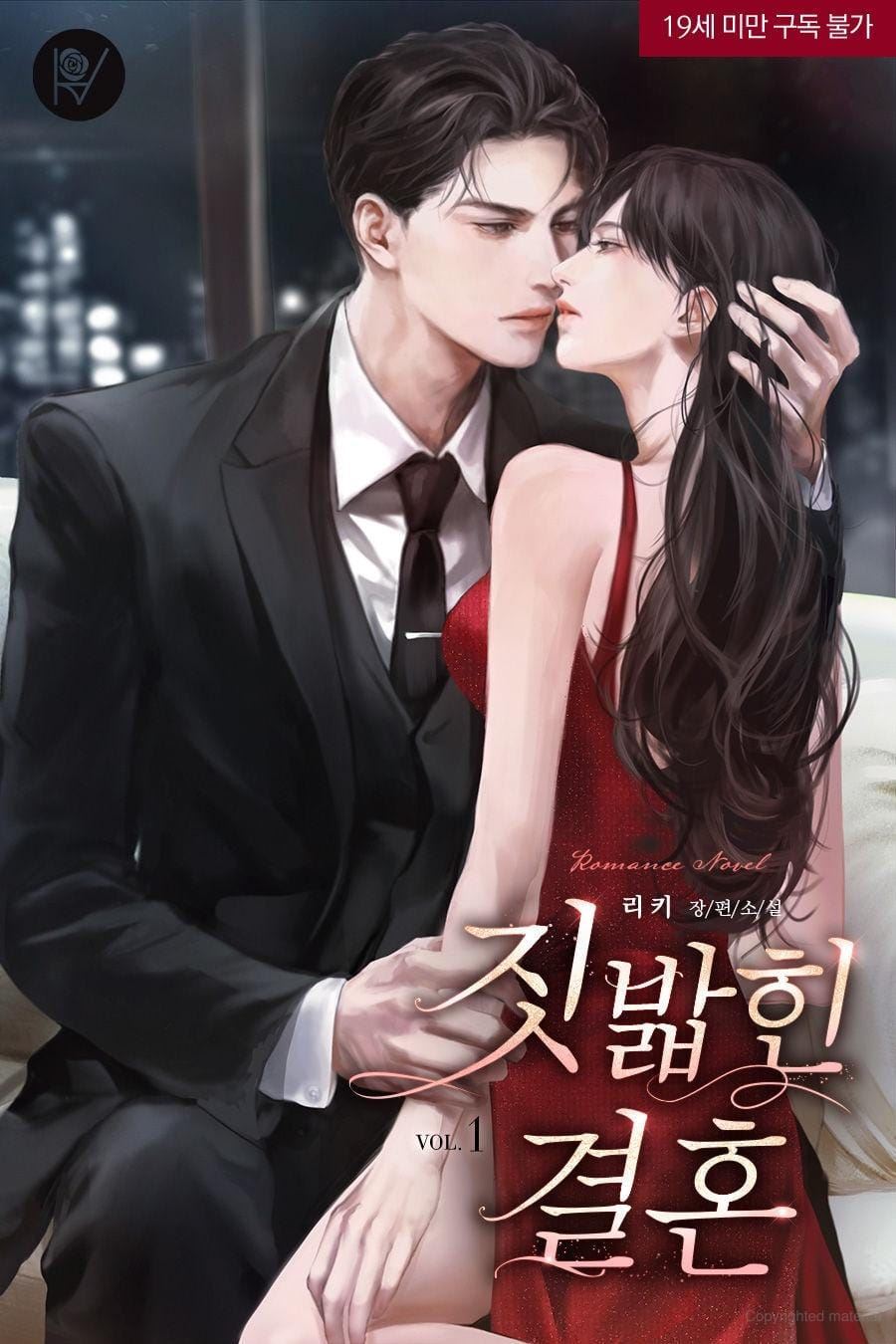
Trampled Marriage
+Add to Custom List
Novel Info
  • Author:
  • Status:Completed

Summary

... Read More

Han Soo-min endures a hollow five-year marriage to Byeon Yedo, a man from the powerful Daeseong Group who cheats openly and squanders family wealth on gambling. When the Daeseong Group collapses into bankruptcy due to Yedo's financial mismanagement, Soo-min is forced to seek a divorce to protect herself and her younger brother Eunhyuk, who runs their struggling Clitie Hotel. The divorce comes just as Soo-min receives news that the Jaewon Group, her maternal family, will not provide the financial aid she desperately needs to keep the hotel afloat.

Years earlier, Soo-min had left her true love, Ji Junhwan, to accept the arranged marriage. She believed he died in a massive fire in Gangwon-do that claimed twenty-four lives. Five years of grief followed, during which Soo-min focused entirely on raising Eunhyuk and caring for her comatose mother. Now, her world is upended when Beom Yuhyeon arrives in Seoul as a wealthy Russian-Korean businessman linked to tycoon Vladimir Vasiliev. He bears an uncanny resemblance to Junhwan, down to his voice and scent, triggering intense confusion and hope in Soo-min.

Yuhyeon rents the suite at the Clitie Hotel for months, creating frequent opportunities for interaction with Soo-min. He is cruel and mocking, openly calling her a gold digger and suggesting she use her body to repay the hotel's debts. Despite his hostile demeanor, Soo-min becomes obsessed with proving whether he is actually Junhwan resurrected or merely a doppelganger. Her investigation leads her to attempt intimate encounters under the guise of service, hoping to find a specific tattoo that Junhwan had inked on his hip bone.

The core conflict deepens as Yuhyeon reveals he is aware of Soo-min's desperation regarding the hotel's finances. He offers silent pressure, knowing she has nowhere else to turn after her own family rejects her. Meanwhile, the truth about Yuhyeon's identity emerges through flashbacks: he is indeed Beom Yuhyeon, a man who was saved from the fire by Vladimir Vasiliev after rescuing his son. Rather than recovering Junhwan's life, Yuhyeon sold his loyalty to Vladimir in exchange for wealth and power, returning to Korea solely to enact revenge on the woman who abandoned him five years prior.

Soo-min faces a precarious situation where her professional survival depends on pleasing a man who despises her, while her emotional turmoil stems from the possibility that her lost love might be standing right in front of her. The narrative establishes a tense dynamic of manipulation and hidden identities, with Yuhyeon systematically dismantling Soo-min's defenses under the cover of business dealings and personal humiliation.

Latest Release
DateGroupRelease
2026-10-03dusk blossoms c75
2026-10-03dusk blossoms c74
2026-10-03dusk blossoms c73
2026-10-03dusk blossoms c72
2026-10-03dusk blossoms c71
2026-10-03dusk blossoms c70
2026-10-03dusk blossoms c69
2026-10-03dusk blossoms c68
2026-10-03dusk blossoms c67
2026-10-03dusk blossoms c66
2026-10-03dusk blossoms c65
2026-10-03dusk blossoms c64

Community Reviews

Rating(0 / 5.0, 41votes)
5 stars
0(0%)
4 stars
0(0%)
3 stars
0(0%)
2 stars
0(0%)
1 stars
0(0%)

Popular reviews

... Read More
This chapter is absolutely drowning in duality and I think that's the whole point. Yuhyeon has Junhwan's face. He recreates the Han River scene. He offers Soo-min comfort using the very memory that causes her pain. Is he a replacement? A predator? Both? The line Unless you're a god, humans are imperfect — is Yuhyeon arguing for forgiveness or justifying his own ruthlessness? He's holding up a mirror to Soo-min's desire for absolution and reflecting it back weaponized. Then there's the whole theme of transaction vs. genuine emotion. Her contract with Yuhyeon is supposed to be purely physical until marriage. But what happens when physical intimacy becomes the only language these characters know? When Soo-min's body responds to Yuhyeon while her heart is mourning Junhwan — what does that say about grief, about desire, about the impossibility of separating them? The financial subplot with Jinseong and Chairman Go talking about Soo-min as bait — relationships as currency, women as instruments of corporate strategy. This isn't just a romance novel, it's critiquing how power structures consume individuals. And Junhwan himself, absent but omnipresent. He's dead but he controls every interaction in this chapter. That's the real tragedy — the dead man's shadow is longer than any living man's.
... Read More
Let me break down how this batch is structured because the pacing is genuinely masterful. It opens IN MEDIA RES with the deal negotiation — high tension, immediate stakes. We don't get any setup, we just dive into 'give me your body' and the internal battle. This is the hook. Within the first few paragraphs, I'm already invested. Then we cut to Yuhyeon sitting alone for hours. This is the breath — the silent aftermath of rejection. It's short, maybe two paragraphs, but it does SO much work. We see his anger, his control, his secret protectiveness all in one scene. The secretary exchange is brisk and efficient. No wasted words. Morning comes with the bank call — crisis escalates. Eunhyuk collapses. Soo-min makes the decision. This section moves FAST, almost frantic, which mirrors her mental state perfectly. 'Without knocking, she swiped the key card' — that action line is everything. She's past hesitation now. The actual encounter scene is LONGER and deliberately uncomfortable. The author forces us to sit in this moment with her — the trembling, the comparison to Junhwan, the physical details. It's not eroticized in a traditional sense; it's clinical and painful and real. The pacing here SLOWS down, which is the right choice. This isn't a scene to skim. Then — BAM — the dream. This is where the structure gets clever. The dream sequence starts tender, almost romantic, drawing us into a false sense of comfort. Junhwan is THERE, alive, loving. We relax. And then — 'Who...? That man... Ah, ah!' — the transformation. The nightmare twist. The burnt Junhwan appearing behind Yuhyeon. This jolt back to reality is perfectly timed. The morning-after scene with the toothbrush is the perfect denouement. Quiet, intimate, devastating. And then the final image of Yuhyeon at the construction site — a complete tonal shift that leaves us wanting more. If I had to nitpick, the transition between the encounter and the dream felt slightly abrupt, but honestly, that might be intentional — it mirrors how her subconscious is processing trauma. The overall arc of the batch goes: tension → crisis → choice → violation → nightmare → hollow aftermath → mystery. Every beat lands.
... Read More
Some authors write dialogue that reads like people reciting their motivations out loud. This author? These characters actually sound like humans under stress. Let me just highlight a few lines that stuck with me because they're doing so much work in so few words. Yedo's "My problems are your problems! We're married!" is the kind of line that makes you want to throw the book across the room. It's so casually entitled, so completely blind to five years of emotional neglect, that it reveals everything about him in one breath. And then Soo-min's response—"Married? Were we ever really married?"—is devastating because it's not screamed. It's delivered flat. Cold. A hollow laugh escaping her lips. That's when you know she's done. Eunhyuk's dialogue is softer but no less revealing. "Noona..." said three times across different scenes—that trailing off, that inability to finish his thoughts—says more about his character than any monologue could. He's gentle, guilt-ridden, deeply devoted. His line "maybe being the CEO is too much for me" is barely above a whisper and it carries the weight of a man who's been pretending to be fine for far too long. The staff chatter at the hotel is surprisingly sharp too. "Somehow it feels like today is his official debut in Korean high society." That line does triple duty—it establishes the VIP's importance, shows the staff's perspective, and subtly reinforces how foreign and out-of-place this situation is. The author knows how to use background characters' dialogue to enrich the scene without slowing it down. And the Junhwan flashbacks—"Even if I die, I can't let you go" and "I'll wait for you until you come back to me!" These lines land so much harder because we now know the fire happened. Every word echoes with tragic irony. That's dialogue writing with purpose.
... Read More
The image of the spilled flowers is something I keep coming back to. Rosa campanula, anemone, baby's breath — scattered on a hotel corridor floor while Soo-min kneels among them, trembling, looking up at a ghost in a suit. The symbolism is almost too on-the-nose (unchanging love broken, betrayal, a promise that also means death), but honestly? It works because the scene itself is so visceral. You can feel the petals against tile. You can hear the shock in her voice. The long shadow looming over her is such a perfect visual metaphor for how Yuhyeon enters her life — not as light or warmth, but as something that blocks everything else out. Then there's the contrast between that cramped, chaotic corridor and the banquet hall — "the star of today is Beom Yuhyeon." Surrounded by VIPs, hyenas circling, her cousin bowing ninety degrees like a goddamn courtier. The world the author builds here is suffocating in its social hierarchy. Everyone is calculating, performing, surviving. And Soo-min is just trying to exist in it while haunted by a corpse she can't stop seeing in living faces. But the scene that truly broke me is her hotel room at night. Unpacked suitcases everywhere. The panoramic Seoul night view that she can't even appreciate because her mind is stuck on a voice and a pair of eyes that belong to someone dead. She's lying on the bed and sleep won't come. Not once. The city is beautiful and she is alone with five years of grief that suddenly feels fresh again. There's something devastating about that image — a woman who has learned to survive alone, only to have the ground shift beneath her feet because a stranger walked into a room. And the grandmother's house in Seongbuk-dong — she only goes there once a year. The whispered gossip about her mother, the coldness of blood relations, the inheritance politics. This is a world where love is conditional and money is the only language anyone speaks fluently. The hotel itself is a character — 150 rooms, three banquet halls, 140 employees, all hanging by a thread. It feels lived-in and fragile, like Soo-min herself.
... Read More
Okay so this chapter dropped some MAJOR backstory on us and honestly? I'm shook. Let me process this. Yuhyeon was literally consumed by flames five years ago, watched the woman he loved vanish into the fire without a single message or showing up at his funeral. That betrayal is what turned him into... whatever the hell he is now. A demon in a tailored suit. The deal he made with Vladimir Vasiliev is actually kind of fascinating from a plot mechanics standpoint. He saved Vladimir's son during that fire, got burned all over, made a full recovery, and then claimed his wish: Han Soo-min. Vladimir offered him wealth and power instead, and he basically played the long game — five years of building a 1 trillion won fortune just to come back and destroy the woman who supposedly abandoned him. But here's what's BLOWING MY MIND: he's using his real identity now but also creating this whole facade. Remember those women dressed in clothes he likes? He sent them away before they could even complain. His secretary is confused but Yuhyeon says "That's exactly the point" — he WANTS people to misunderstand him. He wants Soo-min to see him as this promiscuous, cruel man so she'll never connect him to the man she loved. And then the twist within the twist — Soo-min has NO IDEA it's him. She keeps comparing him to Junhwan, keeps thinking maybe he survived and lost his memory. The dramatic irony here is SUFFOCATING. She's touching the man who ruined her life and wondering if it's her dead husband. Meanwhile he's deliberately being the worst version of himself to push her away while simultaneously being drawn to her. "Soon your neck will be broken like this." That line while crushing those flowers??? He literally says he'll make her suffer a pain far worse than his own. This isn't just revenge — this is obsession masquerading as vengeance. I need to know: is she actually responsible for abandoning him, or is this just a misunderstanding? Because if she was innocent, this whole revenge plot is based on a lie and Yuhyeon has no idea.
... Read More
There's a moment in these chapters that I can't stop thinking about. Not because of the drama or the revelations, but because of how the author stages it. The drizzle, the dense fog, the car headlights cutting through darkness—all of it leading to Seoul General Hospital where Soo-min visits her comatose mother. That scene is soaked in atmosphere. You can feel the cold. You can hear the quiet. It's the calm before every single thing explodes. Then it cuts to the mansion being trampled by court enforcement officers' boots. The contrast is brutal. One moment you're in a hospital room whispering promises to a woman who can't hear you, the next you're watching your family's polished five-year legacy get destroyed by men in uniforms. The house itself becomes a character—a space that once represented stability and status, now reduced to shattered porcelain and echoing footsteps. But the scene that lives rent-free in my head is the banquet entrance. Twenty foreigners standing in two neat rows. A revolving door swinging open. And this man—this impossibly sharp, icy-eyed man—walking in like he owns the air around him. The narrator describes it like a film scene: time freezing, the world sealing off, only her and him existing in slow motion. Even his colleagues notice. "When he walked in, it was like there was a halo of light around him, like the sun was shining right behind him!" And Soo-min? She can't breathe. The hotel itself—Clitie Hotel, over forty years old, chosen by a five-star VIP over a newer competitor—is treated like a character too. It represents her mother's legacy, her sacrifice, her entire adult life. The flower arrangements she's supervising while her world burns? That's the author showing us how she copes: controlling what she can control, one flower stem at a time.
See all reviews

Custom lists

See all custom Lists