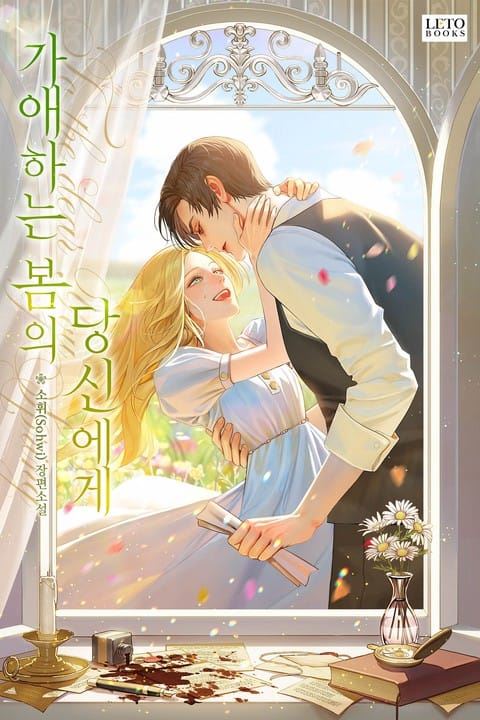
To My Beloved Spring
Novel Info
  • Author:
  • Status:Ongoing

Summary

... Read More
Olivia, a twenty-year-old Marquise from Frenchia, receives a series of strange letters addressed to a woman named Liv, who shares her identity but lives in an alternate 1820. The sender, later revealed to be Freddy vin Hester, Grand Duke of Silvest, writes as Liv's husband, confessing his regrets over their political marriage, the loss of their child, and ultimately his own death by pneumonia. Through these letters, Olivia learns that Frenchia lost a war, that Freddy was preparing to come to her, and that Liv died after taking a bullet meant for him. Distraught, Olivia falls into a feverish state and dies in a carriage accident while traveling to Silvest, desperate to reach the man she only knew through correspondence.

Olivia awakens in 1819, in Freddy's world, two days after he married the original Olivia—Liv. She discovers that Liv had been catatonic since the wedding, refusing to leave her room or acknowledge Freddy. The Olivia of this world is alive but emotionally shattered, having suffered through a loveless political marriage. The real Olivia, convinced she has been given a second chance, resolves to save Freddy from the tragic fate detailed in the letters: the loss of their child, the outbreak of war, and his premature death.

The core conflict centers on Olivia's dual identity. To the servants and court, she is Madame the Grand Duchess, a woman recovering from shock. Internally, she is simultaneously herself and the ghost of Liv, grappling with guilt, grief, and an intense, impossible devotion to a man who is alive before her for the first time. Freddy, initially distant and irritated by her erratic behavior, begins to notice subtle changes. Olivia, drawing on knowledge from the letters, anticipates his needs, responds to his unspoken thoughts, and gradually breaks through his emotional walls. Her efforts are guided by a desperate urgency—to prevent the tragedies that killed Freddy and destroyed Liv's life.

Key turning points unfold as Olivia navigates this new reality. She learns that in this timeline, the war between Frenchia and Silvest has not yet erupted, and the political alliance is still fragile. She also discovers that Liv's suicide attempt—the act of consuming poison meant for Freddy—has not occurred yet. Armed with foreknowledge, Olivia works to alter the course of events: she prevents the assassination attempt on Freddy's life, strengthens the political alliance through diplomatic insight, and slowly builds a genuine relationship with him. Her knowledge of theology, which had seemed eccentric in her original world, becomes a tool for connecting with Freddy on a deeper level, revealing shared philosophical ground.

As the months pass, Olivia faces an increasing tension between her mission and her growing feelings. She is not Liv, yet she occupies Liv's body and relationship. Every moment of closeness with Freddy is tainted by the knowledge that he is loving a replacement, while she is loving a dead man reborn. The letters continue to arrive, now written in a hand that grows more urgent, as if Freddy from the other world is aware of the changes unfolding. They speak of a promise—to meet in the spring of 1821—and of an atonement that is never finished.

The story direction moves toward an imminent crisis. The war that devastated the original timeline begins to take shape on the horizon, and Olivia must use her foresight to prevent it while keeping her true identity secret. Freddy, increasingly drawn to this transformed version of his wife, begins to suspect that she is someone else entirely—or perhaps someone from somewhere else. The narrative builds toward a convergence of both worlds: the letters grow thinner, the boundaries between timelines blur, and Olivia faces the possibility that saving Freddy in this world may erase the very connection that brought her there.

Latest Release
DateGroupRelease
2026-10-03dusk blossoms c74
2026-10-03dusk blossoms c73
2026-10-03dusk blossoms c72
2026-10-03dusk blossoms c71
2026-10-03dusk blossoms c70
2026-10-03dusk blossoms c69
2026-10-03dusk blossoms c68
2026-10-03dusk blossoms c67
2026-10-03dusk blossoms c66
2026-10-03dusk blossoms c65
2026-10-03dusk blossoms c64
2026-10-03dusk blossoms c63

Community Reviews

Rating(0 / 5.0, 33votes)
5 stars
0(0%)
4 stars
0(0%)
3 stars
0(0%)
2 stars
0(0%)
1 stars
0(0%)

Popular reviews

... Read More
The daisies. Let me start there. Olivia picks them specifically because she thinks Freddy would appreciate the thought. But they're small, delicate, and yet—Freddy notices they 'somehow felt strong.' That's not accidental writing. These flowers mirror Olivia herself: seemingly fragile, but possessing a tenacity she doesn't even recognize in herself yet. Then there's the naming thing. 'Madame.' Freddy keeps using formal titles like armor, like if he says the right word in the right distance, he won't have to feel anything. But the real symbol here is 'Liv' versus 'Via.' Olivia has never once assumed they were the same person, and the text says that explicitly: 'It was an obvious thought.' So why hasn't she had it? Because the truth would mean admitting that the person Freddy loves isn't her, and maybe never will be. The Munk/Yal name change subplot that Simon brings up at the end is also doing thematic work—identity as something you can reshape to survive, which directly mirrors Olivia's own situation.
... Read More
Let me just say this opening sequence is genuinely clever. A letter arriving from three years in the future? No return address? The way the narrator treats Olivia as already dead while she's sitting there very much alive? That's a hook that doesn't let go. I kept flipping pages because I needed to understand how this communication works. The structure is fascinating— Chapters 1 and 2 operate like a double helix. We get the mysterious sender's letter first, then Olivia's response, then another letter appears overnight. The mechanism of their exchange remains deliberately opaque, which is both a strength and a mild frustration. I respect the choice to withhold explanation rather than dump exposition, but I will say my patience for mystery-box storytelling has limits. What really sold me on the plot mechanics was the Second Prince's letter intercutting with the anonymous one. This creates a brilliant parallel narrative thread—one letter promises protection from political marriage, the other reveals she was sent into exactly that situation across time and space. Two Olivias, two timelines, one person caught between them. The tension builds organically because every new letter raises questions faster than old ones get answered. I also want to call out the pacing choice regarding the family dinner scene. Olivia's casual mention of "Frenchia" and the Bianche Marquis as if they exist elsewhere in the world—her father's and brother's immediate shift from dismissive to ominous is such a sharp narrative pivot. It signals to the reader that this particular thread matters without spelling it out. That restraint is expert-level storytelling.
... Read More
This entire batch revolves around one central question: who is Olivia really falling for? The man she knows now, or the ghost in the letters? The author keeps forcing them together until you can't tell where Liv ends and Olivia begins. The cedar tree is the obvious symbol here. Planted twenty-seven years ago by the late Grand Duke and Duchess for Freddy's well-being. A tree that 'Liv' loved through those letters. And now Olivia declares she'll grow to love it most. But notice what she doesn't say—she doesn't say she loves it like Liv did. She says she'll GROW to love it. Growth implies time, change, a future that hasn't happened yet. She's not claiming Liv's emotions as her own. She's planting something new in the same soil. The letters themselves are even more complex symbols. Freddy keeps finding them, keeps opening them even though he claims he won't, keeps analyzing them for ciphers and hidden meaning. They represent the past refusing to stay buried. And here's the thing—he's attracted to the woman who wrote them without knowing it's Olivia. That's the core tension. Every time he reads a letter, he's falling for someone who isn't standing in front of him. Every time he looks at Olivia, he's seeing someone he doesn't fully understand yet. The sunlight moment is symbolic too, but not in the way you'd expect. Both of them shielding each other's eyes from the sun. Not from darkness, not from danger, but from brightness. From something too intense to look at directly. They're protecting each other from their own visibility. That's not romantic in the traditional sense—it's almost existential. Two people who've spent their whole lives being watched, calculated, written about, finally finding someone who will literally block the light so they don't have to see themselves as clearly. And then the theology books. Olivia asking to study the theology of Silvest—the very country that swallowed Liv and destroyed her life. Is she searching for meaning? Or is she trying to understand why she was sent here at all? The text never confirms it, but the placement of that request right after the tree scene suggests she's looking for a framework to explain the unexplainable.
... Read More
Can we just talk about how Freddy speaks versus how everyone else speaks in this book? It's genuinely impressive craft. The narration tells us he has a low voice and a heavy scent, and then his actual dialogue is like "Is that so?" and "There's no harm in being prepared." He doesn't do adjectives. He doesn't do emotion. He does statements of fact and occasional questions that aren't really questions. Olivia is his complete opposite. Watch how she talks to him at dinner: "Freddy, did you know? Throughout our conversation today, you haven't asked me a single question." She's performing analysis in real time, turning his behavior into data, reading him like a text. And his response is just... looking down at his plate. The subtext is screaming. He absolutely knows he hasn't been asking questions. He's just terrified that if he starts asking, he'll realize he actually cares about the answers. The best dialogue moment though is the tree exchange. Freddy: "Normally you wouldn't place such a tree in the center of a garden. It's not aesthetically pleasing." This is him saying I don't want this tree but also I don't want to tell you that because Liv loved it and now you're here and I don't know which version of you I'm talking to. Olivia's response—"I think it's something I'll grow to love the most"—is the single most confident line she's spoken in the entire book. She's not Liv. She's Olivia. And she's choosing to love what Liv loved without being constrained by it. Simon's internal monologue is also wildly distinctive. "His voice trembled pitifully. He wasn't even sure if he had properly conveyed Freddy's message." This man is narrating his own suffering in real time and it's comedic gold. He's the Greek chorus of everyone else's relationship drama. Angela barely gets any lines but when she does—"And Her Grace said she would like to have dinner together. How should I respond?"—it's perfectly weighted. She's the messenger bearing impossible news and her tone says exactly what she's thinking without her having to say it.
... Read More
I need to sit with the internal conflict here because it's not surface-level at all. Olivia woke up from a nightmare she can't remember, she's occupying someone else's body, she has blurry memories of that person's death, and she's trying to play the role of Grand Duchess in a foreign world while her husband—who specifically asked for distance—is somehow ending up closer to her every day. The stakes aren't about life and death in the traditional sense; they're about identity and belonging. When Olivia grabs Freddy's sleeve after apologizing, she's not just being clingy—she's admitting she can't let him go even though she knows she should. 'She hadn't realized how impulsive, selfish, and childish she could be. Olivia felt ashamed of herself and berated herself silently. Yet, even amidst these conflicting emotions, she didn't want to be apart from Freddy.' That sentence alone contains the entire conflict: she knows she's being difficult, she judges herself for it, and she can't stop herself anyway. The external stakes are building too—she visits the church specifically because she's afraid of what the resident physician might tell Freddy if she asks about her memory problems. She's hiding things from him, which means the trust between them has gaps she hasn't even acknowledged yet. And Freddy? He's torn between his stated desire for distance and his actions that consistently pull him toward her. He reviews exactly one page of documents all night because he's in her bedroom instead of his study. The stakes here are emotional survival, and the author makes you feel every layer of it.
... Read More
"It's a gift." Those two words came out so pouty and defensive, and I just—she wanted to give him something nice, she picked flowers herself, and by the time she actually handed them over, she'd already had this huge emotional confrontation. The moment she saw his face, all her bitterness melted away. That's the most honest thing Olivia does in this whole chapter. And then immediately after? She throws the heaviest line in the book: "But I'd prefer if we slept together." Walks out. Just walks out. She gave him the flowers as peace, then immediately escalated everything again. This woman is a disaster and I am HERE for it. The CP dynamics are giving desperate-meets-clueless-but-he's-starting-to-felt-something-and-he-doesn't-even-know-what-it-is energy and it's agony.
See all reviews

Custom lists

See all custom Lists