Summary

... Read More
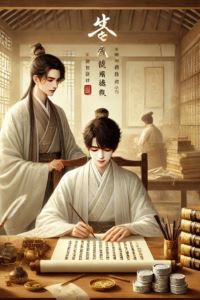
Lin Xiaohan was a celebrated web novel author in the modern era, known for his willingness to kill off popular characters regardless of fan backlash. After being stabbed by an enraged reader at a book launch, his soul traveled through a space-time rift and reincarnated into the body of a boy with the same name in a historical world with three genders. In this society, males who can bear children, known as ge'er, occupy a low social status and are often married into poor families as laborers rather than primary spouses. The original Lin Xiaohan came from a wealthy family but was abandoned by his fiancé after his parents died, leaving him destitute. He was forced to marry Lu Qiucheng, a poor scholar, and threw himself into a well on their wedding day, only for Lin Xiaohan to awaken in his place. Lin Xiaohan found himself in a dilapidated wooden shack belonging to the Lu family. The household was divided into three branches, with the second branch, to which Lu Qiucheng belonged, being the poorest. The Lu family had just fought off Lin Xiaohan’s relatives, who had come to reclaim his dowry under the assumption he was dead. Lu Qiucheng, despite his poverty, treated Lin Xiaohan with unexpected kindness, spending his limited savings on medicine, a new quilt, and expensive meat buns. He revealed that he had chosen to marry Lin Xiaohan out of gratitude, as the original owner of the body had saved his life years prior during an epidemic. Lin Xiaohan, initially resistant and planning to move out once he became self-sufficient, was surprised by Lu Qiucheng’s devotion. Observing the Lu family’s internal dynamics, Lin Xiaohan discovered that the elder branches were exploitative. They forced Lu Qiucheng to pay for meals while secretly enjoying better food in the fields, and they resented Lu Qiucheng’s attentiveness to his husband. Lin Xiaohan realized that his husband’s modest income of four taels of silver a month was being drained by these relatives. Taking charge of the household finances, he negotiated with the village head to write wedding contracts and invitations, leveraging his modern design sensibilities and calligraphy skills to create unique, elegant documents that stood out in the market. This provided him with his first independent income. Lin Xiaohan also formed a bond with Tian Ge'er, a neighboring ge'er whose husband had died in a mine collapse. When Tian Ge'er’s in-laws attempted to seize their land deed, Lin Xiaohan helped him secure legal protection. Deciding to stop eating with the exploitative elder branch, Lin Xiaohan hired Tian Ge'er to cook for him, further reducing household expenses. When Lu Qiucheng attempted to retrieve money owed by his relatives and was met with hostility, Lin Xiaohan reassured him, using his own earnings to support their new living arrangement. The story follows Lin Xiaohan’s transition from a displaced modern author to a capable manager of his new life, using his literary skills to improve his financial situation while navigating the complex social hierarchies and familial obligations of his new world.
Latest Release
DateGroupRelease
2026-08-11shanghai fantasy c18
2026-08-11shanghai fantasy c17
2026-08-11shanghai fantasy c16
2026-08-11shanghai fantasy c15
2026-08-11shanghai fantasy c14
2026-08-11shanghai fantasy c13
2026-08-11shanghai fantasy c12
2026-08-11shanghai fantasy c11
2026-08-11shanghai fantasy c10
2026-08-11shanghai fantasy c9
2026-08-11shanghai fantasy c8
2026-08-11shanghai fantasy c7

Community Reviews

Rating(4.2 / 5.0, 5votes)
5 stars
2(40%)
4 stars
2(40%)
3 stars
1(20%)
2 stars
0(0%)
1 stars
0(0%)

Popular reviews

... Read More
There's a lot going on beneath the surface of this story, and I think the author is using domestic details as symbols for much bigger themes. The most obvious one is the old hen. Third Aunt Wang kills the laying hen to make soup for Lin Xiaohan, and she's furious about it — 'She lays eggs!' It's a seemingly small detail but it represents the entire economic logic of this household. Every living thing has a utilitarian value. The hen is valuable because it lays eggs. Lin Xiaohan, currently, is not valuable because he can't work and his future fertility is uncertain. The question of whether he'll be able to have children is raised explicitly, and it's treated as a financial calculation, not a human concern. This ties into the broader theme of what makes a person valuable in this world. The ge'er system itself is a kind of social commentary — boys who can bear children but can't inherit, who are married off to poor families as labor. They're valued for their reproductive potential and their ability to work, and when they can't do either, they become burdens. Lin Xiaohan, as a modern person transmigrated into this body, is going to have to navigate a world that measures human worth in very practical, economic terms. And his advantage — his modern knowledge, his experience as a writer — isn't something that has immediate value in a farming household. He's going to have to find a way to prove his worth in a system that doesn't recognize the skills he actually has. The porridge scene is another symbol. Adding water to make it last longer — it's an act of survival, but it's also an act of meanness. Third Aunt Wang isn't starving the boy out of malice, exactly. She's rationing resources in a household where everything is scarce. The moral ambiguity here is interesting. She's not a cartoon villain; she's a person making hard choices in a hard world. And that makes the world feel more real. I also want to touch on the idea of authorship and fate. Lin Xiaohan was a web novel god who killed off a popular character and got stabbed by a fan. Now he's inside a body whose fate was already written — married to a poor scholar, driven to suicide on his wedding day. The question of whether he can rewrite his own story, or whether he's trapped in someone else's outline, is a theme that's going to resonate throughout the story. He's a creator who has become a character, and I think that's going to be the central tension.
... Read More
I have to start with the opening scene because it's genuinely well done. The author doesn't waste time — Lin Xiaohan wakes up, the ceiling is mottled, the air smells of traditional Chinese medicine, his body is burning hot and weak. Three sentences and I'm already in his head. Then the external noise starts — arguing, and we get this first glimpse of the world through his confused ears. 'What dowry? What county office?' — that line is perfect because it's the exact moment the reader realizes this isn't just a different hospital, it's a different world entirely. The description of the shack is sparse but effective. 'Moss-covered walls, windows papered over, hardly any decent furniture aside from an old wooden bed, a table and two long benches.' It's not an overwrought description — the author trusts us to fill in the blanks. And that's smart because it matches Lin Xiaohan's own experience: he's half-conscious, disoriented, not taking in details, just registering that something is deeply wrong. Then there's the courtyard scene outside the window, and this is where the worldbuilding really starts to show its teeth. The women arguing about dowry and marriage contracts, dressed in 'strange ancient costumes,' the burly men behind the woman from the Lin family — it's all filtered through Lin Xiaohan's confusion. He doesn't understand what's happening, and neither do we, which is exactly the right feeling for a transmigration story. We're discovering the rules of this world alongside him. The three-gender system is introduced through exposition, but it's woven in naturally through the backstory of the original Lin Xiaohan. We learn about 'ge'er' — boys who can bear children but can't inherit family business, who can only be married off to poor families as male spouses. This isn't just worldbuilding for the sake of it; it's directly tied to the plot and to Lin Xiaohan's personal situation. The world feels lived-in because the social system has real consequences for the characters. I also want to mention the kitchen scene with Third Aunt Wang and her daughter. The detail about adding water to the porridge to make it last longer, the whispered conversation, the guilt of the daughter — it's a small domestic scene but it paints a whole picture of the household economy and the power dynamics. This isn't a grand palace or a mystical realm; it's a poor farming family trying to survive, and every egg and every spoonful of porridge matters. That grounded realism makes the transmigration premise feel more tangible.
... Read More
Okay so I need to talk about Lu Qiucheng because this guy is genuinely one of the most interesting husband characters I've come across in a while. Like, on the surface he's just the poor scholar who married a boy from a fallen family, right? That's basically the entire premise. But the way the author writes him? It's subtle and kind of brilliant. He's not some cold, arranged-marriage trope guy who slowly warms up. He's genuinely caring from the jump. He brings chicken soup, he calls a doctor, he scolds his family for complaining about the cost of medicine for his new spouse. That's not performance, that's just who he is. And then there's the scene where he comes in and says 'I will not let you suffer. I will work hard, and when I pass the imperial examination and become a scholar, I will ensure you have a good life!' — Lin Xiaohan's reaction is just '…' and honestly I felt that. It's so earnest and slightly awkward and I love it. He's not smooth about it. He's a farming-family scholar who just got married to a boy he barely knows and he's already making promises he's going to work his entire life to keep. What's also interesting is the family dynamic. Third Aunt Wang is clearly the antagonist in the household — she's the one killing the laying hen, diluting the porridge, questioning why they're spending money on a 'boy who doesn't do any work.' But Lu Qiucheng stands firm. 'I know what I'm doing,' he tells her. That's a small line but it tells you everything about his character. He made a choice and he's not backing down, even when his own family is pressuring him. And Lin Xiaohan's perspective on him is also fascinating. He's a web novel god in his past life, used to being in control, used to writing characters the way he wants them. But now he's the one being written into a situation he didn't choose. His assessment of Lu Qiucheng is very practical — handsome, passed the exam, good enough on paper, but poor and he married him for labor. He's not romantic about it at all. Which makes me wonder: will this relationship actually develop into something real, or is it going to stay in this awkward 'we're married but we don't know each other' zone for a long time? Because if it does, that's going to be a slow burn that either works brilliantly or drags. I'm hopeful it works.
... Read More
The first seven chapters hit like a freight train and I did not complain. We go from modern-day web novel author getting stabbed at his own book launch to waking up in a dying boy's body in an ancient poor household, all within the first chapter. That's a lot of ground to cover and the author handles it without feeling rushed, which is impressive. The transmigration itself is almost incidental — Lin Xiaohan dies, wakes up, figures out where he is. No lengthy explanation of how or why, just: this is what happened, deal with it. I respect that. Some authors would spend three chapters on the mechanics of time travel; this one just gets him there and moves on. The pacing within each chapter is also tight. There's no filler. Every scene advances either the plot or the character dynamics. The argument at the gate establishes the family conflict. Lu Qiucheng's entrance establishes the central relationship. The overheard conversation with Third Aunt Wang establishes the household tension. Three scenes, three purposes, no wasted words. That said, I do have one note. The exposition about the three-gender system and the backstory of the original Lin Xiaohan comes in a big block right after he faints the second time. It's necessary information, but it reads a bit like an info-dump compared to the rest of the chapter. I get that we need to understand the world and Lin Xiaohan's situation, but it's the first time the author has relied so heavily on narration rather than showing. I'd have preferred to learn about the ge'er system gradually, through Lin Xiaohan's interactions with people in this world, rather than having it explained to him all at once through dream-fragments of memory. The chapter endings are well-crafted though. Each one leaves us with a question or a moment of tension. Chapter 1 ends with 'And the man in front of him was his new husband!' — classic hook. Chapter 2 ends with the porridge scene, which is more of a quiet tension than a dramatic cliffhanger, but it works because we now know the household is hostile and Lin Xiaohan is vulnerable. I'm invested enough to keep reading, which is the whole point. Overall, the pacing is solid. It doesn't drag, it doesn't rush important moments, and it knows when to slow down for character beats versus when to move the plot forward.
... Read More
I'm not going to lie — I did not expect to feel anything for a guy who brings his new husband chicken soup on their wedding day. But that scene got me. Like, genuinely. Lin Xiaohan is half-dead, confused, terrified, and this man he's never met before is sitting at his bedside feeding him broth and telling him he'll take care of him. And the way Lu Qiucheng says it — 'Don't worry; although our family is poor now, I will not let you suffer' — it's not a grand romantic declaration. It's quiet. It's practical. It's the kind of promise a poor farmer-scholar makes when he has nothing else to offer except his word and his labor. And Lin Xiaohan's reaction is what really sells it. He just… burps and wipes his mouth and then notices the man is still staring at him. He's so focused on surviving, on eating, on not dying in this weird world, that he doesn't even process the emotional weight of what's happening. That's so human. When you're in survival mode, kindness can feel almost confusing because you don't have the bandwidth to appreciate it. I think that's why the scene works — it's not written as a romantic moment, it's written as a human moment, and the romance potential is there underneath without being forced. The contrast between how the Lu family treats Lin Xiaohan and how Third Aunt Wang treats him is also emotionally charged. On one side you have Lu Qiucheng, who is willing to spend their savings on medicine, who killed his own laying hen to make soup, who stands up to his own family for his husband. On the other side you have Third Aunt Wang, who sees Lin Xiaohan as a drain on resources, who dilutes his porridge, who questions why he's being treated differently. It's not a subtle contrast — it's pretty black and white — but it's effective because it makes Lu Qiucheng's care feel even more precious. In a household that sees him as a burden, one person sees him as someone worth caring for. I'm also struck by Lin Xiaohan's loneliness. He was a successful web novel author in his past life, but the text makes it clear his personal life was never settled. He died alone, basically. And now he's in a body that's already married to someone, in a family that's already hostile, with no one who knew him before. That underlying loneliness is there even when the story isn't explicitly talking about it. I think that's what makes the emotional core of this story work — it's not just about transmigration and survival, it's about two lonely people finding each other in a world that doesn't have much room for either of them.

See all reviews

Characters

See all characters

Custom lists

See all custom Lists