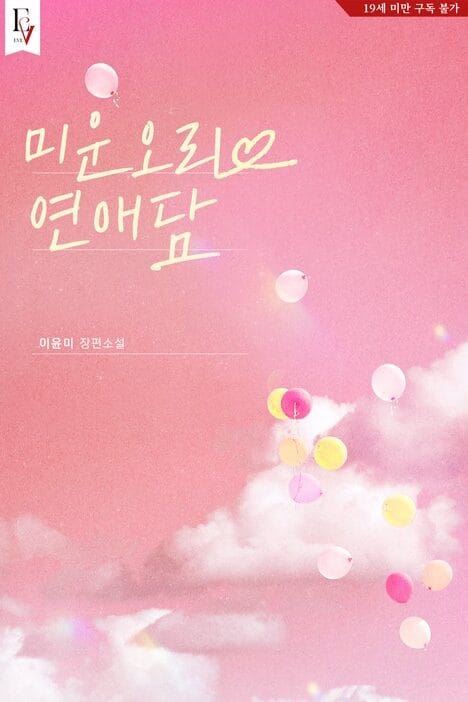
The Ugly Duckling's Romance
Novel Info
  • Author:
  • Status:Ongoing

Summary

... Read More

Go Eunwoo is a twenty-nine-year-old man suffering from severe burnout after quitting his high-pressure job at a major corporation. Having spent his childhood in Switzerland, he returns to Banho-dong, the Seoul neighborhood where he lived during high school and formed his deepest friendship. Seeking solace in familiar streets, he encounters Park Yujin, the fiery owner of a convenience store called "Alley 25 O'Clock," who publicly humiliates a married dentist for harassing her employee. Struck by her boldness and feeling an inexplicable sense of nostalgia and peace in the area, Eunwoo applies for a part-time position at her store despite his elite background. Yujin, skeptical of his qualifications but needing help after recent staff departures, hires him, issuing a stern warning about his attractive appearance causing trouble among customers.

As Eunwoo begins his shift, he struggles with the mundane tasks but finds his apathy slowly lifting through his interactions with Yujin and the neighborhood locals. The narrative reveals that Yujin is the sister of Park Hajin, Eunwoo's closest friend who died eleven years ago in a tragic car accident. During that incident, Hajin and Yujin were both impaled by falling steel beams; medical triage determined that only one could be saved, and Hajin died while Yujin survived. Eunwoo’s father was the surgeon who made the life-or-death decision, a fact that has created an unspoken wound between Eunwoo and the Park family. Although Eunwoo discovers the connection early on, he chooses to keep his identity as Hajin’s friend secret, unsure if revealing it would reopen old scars or complicate his growing attraction to Yujin.

The central conflict arises from these converging secrets and past traumas. Yujin faces external pressure from her mother, Kim Bangsook, who runs a local chicken shop and is fiercely protective yet critical of Yujin’s life choices. When a misunderstanding leads the neighborhood to believe Yujin is having an affair with a married man, her mother confronts her violently, bringing up painful memories of Yujin’s failure to follow a traditional path and the survivor’s guilt associated with her brother’s death. Eunwoo witnesses this abuse and later comforts Yujin, forming a protective bond that blurs the lines between friendship, obligation to his late friend, and romantic interest.

Further tension emerges when a volatile teenager, whom Yujin had previously confronted for attempting to buy alcohol, returns with a group of friends to intimidate her. Eunwoo physically intervenes to protect Yujin, displaying a capability and aggression that startles her. Following this incident, the two share a moment of vulnerability over chocolate, acknowledging their mutual exhaustion and the masks they wear. The story progresses as Yujin mistakenly believes she is being chased by the same threatening group, leading to a frantic sprint that ends in a police box. Eunwoo clarifies the misunderstanding, revealing his keen observation skills, which further deepens Yujin’s confusion and attraction toward him.

Throughout these events, Eunwoo wrestles with his internal conflict. He is drawn to Yujin’s vitality and authenticity, which counteract his own numbness, yet he feels guilty for hiding his connection to Hajin. He worries that his presence is merely a way to cope with his grief and that revealing the truth might destroy the fragile peace they have found. Meanwhile, Yujin continues to manage the operational challenges of her store while dealing with family drama and neighborhood gossip. The narrative sets the stage for a romantic development where both characters must navigate their shared history, unresolved trauma, and the delicate process of opening up to one another. Eunwoo’s journey shifts from seeking oblivion through routine to actively engaging with life through his relationship with Yujin, while Yujin begins to see beyond the mysterious, handsome part-timer to the person who understands her pain.

Latest Release
DateGroupRelease
2026-10-03dusk blossoms c47
2026-10-03dusk blossoms c46
2026-10-03dusk blossoms c45
2026-10-03dusk blossoms c44
2026-10-03dusk blossoms c43
2026-10-03dusk blossoms c42
2026-10-03dusk blossoms c41
2026-10-03dusk blossoms c40
2026-10-03dusk blossoms c39
2026-10-03dusk blossoms c38
2026-10-03dusk blossoms c37
2026-10-03dusk blossoms c36

Community Reviews

Rating(0 / 5.0, 47votes)
5 stars
0(0%)
4 stars
0(0%)
3 stars
0(0%)
2 stars
0(0%)
1 stars
0(0%)

Popular reviews

... Read More
This passage is a masterclass in controlled escalation and strategic de-escalation, moving through at least three distinct emotional temperatures within roughly thirty pages. The opening establishes a low simmer—Eunwoo contemplating coincidence, Yujin handling a routine confrontation. Then the pace quickens imperceptibly as the teenager grows more agitated, building to a breaking point when he swings his fist over the counter. What I find remarkable is how the violent peak resolves not with aftermath, but with almost domestic normalcy. After Eunwoo releases the boy's shoulder and the threat departs, the narrative doesn't dwell on trauma or processing. Instead, Yujin immediately pivots to joking about discrimination and asking about boxing. This is character-driven pacing—the emotional whiplash belongs to the characters themselves, not to an author forcing catharsis. The speed of this transition feels true to how people actually cope: deflection through humor, returning to business as usual. The middle section, where they share chocolate and Eunwoo reflects on his own emotional state, serves as a vital pressure valve. Without this pause, the subsequent chase scene would hit too hard. The pacing here is deliberately slower—fingers brushing, chocolate breaking, casual questions about sports. These small moments matter because they give readers (and Eunwoo) room to breathe before the narrative grabs them by the wrist again. The chase itself is where structure becomes almost cinematic. Short sentences, fragmented dialogue, the urgent physicality of running through alleys—the prose itself accelerates. The misdirection with the teenagers creates a secondary cliffhanger within the sequence, and the resolution at the police box provides another release point before the final revelation that the pursuers weren't after Yujin at all. The ending returns to a quiet, almost anticlimactic register. Eunwoo's explanation, Yujin's embarrassed admission of poor eyesight, the casual back-and-forth about her vision—these mundane details anchor the dramatic sequence and remind us that life continues after danger passes. The chapter closes not with a bang but with Yujin's flustered stammering, which perfectly captures how adrenaline dumps leave us feeling small and silly rather than heroic.
... Read More
'Boss?' Weren't you going to give me the uniform?' That moment where Eunwoo looked down at her lost in thought—there was something in his voice that made me pause. He wasn't being cold. He was being precise. Every interaction between them has this weird calibration, like two people who understand each other's wavelength but are choosing not to drift into it yet. Jiyeong's scene was genius casting. Twenty-one, dramatic, immediately smitten—and Eunwoo's response? "I'm Go Eunwoo. Twenty-nine." Three words. No smile, no warmth, no opening the door. Meanwhile, Yujin notices immediately: 'there was a subtle sense of distance.' She saw it because she's observant. But she also misread it slightly—I think Eunwoo isn't keeping distance because he's shy or aloof. He's keeping distance because he meant what he said: 'I've never given hope to anyone I wasn't interested in.' That's not coldness; that's integrity. Yujin, on the other hand, is all forward motion. She asks about his girlfriend status. She makes a V-sign. She jokes about his face causing trouble. Her defenses are humor and bluntness. But then she goes home alone to a rooftop room and prays to every god she knows. That contrast—outward confidence, inward vulnerability—is what makes her compelling. I keep thinking about that line: 'Your face could cause trouble.' Was that really a warning, or was it Yujin testing whether he'd take the bait? She's flustered. She admits internally that he looks good. And she's already imagining him as a regular customer magnet. This isn't neutral. This is interest being carefully, carefully managed.
... Read More
'Yeah. If only Hajin had lived… it would've been nice.' I need a minute. I genuinely need a second. That line just dropped out of nowhere—Yujin's tiny whisper to the empty city sky, after her mom storms off, and I'm wrecked. Let me walk through why this hurts so much. On the surface, you have this girl who's just been publicly humiliated, physically struck by her own mother in front of a new coworker, and she's standing outside in the cold picking herself back together. But underneath? She's carrying eleven years of grief and the label of "the problem child" in a family that's been broken since her brother died. And the most devastating detail is how mundane the moment is. She's not having a dramatic breakdown. She's just… sighing at the sky. No stars. Pitch black. Then—Eunwoo. The guy picks fried batter out of her hair like it's nothing. Not a big romantic gesture. Just… care, quiet and practical. "There are a few more. Should I take them off for you?" And she flushes. That contrast between the violence of her home life and this gentle, almost casual tenderness from someone who barely knows her is the exact emotional whiplash that made me fall for this story. The CP chemistry isn't built on grand declarations. It's built on him seeing her at her worst and not looking away. Or even worse—he looks away so she doesn't feel exposed. He pretends nothing happened. That's the kind of intimacy that actually makes me believe in romance.
... Read More
I need to talk about this exchange because it is absolutely masterful writing disguised as casual conversation. Yujin: "If you're Hajin's friend... then call me 'Noona' when we're off work." Eunwoo: "Is it okay if I call you that?" Yujin: buries her face in her udon Then later: "Noona, you can speak comfortably too." Do you understand what's happening here? In Korean culture, 'Noona' isn't just a word. It's a relational declaration. It means I acknowledge you as my older sister figure. It's intimate in a specific way — warm, protective, familial but with an undercurrent of something else entirely. And the author makes Yujin's reaction SO real. She doesn't plan what happens next. She just... freezes. "Did she make a mistake telling him to call her 'noona'?" The embarrassment she feels isn't teenage crush energy — it's the confusion of a woman who hasn't felt anything in eleven years suddenly being touched by something warm. Eunwoo's dialogue is equally perfect. He's direct, almost blunt, but never rude. "If it's uncomfortable..." "Yeah. Noona." The way he says it — twice, deliberately — shows he's testing the weight of the word himself. He's not just using it; he's claiming it. And Jaehyung's voice is completely different. He's the psychiatrist cousin who observes everything. His lines are laced with worry he can't quite hide: "Did you write out your entire career history?" "Are you stupid or crazy?" Underneath the teasing is genuine fear that Eunwoo might spiral back into his old patterns. The narrative voice itself deserves mention too. It's third-person limited, dipping into both Yujin's and Eunwoo's heads at different moments, but always with this tender distance — like the narrator is watching through a window, respecting their privacy even as it describes every flicker of emotion. "Quickly escaping the strange feeling that washed over her" — this line about Yujin deflecting is SO accurate to how people actually behave. You feel something unexpected and your first instinct is to run from it, not toward it.
... Read More
I am genuinely shook by how the pacing works in this section. Like, let me walk you through what happens: Yujin sees what she thinks is revenge-seeking thugs → she SPRINTS through alleys like a horror movie protagonist → hides behind Eunwoo → turns out it was nothing → they go eat noodles → AND THEN boom, he drops the biggest revelation in the entire story. From 'I scared myself for nothing' to 'my dead brother's last words were about ME' in the span of three meals' worth of dialogue. That is some serious whiplash and I am HERE for it. The transition is handled so smoothly though. The author doesn't just yank the rug out. There are these little breathers—Yujin's embarrassed rambling about not being a scatterbrain, Eunwoo actually laughing (which we haven't really seen before), the awkward silence between them. These moments of normalcy make the emotional bomb hit even harder because you let your guard down. And that ending?? 'Do you know how Hajin passed away?'—I physically cannot. The chapter cuts right there and I need the next one immediately. This is the kind of pacing that makes you pretend you'll stop at 'just one more chapter' and then it's 4 AM.
... Read More
I keep coming back to the rooftop scene. Like, the author just paints this whole picture — full moon hanging high, soft glow of streetlights, twinkling lights in the distance, laughter and voices drifting up from somewhere below. It's giving cinematic. It's giving "this is the moment everything shifts." Yujin's up there preparing to grill pork belly, and the whole world just feels softer, quieter, like the chaos of the day finally settled. And Eunwoo is leaning against the railing like he belongs there. Like he belongs wherever she is. Then there's the store — the convenience store that got trashed, the messy display stands, the damaged goods packed in a box. It's this grounded, everyday space that contrasts so hard with the drama that just happened. A random gossipy woman in the alley, the police station chaos, husbands slapping wives and yelling about "low-class" and "disgrace" — it's ugly and real and uncomfortable. But then you cut to Yujin's kitchen, the gas burner, the ssamjang, the mushrooms, the scissors and tongs for cutting meat. It's domestic. It's hers. It's the kind of scene that makes you want to pull up a chair and watch. The mirror scene though — OH MY GOD. Yujin looking at her swollen cheek, the handprint on her bare face, bloodshot eyes, and then going through this entire ritual of changing clothes, applying and removing lipstick, switching from a hoodie to a skirt to mink pants — all while muttering "he's just my brother's friend" to herself. The author writes it so simply but it's SO much. Every time she thinks she's ready, something catches her eye in the mirror and she has to start over. It's hilarious and heartbreaking at the same time.
See all reviews

Custom lists

See all custom Lists