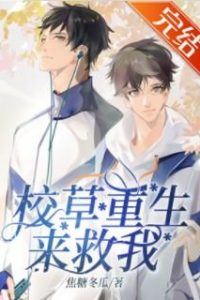
The School Hunk Reborn to Save Me
+Add to Custom List
Novel Info

Summary

... Read More
Cen Qingmei is a high school senior whose summer vacation is marred by a fall from a second-floor window that leaves him with cracked ribs and a twenty-pound weight loss. Upon returning to school, he undergoes a dramatic physical transformation that draws the attention of his peers and the mockery of his rival, Zhong Chun. On his first day, he receives mysterious text messages from an unknown number warning him to avoid taking the bus, which he dismisses as a prank. However, the predictions begin to come true when his bike chain snaps, forcing him onto the bus he was warned to avoid. There, he is attacked by a thief wielding a razor blade, only to be saved by a tall, quiet transfer student named Shu Yang, who disarms the attacker with lethal precision before disappearing into the crowd. Shu Yang later reveals himself to be a top-scoring repeater who had already been admitted to a prestigious university but returned due to a head injury and family turmoil involving his parents' divorce. Despite his cold and detached demeanor, Shu Yang repeatedly intervenes in Cen Qingmei's life, from saving him from a confrontation with a delinquent at an internet cafe to resolving a bathroom dispute with a school jock. Cen Qingmei becomes increasingly aware of Shu Yang's protective presence, especially after receiving further cryptic warnings about avoiding online romance and physical altercations. These warnings prove accurate as Cen Qingmei's friends accidentally get him involved in a gaming dispute that leads to a dangerous encounter with Shu Yang's aggressive brother, Shu Jun. The narrative deepens with the introduction of a recurring nightmare in which Cen Qingmei is kidnapped and offered a choice between a controlling captor and a mysterious figure searching for him, a dream that mirrors the enigmatic paper rose left at his home. As Cen Qingmei navigates the social hierarchies of his senior year, he finds himself drawn into a complex web of relationships involving his childhood friend Xia Zhi, the aloof physics class representative He Bin, and the increasingly possessive Shu Yang, whose true intentions remain shrouded in mystery. The story establishes a tense atmosphere where Cen Qingmei's newfound popularity and physical transformation attract both admiration and danger, while Shu Yang's cryptic warnings suggest a larger, more sinister plot unfolding around him.
Latest Release
DateGroupRelease
2026-08-11shanghai fantasy c56
2026-08-11shanghai fantasy c55
2026-08-11shanghai fantasy c54
2026-08-11shanghai fantasy c53
2026-08-11shanghai fantasy c52
2026-08-11shanghai fantasy c51
2026-08-11shanghai fantasy c50
2026-08-11shanghai fantasy c49
2026-08-11shanghai fantasy c48
2026-08-11shanghai fantasy c47
2026-08-11shanghai fantasy c46
2026-08-11shanghai fantasy c45

Community Reviews

Rating(4.3 / 5.0, 4votes)
5 stars
2(50%)
4 stars
1(25%)
3 stars
1(25%)
2 stars
0(0%)
1 stars
0(0%)

Popular reviews

... Read More
I keep coming back to this question: what is Cen Qingmei actually risking in this story? On the surface, it's a high school setting with typical conflicts—bullies, romantic tension, academic pressure. But the stakes feel way bigger than that. There's this recurring nightmare that haunts Cen Qingmei, right? "He was desperate to forget it, yet he couldn't help but wonder about the person searching the world for him… and the crumpled scrap of paper he hadn't wanted to let go." This isn't just a dream. This is foreshadowing something massive. The paper rose, the nightmare, Shu Yang's precognitive warnings—they're all connected, and the reader knows it even if Cen Qingmei doesn't yet. That's the real tension here. Every time Shu Yang warns Cen Qingmei about something, it raises the question: how does he know? And what's the cost of knowing? The bathroom confrontation with Ke Yan is a perfect microcosm of the larger conflict. Ke Yan represents the immediate, physical threat—the guy who wants to humiliate Cen Qingmei on the school forum, who's protective of his relationship with Zheng Yu in a toxic way. But Shu Yang intervening isn't just about saving someone from a bathroom fight. It's about two people who are clearly destined to be connected navigating a world where danger keeps finding them. And the stakes keep escalating. Cen Qingmei's sketches reveal something about this connection too—this boy with no face, this recurring figure in Cen Qingmei's subconscious. The author is playing with suspense masterfully: we know something big is coming, we just don't know what it is, and every small moment—the paper rose, the warning message, the sketch—feels like a piece of a puzzle that's slowly clicking together. The tension isn't in whether Cen Qingmei will survive Ke Yan; it's in whether Cen Qingmei will remember who they're supposed to be.
... Read More
Can we just take a moment to appreciate how this character speaks? Because Cen Qingmei's dialogue is absolutely lethal and I have never been more entertained in my life. The mom interaction alone is a masterclass. "Mom, impressive—which young admirer gave you this? Quick, take a photo and post it to make Dad jealous." And Jiao Ting's response: "The only ‘young admirer' I've ever raised is you! And I haven't seen you give me anything for holidays all year." This is such a natural mother-son dynamic. Then Cen Qingmei's entire narcissistic routine—running to the TV screen to admire himself, striking poses "like a preening daffodil." The author's voice is so distinct here. It's witty without trying too hard, self-deprecating but genuinely charming. And then there's the line: "Lucky you didn't try to convince me your boiled water smells amazing." This is the kind of dialogue that makes you laugh out loud because it's so specific to how this family talks to each other. The banter with Chen Shuo and Mu Ning about the bunny-ear pink wig threat is equally good. "What kind of excavators are you two? Digging such a massive pit and burying yourselves wasn't enough—you had to drag me down with you!" And the forum revelation scene where Mu Ning delivers the Ke Yan and Zheng Yu relationship bomb: "Zheng Yu didn't paint her own boyfriend but instead painted another guy and went viral. I don't know what others are saying, but doesn't Ke Yan's head seem a little green right now?" The humor is sharp, the timing is perfect, and every character has a distinct voice. Even Shu Yang, who barely speaks, has a presence in his silence. "I said—move." Two words that carry more authority than Ke Yan's entire personality. The narrative voice balances humor and warmth with these moments of genuine emotional depth, and that's what makes it work so well.
... Read More
I need to discuss the bathroom scene because honestly it was directed like a film. Let me paint this for you: Cen Qingmei, desperate, bladder at critical levels, cuts off Ke Yan—who is apparently a jock with a phone ready to film everything—and then SHU YANG appears. Just appears. From behind. Cold voice. "Move." The way the author writes this moment is incredible. You have Ke Yan, all ego and threat, getting physically overpowered by Shu Yang in literally two seconds. "Ke Yan felt himself being pushed into a stall by an overwhelming force, nearly crashing into the toilet." And then Shu Yang does this thing where he walks past Cen Qingmei and his elbow bumps Cen Qingmei's back, and Cen Qingmei has this electric shock reaction and just… loses control. I'm not making this up. "A jolt like an electric shock ran through him, and Cen Qingmei shuddered. Instantly, the floodgates opened." The author had the audacity to write that. And then immediately follows it with "So… this guy just came in to wash his hands?" The mundane observation after the most charged physical contact. And Shu Yang's message five minutes later: "Avoid fighting over the toilet today." The man has precognition and uses it to warn people about bathroom conflicts. The worldbuilding here is so grounded in this hyper-specific high school reality—the principal with photographers, Lao Wei's retro 80s suit, the school forum full of sappy romance stuff, the art students using Cen Qingmei as a muse. Everything feels alive. The classroom scene with everyone sitting rigid during the inspection, then wilting "like frostbitten eggplants" when it ends—that's such a specific, vivid image that immediately puts you in that Chinese high school setting. The author doesn't over-explain the world; they just drop you into it and let the details do the work.
... Read More
Okay so I need to talk about this paper rose because it's been living in my head rent-free since I finished this chapter. Think about it—someone spent time folding this thing, meticulously, layer by layer, and pinned it to their door. No note. No name. Just the flower itself. And Cen Qingmei's reaction? She just… tucked it in her drawer. Didn't even open it. Because knowing would ruin the mystery, right? "What if she opened it only to find some marketing flyer or realize it was genuinely delivered to the wrong floor? That would ruin the charm." That line absolutely wrecked me. It's the most honest thing about longing I've ever read. The person who made that rose is out there somewhere, and Cen Qingmei feels it too—like, she had this nightmare about clutching something, and then this paper rose appears, and she's like "could the thing he'd been clutching in that dream… have also been a folded paper rose?" My heart. My actual heart. This unspoken connection between two people who haven't even properly met yet, and the author just drops it like it's nothing. Also the sketching subplot—Cen Qingmei has been drawing this boy in her textbook margins for weeks, right? Just the back view, broad shoulders, white sneakers, ankles. No face. And then Li Chenxia finds it and whispers "Who is this? So beautiful…" and I just—how do you draw someone you can't even see their face but you know exactly who they are? That's the most romantic thing ever. The fact that Cen Qingmei's sketches have "a sense of strength, blending a pure essence with a restrained aura" while Zheng Yu's drawings of Cen Qingmei are "delicate and elegant, carrying a dreamy, sweet, almost girlish vibe"—these are two completely different ways of seeing someone, and both are acts of love in their own way. I'm not crying, you're crying.

See all reviews

Characters

See all characters

Custom lists

See all custom Lists