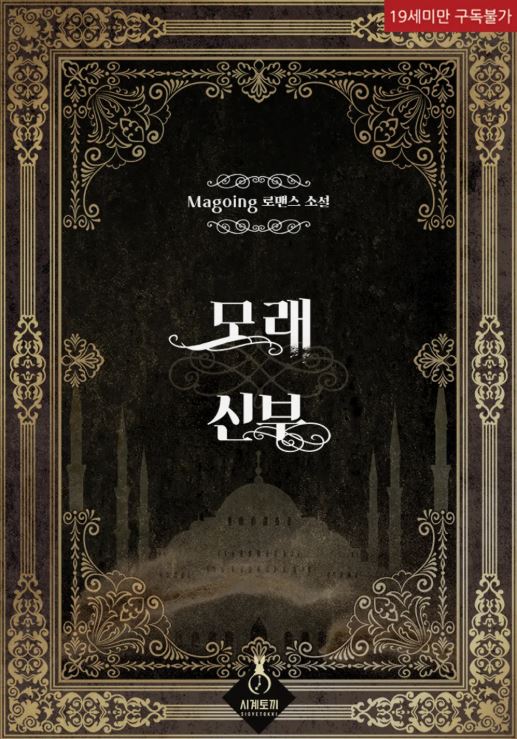
The Sand Bride
Novel Info

Summary

... Read More

Esther is the daughter of a skilled physician in the prosperous Kingdom of Donova. When her mother falls critically ill, her father accepts a lucrative contract to accompany a merchant caravan across the treacherous desert to the nation of Gharyam, hoping the earnings will secure the expensive medicine his wife needs. Esther, aspiring to follow in her father’s footsteps, insists on joining the journey despite her parents’ fears. However, shortly after entering the desert, the caravan is ambushed by bandits from the Kemut tribe, a warlike people known for their brutality and the harsh survival-of-the-fittest ideology that governs their society.

During the attack, Esther’s father hides her in a carriage filled with merchandise, instructing her to remain silent and still. She watches in horror as the bandits slaughter the merchants and survive. The leader of the bandits, Karzhen, discovers her hiding place. Struck by her unusual beauty and pale turquoise eyes, which contrast sharply with her sandy hair, he orders her to be kept among the captives. As the only surviving woman from her group, Esther is designated as Karzhen’s personal plaything. She is subjected to relentless sexual violence and physical abuse, forced to endure his drunken whims in the desolate desert. Despite the trauma, Esther’s primary motivation remains survival. She clings to the hope of reuniting with her parents and returning to her peaceful life, convincing herself that she must endure until she can escape.

The journey to the capital takes the captives through a region known as the Ring of Hell, where a violent sandstorm kills many of the weaker prisoners. Karzhen, noticing Esther’s fading strength, drags her back from the sand and carries her on his shoulder, a gesture that sparks resentment among the other captives who view her as a collaborator. In the capital of Gharyam, Karzhen’s status as a supreme ruler becomes evident. He raids, kills, and consumes without consequence, embodying the cruelty of his tribe. Yet, despite his rough treatment, Karzhen exhibits moments of twisted possessiveness. He feeds Esther, ensures she is fed, and grows irritated when she cries outside of their intimate encounters, viewing her fear and submission as a form of ownership.

A turning point occurs when the captives reveal a desperate plan to Esther. They provide her with a potent sedative derived from a rare fish, intended to incapacitate the bandits so the prisoners can flee. Esther is asked to administer the drug by drugging the alcohol supply during a feast. However, before she can execute the plan, she encounters a dying fellow countryman who gives her a small glass vial containing a message before passing away. This encounter deepens her resolve but also introduces a new layer of mystery regarding the message’s contents.

As Esther prepares to drug the drinks, Karzhen confronts her. He seems to sense her betrayal, yet his reaction is not immediate violence but a dark amusement. He allows her to proceed, watching her with predatory interest. The narrative shifts focus to Karzhen’s internal conflict; he is beginning to realize that his feelings for Esther extend beyond mere physical gratification. His obsession with her safety and his frustration at her attempts to escape suggest that he is falling in love with his captive, a emotion he struggles to understand and control. Meanwhile, Esther remains trapped between her desire for freedom and the terrifying reality of her dependency on the man who torments her.

The story sets the stage for a complex power dynamic where the captor and the captive are inextricably linked. Karzhen’s sister, Hemor, is revealed to have died by suicide after losing a loved one, a tragic backstory that Haunts the brothers and highlights the emotional repression inherent in their culture. As the plot progresses, Esther discovers that her escape is not merely a matter of physical flight but involves navigating the political and emotional labyrinth of Gharyam’s court. The sedative plan fails or is interrupted, leaving Esther at the mercy of Karzhen’s changing moods. The central conflict evolves from a simple struggle for survival into a tragic romance defined by obsession, regret, and the impossibility of escape from a man who believes he owns her soul.

Latest Release
DateGroupRelease
2026-09-27citrus aurora c101
2026-09-27citrus aurora c100
2026-09-27citrus aurora c99
2026-09-27citrus aurora c98
2026-09-27citrus aurora c97
2026-09-27citrus aurora c96
2026-09-27citrus aurora c95
2026-09-27citrus aurora c94
2026-09-27citrus aurora c93
2026-09-27citrus aurora c92
2026-09-27citrus aurora c91
2026-09-27citrus aurora c90

Community Reviews

Rating(3.8 / 5.0, 46votes)
5 stars
13(28%)
4 stars
17(37%)
3 stars
10(22%)
2 stars
6(13%)
1 stars
0(0%)

Popular reviews

... Read More
The dynamic between Karzhen and Hakan is absolutely fascinating, and not in a good way. You've got two brothers sharing a tent after a feast, and the tension is palpable from the moment Karzhen drags Esther into his sleeping quarters. Hakan says he can't watch, that it's "torture enough" — but here's the thing, he STAYS. He doesn't leave. He just grumbles and pretends he doesn't hear anything until the morning after. Then the real gut-punch: Hakan wakes up, finds Esther half-naked in HIS tent (because Karzhen apparently tossed her there overnight), and instead of immediately escorting her back or reporting this to his brother, his first thought is… well. Read it yourself. "The thought crossed his mind that maybe Karzhen had left her here as a gift for his younger brother." Gift. She's a PERSON, and even in his lust-addled state, the narrative frames this as an absurd thought — but it's ABSURD because it's INVISIBLE to no one. The power dynamic is so grotesque and normalized that even the characters treat Esther like property being transferred. And then Karzhen walks in, sees his brother standing over Esther, and what does he do? He makes a JOKE about it. "She probably likes it hard too." He's not angry. He's not threatened. He's AMUSED. And Esther — trembling, tearful, terrified — has to perform oral sex while Hakan watches because KARZHEN TELLS HIM TO LEAVE. Hakan sighs and goes. This is broken in ways I can't even process.
... Read More
The stakes here operate on so many levels simultaneously. On the surface, Esther is trying to escape captors—simple enough. But the real tension comes from the internal conflict: she knows Karzhen sees through her, and the scene where he drinks the drugged wine and just laughs instead of collapsing is a gut punch. His line "Try it. Run" reframes the entire escape attempt. He let her think she had a chance. He orchestrated her hope. That's a level of psychological control far beyond physical imprisonment. And then there's the backstory stakes—Hemor's suicide reveals that the very code Karzhen and Hakan live by was forged in personal devastation. Their grandmother's teaching to never show weakness didn't come from abstract philosophy but from watching a woman who loved too much and chose a shameful death. The dying man's vial adds another thread: it mentions Re'shi, a name that connects to something larger than this immediate scene. Every character is trapped—Esther by Karzhen, Karzhen by Hemor's legacy, the tribe by its own harsh codes. The question isn't whether they'll escape. It's whether anyone ever truly escapes anything.
... Read More
I need to discuss Karzhen's dialogue because honestly it's terrifying how good it is. The man barely speaks, and when he does, every word is a weapon. Look at the pattern: he never explains himself. Never justifies. Just commands and curses. "Stay still, will you?" — polite phrasing for an act that is anything but polite. That juxtaposition is authorial genius. He uses domestic courtesy language while committing domestic violence. It's so casually cruel it almost registers as absurd until you realize it's meant to. "You ruined the mood. Annoying." — said after making her cry. He blames HER emotions for interrupting HIS pleasure. This is the dialogue of someone who has never, in his entire life, been told no and therefore genuinely cannot comprehend that another person's feelings exist. And Esther's dialogue! Or rather, her lack of it. She pleads: "I'm sorry… I'm sorry……. Let me go… please……!" Three times she apologizes. THREE TIMES. To her abuser. For existing. For reacting. For being human. And then later, when he tells her to do it herself, her only verbal response is a muffled "N-no……." and sobs. Her voice has been systematically erased through these chapters. What replaces it is physical sound—gagging, screaming, whimpering, the lewd wet noises the author deliberately draws attention to. She is reduced from a person with words to a body with reactions. That's not accidental writing. That's the author making a point about what violence does to a human being's ability to speak. Karzhen's dialogue also shifts subtly between chapters. Early on he's purely physical—commands, slaps, silence. Later, there's this moment where he watches her suck him and thinks, almost confused, "why did I feel such satisfaction from the change?" He notices her compliance has shifted from reluctant to desperate, and something in him... responds? It's the most uncomfortable sentence in the book because it suggests he's not even aware of his own emotions. He just acts. And Esther has to interpret them.
... Read More
I need to talk about Bianca and Esther because my heart is absolutely shattered and I need to scream into the void. Here's Bianca: already chosen by a king, already having secured some kind of protection, and yet she keeps coming back to Esther. Day after day. Stroking her cheek. Counting down the days. Offering to risk HER own standing to save someone who barely has any. When Esther asks 'why are you helping me?' Bianca says 'just like her.' LIKE WHO? LIKE WHOM, BIANCA? And Esther—poor, broken Esther who's been through absolute hell and still finds the capacity to be surprised by kindness. She doesn't fully trust Bianca, which is RATIONAL given her circumstances, but you can see she WANTS to believe her. She takes Bianca's hand. She lets herself hope. And then Karzhen takes her away and ALL OF THAT HOPE gets crushed underfoot. The most heartbreaking part? Bianca telling herself 'it'll be okay' over and over again. The same phrase she used as a child when comforting her mother. She's repeating her own coping mechanisms, standing at a door she just closed, knowing she couldn't do anything even if she tried. She's already mourning Esther and Esther isn't even dead yet. These two women—both pawns, both trying to be someone's savior, both utterly powerless—and I swear to god if Bianca also gets taken I will lose my mind.
... Read More
I've been thinking about the symbolism in this opening and there's so much underneath the surface that most readers might miss on first read. The desert first. Gharyam is described as barren except for oases around the Demot River. This isn't just setting - it's philosophy. The desert selects for the strong. The weak die. Esther learns this through the captives who die one by one - illness, heat, execution. But the desert also buries secrets. The carriage where Esther hides is literally filled with worthless items - carpets, porcelain, things that seem like junk but might contain gold if you know where to look. Esther herself is that carriage. She appears worthless to the bandits ("Nothing valuable in there") but she contains something precious - survival, resilience, the capacity to endure the unbearable. Karzhen finds her because he's looking for something valuable. He just doesn't know what it is yet. Then there's the blood. Karzhen smells like it. His hands smell like it. Esther notices this immediately and it terrifies her. Blood is the currency of Gharyam - it buys loyalty, it enforces hierarchy, it determines who lives and who dies. And Esther is learning that in this world, her body is also currency. Karzhen takes it because he can. The bandits sold captives because they could. The Kemut tribe killed enemies because they could. Violence is the language and Esther is being forced to speak it fluently. The alcohol is another symbol I can't ignore. Karzhen drinks heavily throughout their first encounter. Alcohol lowers inhibitions, yes, but it also numbs pain. The author is showing us that this man who appears entirely in control is actually self-medicating. He's drunk, he's violent, he's tormenting a captive - but he's also reaching for the bottle between thrusts. What is he running from? The text doesn't say, but the symbol is clear: power doesn't protect you from having something to escape from. And finally, that quote: "To think that the one who loves me is also my enemy…… Wouldn't my death be the sweetest revenge?" This is the thematic thesis. Love and enmity are not opposites here - they're intertwined. The person who holds your life in their hands is also the person you might learn to need. And in a story where the strong deserve to win, Esther's greatest enemy might also be her only hope for survival. That's not romance. That's hostage psychology dressed up as court intrigue.
... Read More
There's so much symbolism packed into this section that I want to unpack slowly. First: white. It appears everywhere. White robes slipping between palm trees. White silver hair. White pale lashes. White vision flushing before black. White s***n. White skin marked red. The color white here isn't purity—it's blankness. Erasure. Esther is being stripped of her identity, her name, her bodily autonomy. But simultaneously, white is also the color of the sarasa flowers she dreams about, the color of home, the color of Bianca's hair. So white is both violence and tenderness. Both destruction and memory. That duality is the whole theme right there. Then there's the name “Eder.” Esther gives a false name—not hers, not quite. And Karzhen says it doesn't suit her, but he keeps using it anyway. What's happening here is that names = identity = power. By refusing to give her real name, Esther is protecting something internal that Karzhen can't touch. But by accepting “Eder,” she's also acknowledging that in this world, her master gets to name her. The tension between those two realities—that's the core conflict. The sarasa flowers themselves are symbolic in multiple layers. They're from home. They change color when pressed. They bloom and then wither. They're beautiful but temporary. And Esther wants to press them between pages—preserving them, making them last. That's exactly what she's trying to do with her own sense of self: preserve it, protect it, keep it from fading even as the world around her tries to erase it. And the roots imagery! “Their intertwined fingers, like the roots of a tree, anchored her.” Roots don't just hold—you grow from them. They connect you to something bigger, something underground, something that survived before you and will survive after. Bianca and Esther aren't just friends; they're each other's foundation. Their friendship is the symbolic counterweight to everything Karzhen represents. Even the coronation mentioned at the end functions symbolically—it's not just a political event, it's a threshold. A moment when power structures shift, when new rules apply, when the game changes. Esther's survival isn't just personal anymore; it's tied to larger forces.
See all reviews

Custom lists

See all custom Lists