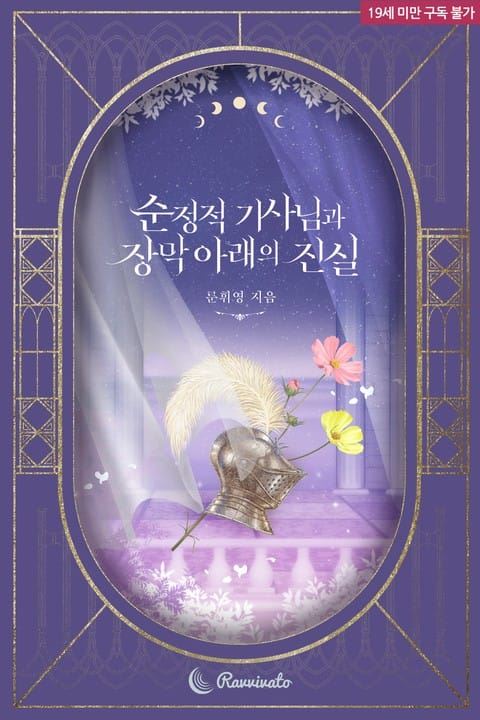
The Pure-Hearted Knight and the Truth Beneath the Veil
Novel Info
  • Author:
  • Status:Ongoing

Summary

... Read More

Violet Ryle is the youngest princess of the Scotia Empire, a title that grants her royal status but little political power. Her life is defined by her position as the second daughter, overshadowed by her older sister Olivia, the First Princess and heir apparent. Violet has long harbored a secret, unrequited love for Dein Bates, a man who rose from a viscount family to become the Imperial Knight Commander through sheer military brilliance. Dein won a decisive victory against the invading Lybian Kingdom, transforming a defensive struggle into a conquest that restored the empire's fading strength. This victory propelled him to the peak of societal admiration, earning him the title of Earl and making him the most eligible man in Scotia. Despite this, Violet’s engagement to him was arranged by the Emperor not out of affection, but as a political safeguard. The court whispers suggested that Dein’s true place was by Olivia’s side, destined to become emperor, while Violet served only as a placeholder until a more suitable match could be secured.

The return ceremony for Dein’s army serves as the catalyst for the story’s central conflict. Violet attends the event hoping to see him, masking her anxiety with a cheerful facade. The banquet is filled with rumors that Dein is poised to break his engagement to Violet and marry Olivia instead. Watching Dein dance with Olivia, who commands the political sphere with grace and authority, Violet feels the crushing weight of her own inadequacy. She believes she is merely a temporary arrangement, unworthy of a man who belongs with the empire’s future ruler. When Dein approaches her and asks for a dance, Violet, fearing she is an obstacle to his true happiness, declines and flees to the terrace. She assumes he will follow Olivia, reinforcing her belief that she has no place in his life. That night, unable to sleep, Violet is startled by a visitor. Dein enters her bedroom without permission, his demeanor far removed from the noble knight she knew. He confronts her about rejecting the engagement, his jealousy palpable as he references her interaction with Duke Evan Ludwig, a powerful noble who had shown interest in Violet. Dein accuses her of seeking another man, interpreting her rejection as a desire to leave him for someone of higher political standing.

The confrontation escalates rapidly. Dein reveals that he did not want the marriage for political gain, nor did he intend to marry Olivia. He confesses that he has desired Violet for years, suppressing his urges to maintain his noble composure. His frustration boils over as he explains that he stayed away because he believed she only saw him through the lens of courtly duty. The misunderstanding between them is laid bare. Violet had never received the letters Dein sent during his campaigns, intercepted by circumstances she was unaware of. She accepted the engagement hoping to stay close to him, while he thought she was merely tolerating him for the sake of the empire. This realization shatters Violet’s sorrow. Dein asserts his dominance, declaring that he will not let her go. He forces himself upon her, claiming her body and breaking down the barriers of propriety that had kept them apart. The act is violent and passionate, a release of years of pent-up desire and miscommunication. Through the night, Dein claims Violet, establishing a physical bond that supersedes the political arrangements of the day before.

By morning, the reality of their situation sets in. The imperial maids discover them together, forcing a public acknowledgment of their intimacy. Dein remains calm, dismissing the servants and declaring that he and Violet will not attend the day’s events due to fatigue. He frames their union as inevitable, noting that as fiancés, their physical relationship should have been anticipated. Violet is distressed, fearing the scandal and worried that Dein views her only as a convenient outlet for his lust. However, Dein counters her fears by revealing the depth of his feelings. He admits that Olivia is a hindrance to him, just as he is to her, and that he has no desire for the throne or the political alliance it would bring. His only ambition is Violet. He questions why she agreed to the engagement if she disliked him, prompting Violet to confess her long-held love and her fear that she was not good enough for him. Dein assures her that he has always wanted her, and the only obstacle has been the interference of rumors and misdirected communications. As they navigate this new dynamic, the political landscape of Scotia remains volatile. Noble factions eye Dein’s rising power with suspicion, while Duke Ludwig watches from the sidelines, waiting to see how Violet’s position changes. The story moves forward with Violet no longer a passive observer of Dein’s life, but an active participant in a union forged through passion and confession. Their relationship is tested by the empire’s intricate politics, as Dein must now balance his love for Violet with the expectations of a warrior who has become too powerful to ignore.

Latest Release
DateGroupRelease
2026-10-03dusk blossoms c16
2026-10-03dusk blossoms c15
2026-10-03dusk blossoms c14
2026-10-03dusk blossoms c13
2026-10-03dusk blossoms c12
2026-10-03dusk blossoms c11
2026-10-03dusk blossoms c10
2026-10-03dusk blossoms c9
2026-10-03dusk blossoms c8
2026-10-03dusk blossoms c7
2026-10-03dusk blossoms c6
2026-10-03dusk blossoms c5

Community Reviews

Rating(0 / 5.0, 46votes)
5 stars
0(0%)
4 stars
0(0%)
3 stars
0(0%)
2 stars
0(0%)
1 stars
0(0%)

Popular reviews

... Read More
The imagery in this section is INSANE. Let me paint what I saw in my head: Dein and Violet emerging from Moel Palace, him holding her close because she can barely walk, her face absolutely crimson, his bronze arm wrapped around her waist like a vice. And standing at the ENTRANCE — the Imperial Guard, Olivia in full princess-mode, Evan lurking in the background. All these eyes watching. The corridor scene. I literally gasped at the visual of it. Olivia rushing toward them like she's going to SNATCH Violet away, Dein pivoting to shield her, the way Violet looks at her sister flushed and trapped between two people who both want to protect her in completely different ways. And then the ending scene in the outer garden — tea time, the first leisurely moment they've had in what feels like forever, sunlight, papers on the table. It contrasts SO beautifully with the public spectacle earlier. From maximum drama to quiet intimacy in one chapter transition. The detail about the rough paper from the battlefield vs the palace stationery — it grounds the whole romance in physical reality. This isn't some marble palace love story, it's a man who wrote love letters on whatever scraps he could find while literally fighting wars. The world feels lived-in, not decorative. Every object tells a story about where these characters come from and what they've survived.
... Read More
"Did you know it's always been like this? Every time I see you, every time I think of you. Always." I need everyone to understand what just happened to me. That single paragraph absolutely dismantled my entire nervous system. Dein Bates does not speak in normal sentences. He speaks in raw, bleeding truth and I am LITERALLY on the floor. The dialogue in this chapter is SO distinct between the two characters. Dein? He doesn't do subtle. Every word that comes out of his mouth is either a confession or a demand. There's no middle ground. And yet it doesn't feel one-dimensional — it feels like a man who has spent years practicing silence and finally broke. Violet's dialogue is equally sharp, especially her denials. "No, it's not like that" / "Don't speak there" / "I didn't know you were THIS kind of person" — each one reveals more than she intends. Her voice is defensive, flustered, but underneath all the "no" there's this constant thread of "why did you wait so long." The narrator's voice is another whole thing. It's breathless. It matches Dein's pace — sometimes slow and detailed, sometimes rushing through like you can't keep up. The sentence fragments, the repetition, the way the narrative itself gets wet and panting halfway through? That's not an accident. The author wrote the prose to MATCH the physical experience. And the ending — "The night is still long" — delivered as a whisper? I'm not breathing. This author is a VILLAIN and I love them.
... Read More
Okay so I need to talk about the torn dress scene because it literally hit me like a truck. The way the author uses that fabric ripping as a metaphor for everything they've been holding back — I'm not even mad about it, I love it. Dein doesn't just slowly undress her, he TONS the dress. That moment when the ribbon string comes undone and then the fabric gives way tells you everything about his patience level (zero) and how long he's been simping for Violet (forever). But here's the thing that made me actually sit up straight — the narrative doesn't just rush through. It PULLS. There's this one beat where he almost finishes, then he STOPS and pulls back, and I was literally shaking my head going "what are you doing??" But then it makes total sense when you realize he's trying to BE SURE she wants this before he goes full beast mode. He could've just taken what he wanted but he doesn't. That restraint IS the plot. And the morning after? Chef's kiss. The way the author makes you wonder if it was all a dream — the clean sheets, the physical evidence still lingering but also gone — that ambiguity? Genius. You're sitting there going "no wait, let me go back and re-read that section." The story structure here isn't linear at all, it's emotional — building to the climax, then dropping you right back into reality with that ache in Violet's body as proof. I genuinely couldn't put it down. The pacing from chapter to chapter was like the author knew exactly when to breathe and when to suffocate me with tension.
... Read More
The dialogue in these chapters is absolutely dripping with character. Let me just highlight a few moments that made me laugh, cry, and throw my phone on the bed: Olivia: "You, how dare you with my sister… my sister…!" — She goes from composed princess to unhinged in ONE sentence. And it's funny because it's also genuinely terrifying. The repetition of 'my sister' like she's trying to summon some magical protection through words. Dein's response: "Well, 'someone like me' already has that lovely sister." — THE AUDACITY. The quotes around 'someone like me' when Olivia has been calling him that entire time. He's weaponizing her own words. Chef's kiss. Evan whispering to Violet: "I told you, didn't I? Olivia can't control a horse like this." — Such a casual, almost playful delivery for what is essentially a devastating threat. Evan's voice is so distinct here — dry, knowing, barely hiding his amusement. And Dein: "Next time, I'll make sure to give you a chance between m*ans, so please tell me. Don't just think it." — I actually laughed out loud. He's being SO crude and so sincere at the same time. The contrast is everything. The narrative voice itself is wonderful — it stays close to Violet's perspective, filtering everything through her observations and reactions. When she describes Dein's smile as one that would "surprise others, even Violet herself, who wasn't yet used to it," that's the narrator giving us a whole paragraph of characterization in one sentence.
... Read More
Okay I need to talk about this moment because it absolutely destroyed me. Dein saying 'The only thing I've ever said I wanted, out of my own mouth, is you, Violet Ryle' — it's so brutally honest and stripped of all the courtly pretense he normally carries. Everything before this two-year period of her 'gradually decided on an impossible abandonment' hits differently when you realize he was feeling the exact same thing. Her internal narration about how she'd given up on her unrequited love being fulfilled in any way, and then BOOM, here's this man who's basically been 'clinging to you like a dog in heat' just saying it out loud. What killed me though was the ending. She wants to confess properly — 'I wanted to tell him that she loved him too' — but loses the chance because Dein just overwhelms her with his own verbal barrage. And honestly? That feels so real. The most perfect moment of your life and you can't even articulate because the other person won't let you. The text says 'Violet's last memory' was his incoherent muttering. That's intimate in a way that had me clutching my chest. Also the line 'You're mine. Because you are the reason and meaning for everything I've achieved' — that's not just possessive. That's a man laying bare his entire philosophy of existence in one sentence.
... Read More
Can we just take a moment for this one scene? The imperial garden during Olivia's coming-of-age ceremony. This is where everything pivots for Dein, and the author sets it up like a god. Dein is wandering alone, avoiding people, wearing an outfit that doesn't fit him properly, feeling like an impostor at the most important social event of the year. The wind is chilly. He's surrounded by fake smiles and sneers from nobles who only see him as a viscount-born upstart. And then—Violet. Alone, also somewhat outside the main event because she hadn't made her debutante appearance yet, also grumbling about being bored. The contrast is stunning. You have this glittering, suffocating ball full of people calculating interests and desires, and then this quiet corner of the garden where two people who actually see each other exist. The author doesn't give us a ton of decorative description—just the chill wind, the distance from the crowd, the simplicity of draping a uniform over someone's shoulders. But it works because we FEEL the relief of escaping that party. And later, the epilogue scenes—they shift so naturally from public to private. The wedding is mentioned in one paragraph, almost casually, then we're immediately in their bedroom with Dein drying his hair and Violet in indoor clothes. The intimacy of those domestic moments—the towel tossed in a basket, the chair pulled closer, the cheek kisses—creates this sense that we've been let into something real and private. The world feels lived-in because we see what happens AFTER the ceremony, not just during it. The succession ceremony itself gets a brief mention but it's described as "more glamorous and grand than the wedding," which is honestly a hilarious detail. Like, your wedding was outshone by your sister's political ceremony. Classic. What I love most is how the settings mirror the emotional arcs. The garden = intimacy away from pretense. The bedroom = safety and vulnerability. These spaces aren't just backgrounds; they're where these characters become themselves.
See all reviews

Custom lists

See all custom Lists