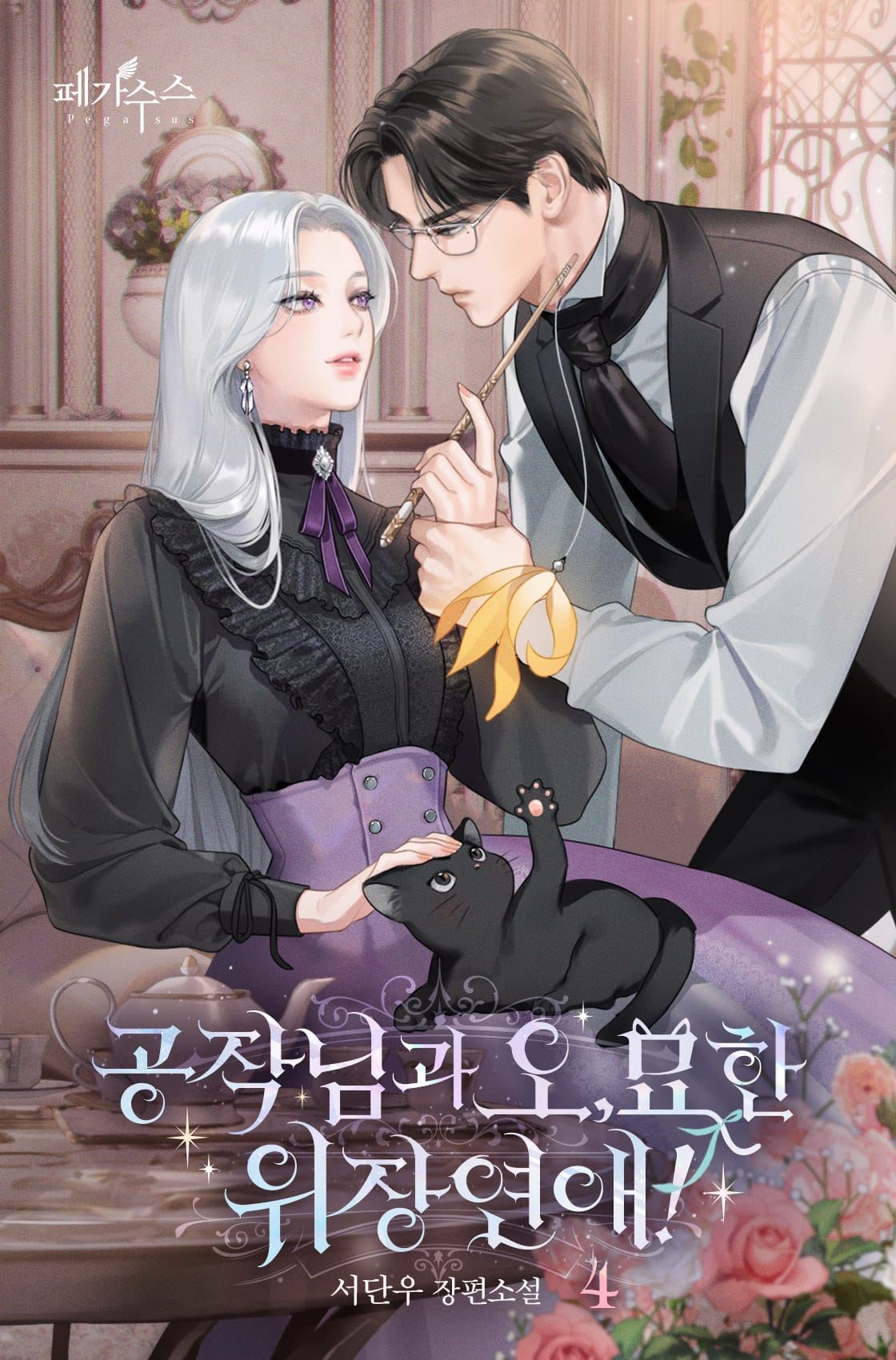
The Predator Who Desired Me
+Add to Custom List
Genres:
Novel Info
  • Author:
  • Status:Ongoing

Summary

... Read More

Julietta Lumiere is the daughter of Brahms Lumiere, a distinguished physicist and count who invented a devastating missile that secured victory for the Conaut Empire in a four-year war against Cardin. Her mother was killed by peace protesters shortly after Brahms received his title, leaving Julietta with a strained relationship with her father. Julietta is engaged to Ivan le Hartfield, the eldest son of the powerful Marquess of Hartfield. Their families arranged the engagement to strengthen business ties between the Hartfield banking and railway empire and Brahms’s arms research. Julietta remembers Ivan as a striking nobleman who helped her when she was lost in the woods of Braxiter during her childhood.

As the war concludes, Julietta eagerly anticipates Ivan’s return and plans to visit Braxiter, the Hartfield estate, to share the news. She receives a phone call from Lydia, Ivan’s younger sister and Julietta’s closest friend, who reveals that Ivan will arrive in ten days. Overcome with joy, Julietta rushes to prepare for the reunion, dreaming of her future with Ivan. Meanwhile, Ivan travels back from the military base, his emotions dulled by years of battlefield trauma. He views Julietta primarily as an essential asset to his family’s rising power and feels a dangerous, possessive obsession toward her, imagining restraining her and marking her skin. Despite this dark undercurrent, he maintains a composed exterior, planning a wedding that solidifies his family’s status.

Upon arriving at Braxiter, Ivan greets his family with cold politeness but displays intense, unsettling fixation when he holds Julietta’s hand. During dinner, the marriage is formally announced, and Julietta accepts it with happiness, unaware of the psychological turmoil brewing within her fiancé. That night, Ivan experiences overwhelming urges and fantasies regarding Julietta, which he suppresses with difficulty. The following morning, Julietta returns to her father’s mansion to discuss wedding arrangements, but Brahms is absent. She waits for him throughout the day, eventually falling asleep. When she wakes, it is late evening, and her father has not returned.

Suddenly, police officers arrive at the Lumiere mansion. Lieutenant Hansent informs Julietta that her father is the prime suspect in the murder of the entire Hartfield family. Shocked, Julietta accompanies the police to Braxiter, where she learns that Orlando, Elizabeth, and Lydia have been shot dead in the basement. Ivan, who returned to Braxiter to buy a diamond ring for Julietta, arrives to find the crime scene. He discovers his family’s corpses with eerie calmness, asking for details rather than expressing grief. The police reveal that Brahms visited Braxiter earlier that day and was arrested near the woods with a pistol found in his car. Dibillo, the head butler, confirms Brahms was the last visitor before the murders.

Julietta insists on her father’s innocence, recalling his gentle nature and belief in the value of life. She cannot reconcile the loving father who invented weapons to prevent greater wars with the accused murderer. At the mansion, she encounters Ivan, whose face is devoid of emotion. He冷ly notes that everyone blames Julietta’s father, his tone suggesting suspicion rather than sorrow. Ivan’s internal conflict grows as his obsessive desire for Julietta collides with the tragedy surrounding their families. The narrative ends with Julietta trapped between her devotion to her innocent father and her crumbling engagement to a fiancé who is both obsessed with her and implicated by circumstance in the deaths of his own blood.

The story explores the intersection of political ambition, industrial warfare, and personal psychology. Brahms’s invention changed the course of the war but also led to domestic unrest and his social ascent. The Hartfields, representing old money and military prestige, sought to consolidate power through the union with the Lumeres. Ivan’s detachment from humanity, forged in war, makes him susceptible to controlling impulses rather than genuine emotional connection. His journey from a stoic soldier to a man consumed by possessive lust highlights the moral decay beneath the empire’s victory. Julietta’s blindness to Ivan’s true nature underscores her vulnerability within this arrangement.

As the investigation proceeds, the circumstantial evidence against Brahms appears overwhelming, yet Julietta remains convinced of his innocence. The presence of the gun in his car and the timeline of his visit contradict his claims of innocence. Lieutenant Hansent suspects Brahms is using a sophisticated alibi strategy, while others may believe he is merely desperate. Ivan, now the sole survivor of the Hartfield line, stands at a crossroads. His desire for Julietta intensifies despite the blood on his hands, or rather, because of the entanglement it creates. The looming wedding becomes a symbol of power rather than love, binding Julietta to a man who views her as property. The narrative sets the stage for a legal and emotional battle as Julietta seeks to clear her father’s name while confronting the terrifying reality of her impending marriage.

Latest Release
DateGroupRelease
2026-10-03dusk blossoms c5
2026-10-03dusk blossoms c4
2026-10-03dusk blossoms c3
2026-10-03dusk blossoms c2
2026-10-03dusk blossoms c1

Community Reviews

Rating(0 / 5.0, 14votes)
5 stars
0(0%)
4 stars
0(0%)
3 stars
0(0%)
2 stars
0(0%)
1 stars
0(0%)

Popular reviews

... Read More
I need to talk about this exchange: "So you are the one who will become my wife." A single line from Ivan when they first meet, and it does SO much work. It's not romantic. It's not cruel. It's clinical. He's stating a fact, like reading a inventory list. And yet — this is the moment Julietta falls for him. The fact that her heart responds to someone who speaks like a ledger is honestly kind of devastating when you think about it. The dinner scene in Chapter 3 is a masterclass in dramatic irony through dialogue. Everyone is asking Ivan war questions, showering him with praise, and he gives them this perfectly rehearsed line about missing his family being the hardest part. Elizabeth melts. Lydia beams. But Julietta — Julietta notices the mechanism behind the words. "His words were moving, but they were quite mechanical. She was the only one who noticed." That's the narrator winking at us, telling us: pay attention to Julietta. She sees what others don't. And then there's Ivan's whisper to Julietta — "I, too, have been looking forward to seeing you" — followed immediately by the eyebrow twitch. One second he's delivering a romantic line, the next his body betrays him. The author doesn't need to tell us Ivan is uncomfortable. His own face does the talking. This is dialogue writing that operates on subtext, and I am HERE for it. Julietta's voice in her internal monologues is distinctive too — she's earnest, hopeful, sometimes naive, but never annoying about it. Her excitement feels real, not performative. When she's crying by the telephone, it's messy and human. The author balances her voice carefully so we never lose sympathy for her, even as the story clearly sets her up for heartbreak.
... Read More
"A dreamlike mansion built in the middle of a beautiful forest." That line hit me in a weird way. On the surface it's romantic, right? But reading it again, it felt almost ominous. A mansion surrounded by dense woods, cut off from the world. Beautiful but isolated. Soundtrack to a gothic novel. The war-torn landscape is barely described, but we feel its weight through what's absent. Ivan's description of the battlefield — "scenes engulfed in horrific flames, air filled with gunfire and explosions, the groans of the wounded" — these images are so visceral and brief they linger far longer than a full-page battle scene would. The author trusts us to fill in the horror. I love that. But what really sticks with me is the contrast between Braxiter's warmth and the cold machinery underneath. The dining room with caviar garnished in gold dust and fine wine while Ivan mechanically answers questions about war. The servants sweeping and polishing until everything shines — like they're preparing for a performance, not a homecoming. Elizabeth's excitement feels genuine but almost too bright, like someone performing joy because the situation demands it. And Julietta's room, her choosing clothes, looking in the mirror — these domestic moments are rendered with such tenderness that when the darker undertones start bleeding through, it hurts more. The worldbuilding here isn't about maps or magic systems; it's about emotional geography. Every room, every glance, every silence tells you where the power actually sits in this house. Braxiter isn't just a setting. It's a character that's slowly revealing its teeth.
... Read More
There's something haunting about the snow in this chapter. It starts as sleet-like flurries, then grows into large flakes—a quiet, almost beautiful transition that masks the horror unfolding. The woods of Braxiter are described as a nighttime sea that might swallow them whole. That's not just atmosphere; it's symbolism. The snow covers everything, buries the truth, makes the world feel cold and indifferent. And beneath that beauty is death. The Hartfields are dead, Brahms is a suspect, Julietta is shattered. But the deeper theme here is the contradiction of creation and destruction. Brahms invented a lethal bomb to prevent war—to preserve life by threatening massive death. He championed the preciousness of life, yet his invention could cause enormous harm. That paradox is right there in Julietta's defense of him: “He had championed the preciousness of life more strongly than anyone. That was also why he had invented the lethal bomb.” The snow, the sea of woods, the bomb itself—all of it points to a world where protection and threat are tangled together. Is Brahms guilty because his creation has turned against him? Or is he innocent, and the real darkness is in how quickly suspicion falls on the one person who never seemed capable of harm? The story isn't just asking “who did it?” It's asking “what does it mean when the things we build to save us become the tools of our destruction?”
... Read More
Okay so this chapter hits you right in the feels and then keeps going for another three rounds. We start with snow—that's never a good sign in any story, especially when the woods are described as a nighttime sea that might swallow them whole. And then BAM, the Hartfields are dead. Not just any dead, but terrible deaths that Julietta can't even find words for. The plot here is doing two things at once: it's establishing the central mystery (who killed the Hartfields?) and it's immediately pointing the finger at someone Julietta would NEVER suspect. Her father. Brahms. And the way the author lays it out is so careful, so deliberate. First we see Julietta's shock in the police car, then we get her internal monologue defending him—he wouldn't hurt anyone, he invented a bomb to PREVENT war, he championed life. That's where the tension comes from, right? It's not just “who did it?” it's “how could this possibly be her father?” And then we cut to Ivan's icy reaction, that faint sneer, “Well. Everyone says it was your father's doing.” The plot isn't just moving forward; it's tightening a screw. Every detail—the arrest near the mansion, the firearm examination pending, the guard at the door—feeds the mystery. And I'm left wondering: is Brahms actually guilty, or is someone setting him up? Because if the man who invented a lethal bomb to prevent war could be the killer, then nothing is what it seems. That's a plot that keeps you up at night.
... Read More
The stakes in this story are layered like an onion that will make you cry, and I mean that in the best way possible. On the surface, the conflict is simple: will Julietta and Ivan end up together? But the moment you scratch beneath that, it becomes something darker and far more dangerous. Brahms created a weapon of mass destruction. The Marquess wants to invest in more weapons. The engagement exists to cement a business alliance. Julietta's personal happiness is, apparently, secondary to all of this — maybe even an afterthought to the men arranging her life. And then there's Ivan's internal conflict, which is honestly the most unsettling one in the book. "To him, emotion was a luxury he had abandoned long ago." A man who has numbed himself to survive war is now expected to play the role of a loving fiancé. How does that even work? The notice at the beginning warning about coercive scenes suddenly doesn't feel like a vague caution — it feels like the author is telling us exactly what kind of conflict we're walking into. Julietta's father-daughter relationship is its own quiet tragedy. She runs to him with news of victory, hoping to share joy, and he shuts her down. Ten years of distance since her mother's death. A woman killed by protesters angry about her husband's invention. The father who built an empire on blood and grief, now treating his daughter like a pawn in a deal he won't even discuss in front of her. The stakes here aren't just romantic — they're existential. Julietta is standing inside a web spun by men who think they've already decided her fate. The most terrifying question this story is planting: when the people who claim to love you are the same people trapping you, how do you even recognize the cage?
... Read More
The pacing in these chapters is masterful. We start with a almost cinematic stillness: snowflakes drifting, woods like a dark sea, Julietta staring blankly out the window. It's quiet, melancholy, and then—just as you settle into that mood—the plot slams into gear. The police car ride, the mention of the Hartfields' deaths, the arrest of Brahms, the arrival at Braxiter Mansion with officers everywhere. It's a rapid succession of shocks, each one building on the last. The author doesn't linger on exposition; instead, we get Julietta's internal reactions, the lieutenant's terse instructions, the visual of Ivan emerging from the basement with that cold face. The structure moves from external observation (the snow, the woods) to internal turmoil (Julietta's memories, her doubts) to external conflict (the mansion, the guards, Ivan's sneer). And then it ends on a line that's basically a cliffhanger: “Well. Everyone says it was your father's doing.” No resolution, just a question mark hanging in the air. The pacing here feels like a rollercoaster—you're given moments of breathless quiet, then suddenly you're dropped into the deepest part of the loop. I didn't want to skip anything. Every sentence pushed me forward.
See all reviews

Custom lists

See all custom Lists