The Pious Priest’s Sinful Collection - Reviews

The Pious Priest’s Sinful Collection
+Add to Custom List
Sort
Add review
... Read More
I want to address the pacing because this passage is a masterclass in how to stretch a moment without making it feel slow. Let me walk through it. The scene opens with Daphne trying to leave. That's our inciting friction — she's autonomous, she's setting boundaries, she's got dignity. Then Theodore says 'You may not' and binds her. Boom. In one line, the entire momentum of the scene reverses. She was the one walking away; now she's the one who can't move. That's a powerful structural pivot and it happens almost casually. From there, the author deliberately slows down. Every touch is given weight — the adjustment of her hair, the unbuttoning of her robe, the first contact of his mouth. These aren't rushed. The prose lingers on specifics (the spiral of his tongue, the bite on her nipple, the way her back goes rigid). This is the anti-rush. And yet — and this is the trick — it never feels slow because each micro-moment reveals something new about their dynamic. Then comes the longest pause: the 'Say my name' moment. He stops. He withholds. He makes her ask. This is the structural heart of the entire scene — the tension point where everything could go differently. Daphne could refuse, could go silent, could reclaim some measure of control. Instead she says it. 'Theo.' And the moment those two syllables leave her mouth, the story commits fully. There's no turning back after that, and the pacing accelerates — the penetration, the reactions, the messy climax of it all. The ending of this excerpt cuts off at 'He propped himself up on one knee, barely hanging ont' — which, whatever, the text seems truncated — but the structural intention is clear. Each beat earns the next, and the author never lets the reader breathe too comfortably between them. I stayed up way too late reading this because I needed to know what happened next.
... Read More
Okay so let's talk about the moment Theodore grabbed Daphne's arm before leaving, right after that whole 'if anything is needed, let me know — allow me to assist you' bit. Because that wasn't just him being polite. That was a man standing on the edge of something he clearly wanted to say but couldn't, and then Bishop Caleb practically body-slammed between them like a human buffer zone. And what did he do when he was freed? He slipped something into his robe. Something thin. Never once opened. What was it? The missing bracelet? I am OBSESSED with this. The author had us wondering about Daphne losing her bracelet earlier and then BAM — a thin object in the cardinal's hand. Is it hers? Does he know it was hers? Or was it something else entirely? The way he was staring at her, opening and closing his fist like he was fighting himself not to say something, it's giving 'I have feelings I cannot express because literally every reason in the world says I shouldn't.' Meanwhile Daphne is over here having an internal crisis about wanting his chest pressed against her face and we are NOT OKAY. Also the fact that he protected those girls verbally from Bishop Caleb — 'they are proper clerics as well' — when everyone else is treating them like prophecy ticking time bombs? That's not neutral. That's not polite distance. That's someone who has already chosen a side and is just waiting for the right moment to make it visible.
... Read More
Okay I need to process the absolute stakes in this scene because everything Daphne is risking here goes way beyond 'maybe someone will find out.' Let's be clear about what's on the line. Daphne is a novice — someone who has dedicated her life to religious service, likely since childhood. Her entire identity is built around piety, obedience, and purity. Theodore is a Cardinal, one of the most powerful figures in the Church hierarchy. They are both trapped in roles that leave zero room for what's happening between them. If this gets discovered, it's not just scandal — it's ruin. For her, possibly expulsion from the convent, loss of her community, her purpose, everything she's worked for. For him, well, the consequences for a Cardinal would be even more severe on an institutional level. But here's what makes the conflict so compelling: Daphne isn't unaware of any of this. The text makes that clear. She arrives 'late and humiliating herself like this' — she knows what she's doing is wrong, she knows it compromises her position, and yet she's there. The binding spell doesn't force her body alone; it forces a situation she'd never willingly choose but somehow couldn't walk away from either. Theodore's conflict is equally layered. He's a man of the Church who has 'endured until the end' according to his own words — and his self-awareness is painful to watch. He knows this is 'something you brought upon yourself,' placing some blame on her even as he clearly can't stop himself. His golden eyes are described as 'beastly and possessive,' which is such a loaded phrase for a religious figure. He's fighting something he can't pray away, and the desperation in his actions — the ripping of her robe, the binding of her wrists, the withholding of release until she speaks his name — all of it screams a man who has lost control and is pretending he never had any to begin with. The real stakes though? Emotional stakes. Because whatever happens after this, these two people have now crossed a line that can't be uncrossed. They've seen each other raw, vulnerable, desperate. The power dynamic has shifted irrevocably. And Daphne's final thought before the chapter ends — 'I want to make him feel good, too' — that's the moment the conflict transforms from external (will we get caught?) to internal (what do I want, and am I brave enough to want it?). The tension here isn't just about whether they'll continue — it's about whether Daphne will ever be able to look at herself the same way again.
... Read More
This book is about so much more than a forbidden romance, and I need everyone to understand what I just realized after reading these first seven chapters. The Three Stars prophecy operates on multiple symbolic levels simultaneously. On the surface, it's a magical framework—a child born beneath three stars will "lead a saint into corruption." But read between the lines and what you find is a devastating commentary on institutional control, the commodification of female bodies, and the violence of religious prophecy. "Children born on that day have three marks on their body, arranged in an inverted triangle." The inverted triangle is such a loaded symbol. In alchemy and occult traditions, it represents the feminine, the womb, creation itself. The Church has taken a natural symbol of female power and declared it cursed—literally branding these girls with something that looks like divine geometry and calling it the mark of the devil. The institution that claims to serve God is the one doing the defiling. And think about what the prophecy actually says: "Only the righteous shall bring them to repentance." The word "righteous" is doing heavy lifting here. Theodore is THE righteous one—the youngest cardinal, beloved by the gods, possibly holier than the Pope. He is literally the fulfillment of the prophecy's condition. And what does he do? He finds Daphne in her most vulnerable moment and offers to "break the devil's foul curse" with his own body. Is this salvation or exploitation? The text refuses to give us a clear answer, and that ambiguity IS the point. Daphne's name is deeply symbolic too—Daphne is the nymph from Greek mythology who was transformed into a laurel tree to escape Apollo's advances. She becomes sacred ground, untouchable, preserved but never free. This parallels perfectly with how the temple treats these girls: they're kept pure not because they're valued, but because they're contained. The inverted triangle marks on their bodies mirror the structure of the temple itself—a hierarchy that narrows toward a point, with power concentrated at the top and the girls crushed beneath it. Daphne carries dishes stacked high, physically bearing weight that mirrors the ideological weight placed on her. "To endure the devil's curse all on your own. You must have suffered greatly." Theodore's words reveal the central theme: isolation. These girls are raised in an institution designed to make them believe their very existence is a sin. Their bodies are marked, their futures predetermined, their autonomy stripped away. The temple teaches them chastity and obedience until they internalize their own oppression. Daphne prays for forgiveness even for ANGRY THOUGHTS about men. That's not piety—that's institutionalized self-hatred. The most chilling question the text raises is whether Theodore is breaking the cycle or perpetuating it. He calls himself the righteous one who brings repentance, but his methods—finding her alone, touching her, promising to use his body—feel less like salvation and more like another form of possession. The prophecy says he will "lead a saint into corruption," and the text is carefully constructing a scenario where we're not sure if corruption is always a bad thing, or if the real corruption was the system that created this situation in the first place. This isn't just a romance novel. It's a study of power, faith, and the violent intersection between institutional control and human desire. And I am HERE for it.
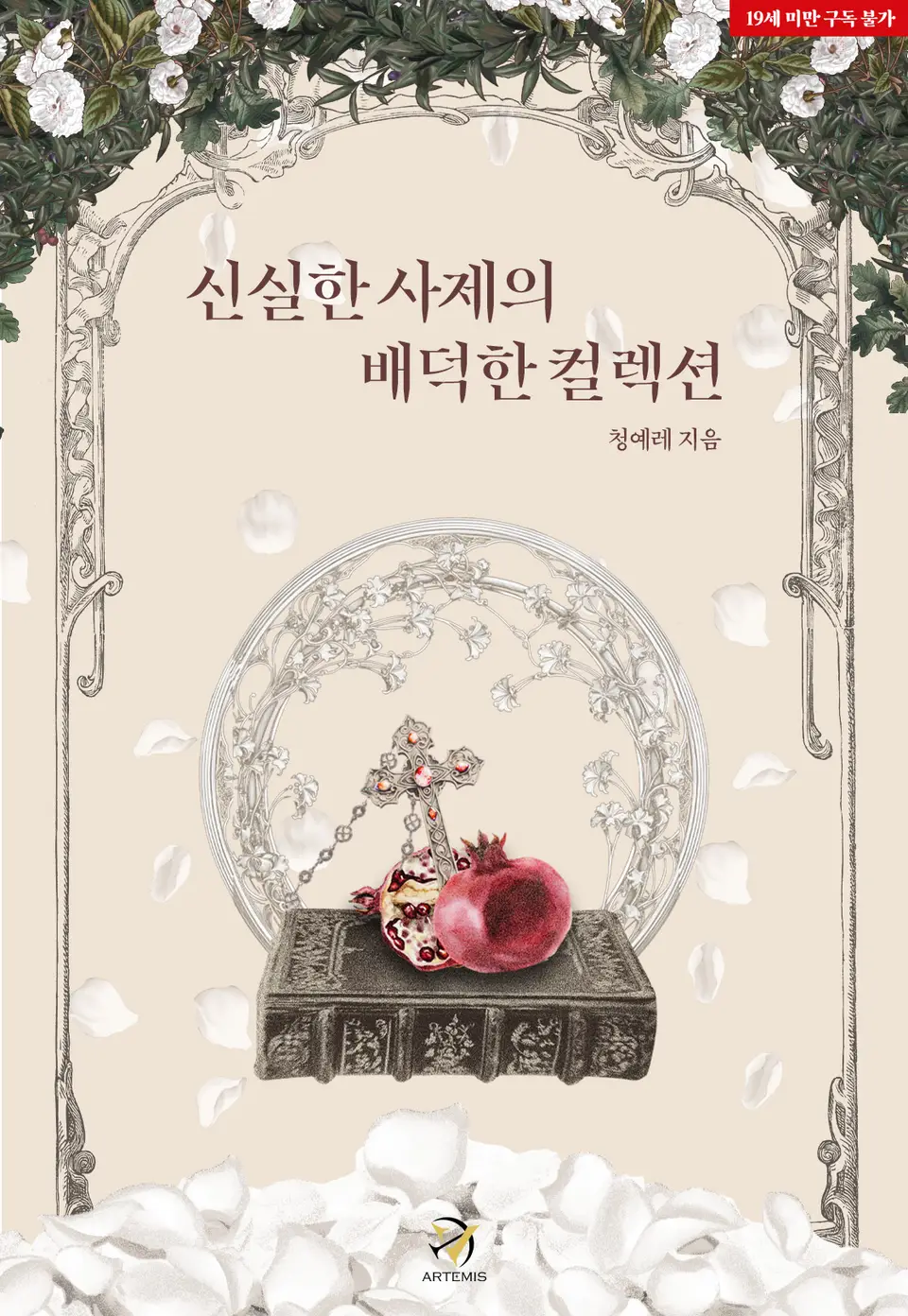
... Read More
I need to talk about the sensory world of this scene because the author is doing something really clever with setting that most people probably gloss over. Daphne wakes up and immediately registers: 'The sheets were far too fine to belong to the prayer dorms. Cushions that could never exist in the novices' quarters.' This is such a small detail but it tells us everything about who Theodore is and what his position means. We're not told 'he's a powerful cardinal' — we're shown it through thread count. The author trusts the reader to connect the dots. But the real genius is the ceiling fresco. Right when Daphne is looking up at Theodore's bare chest, the narrative mentions 'the ceiling fresco behind his back that depicted a march of trumpeting angels.' Think about what's happening here — she's lying on a cardinal's bed, half-naked, about to be taken, and above them painted in plaster and pigment are angels marching in holy triumph. The juxtaposition is almost obscene in the best possible way. It turns the room into a kind of sacrilegious cathedral, where the act below is both profane and deeply reverent. The temperature details are also worth noting. There's this constant contrast between cold and heat — her nipples 'taut and sharp from the cold air,' his mouth 'hot and deliberate,' sweat tracing from his temple into her eye. The thermal landscape of the scene mirrors the emotional one: she's shivering between fear and want, and he's all steady, consuming fire. And the sound design! The rip of her robe described as 'like torn parchment in a storm,' her gasps, his low groans against skin, the wet rhythm that starts later. The author builds this entire auditory world that makes the scene feel almost cinematic. I kept wanting to see this adapted because the visual composition alone — golden light, silver lashes, turquoise eyes wide with shock — is stunning.
... Read More
I need to talk about Theodore and Daphne because this section really cracks open what's actually going on between them, and it's not just the obvious physical tension (though God knows there's plenty of that). Theodore Valentino is one of the most frustrating characters I've ever read. He will edge her until she's screaming, he will watch himself finish on HER desk, he will touch her everywhere EXCEPT where she actually needs him. And when she finally corners him, when she's on her knees practically begging — he asks her if God will still love him. THAT line broke me. Because it tells you everything. This isn't about not wanting her. It's about being genuinely, deeply terrified that he'll lose himself, lose God, lose EVERYTHING if he crosses that one line. And yet he can't stop torturing her either. He's trapped in the same cage she is. And Daphne — oh my god, Daphne. Her arc in this section is incredible. She goes from someone who's been reduced to a state of constant sexual frustration and desperation to someone who actively RECLAIMS her own body and desires. When she starts touching herself right in front of him, when she says 'I don't want much. Just once, please' — she's not performing submission anymore. She's making a demand. She's saying: you made me this way, you take responsibility. The chemistry between them is absolutely off the charts because neither of them is pretending. Everyone else in this story might be playing roles, but these two? They're raw. Honest. Desperate. And that makes every glance, every trembling voice line, every moment of hesitation feel electric.
... Read More
Okay so let me just... breathe for a second. I need to process what just happened because my heart is still racing. This chapter is a masterclass in building tension and then absolutely demolishing expectations. Let's talk about the structure here because the author is playing 4D chess with plot devices. So Daphne is alone in this shed, using this ivory darling of hers, totally lost in the moment — and then *crucial moment* — she catches sight of Theodore. Not a hallucination. Not a trick of the candlelight. The man himself stands in the doorway. My jaw hit the floor. I actually gasped out loud reading that. But here's where the genius kicks in. Daphne's immediate thought isn't seduction or panic — it's the desperate scramble for an excuse. "I was just praying." Praying?! In this position? With an imitation phallus rolling on the straw? And Theodore... Theodore doesn't call her out on it. He doesn't report her. He doesn't even seem that mad. Instead, he does something I absolutely did not see coming. He *misinterprets* everything. "How long have you been suffering like this, Sister?" "Were you truly planning to endure the devil's curse on your own?" THE MAN THINKS SHE'S BEING DEMONICALLY OPRESSED BY HER LUST. He genuinely believes her masturbation is the result of a demonic curse, not normal human desire. And then his response? "I will liberate you." He offers to SACRIFICE HIMSELF to perform an exorcism using the exact same implement. He picks up THE SOILED PHALLUS and says "Let us begin the exorcism." I AM SCREAMING. The dramatic irony is SO thick you could cut it with a knife. He thinks he's performing holy deliverance. She thinks he's lost his mind. And the reader? We're sitting here watching two people operate on completely different wavelengths and the sexual tension is absolutely palpable. The pacing in this chapter is ruthless. It goes from solitary pleasure → shocking intrusion → panicked excuse-making → physical search (which itself is charged with weird tension) → the reveal of the phallus → his misinterpretation → his "rescue" → the actual act. That's a complete narrative arc compressed into a single scene and it flows like water. No fat, no filler, every beat pushes toward the inevitable collision. What I love most is how the author uses the setting. This abandoned shed, the flickering candle, the straw bed — it's got this claustrophobic, almost sacred atmosphere. Like a chapel where something unholy and holy is happening simultaneously. The temple grounds being "noisy lately" is an interesting detail too. Feels like there's more happening in the background — political intrigue, religious tension, the rise of this "new star" — that's weaving into their personal drama. Also, the fact that Theodore had an erection earlier that he was embarrassed about? That memory flashes through Daphne's mind at the crucial moment. It's a gorgeous callback. It suggests this wasn't entirely one-sided, and it makes his "sacrifice" feel less like naive misunderstanding and more like... something else entirely. Or maybe he's just really committed to the bit. I don't know anymore and I need to keep reading.
... Read More
I've been thinking about this passage for hours and the religious imagery keeps coming back to me like a refrain I can't escape. The central metaphor here is so thick you could cut it with a knife: holy power used to bind, a cardinal's bed doubling as an altar, a first kiss that feels like devotion. The author isn't just writing a sex scene — they're writing a kind of blasphemy and reverence simultaneously, and that tension IS the point. Look at Daphne's arc in this scene. She arrives thinking she's there for 'training,' performing duty. She's been compartmentalizing herself — body separate from desire, role separate from self. The binding spell forces that separation apart. She can't move, can't pretend, can't escape into her routine. The physical restraint becomes emotional liberation in the most contradictory way. 'It was time to do her duty and move on' — and then her duty becomes something she never expected it to be. The name 'Theo' is symbolic in a way that goes beyond cute intimacy. In this world, names seem to carry weight — Theodore's full title 'Your Eminence' is a position, a rank, a distance. 'Theo' is a person. When she says it, she's not just obeying; she's acknowledging the human beneath the holy office, and in doing so, she's letting go of her own carefully constructed identity as a woman who doesn't want this. Her arousal becomes a kind of truth-telling that her mind isn't ready to admit out loud. And then there's the imagery of consumption — 'it feels like I'm being devoured,' his 'ravenous' kiss, the 'abomination' being 'devoured.' This ties into a much older literary tradition where desire and destruction are siblings. But what's interesting here is that Daphne isn't being destroyed; she's being transformed. The page ends with her connected to him physically and emotionally in a way that her life as a novice never allowed. She's crossed a threshold, and the symbol of that threshold is the bed itself — consecrated space turned profane, or maybe profane space finally made holy by genuine feeling.
... Read More
I keep thinking about those thread bracelets. Daphne made eight — one for each girl, including herself — and somehow hers went missing. She never found it. She told Thalia 'I made them for you. That's enough for me.' But it wasn't enough, was it? Because she was still the one staying behind. The one everyone assumed would want to leave just like them, except she chose to remain. The bracelet disappearing feels symbolic on so many levels — she gave pieces of herself to everyone else and lost her own place in the process. Colorful threads woven together, connecting them, and yet the one meant for her vanishes into the night like her own future might. And then there's the three-star prophecy looming over everything like a storm cloud that never breaks. The narrative keeps referring to these girls as 'no longer considered part of the prophecy' — which means they WERE once considered candidates, once thought they might be the one. But they were discarded. Replaced by newcomers. And yet Bishop Caleb calls them 'those ones' like they're contaminants, like their very existence is a problem to be managed. Theodore pushes back on that, and that single act of defense — 'they are proper clerics as well' — is quietly revolutionary in this world. The book is asking: who gets to decide who is sacred? Who decides which prophecies matter and which humans are just disposable vessels? And what happens when someone with power actually starts treating them like people instead of props in someone else's divine plan?
... Read More
There's a moment in this chapter where Theodore presses his chest against Daphne's and she feels "the rapid heartbeats through several layers of cloth. She couldn't tell whose it was." I had to stop reading. I genuinely had to put the phone down and stare at the wall. Because that detail — that inability to distinguish whose heartbeat is whose — is the entire emotional thesis of this relationship compressed into one sentence. Two people so entangled that even their most basic biological responses merge together. The emotional journey in this chapter is devastating because it moves through so many layers. Daphne starts in a place of private shame — she's pleasuring herself and immediately feels guilty about it, wondering if she's broken, wondering if the ivory darling is inadequate, wondering if she should involve someone else and then slapping herself mentally for the thought. 'Just thinking about him made her feel like she was committing adultery.' The word adultery used in relation to herself and a toy? That's the level of internalized guilt we're dealing with. Then Theodore enters and the panic is immediate and visceral. Her hiccups aren't comedic — they're a manifestation of pure terror. This is a woman who believes her three-star fate condemns her to suffering, and now the most powerful man in the temple has caught her in her most vulnerable moment. 'My life is over' isn't hyperbole. For someone with her background, it's a genuine assessment. But then comes the turn — the moment when she realizes he's not there to condemn her. He's there to save her. The relief must be oceanic, and the author captures it perfectly in the way Daphne's resistance melts. She stops fighting. She lets herself be held. Lets herself feel. And Theodore — oh, Theodore. His motivation is so beautifully complicated. He claims it's religious duty, that she's cursed by the devil. But the text keeps undermining that explanation. His jaw clenching. His breath catching. The way his 'stunningly beautiful face contorted in an odd way' with every thrust. He tells himself he's performing an exorcism, but his body tells a different story. 'Something large and hard poked Daphne in the stomach' — that's not the description of a man conducting a ritual. That's the description of a man who wanted this too. The CP chemistry between them is nuclear because it's built on mutual misunderstanding that somehow leads to mutual truth. He thinks he's saving her. She thinks she's being punished. But both of them are feeling something real, something that transcends whatever narrative they've constructed around it. That ending where she hugs him tightly and experiences a second orgasm? That's not just physical. That's the moment she stops being afraid of wanting him.
... Read More
The way this chapter moves is absolutely chef's kiss. It starts SO quiet — just girls whispering in bed about marriage prospects, one girl feeling sorry for herself because some guy hasn't shown up at the temple, and Daphne making these little thread bracelets she spent weeks on. It's domestic. It's soft. You can practically hear the blankets fluffing and the girls giggling over braided colors. And then Daphne can't find her own bracelet and suddenly there's this tiny ache — she gave everything to everyone else and was left with nothing. That's a beautiful gut-punch disguised as a throwaway detail. Then the laundry scene hits and Marianne drops the bomb that Daphne hasn't applied for a marriage permit, and the whole mood pivots. Everyone stops. Even the story stops for a beat. And then Daphne lunges for the blanket, falls backward, and THEODORE'S HAND is there. From sleeping-in-bed whisper energy to a cardinal catching you mid-fall in under three paragraphs. The chapter also does this thing where it gives you the prophecy context right when you need it most — not as info-dump but woven into Caleb's dialogue while he's trying to get Theodore to leave. 'It was done to prevent the prophecy from being fulfilled.' That line hit me like a truck because suddenly everything about this place has teeth. The last bit with the girls groaning about tomorrow's field work is almost comedic relief after all that tension, like the book is giving your nervous system a second to breathe before whatever's coming next. But I swear if those fields aren't where something explodes next chapter I will be very upset.
... Read More
Okay, can we just talk about Cardinal Theodore Valentino for a second because this man is the most dangerously compelling character I have ever encountered in romance fiction. The way he walks into that scene—silver hair like melted moonlight, golden eyes that seem to see everything, an actual young cardinal who is apparently beloved by the gods—and he doesn't scold her or turn her in. He picks up HER TOY and whispers "let us begin the exorcism" with a smile that is equal parts sweet and completely unhinged. "To endure the devil's curse all on your own. You must have suffered greatly." Hear me when I say this line wrecked me. He's acknowledging her suffering, her secret pain, and instead of condemnation he's offering himself up as the solution. Who does THAT as a cardinal? Who even THINKS like that? And yet he's presented as upright, pious, the youngest cardinal in history, possibly holier than the Pope himself. That contrast between his public image and whatever is going on in that private shed is absolutely electric. Then there's Daphne, who maintains this impenetrable wall of piety everywhere except when she's alone—and the moment she thinks she's safe, THE ONE PERSON who knows about her private suffering shows up. Her reaction to him touching her wrists, the way her body betrays her with involuntary reactions even as her mind is screaming—it's such a rich portrayal of someone caught between devotion and desire. And Alec! The little layman who bumps into Theodore and gets his hand crushed with what I can only assume is an ON PURPOSE iron grip. The fact that Theodore's golden eyes quietly follow Alec's retreating back afterward—that tells me everything I need to know about Theodore's protective instincts. This man has layers upon layers. But here's what's really getting under my skin: Daphne's internal monologue after Theodore leaves. She calls him disgusting, wonders if he was "in heat," frames his interest as some kind of predatory temptation because of the Three Stars prophecy. She can't even PROCESS that someone might genuinely want to help her without assuming the worst. How many years of institutional control has broken her ability to trust kindness? I keep thinking about who Theodore really is versus who everyone thinks he is. The text tells us he's known for his upright character and overwhelming grace, but the way he looks at Daphne, the way he grips Alec's hand too tight, the almost reverent way he speaks about her suffering—something much more complicated is going on beneath that polished exterior. Is he truly offering salvation, or is there something darker driving his fascination with her? Because that smile of his felt painted on, didn't it? Too perfect. Too composed. Like he'd been rehearsing this moment. Also, the fact that Daphne just PRAYS FOR FORGIVENESS after having an angry thought about men? The institutional conditioning is SO deep in her that even her private thoughts feel like sins. Meanwhile Theodore—this paragon of the Church—seems to be the ONLY person who might actually see her as a human being rather than a prophecy or a problem. I need to know what happens next because I am NOT ready for this dynamic to resolve. What do you think is actually motivating Theodore? Genuine religious devotion to "save" her from her cursed nature, or something far more personal that he hasn't even admitted to himself yet?

Leave a comment

You must be logged in to leave comments. or
