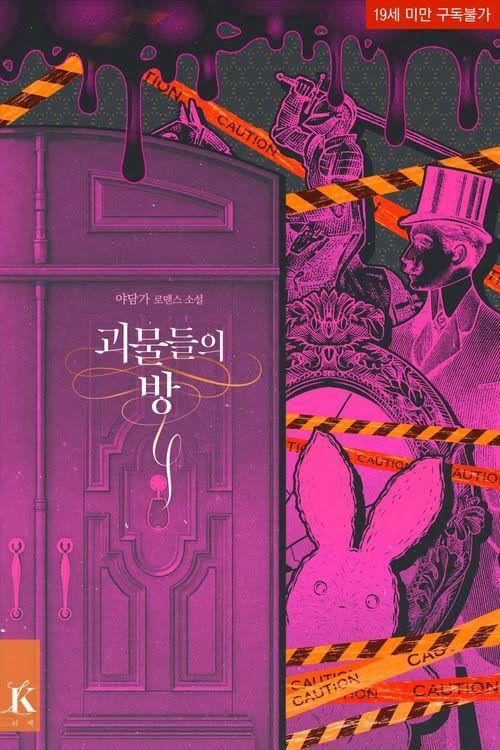
The Monster’s Room
+Add to Custom List
Genres:
Novel Info
  • Author:
  • Luna
  • Status:Ongoing

Summary

... Read More

Marie Garcia, an orphan raised in a Korean facility and subsequently adopted by a American family, suffered a series of devastating tragedies. After her adoptive family was murdered, her guardian, Andrew Garcia, revealed himself to be the perpetrator. He coerced Marie into marriage under threat of death, but the confrontation ended with Andrew dead and Marie holding the weapon. Framed for multiple murders and labeled a psychopath, she was sentenced to death. On death row, she was approached by the SCP Foundation, represented by Senior Researcher John Doe. In exchange for clearing her name, Marie agreed to join the Foundation as a D-Class personnel, designated D-1705, to manage anomalous entities in Area F-49.

Upon entering the facility, Marie was subjected to a rigorous orientation and tasked with managing five specific SCPs in Sector F-49. Her first assignment involved SCP-1705-2, known as the Transparent Jelly Eraser, a Euclid-class entity that resides in a marble bathtub. The instructions were minimal: provide moisture daily and avoid loud noises. However, upon entering the containment chamber, the entity attacked Marie, erasing her protective suit and clothing. Rather than killing her, the entity, displaying high intelligence, sought bodily fluids through sexual stimulation. Marie survived by learning to control her reactions and eventually negotiated terms, convincing the entity to preserve her clothes in exchange for continued interaction. This encounter resulted in an unexpected benefit; the entity healed her physical ailments and improved her appearance, removing bruises and enhancing her skin and hair quality.

Following this, Marie managed SCP-1705-1, the Fluffy Cotton Doll, a Safe-class entity that requires a daily hug with appropriate force. This task was straightforward and posed no physical threat. Her third responsibility involved SCP-1705-3, the Marionette Troupe Leader, an Euclid-class entity hosting a weekly performance. The containment procedure required attending the show and clapping at the end. During the performance, marionette-like dancers forced Marie into sexual acts, creating a scenario where refusing to choose a partner would prolong the torment indefinitely. Marie endured twenty-one encounters with the dancers before finally clapping to end the performance, afterward sharing a brief kiss with the stitched-mouthed Troupe Leader as a gesture of acknowledgment.

Marie’s fourth task concerned SCP-1705-4, the Shattered Mirror, a Keter-class entity that asks three questions during a monthly visit. Marie successfully answered its inquiries and, in a deviation from standard protocol, kissed the mirror reflection, learning its name was Spiegel. This interaction triggered significant changes within the Foundation. Researchers discovered that Marie’s security clearance had been anomalously elevated, and her interactions were not being recorded in standard logs. Meanwhile, junior researchers Connor and Amelia proposed experimental protocols to test the unique compatibility between Marie and the anomalous entities, seeking to understand why she survived and thrived under conditions that typically resulted in death or erasure for other D-Class personnel.

The narrative shifts as Marie is temporarily transferred to the E-Section for a Safe-class task alongside another D-Class subject, D-911 Kevin Harris. They were assigned to manage the One Hour Cafe Table, which required continuous conversation for sixty minutes. During their task, Kevin revealed the harsh realities of Foundation operations, including the high mortality rates in other sectors and the use of anomalous entities against each other in secret projects. Marie observed that anomalous entities operate beyond human logic and cannot be fully controlled, a lesson reinforced by her experiences with the erratic behavior of the entities in F-49. The story concludes with Marie navigating the precarious balance between survival and exploitation, utilizing her unique rapport with the SCPs to secure better living conditions and information access while remaining trapped within the Foundation’s unaccountable system.

Latest Release
DateGroupRelease
2026-09-27citrus aurora c76
2026-09-27citrus aurora c75
2026-09-27citrus aurora c74
2026-09-27citrus aurora c73
2026-09-27citrus aurora c72
2026-09-27citrus aurora c71
2026-09-27citrus aurora c70
2026-09-27citrus aurora c69
2026-09-27citrus aurora c68
2026-09-27citrus aurora c67
2026-09-27citrus aurora c66
2026-09-27citrus aurora c65

Community Reviews

Rating(4 / 5.0, 43votes)
5 stars
17(40%)
4 stars
10(23%)
3 stars
14(33%)
2 stars
2(5%)
1 stars
0(0%)

Popular reviews

... Read More
The courtship scene is the single most tension-packed moment in this entire batch and I'm still recovering. Let me explain why this works so well as conflict. The gramophone asks Marie: <"What will the lady choose?"> And this seems like a simple preference question. Pick a dancer, show appreciation, end the scene. But Marie immediately recognizes the trap: "Choosing something meant dividing sides. Yours and mine. To take it to an extreme, it meant allies and enemies." This is the core stakes of the entire encounter compressed into one realization. The SCP warns: "Do not antagonize the characters." The dance is designed to force a choice that creates an antagonist — whoever you DON'T choose becomes your enemy. The Marionette Troupe Leader's rules aren't suggestions; they're survival mechanics. So Marie chooses silence. "I choose nothing." And the gramophone laughs. Not angrily — genuinely amused, almost impressed. <"Oh?> <"It seems the courtship is still lacking!"> This response does something incredible: it validates Marie's intelligence while simultaneously raising the stakes. The trap wasn't closed, so now the trap gets bigger. The dancers remove their pants. The situation escalates from psychological danger to physical intimacy to... whatever happens next. But there's another layer of conflict running parallel. Marie's internal struggle against her trauma from Andrew — the man who tried to kill her after she rejected him. The narrative deliberately contrasts the dancer's warm but scentless, faceless body with Andrew's "sticky skin, sweat, pungent scent, and breath." The SCP encounter is simultaneously the most dangerous and the most safe experience Marie has had in a long time. That's not just irony; that's tragic worldbuilding. And externally, the researcher subplot raises the stakes even further. D-1705 might be assigned to dangerous tasks. Records might get deleted because people are dying. Brooks is watching everything with entertainment while Amelia pretends to care. The Foundation isn't just containing anomalies — it's consuming people. What does Marie stand to lose here? Her mind? Her body? Her life? And what has she already lost — her memories of Andrew, apparently, which means the Foundation has already taken something from her she can't get back.
... Read More
Can we talk about how the gramophone narration works in this chapter because the voice writing is NEXT LEVEL. First off, the gramophone uses these angle brackets for its dialogue — — and it immediately sets it apart from everything else in the text. You KNOW something's wrong when the narration voice is mechanized and the human character is just... stuck in the middle of it. The shifts in tone are everything. When it addresses the dancers, it's cold. "Drag the eliminated one out." Just that. No flourish. No emotion. But when it talks to Marie, it'sPerforming. "Oh! Did you like the first dancer after all?" "Who will be the dancer to win your favor?" It's like a game show host from hell, enthusiastically facilitating torture. And the best part? The gramophone LIED to her the whole time. Or at least, it never told the whole truth. Marie figures it out mid-scene: "the gramophone's voice was orchestrating everything. Its true nature was that of the leader of the troupe." She deduces this from listening to the voice patterns across twenty-one encounters. THAT is character intelligence right there. She's not just surviving, she's ANALYZING. Compare that to the Shattered Mirror dialogue. Spiegel writes on glass. No voice at all. Just fogged text appearing letter by letter. The contrast between the loud, invasive gramophone and the silent, creeping mirror entity tells you everything about their different personalities. And Marie's actual spoken dialogue? Almost none. She makes sounds — "Ugh," "Ahh," "Haa" — but real words? Rare. When she DOES speak, it's deliberate. "Next time." Two words that carry MORE weight than any monologue could. That's restrained writing at its finest. The cotton doll scene has no dialogue at all and it's somehow the most peaceful moment in the entire chapter. Just Marie patting the doll and saying "You're a good one." After everything, the simplest conversation is the most soothing. The author knows exactly when to silence things. Also the mirror SCP saying "See you again, Marie" by name? That's the kind of line that gets repeated in discussion forums for weeks. Short, personal, slightly threatening, and delivered with zero fanfare. Perfect.
... Read More
I need to think out loud about this chapter because the symbolic weight behind it is staggering and I can't stop turning it over in my mind. Let's start with the obvious one: marionettes. The Troupe Leader is literally called the Marionette Troupe Leader. The dancers move however they're told. When one is eliminated, they're dragged away like a puppet with cut strings. Marie is the audience AND the performer, but is SHE also a puppet? She didn't choose to be here. She's following rules she didn't write, performing for an entity she doesn't understand. The parallel is almost too on-the-nose, except the book earns it because we FEEL her gradual shift from victim to player. She learns the rules. She claps at the right time. She chooses to kiss the Leader. That's not a puppet — that's someone learning to cut their OWN strings. Then there's the mirror. Spiegel. The name itself means mirror in German — such a small detail but it's there if you look. Mirrors are about identity, self-recognition, duality. The cracked mirrors suggest something broken about how we see ourselves, or how this world fractures identity. Marie asks the mirror its name and it gives one — Spiegel — and then tells her "See you again." Mirrors reflect, but they also RECUR. Every time you come back, the reflection comes back too. This isn't a one-time encounter. And the Jelly Eraser. Think about what it ERASES. Not just bodily fluids — it erases exhaustion. It erases pain. It's essentially a forced reset button. What does that say about Marie's existence? That her suffering is something to be cleaned away, not addressed? Or that survival requires erasure — of trauma, of memory, of self? The creature both cares for her and consumes parts of her. It's contraception AND cleansing. Nurturing AND violating. The breadcrumbs. Hansel and Gretel. Marie leaves a trail of herself through the Troupe room, marking her passage, but she's also the child who got lost in the woods. Except she's not lost — she found her way OUT. She walked through the audience section, past the bowing dancers, past the gramophone's questions, and she LEFT. The fairy tale subversion is brilliant because she's not rescued — she escapes on her own terms. And kissing. Throughout the chapter, Marie is physically intimate with twenty-one beings and CANNOT kiss any of them. But she KISSES the Troupe Leader at the end. Kissing as intimacy, as communication, as something that can't be automated or orchestrated. It's the one truly HUMAN act in an inhuman situation. When she kisses Spiegel in the mirror, it's the same impulse — connection across boundaries, across realities, across the gap between self and other. What is this book really about underneath all the horror? I think it's about agency. About finding moments of genuine human connection in systems designed to strip them away. About how survival isn't the same as winning, but it's still worth something. Marie walks out changed, marked, traumatized — but she chose that kiss. She asked the mirror its name. She said "next time" like someone who plans to return, not someone who's broken. That's the theme. That's what I keep coming back to.
... Read More
I have to address the fact that this chapter is almost entirely WITHOUT dialogue and it works SO well. Marie's spoken words are basically just cries and pleas — "Ah," "No, no, please," "See you again, Sir Knight." That's it. And yet the narrative voice is so vividly present that I never once felt starved for conversation. The author's voice is doing the heavy lifting here. It's intimate, raw, unflinching — sometimes clinical ("her body was intact. Almost cruelly so") and sometimes poetic ("Her walls were like fully bloomed flower"). That tonal flexibility is what makes the prose sing. The narration doesn't flinch from the erotic content but it also doesn't wallow in it. There's a restraint underneath the explicitness that gives it real literary weight. And those fragmented whispers at the end — "Have to ▉▉. Have to ▉▉ ▉." — I love how the author uses redaction and fragmentation as a stylistic choice. It forces the reader to participate, to fill in the blanks with their own imagination, which is somehow MORE unsettling than if the words had been spelled out. The withheld language becomes part of the horror. "See you again… Sir Knight." That one line of dialogue at the end? Perfect. The added "Sir" — explained as being "due to the ring" — is such a small character moment but it tells us everything we need to know about how Marie has processed this encounter. She's reclaiming some dignity, some protocol, some normalcy. It's a tiny act of defiance wrapped in politeness.
... Read More
"Astonishing, Delightful, Chilling Marionette Show!" — I need this on a t-shirt immediately. But seriously, the author built this entire scene like a proper descent into beautiful horror. Let me walk through it because every detail matters. First, the jazz leaking from the fourth room's door. Not silence, not ominous humming — UPBEAT JAZZ. That's such a specific tonal choice that tells you everything about this SCP. It's not lurking in darkness; it's performing under spotlights. The gramophone voice welcoming guests like a vintage TV host sets up this bizarre carnival atmosphere before you even cross the threshold. Then the stage reveal: three mannequin-headed musicians in elegant evening wear. Human hands, wooden faces. That dissonance between the classy appearance and the wrongness underneath is chef's kiss. And the dancers later — "Their steel-like movements... moved with a grace and beauty that seemed as light as air" — this is actually beautiful writing. The author isn't just scaring us; they're making us appreciate the horror aesthetically first. The moment the lights dim and the music stops, and the opera house becomes "a desolate ruin" — that transition gave me actual chills. One second it's grand and opulent, the next it's empty and decaying, and only the unnatural sounds of those jointed bodies moving fill the void. The acoustics detail later, where Marie hears her own moans amplified through the theater's sound design, is both horrifying and perversely intimate. And the bed being wheeled onto stage by "monsters in work uniforms, possibly part of a separate stage crew" — the casual matter-of-factness of this detail is what makes it work. In a normal story this would be shocking; here it's just Tuesday. The worldbuilding here operates on a level where the mundane and the monstrous share the same air without one explaining the other. That's the Foundation at its finest — clinical documentation coexisting with grotesque spectacle.
... Read More
This chapter is drenched in symbolism, and I'm here for it. The magic mirror, Spiegel—it's not just a plot device; it's Marie's soul externalized. It reflects truth, shows her independence, her power, but also traps her image. She says, "I am the Queen, and I have the magic mirror." Fairy tale motif, but twisted. The pale horse of death? Classic apocalyptic imagery, but here it's her guardian, her lover. Death serving life. The blood puddle that reflects her agony before she's healed—it's purification through pain. And the cotton doll? Childhood innocence, clutched even as she becomes a monster. The deepest theme, though, is the paradox of love. Marie wished for love to cure loneliness, and she got it—but it's monstrous, all-consuming, violent. The anomalies fight each other for her attention. Is that love or obsession? The story doesn't judge; it just shows. And the Foundation's role? They "secured" her by offering a path when she was desperate. Institutional manipulation as abandonment. Beautiful, devastating stuff. I need to think about this for a week.
See all reviews

Custom lists

See all custom Lists