Summary

... Read More

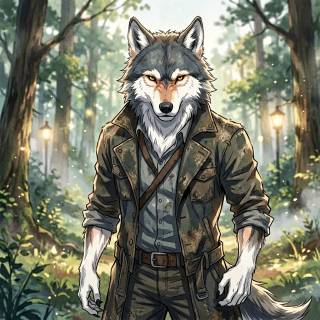
Qin Zhenzhen was a dedicated ballet dancer preparing for an international competition when her life was abruptly upended. While practicing in a park, she was suddenly transported to a savage world inhabited by beastmen. In this new reality, she found herself being hunted by a tiger in the Black Mist Forest. Her only chance of survival came from Karl, a silver wolf beastman of exceptional strength and status. Karl, who was known for his cold demeanor and disdain for the social customs of his kind, intervened to save her. He killed the tiger and, upon seeing Qin Zhenzhen, felt an immediate and powerful attraction. He noticed she wore no Beast Ring, indicating she was unpaired, and decided to claim her as his own. Despite his initial reluctance to engage with females, he shifted into his human form and commanded her to return to his tribe with him.

Karl’s world is governed by strict hierarchies and dangerous beasts. He is a high-ranking wolf beastman who values his independence and has no interest in the polygamous norms that define his society. The concept of a female being alone in the forest is abhorrent to him, and his decision to save Qin Zhenzhen is driven by both instinct and a desire to protect something rare. He is determined to take her to the Wolf Tribe, regardless of the consequences. Qin Zhenzhen, confused and terrified, realizes she has transmigrated into a world of monsters and magic. She agrees to go with Karl, hoping to understand her new surroundings and find a way to survive. Her background as a ballet dancer, while seemingly irrelevant in this brutal world, becomes a point of curiosity and fascination for Karl.

The journey to the Wolf Tribe is fraught with peril. Qin Zhenzhen struggles to keep up with Karl, who moves with supernatural speed and agility. She is overwhelmed by the sights and sounds of the forest, filled with dangerous creatures and strange energies. Karl remains watchful, ensuring no other beastmen interfere with his claim. He is wary of other males who might see Qin Zhenzhen as a prize to be won. The tension between them is palpable; Qin Zhenzhen is afraid of Karl’s raw power, while Karl is intrigued by her fragility and determination. He is accustomed to females who vie for his attention, but Qin Zhenzhen is different. She does not fawn over him or try to manipulate him. Instead, she is honest and direct, which confuses and intrigues him.

Upon arriving at the Wolf Tribe, Qin Zhenzhen is introduced to a society that is both primitive and highly structured. The tribe is led by a powerful Alpha, and Karl is one of his most trusted warriors. The other beastmen are skeptical of Karl’s sudden interest in a human female. They question her worth and wonder if she is a threat or a burden. Karl silences their doubts with his authority and strength. He declares that Qin Zhenzhen will be his mate, a decision that shocks the tribe. In this world, females are scarce and valued, but a human female is an anomaly. Karl’s choice is seen as unusual, but his reputation ensures that no one dares to openly challenge him.

Qin Zhenzhen begins to adapt to her new life. She learns about the beastmen’s culture, their powers, and their dangers. She discovers that she has a unique resilience that allows her to survive in this harsh environment. Her ballet training has given her strength and flexibility, which she uses to navigate the physical challenges of her new world. Karl watches her progress with growing admiration. He sees her determination and courage, qualities he respects deeply. Their relationship begins to evolve from one of captor and captive to something more complex. Karl finds himself drawn to her not just for her beauty, but for her spirit. He is willing to protect her from the dangers of the tribe and the outside world.

However, challenges remain. Other beastmen, jealous of Karl’s attention, plot against him. They see Qin Zhenzhen as a weakness and attempt to undermine his position. Qin Zhenzhen must navigate these political intrigues while trying to understand her place in this world. She is not just a passive observer; she begins to assert herself, using her wits to survive. The story follows her journey from a confused outsider to a key figure in the Wolf Tribe. Karl’s loyalty to her is tested as he faces threats from rival factions. Together, they must overcome external dangers and internal doubts. The narrative explores themes of survival, adaptation, and the breaking of social norms. Karl’s rejection of polygamy and his commitment to a single mate challenge the traditions of his people. Qin Zhenzhen’s presence forces the tribe to reconsider their values. The story builds towards a climax where their bond is tested by a significant threat, requiring them to rely on each other for survival.

As the plot develops, Qin Zhenzhen uncovers secrets about the world she has entered. She learns that her transmigration was not accidental and that she may have a role to play in the fate of the beastmen. Karl’s past is also revealed, showing that his cold exterior hides a deep sense of duty and honor. Their partnership becomes a symbol of change in a rigid society. The story concludes with them facing a common enemy, solidifying their alliance. Qin Zhenzhen proves her worth not through combat, but through her intelligence and compassion. Karl, in turn, proves his devotion by standing by her side against all odds. The narrative ends with the promise of a new era for the Wolf Tribe, one where tradition and change can coexist.

Novel Items

More
Item
A ring that represents a partner's mark in the beastman world. Qin Zhenzhen is discovered to not have a single Beast Ring on her hands, indicating she has no mate or partner, which surprises Karl and makes her particularly valuable in his eyes.
Item
A cultivation energy or power level in the beastman world. Second-Order Beast Qi is mentioned as potentially necessary to win against Lilith, who has reached First-Order Great Perfection. This indicates a cultivation system with different orders and levels.
Event
A competition held by Lilith in Jushou City to attract males. The event draws a large crowd of young, sturdy beastmen wearing animal skins. Contestants emit white light during the competition, and Lilith's First-Order Great Perfection cultivation level makes her an formidable opponent.
Item
A snow-white ballet tutu worn by Qin Zhenzhen after transmigrating. She is described as sitting huddled on the forest floor in this outfit, looking like a wounded little white rabbit. The tutu contrasts with the wild beastman world she has entered.
Latest Release
DateGroupRelease
2026-08-11shanghai fantasy c1

Community Reviews

Rating(4.2 / 5.0, 6votes)
5 stars
2(33%)
4 stars
3(50%)
3 stars
1(17%)
2 stars
0(0%)
1 stars
0(0%)

Popular reviews

... Read More
I need to talk about Karl because WOW. This guy is everything. Let me paint the picture for you: he's a silver wolf, rare silver-grey fur, cold and intimidating, and he literally snorts at the most beautiful female in the city. That's not just arrogance—that's a man who knows his worth and has zero interest in playing the harem game. The self-mockery in his eyes when he thinks about females not being willing to stay with one male? That's not just a tough exterior, that's someone who's been hurt or at least deeply cynical about love. It makes him immediately three-dimensional. And then he meets Qin Zhenzhen. The way the author writes his internal panic is hilarious and endearing. He catches her scent, goes full rescue mode, sees she has NO beast ring (meaning no partner), and his heart starts pounding like he's the one who's been chased. He tries to talk to her in wolf form and sounds like a Husky. 'Awoo-woo-wuff~' I literally screamed laughing. And then his ears turn red when she laughs at him. This man is a terrifying predator in wolf form but absolutely flustered by a lone female, and I am HERE FOR IT. The dynamic between them is already crackling. He's forceful—'Come back to the tribe with me!'—but there's this underlying protectiveness. She's shocked, confused, terrified, but also genuinely grateful. And that moment where he freezes shifting into human form? That's not just comedic timing, that's the author showing us that Karl is inexperienced when it comes to actual interaction with females. He's been alone, hunting, surviving. Now he's face-to-face with the female of his dreams and he has no idea what to do. Their relationship is going to be so much fun to watch develop.
... Read More
Can we talk about how natural and funny the dialogue is in this book? Because I was genuinely surprised. The wolf beastman's introduction of Karl is perfect: 'Hey! Karl!' followed by the enthusiastic pitch about Lilith. It feels like real banter between friends who've known each other forever. And Karl's response? Just a 'Snort!' and walking away. One word, one sound, and we know everything about his personality. The author doesn't need paragraphs of description—Karl's silence speaks volumes. Then there's Karl's internal monologue, which is where the voice really shines. 'Just what kind of person would leave a female alone in the forest?' That line is so Karl—protective, judgmental, but also genuinely confused by a world that operates differently from his values. And when he tries to talk to Qin Zhenzhen in wolf form: 'Awoo-woo-wuff~' I cannot stop thinking about this. The author has the comedic timing of a stand-up comedian. Karl wants to say something meaningful, something charming, and instead he sounds like a Husky having an identity crisis. 'Pfft!' Qin Zhenzhen's laugh is the perfect response—it's human, it's warm, and it immediately breaks the tension between them. Qin Zhenzhen's dialogue is sparse but effective. 'Did you come to save me?' 'Thank you.' 'Tribe?' Each line reveals her state of mind—confused, grateful, processing. And Karl's 'Come back to the tribe with me!' is forceful but not cruel. You can hear the desperation underneath it, like he's afraid she'll say no. The dialogue here does so much heavy lifting for character development, and it never feels forced or expository.
... Read More
Okay so let me just say this—Chapter 1 starts with what I thought was going to be a standard harem-beastman romance setup. A martial arts competition to find a husband? Classic. I was already mentally preparing to roll my eyes. But then Karl walks in like, 'snort, not interested,' and suddenly I'm like wait, this guy actually has principles? Monogamy in a world where even the City Lord can't enforce it? That's a plot hook I didn't see coming. And then Chapter 2 hits me with the transmigration reveal. I literally sat there like—what? One second she's a ballet dancer getting chased by a tiger, the next she's in a forest with a talking werewolf. The pacing of that reveal was *chef's kiss*. The author didn't just dump it on us; we experience Qin Zhenzhen's confusion alongside her. 'The strange environment, the sudden appearance of a wild beast, and a talking werewolf… everything pointed to one possibility.' That line gave me chills because it was the exact moment her realization clicked, and mine did too. The plot structure here is actually really smart. It opens with worldbuilding through the contest scene, introduces our male lead with his defining trait (monogamy obsession), then pivots hard into the female lead's POV and drops her into the most dangerous situation possible. By the end of Chapter 3, we already know she's transmigration-bound and Karl has decided to 'snatch' her. That's a lot of plot compressed into three chapters, and it doesn't feel rushed at all. The narrative arc is setting up a classic opposites-attract dynamic but with a transmigration twist that promises internal conflict—she's a modern human, he's a beastman who doesn't trust females to be faithful. I'm already invested.
... Read More
I have to be honest with you—I did not expect to feel anything from a transmigration romance opening, but the scene where Karl saves Qin Zhenzhen actually made my heart squeeze. Let me break down why. Qin Zhenzhen is alone. She's a ballet dancer who was practicing in a park and suddenly she's being chased by a tiger in some weird forest. The desperation in her internal screaming—'Heaven only knows, she was just practicing a dance'—that contrast between her normal life and this nightmare is genuinely unsettling. And then she trips. She's going to die. She thinks about her life and realizes she did almost nothing except dance ballet, and her heart is filled with unwillingness. She wants to live. That moment of raw survival instinct, that 'I don't want to die' energy—it's universal and it hits hard. Then Karl appears. The description of him: 'An exceptionally large silver wolf stood beside her, one paw pinned firmly on the tiger's head. The wolf's blood-stained head was rising from the tiger's neck, blood dripping slowly from its sharp fangs.' That image is both terrifying and incredibly protective. He just saved her life, covered in blood, and the first thing she does is look at him with those 'large, bright eyes' and ask if he came to save her. She sees no hostility in his eyes, and that trust—placing trust in a wild beast right after almost dying—is so vulnerable. And Karl's reaction? 'Fortunately, the female was fine.' He's furious that someone would leave a female alone in the forest. There's this tenderness underneath his rough exterior that I find myself absolutely swooning over. The emotional beat here is perfect—it goes from terror to relief to awkward flustered romance in three paragraphs, and it works because every emotion feels earned.
... Read More
I'm going to be real with you—I usually skim through the first few chapters of a novel to see if it's worth my time. But this? This had me reading chapter after chapter like a madwoman. Here's why the pacing is so effective. Chapter 1 opens with atmosphere. The scorching sun, the cracked earth, the beastmen gathering. It establishes the world, the stakes (martial arts contest for a wife), and introduces Karl as a character who doesn't care about any of it. The chapter ends on his internal monologue about monogamy, which is a great hook. It's short, punchy, and leaves you wanting to know more about this silver wolf who snubs the most beautiful female. Chapter 2 immediately pivots to danger. No transition, no 'meanwhile'—we cut straight to Qin Zhenzhen being chased by a tiger. The action is breathless. Short sentences. 'Thump!' 'Ah!' The pacing mirrors her panic. And then the rescue happens, and suddenly the pace slows down for this awkward, almost comedic exchange between a flustered werewolf and a confused human. The shift from life-or-death tension to romantic comedy timing is masterful. Chapter 3 resolves the immediate danger but opens a much bigger mystery. She realizes she's transmigrated. Karl decides to take her to his tribe. The chapter ends on 'It's over, it's over. I really have transmigrated.' That's a perfect cliffhanger—not because something dangerous is about to happen, but because the entire world has just opened up and we have no idea what's coming next. The author knows exactly when to speed up and when to let a moment breathe. I was not prepared for how good this was.
... Read More
I've been turning over the imagery in these chapters, and there's some really interesting symbolism here that I think the author is planting early. The silver wolf. Karl's fur is described as 'a rare silver-grey—unrestrained, cold, and intimidating.' Silver is a color associated with moonlight, mystery, and something otherworldly. In beastman romance fiction, rare colors often signal rarity of spirit or soul. Karl is rare not just in appearance but in values—his insistence on monogamy in a world that doesn't support it makes him an outlier, a creature out of step with his environment. He's literally and figuratively silver—a wolf among wolves who doesn't fit. Then there's Qin Zhenzhen in her 'snow-white ballet tutu,' described as looking 'exactly like a wounded little white rabbit.' The white rabbit is a classic symbol of vulnerability, innocence, and prey. But she's also a dancer—someone who has trained her body to be strong and graceful. The contrast between her delicate appearance and her desperate will to live ('She wanted to live! She desperately wanted to live!') adds depth to the symbolism. She's not just a damsel; she's a survivor who happens to look fragile. The forest itself is another symbol—the Black Mist Forest. It's dangerous, unknown, a place where a human shouldn't be. But it's also where Karl and Qin Zhenzhen meet. The forest becomes the liminal space between their worlds, the place where transmigration and fate intersect. And the tiger—the immediate threat—represents the brutal reality of this new world, a world where the strong hunt the weak and a lone female is in constant danger. These symbols are woven subtly into the narrative, and I think they're going to pay off big as the story develops.
See all reviews

Characters

See all characters

Custom lists

Oops…There is nothing here.