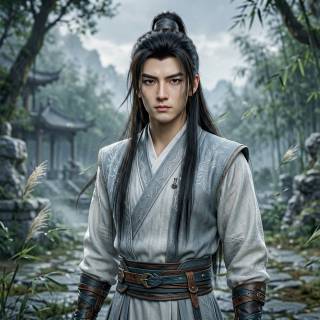
The female supporting character in the abusive novel made a comeback by raising a baby
+Add to Custom List
Novel Info
  • Author:
  • 籽亭
  • Status:Completed

Summary

... Read More
Zhu Jia, a recent university graduate and orphan raised by foster parents, dies in a car accident during a trip with classmates and transmigrates into the body of a third female supporting character in the melodramatic novel The Young Master's Childhood Sweetheart. She awakens in a luxurious bedroom as Zhu Jia, the second daughter of a nouveau riche family who has just married the cold, aloof male protagonist, Mo Yichen, in a contractual one-year union. The system 8888 reveals her original fate: she will be cast out after discovering Mo Yichen brought home an illegitimate son, her family will be ruined, and she will suffer a tragic death five years later regardless of her actions. To survive, she must accumulate three million points by raising the infant, Xiao Wen, who is only twenty days old. Zhu Jia accepts her new reality and begins learning childcare skills through the system's training modules, which cover feeding, diaper changing, bathing, and early education. She discovers that the original host had been volatile and abusive toward the baby, but Zhu Jia approaches caregiving with scientific precision and genuine affection. She immediately sends away the incompetent nannies Mo Yichen provided and takes full responsibility for Xiao Wen's daily care. Her behavior shifts dramatically from the original character's erratic temper to calm competence, confusing Mo Yichen, who returns home early from abroad to investigate. He observes her interacting with the baby and notices the stark contrast in her demeanor, yet remains suspicious of her motives. Zhu Jia navigates the challenges of caring for a newborn while managing the social expectations of the Mo family. She purchases extensive baby supplies, including a car seat and a nursery, and prepares for Xiao Wen's full moon banquet. During the event, she encounters Mo Yichen's family, including his father Mo Ronghua, his stepmother, and his half-siblings. She also reconnects with her biological father, Zhu Tianyao, with whom she had a strained relationship due to her previous obsession with Mo Yichen. The banquet serves as a public introduction of Xiao Wen as the Mo family heir, solidifying Zhu Jia's position as the child's legal mother. As Zhu Jia continues to care for Xiao Wen, she earns points steadily and begins to form a bond with the infant. Mo Yichen watches her progress with growing curiosity, noting her dedication and the positive changes in the household atmosphere. He begins to question whether her transformation is genuine or a calculated act. Meanwhile, Zhu Jia focuses on her goal of surviving the year-long contract and escaping her tragic fate. She balances her new role as a mother with her desire to maintain her independence, planning to leave the Mo family once she has secured enough points to change her destiny. The story follows her daily efforts to master parenting while navigating the complex dynamics of a wealthy, aristocratic family.

Latest Release
DateGroupRelease
2026-08-11shanghai fantasy c69
2026-08-11shanghai fantasy c68
2026-08-11shanghai fantasy c67
2026-08-11shanghai fantasy c66
2026-08-11shanghai fantasy c65
2026-08-11shanghai fantasy c64
2026-08-11shanghai fantasy c63
2026-08-11shanghai fantasy c62
2026-08-11shanghai fantasy c61
2026-08-11shanghai fantasy c60
2026-08-11shanghai fantasy c59
2026-08-11shanghai fantasy c58

Community Reviews

Rating(3.8 / 5.0, 46votes)
5 stars
14(30%)
4 stars
14(30%)
3 stars
12(26%)
2 stars
6(13%)
1 stars
0(0%)

Popular reviews

... Read More
Can we talk about how Mo Yichen's dialogue works in these chapters? The man says almost nothing and it's devastating. Let me give you the evidence. When Zhu Jia asks why Xiao Wen isn't with his biological mother, Mo Yichen's response is basically: "She died three days after he was born." That's it. No elaboration, no emotional display, just facts delivered in that cold flat tone he's known for. But the narration does all the heavy lifting here—we see his face change, his eyes avoid hers, and suddenly this one sentence carries the weight of a man who has been carrying this secret alone. Compare that to Zhu Jia's voice, which is so much more expressive. She asks questions, she processes out loud, she tells the system exactly how she feels. Their dialogue patterns show us everything about their characters without the author needing to explain it. And the system! The 8888 interjections are perfect comic relief but also serve a purpose—they ground the story in its genre while letting Zhu Jia have private emotional moments. The doctor's dialogue is another highlight. "Parents don't need to be too anxious. You'll get better with experience." This line sounds dismissive on the surface but it's actually the most honest thing in the entire passage. Nobody else in this story is being honest about how hard parenting is. The author's narrative voice also shifts subtly between chapters—more introspective in the photo studio, more urgent during the hospital scene. That tonal flexibility is what keeps the reading experience fresh even when the basic setup stays the same.
... Read More
The pacing in these chapters is absolutely wild. Let me break it down because the author really knows how to control the tempo. We start slow—baby photography, light moments, cute descriptions of Xiao Wen in different outfits. It's warm, it's cozy, it's basically a commercial for family values. And then? Within the same chapter, Zhu Jia learns her charge's mother is dead, has an emotional breakdown about her own childhood, and then the kid FALLS OFF A BED. The whiplash is intentional. The author doesn't let you settle into the sweetness because life doesn't work that way for single parents—or whatever they are now. The hospital scene is where the pacing really shines though. Quick dialogue from the doctor, Zhu Jia's panic, Mo Yichen rushing from a boardroom meeting. All of it moves fast but never feels rushed. The chapter ends with Mo Yichen agreeing to watch Xiao Wen while Zhu Jia showers, and that's a perfect mini-cliffhanger—not because anything dangerous is happening, but because we're all waiting for the other shoe to drop. These two are becoming a real team and the reader knows it. The structure also plays with time nicely. More than half a month passes between the photo shoot and the fall, but the author doesn't summarize it away—we get specific details like clothes not fitting anymore, the crib being too small. Those tiny details make the time skip feel real instead of lazy storytelling.
... Read More
The dialogue in this section is surprisingly sharp and I want to talk about how the author uses different voices for different characters. Zhu Jia's internal monologue is the real star here — it's casual, funny, and completely unfiltered. "Men's hearts are like needles at the bottom of the sea" — I need this energy in my own life. Her observations about Mo Yichen being "full of problems, from head to toe" feel like something a real person would think while trying not to laugh at their partner's absurd behavior. Then there's the contrast with Mo Yichen's actual dialogue, which is barely dialogue at all. "I still have work to do. I'm going upstairs." "Mm." That's it. That's the entire contribution from the male lead across multiple chapters. It's almost comically sparse and it says everything about their relationship dynamic. The father-daughter dialogue is where things get really interesting though. Zhu Tianyao's lines feel natural and warm — "Jiajia, you're back?" with that surprised tone, the way he immediately goes to shower and then comes back to see her, the nagging about coming home if she's being bullied. And Zhu Jia's response — "Dad, you're going to say that if I'm being bullied, I should come home, right? Don't worry" — shows how she's learned to anticipate his worries and address them before he even finishes the sentence. That's years of relationship history packed into one exchange. The author clearly understands how real families talk to each other versus how strangers (or distant spouses) communicate.
... Read More
Okay so let me just say—Mo Yichen is the coldest husband I have ever encountered in my entire life and I am OBSESSED. One million yuan per month for living expenses, zero personal interaction, literally communicates through an assistant. Assistant Lin didn't even get to use his prepared lines because Zhu Jia was so different from the original owner. That moment when Mo Yichen says "Keep an eye on her" while smoking by a five-meter floor-to-ceiling window? Chilling. Absolutely chilling. The man is a villain protagonist and I love him for it. But here's what got me—Xiao Wen. This baby is barely a month old and already has these big bright eyes, already calm, already an "angel baby." The way he stops crying the moment he's held, the way he drinks his milk patiently for 20 minutes without fussing—it's like this child instinctively knows his father abandoned him and decides to be good so nobody has to deal with his tears. That hit me harder than I expected. And Zhu Jia herself—she went from a scholarship student who never asked her foster parents for money to suddenly being a mother in a billionaire mansion. The contrast between her past life and this one is wild. She's not some spoiled rich wife; she's a girl who wore the same clothes for years and lived in a dorm. That background makes her handling of everything so much more impressive. She doesn't panic about the poop incident. She watches the system video three times and does it right. She's genuinely capable. The dynamic between all three of them is just... simmering. Mo Yichen is watching from afar, Zhu Jia is trying to survive, and Xiao Wen is just existing in the middle of it all like a tiny little bomb waiting to explode. I can't wait to see what happens when this father actually meets his son.
... Read More
I keep thinking about the yellow rubber ducks. They show up in the most unexpected moment—Mo Yichen in the Bentley, surrounded by baby gear he clearly didn't buy for himself, and one of those ducks gets squeaked when he shifts his leg. It's such a small detail but it represents everything that's changing between these two characters. The ducks are soft, silly, ridiculous things. They have no place in the world of a cold CEO in a dark gray suit. And yet there they are, taking up space in his car, next to his important documents. He didn't remove them. He got used to them. The text literally says he'd "gotten used to such things" after spending time with Zhu Jia. The matching outfits at the end work the same way. His dark yellow leather tie coordinating with her pale yellow gown isn't mentioned as a grand romantic gesture. It's noticed almost accidentally, the way she scans him before they leave. These small visual echoes between them—the ducks in the car, the matching colors, the baby toys scattered through his immaculate house—these are the author's way of showing intimacy without writing a single romantic line. The romance is in the environment, not the dialogue. Xiao Wen himself is a symbol, obviously. He's the reason this marriage exists on paper, but he's also the thing that's slowly making it real. The baby monitor, the passive exercises, the gas massage at 2 AM—every act of care Zhu Jia performs is a brick in the foundation of something that wasn't supposed to exist. And the system points? They represent her escape route, her original motivation. But the more time she spends on those little exercises with Xiao Wen, the more the points feel secondary. She started this journey to change her destiny, but she's accidentally building a life she actually wants. The full moon banquet itself is symbolic too—it's the public acknowledgment of the child, the moment the private becomes official. In the original storyline this happened months later. The fact that it's happening earlier shows how much the plot has shifted, how Zhu Jia's presence has altered the trajectory of everything.
... Read More
I have to be honest — the scene with Zhu Jia visiting her father hit me way harder than I expected. I went in thinking this was just another rich family visit subplot and ended up genuinely moved. The way Zhu Tianyao looks at his daughter, the way he immediately orders more food without even asking what she wants, the fact that he's been worried enough to think she came home because she was being bullied by Mo Yichen — it's all so tender and real. And then Zhu Jia, who had this whole awkward history with her father, starts actually talking to him. Really talking. She jokes about Mo Yichen, shares stories about Xiao Wen, and for the first time in years they're just... having a normal conversation. "They talked on until lunchtime" — that line made me smile so hard. The contrast between how Mo Yichen treats her (cold, avoiding, one-word WeChat replies) and how her father treats her (warm, welcoming, genuinely worried) is brutal. And the most heartbreaking part? Zhu Tianyao's internal monologue about regretting not spending enough time with her as a child. "What was the point of earning so much money if he couldn't even take care of his own daughter?" Oof. That one landed. It made me think about how Zhu Jia has this whole emotional void where she should feel most secure, and she's filling it the best she can — with her dad, with Xiao Wen, with building a life that's actually hers. Meanwhile the husband who supposedly shares that life is barely present.
See all reviews

Characters

See all characters

Custom lists

Oops…There is nothing here.