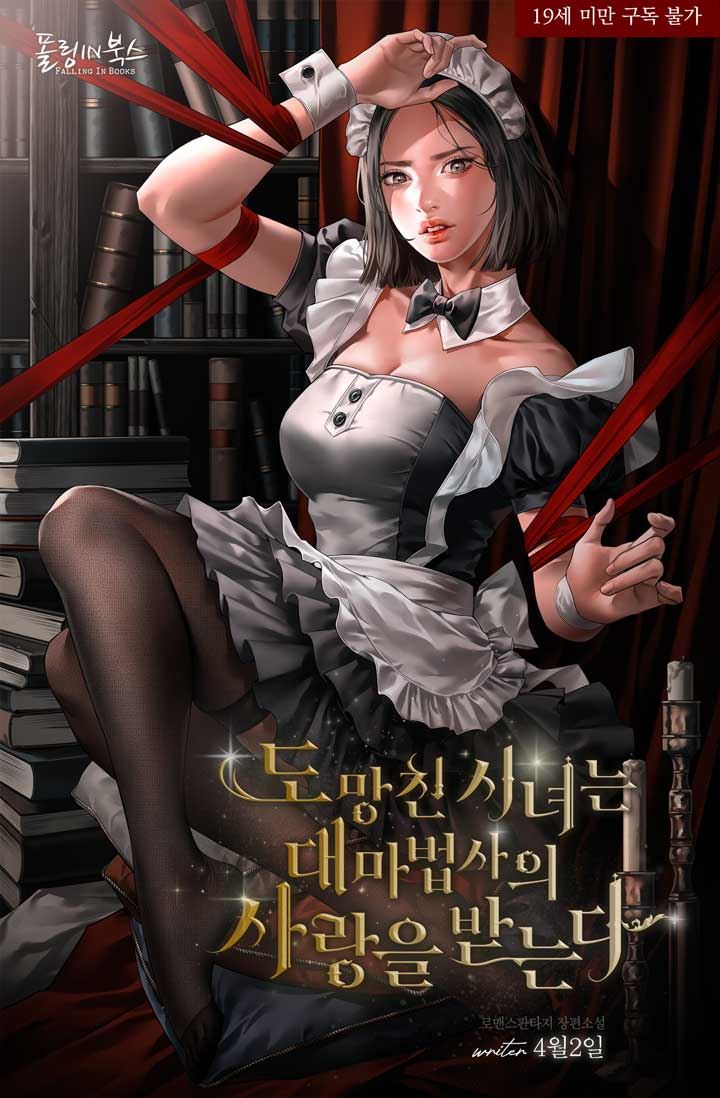
The Fake Madam Disappeared
+Add to Custom List
Novel Info

Summary

... Read More

Duke Edmund Winter is a celebrated war hero and commander of the Black Knights, revered for ending the Great War. Despite his power, he harbors a dangerous secret: his aura turns everything it touches to ash when he loses control. To manage this volatile condition, he entered a contractual marriage five years ago with Daphne Bled, the daughter of Marquis Bled. The union was orchestrated through blackmail, as the Marquis held evidence of Edmund’s weakness. Their wedding was a grand spectacle designed to project an image of true love, masking the cold reality of a loveless alliance. Daphne, plain in appearance and reserved, kept her head down while Edmund viewed her merely as a necessary shield. They lived under the same roof but rarely interacted, maintaining a polite but distant coexistence in their northern stronghold.

Five years into the marriage, with no children born and tensions simmering beneath the surface, Daphne suddenly vanishes ten days before the coming-of-age ceremony of Damian, the Young Master. The servants, accustomed to her occasional brief disappearances, initially dismiss the alarm. However, when the storm subsides, Edmund discovers her empty, dust-covered room and a signed divorce paper left behind by her. Simultaneously, a search party finds her blood-soaked robe in the lair of a mutated monster, leading the household to presume she has died. Edmund, however, refuses to accept this conclusion, displaying an uncharacteristic agitation that terrifies his subordinate, Alec. He orders the Black Knights to scour the region, driven by an intense, confusing need to find her alive.

As Edmund grapples with his growing obsession, he realizes he cannot clearly remember Daphne’s face, suspecting that her presence has been magically or psychologically erased from his mind. This confusion drives him to hire a painter to recreate her image based on description alone. Meanwhile, young Damian becomes increasingly disturbed by his mother’s absence. He had once wished for her disappearance during a bitter exchange, but now feels a hollow ache. Through interactions with the servants, particularly Anna, a maid who was one of the few kind to Daphne, Damian learns that his mother had quietly supported him from afar, sending him gifts and watching over him. He discovers that the ornate sword he received for his ceremony was not a gift from his father, but from Daphne, deepening his sense of loss and guilt.

The narrative reveals that Daphne did not flee out of fear, but as part of a desperate plan. Her maid, Marinda, reveals herself to be a secret admirer of Edmund who stole a portrait of the Duke and framed another maid, Angela, for the theft. Marinda manipulates the Chambermaid, who is involved in embezzlement, to cover up the chaos. Daphne had lent Marinda her carriage and clothes to facilitate a swap, allowing her to vanish while the household was distracted. Edmund uncovers these schemes, interrogating the servants and retrieving a criminal, Nick, to pierce the web of lies. Despite the evidence pointing to her death, Edmund’s intuition holds that she survives. The story ends with Edmund determined to find the truth, aware that Daphne’s disappearance is tied to secrets far deeper than a simple escape from a loveless marriage.

Latest Release
DateGroupRelease
2026-10-03inoveltranslation c103
2026-10-03inoveltranslation c102
2026-10-03inoveltranslation c101
2026-10-03inoveltranslation c100
2026-10-03inoveltranslation c99
2026-10-03inoveltranslation c98
2026-10-03inoveltranslation c97
2026-10-03inoveltranslation c96
2026-10-03inoveltranslation c95
2026-10-03inoveltranslation c94
2026-10-03inoveltranslation c93
2026-10-03inoveltranslation c92

Community Reviews

Rating(0 / 5.0, 46votes)
5 stars
0(0%)
4 stars
0(0%)
3 stars
0(0%)
2 stars
0(0%)
1 stars
0(0%)

Popular reviews

... Read More
So the way this chapter sequence unfolds is genuinely masterful and I need to unpack it. We open with Damian in real-time, running through the mansion in a panic — that's immediate, urgent, kinetic energy. Then it CUTS to Marinda's explanation, which is basically exposition dressed up as dialogue, and it works because we're desperate for answers. Then BAM — another cut to Edmund alone in Daphne's empty room, which slows everything down to a haunting crawl. The contrast between those two scenes (his frantic running vs. his frozen stillness) is doing so much without saying a word. And then the flashback to the banquet? That's a complete tonal shift — warm candlelight, music, the smell of alcohol on Daphne's breath — before it curdles into one of the most painful conversations in the book. After that devastation, we snap back to the present with Marinda and Angela's confrontation, which is lighter but still tense, and then Marinda's secret room scene which is straight horror-adjacent. And finally Edmund's nightmare, waking up drenched in sweat, needing to see Daphne's face, frantically describing her features to a groggy painter. The pacing here is like a rollercoaster designed by someone who hates happy endings. Each transition either accelerates or decelerates the tension in a way that feels intentional, not random. The nightmare-to-painter sequence especially is a gorgeous structural choice — the subconscious desire to remember her made visible through a commissioned portrait.
... Read More
I need to talk about the atmosphere in this book because it is UNMATCHED. The scene where Edmund walks into Daphne's room after five years and it's just... dust. Nothing. Not a single trace that anyone lived there. "A letter and the divorce papers — that was all." That line hit me like a truck. The way the narrator describes it — sparse furniture, thick dust, neatly arranged to the point of erasure — it's not just a room, it's a crime scene of a marriage. And then Edmund pulls out a cigarette, almost lights it, and realizes the smoke would fill the entire space, and stops himself. That tiny moment of self-awareness in a room that has no memory of her in it? Chilling. The blizzard outside is doing heavy lifting too — it's not just weather, it's the emotional temperature of everything. Nobody can go anywhere. The northern region is desolate, infested with monsters even after the snow melts, and the Bled family was exiled for rebellion five years ago. This world feels genuinely dangerous and isolating. And then Marinda's secret room — cold, pitch-dark, no light penetrating, just her kneeling before a dusty portrait whispering "I really missed you, Your Excellency" — that scene gave me actual goosebumps. The visual contrast between the grand Banquet Hall from the flashback and the suffocating emptiness of Daphne's current room is doing so much thematic work.
... Read More
Let me just say this: I did not sleep after reading these chapters. Not because the story was fast-paced in a traditional sense—because it was so SLOWLY crushing, like being pressed under snow until you forget what air feels like. Chapter 7 opens with Edmund holding a letter he can't remember the contents of, unable to look away from it. The nausea. The quill breaking. The ash. We're GIVEN his curse almost casually, right in the middle of a domestic moment about divorce papers. That's masterful pacing—dropping world-changing information the way someone might drop a spoon, like it's just part of the furniture. Then we CUT to Damian, legs trembling, coming out of a room. Who was in there? We don't know. We just know he's shaken, and we're left hanging while the story moves on. That's the author playing with us, and I was HERE for it. The flashback to the banquet happens right when Damian and Daphne are having their most charged conversation on the balcony. The timing is deliberate—the past bleeding into the present, showing us what their marriage LOOKED like to the world versus what it actually WAS. Five years of performance. Five years of one person staring at snow while everyone else stared at each other. And then Damian says the thing. The wish. And the chapter essentially HOLDs its breath. We feel it—the wind stopping, the guilt arriving too late, the realization that he wished for her to disappear and now she MIGHT actually be gone. The scene with Anna the maid iswhere the pacing shifts from emotional to investigative. We're getting ANSWERS now—about the missing handmaid, about the sabotage, about the five years of neglect. But each answer just opens a deeper wound. No one volunteered. No one wanted to serve her. And then Vent bursts in with the news: "They've found her!" And the chapter ends on Edmund's reaction—or rather, the ABSSENCE of one. "Shadows obscured Edmund's face, making it impossible to discern his expression." The request: "Find it. Her body. Bring it to me." That's it. That's the cliffhanger. No dramatic exclamation, no internal monologue, just a cold command from a man who has just received the worst possible news and is already moving into action mode. The pacing from the soft, aching balcony scene to this hard, sharp ending is ruthless, and it works perfectly.
... Read More
Let me just say this: the stakes in this chapter went from 'find the missing wife' to 'everyone's being manipulated and nothing is what it seems' and I am not okay. Edmund's external conflict is obvious—he needs to find Daphne before someone else does, and the clock is ticking. But his INTERNAL conflict is where it hurts. He received a note saying she despises him, he's racing to find her, and he's terrified of what he'll hear when he actually looks her in the eye. 'Even when he had been surrounded by enemies on the battlefield, or when his arm had started to rot from a monster's venom, he had never felt such dread.' A man who faced death without flinching is scared of his own wife's opinion. That's devastating character work. Daphne's stakes are even higher and she's carrying them alone. She escaped, she's hiding, she's pregnant (yes, 'the baby' is apparently why Edmund cares), she sent a note she probably regrets, and now she's in a monster attack with no weapons and a bleeding arm. Every chapter she survives is a victory. The fact that she was 'perfectly fine' with no injuries after being in a monster's lair should be suspicious—did someone save her? Is she being protected? Sergei's conflict is the most interesting because he's not fighting anyone directly. He's gathering information, eliminating threats (RIP Noah), and positioning himself. His sister escaped and he wants to see her again—but the way he says 'We'll meet again soon' with 'anticipation dripping from his voice' makes me wonder if his idea of meeting is actually threatening. And Marinda—poor Marinda. She risked her sentence to deliver a message and then her eyes flashed red. If she's brainwashed or controlled, then Daphne's closest ally might already be compromised. The信任 chain is breaking at every level and I just want someone to catch a break for once.
... Read More
Let's talk about the dialogue in this batch because the author is playing 4D chess with subtext and I am HERE for it. The Chambermaid scene is a masterclass in verbal sparring where nobody says what they mean. Marinda: "Please calm down, Chambermaid." She's not calming her down. She's steering her. "As long as Angela is alive, she'll keep threatening us." She's not stating a fact — she's planting an idea. And the Chambermaid picks it up like it was her own: "As long as she's alive... As long as she's alive, you say." The repetition is deliberate. She's testing the words before she swallows them. Then Marinda covers her mouth to hide a wide smile. All that dialogue was performance. Every word was calculated. Contrast that with the dinner scene between Edmund and Damian. It's barely dialogue at all — it's silence with cutlery sounds between the lines. "Stop worrying about that matter and focus on your successor training." That's Edmund saying everything he can't actually say. He knows something is wrong. He sees the sword. He knows it wasn't him. But he redirects. He controls the conversation the way he controls everything else. And Nick's voice — raw, bitter, grounded in body horror: "That's how lowly people like us live their life." He's not performative. He's exhausted. The contrast between Marinda's polished lies and Nick's blunt honesty gives the batch this incredible vocal texture. The author never lets dialogue be just dialogue. Every conversation is a power struggle, a misdirection, or a confession dressed as something else.
... Read More
Okay so let me just say this: the way this batch ties together three separate threads—Edmund's monster investigation, Damian's mother hunt, and Elizabeth/Daphne's social warfare—is genuinely impressive plotting. You think this is just a fantasy action story? Think again. The mutant monster reveal hits like a gut punch. Edmund killing it, discovering the sealed eyes and layered eardrums—this isn't some random encounter. The text drops that line: "This is already the second mutant monster we've encountered in five years." FIVE YEARS. That single number changes everything. It means whatever is spawning these things has been happening quietly, and the fact that they're getting more sophisticated (blind but hyper-auditory, specifically targeting Daphne's carriage) is terrifying. But here's what really made me sit up: the monster didn't attack randomly. Edmund realizes it deliberately went for the carriage. "It suddenly appeared and attacked the carriage. Specifically, the one Daphne and I were in." That's not a beast. That's a weapon being used. And then the chapter note confirms it—Sergei controls Olga too, same as Miranda before her. Multiple pawns, same controller. Meanwhile Damian's subplot about his mother is converging on the same timeline. The noble contact meeting him on the last day of the hunting competition? That's not coincidence—it's narrative convergence. Three plots about to collide. And Elizabeth? She's not just a petty noble girl. Grabbing Daphne and delivering her to Elizabeth like prey? "They watched her like hyenas about to tear into their prey." That's not social maneuvering. That's an ambush dressed in silk. What I love: the author never lets us relax. Every chapter ends on a note that recontextualizes everything before it. Edmund realizes the scabbard strap was cleanly cut—"as if something was being signaled"—and immediately orders retreat. He doesn't wait. The tension between "investigate more" and "run now" is razor sharp.
See all reviews

Custom lists

See all custom Lists