The Disciples I Raised Are All Villains
+Add to Custom List
Novel Info

Summary

... Read More

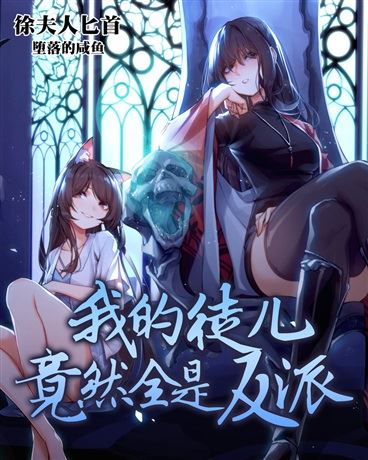
Qin Gou is the reclusive master of Arc Moon Mountain, having spent over a thousand years alone on the peak. He raised six disciples with immense care, providing them with顶级 resources and weapons. However, the moment each disciple left the mountain, they revealed their true nature as notorious villains of the cultivation world. Zhao Xinting became the Purple Extreme Demon Lord, Ye Qishuang founded the demonic Xuan Nu Rakshasa Palace, Kong Ling returned as the Demon Clan Princess, and Mu Man'et, his youngest and supposedly most innocent disciple, ranked seventh on the cultivation world's Most Wanted Blacklist as the Evil Sword Fairy after robbing a royal tribute within a month of leaving.When Mu Man'eter leaves for a three-month family visit, Qin Gou discovers through a cultivation newspaper that she has become infamous. Shortly after, the system completes its task and rewards him with a mortal body, but he can only wield his full power while remaining on Arc Moon Mountain. Outside, he is extremely weak at the early Gathering Qi Realm. The system issues a new task: spank Mu Man'eter one hundred times or lose all his body hair permanently. Qin Gou descends the mountain, using spirit stones to barely advance to the Weapon Refining Realm, and travels to Gu Yue City to find his disciple.He encounters Mu Man'eter, who has matured in appearance due to her Jade Maiden Profound Body. After a playful confrontation where she reveals she learned cheeky jokes from a forbidden book in their shared mountain home, Qin Gou disciplines her with a hundred strikes, reverting her physical form back to her younger self. The task completes, rewarding him with the Enlightened Dao Body, which allows him to understand the structure of living beings through touch, and a life-bound spiritual tool called Dreamwalker, a lantern that can pull targets into dreams. He also earns merit points by scaring various low-level villains in the area.While in Gu Yue City, Qin Gou learns that Mu Man'eter's family has been bullied by the local Situ clan, who stole their ancestral technique through coercive duels. Using a disguise talisman to simulate his full Heavenly Master aura, Qin Gou challenges the Situ patriarch Situ Pei to a duel. With Mu Man'eter wielding his Astonishing Immortal Sword, she defeats Situ Pei and reclaims the stolen Rain Flower Sutra. Qin Gou then uses his avatar to drive all evil cultivators out of the city, earning significant merit points in the process.As he prepares to return to the mountain, Qin Gou meets Chen Keshai, a chubby young man who happens upon him and becomes his reluctant companion. The two travel together, with Qin Gou continuing to complete minor justice tasks. However, an elder from the Seed Demon Holy Sect detects Qin Gou's unique Enlightened Dao Body and tracks him down. The elder offers him a choice: join their sect or die. Qin Gou pretends to agree and boards the elder's spirit boat, bringing Chen Keshai along. Meanwhile, Zhao Xinting receives news of his master's whereabouts and decides to enter seclusion to prepare for a breakthrough that would allow him to challenge Qin Gou. At the Seed Demon Holy Sect, Qin Gou witnesses the ruthless culture and encounters Gu Feiyan, the capricious daughter of the sect leader, who becomes the subject of his next system task: to stay close to her for six months and reform her behavior, or face irreversible physical deformity. The story follows Qin Gou as he navigates the dangerous cultivation world in his weakened state, attempting to maintain his righteous master persona while completing absurd system tasks and dealing with his increasingly infamous disciples and new enemies.

Latest Release
DateGroupRelease
2026-10-01hiraeth translations c131
2026-10-01hiraeth translations c130
2026-10-01hiraeth translations c129
2026-10-01hiraeth translations c128
2026-10-01hiraeth translations c127
2026-10-01hiraeth translations c126
2026-10-01hiraeth translations c125
2026-10-01hiraeth translations c124
2026-10-01hiraeth translations c123
2026-10-01hiraeth translations c122
2026-10-01hiraeth translations c121
2026-10-01hiraeth translations c120

Community Reviews

Rating(0 / 5.0, 25votes)
5 stars
0(0%)
4 stars
0(0%)
3 stars
0(0%)
2 stars
0(0%)
1 stars
0(0%)

Popular reviews

... Read More
There's something deeply ironic about a story where the protagonist's greatest skill is lying, and this batch is basically a thesis on performance and identity. Take the Soul-Chasing Lamp first. It's supposed to be a tool of control—a way for the sect to track Qin Gou, to prevent betrayal, to ensure loyalty through blood magic. But Qin Gou offers his blood without hesitation, knowing full well what it means. The lamp becomes a symbol of the sect's ignorance, their misplaced faith in systems of control. They think they've captured him, but they've only captured a drop of blood. The real Qin Gou is somewhere else entirely, running a merit point empire in their valleys. Then there's the mask itself—literally and figuratively. Qin Gou wears a Perfect Disguise Talisman in the dream, obscures his face with gray mist, uses a deep authoritative voice to become someone he's not. But the most revealing moment is when he DROPS the disguise and Mu Man'er is the one who's been performing the whole time. She entered the sect as Man Xiaomu, adopted daughter of the Sect Master, and Qin Gou had to recognize her by her figure alone. Both of them are wearing masks. Both of them are performing roles. The question the text keeps asking is: who is the real person underneath? And the Dreamwalker lantern—this life-bound spiritual tool that lets Qin Gou infiltrate dreams—is perhaps the most potent symbol of all. Dreams are where truth comes out, where the unconscious reveals what the conscious mind hides. Qin Gou entering Mu Man'er's dream isn't just a plot device; it's the narrative asserting that reality is多层(layered), that the surface world of cultivation sects and spirit stones and merit points is just the shallowest layer, and the real story happens beneath it, in the gray void where palaces rise from nothing. The recurring motif of blood connections—essence blood in the lamp, blood samples collected from disciples, the spiritual bond between master and disciple—all of this points to a world where relationships are transactions, but also where genuine bonds stubbornly persist beneath the calculations.
... Read More
Shen Tianyin is probably the most memorable character from this batch, and honestly, he's just absolutely deranged in the best way possible. The man genuinely believes Gu Feiyan is his dead lover Yan'er reincarnated, despite literally zero evidence other than a physical resemblance. And when she physically attacks him with a whip, he interprets it as a sign she REMEMBERS him. That's not just love — that's something beyond love. That's a spiritual condition. Meanwhile, Gu Feiyan is fascinating in her own right. She showed a real moment of genuine laughter when discussing Qin Gou with Mu Man'er — calling him shameless but also 'unique,' comparing his brazenness to her father's youthful days. It's the first time we see her truly soften, and it's directed at someone OTHER than Shen Tianyin. That's interesting. She's guarding herself around Shen Tianyin (rightfully so — he's a stalker at this point), but she's almost... curious about Qin Gou? She noted his disguise couldn't be seen through by anyone except her. There's something there. The family dynamics are also incredibly layered. Gu Jinghong bringing Qin Gou before his wife and hinting at the political tensions with his 'three children' — one of whom is Feiyan — sets up this massive web of potential alliances and betrayals. And the reveal that Duanmu Shuiyu has ties to the Xuan Nu Rakshasa Palace adds another dimension. Who supports whom? Who loves whom? This story has relationships that feel genuinely complicated and real, not just face-value tropes.
... Read More
Let me just be clear about the stakes here because the author does NOT waste time establishing them. Chen Keshai is at rock bottom—he's been dragged into the sect, forced into servant status, beaten constantly, had his resources stolen, and was told explicitly that no one would care if he died. When he goes to Qin Gou crying, he's not just asking for help, he's begging for survival. And then Qin Gou wagers five high-grade spirit stones AND his own safety in a duel against someone nearly a full realm above him. The tension from the moment Jue Ya shows up is absolutely suffocating in the best way. What really kept me on the edge of my seat wasn't just whether Qin Gou would win—it was the growing sense that he might actually be in over his head. Jue Ya's clone technique, the automatic defensive kite, the way he tears apart his own spiritual tool to unleash its true power... each escalation made the danger feel more real. And Qin Gou just stood there, completely calm, pulling out a jar of wine like this was a casual afternoon stroll rather than a life-or-death match in a demonic sect arena. The moment the green droplet pierces Jue Ya's chest and the steward declares Qin Gou the winner? I actually exhaled. But the stakes don't end there—Jue Ya immediately tries to drag it into a rematch, pulling out a dagger, and the steward has to physically intervene. The fact that the rules explicitly state the arena treats fights as "real-life deathmatches where no means are spared" means Qin Gou winning didn't just save Chen Keshai, it put a literal target on his back. Every disciple in that arena now knows he's someone who can take down a senior disciple through cunning. The seed is planted for future conflicts, and I am HERE for it.
... Read More
The pacing in this batch is absolutely ferocious and I respect it. We open with what reads like a classic wuxia espionage scene—Mu Man'er reporting to Qin Gou, exchanging information, the whole vibe—and then BOOM, dream realm transition, and suddenly we're in a completely different narrative mode. The author doesn't waste a single beat on exposition either. We don't get a lengthy explanation of how the dream world works or why Qin Gou has this power; we just watch it happen and trust the reader to keep up. The transition from Mu Man'er's storyline to the dream world sequence is seamless enough that you almost miss the pivot until you're already deep in Reincarnation World lore. Then the first world unfolds with ruthless efficiency—ten grueling days compressed into a few paragraphs, the fake girl's death hits hard, and within minutes we're back in reality with Shen Tianyin's complete psychological transformation. What really sells the pacing though is how the author uses Qin Gou as the anchor. No matter where the narrative jumps, he's always there in the background, the puppeteer. That line "Do your best" to the illusion-girl before she vanishes? Two words and the entire emotional weight of the next scene is pre-loaded. The chapter ends on Keshai's arrival which is a perfect soft landing after all that chaos—grounding us back in the mundane while the reader is still reeling from the metaphysical gymnastics. Each section breathes but nothing lingers too long. This is tight writing.
... Read More
The stakes in this batch operate on two levels and they feed each other in interesting ways. On the surface, Qin Gou has a system-imposed deadline—fifteen days to "discipline" Mu Man'er before something unspecified goes wrong. That's the external clock ticking. But the deeper conflict is internal: he's a former Heavenly Master trapped in a body that can barely gather qi, forced to maintain an image of power he no longer possesses. Every scene in this batch tests that tension. The beggar scene shows him bullying thugs because he literally cannot handle real enemies yet. The convoy scene shows him winning through deception rather than strength—he traps Wei Yuanzhong in an illusion before the fight even starts because he knows he'd lose a fair fight. The Mu Man'er scene is the highest stakes moment because it's personal. She doesn't just doubt his power; she doubts his identity. For a man whose entire survival strategy depends on appearing formidable, that's the worst-case scenario. The system raises the stakes further by giving him rewards that solve immediate problems but create new dependencies. The Demon Master talisman lets him fake being a Heavenly Master for two hours, which solves the Mu Man'er situation—but now he's reliant on a consumable item with a limited duration. The lottery gave him underwear instead of a physique upgrade, which is funny but also frustrating for a character who clearly needs real power improvements. What makes the conflict compelling is that Qin Gou never stops fighting. He could give up, retire to a quiet life, accept that he's no longer the top predator. But he keeps performing, keeps scheming, keeps deploying illusions and talismans and fake auras. He's a man holding up a collapsing structure with one hand while telling everyone it's still standing. And the reader can't help but root for him anyway.
... Read More
There's a symbol in this batch that I can't get out of my head and it's the spiritual tool prototype Qin Gou creates. This tiny translucent green droplet, no bigger than a pea, can pierce through a sturdy wall like paper. Think about what that represents in the context of everything else happening. Qin Gou's power doesn't look like grand magic or epic sword techniques—it looks like something fragile, almost beautiful, almost innocent. A water droplet. But it cuts through everything. That's exactly what he's doing to these characters. He's not crushing them with force; he's渗透ing their realities, their dreams, their sense of self, the way water finds its way through the smallest crack. The reincarnation world itself is another potent symbol. Shen Tianyin and the others are trapped in a cycle where they must complete tasks to earn points, where death in the dream means death in reality, where even grief can be monetized. It's a metaphor for cultivation society itself—endless grinding, trading pieces of yourself for power, believing that if you just accumulate enough, you'll eventually be free. But the cruelest irony is that Shen Tianyin thinks reviving Gu Yan'er will make him free, when really he's just dug himself deeper into Qin Gou's web. And that line from the fake girl—"Shall we become Dao companions and seek immortality together?"—immortality as the ultimate commodity, the thing you'd die for and kill for. The green droplet doesn't just pierce walls; it pierces illusions about what power and freedom actually mean.
See all reviews

Custom lists

See all custom Lists