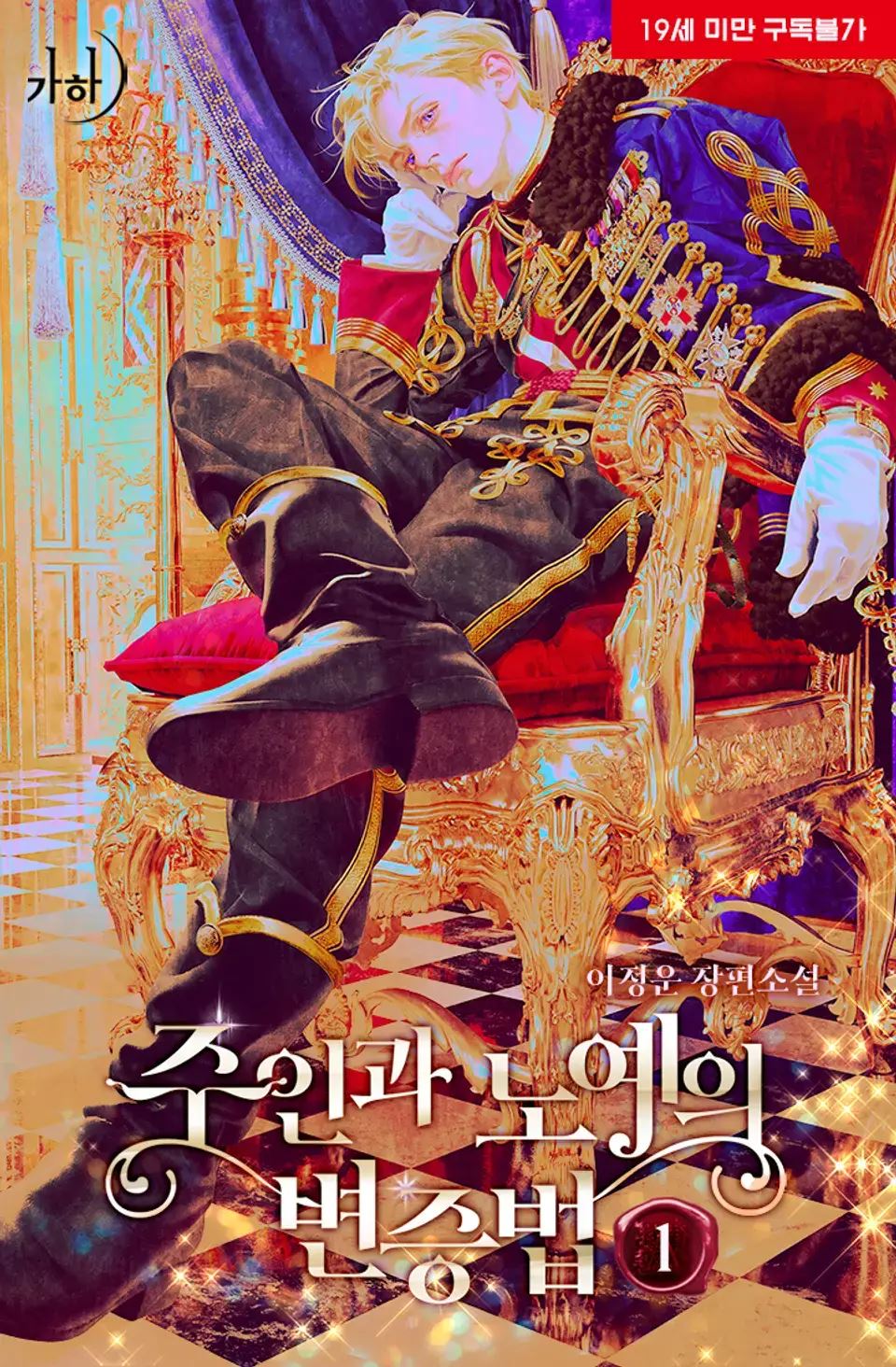
Attempting to communicate using the languages she learned through formal education—Korean, English, basic German, and elementary Chinese and Japanese—Jaha discovers she cannot speak to anyone. When one of her captors attempts to violate her, a magical item used to detect virginity prevents him from proceeding, as virgin slaves command higher prices. She is eventually sold to Baron Palga, an elderly man over seventy who is impotent but seeks a companion for undressing and fondling. Jaha resists fiercely and pleads that she can perform other work, leveraging the minimal language skills the slave trader taught her for better pricing. The baron, intrigued, gives her three days to prove her usefulness.
During those three days, Jaha offers all her knowledge—school lessons, common sense, and stories like Scheherazade—but her language ability is far too crude to communicate effectively. On the third night, just as she faces inevitable sexual servitude, the baron's youngest son collapses choking on an octopus-like creature. Remembering the principle of osmosis—that salt draws water out of organisms—Jaha administers salt to the child, shrinks the creature, dislodges it, and performs CPR. The child survives, and the baron, regarding himself as clear about debts of gratitude, assigns Jaha a writing teacher rather than treating her as a sex slave.
In a month, Jaha masters daily communication and then studies etiquette, history, and culture. She learns this world resembles pre-modern Europe with one empire and numerous small countries, but magic exists while science is underdeveloped. An absolute emperor with magical power considered legendary—rumored to be able to do anything except revive the dead—rules with terrifying authority. The class system is rigid, and as a slave at the bottom, Jaha has few options. She asks to work in arithmetic, revealing she can calculate without a counting board using written methods unknown in this era. The baron, shocked that a daughter educated to such a level became a slave, assigns her to check ledgers and promises to free her from slavery within a month.
Three weeks later, knights invade the baron's mansion, slaughtering the entire family on charges of treason. Because slaves are considered property rather than people, Jaha and the other servants survive the massacre. Her status transfers to the imperial family, and due to her literacy and calculation skills, she is assigned to the library of Langjev Palace, which serves as the residence for the emperor's consort—a position currently vacant, making the palace quiet and relatively safe.
Jaha begins making soap from lye water and crushed fruits to maintain hygiene and prevent disease. The librarian, Ranya, a second daughter of a humble noble family who loves reading, takes pity on Jaha and occasionally shares her own troubles. When Ranya struggles with a mathematics problem, Jaha explains it using what this world calls Dekal's Theorem—the equivalent of the Pythagorean Theorem. Ranya begins bringing Jaha food as payment for tutoring, providing crucial nutritional relief from the terrible slave rations.
The emperor suddenly appears at Langjev Palace and summons Jaha. Despite her efforts to remain invisible, he selects her for sexual use. The encounter is violent and non-consensual; the emperor forces himself inside her without foreplay, causing tearing and bleeding. He uses magic to prevent pregnancy and leaves without a word. Jaha returns to the library, applies an ointment Ranya provided, and recovers enough to return to work. The next day, however, she is summoned to the emperor's bedroom again.
The emperor heals her torn flesh with magic and continues the forced intercourse. Afterward, he molds a slime—a magical beast that prefers dark, moist places—into the shape of a phallus and inserts it into Jaha, ordering her to keep it inside until called again. The slime gradually stimulates her sensitive spots, causing her body to become aroused despite the humiliating circumstances. Jaha experiences conflicting emotions: shame, self-loathing for her body's physiological response, and fear that she is losing her humanity. She reminds herself that her self-identification as a human being is her final fortress.
Five days later, the emperor summons her a third time. The slime has adapted her body, and intercourse is less painful. Jaha's body responds with arousal, and she cries out involuntarily. The emperor, pleased by her moans and the perfect fit, engraves a permanent contraceptive seal in the shape of a blooming flower on her lower abdomen. He recognizes that Jaha feels shame unlike other slaves, sensing she is different—a person with an interior life that does not match her outward obedience. The story ends with Jaha trapped in this dangerous relationship with the most powerful being in the world, her only hope being that she will one day wake up back on Earth.
Throughout the narrative, Jaha navigates a world where magic is real and monopolized by the ruling class, where democracy and gender equality have not arrived, and where slaves are treated as livestock. Her knowledge of science, mathematics, and hygiene becomes her primary tools for survival, even as she faces sexual violence, physical trauma, and the psychological toll of dehumanization. The emperor views her as both a useful toy and an intriguing puzzle, while Jaha struggles to maintain her sense of self in a world that refuses to recognize her humanity.
| Date | Group | Release |
|---|---|---|
| 2026-09-27 | citrus aurora | c284 |
| 2026-09-27 | citrus aurora | c283 |
| 2026-09-27 | citrus aurora | c282 |
| 2026-09-27 | citrus aurora | c281 |
| 2026-09-27 | citrus aurora | c280 |
| 2026-09-27 | citrus aurora | c279 |
| 2026-09-27 | citrus aurora | c278 |
| 2026-09-27 | citrus aurora | c277 |
| 2026-09-27 | citrus aurora | c276 |
| 2026-09-27 | citrus aurora | c275 |
| 2026-09-27 | citrus aurora | c274 |
| 2026-09-27 | citrus aurora | c273 |