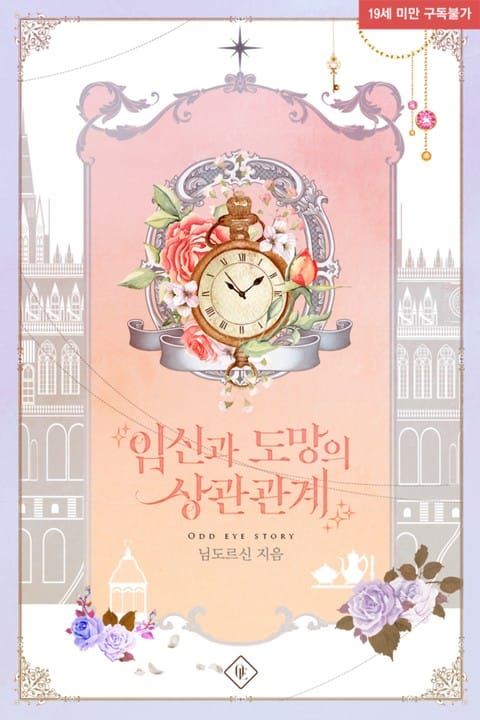
The Correlation Between Pregnancy and Running Away
+Add to Custom List
Genres:
Novel Info
  • Author:
  • Status:Ongoing

Summary

... Read More

Yulia, a cheerful young woman living a quiet life in a small village, meets Resti, a large and intense man who was found unconscious in the nearby forest. Despite his mysterious origins and lack of past history, the two quickly fall deeply in love. Their relationship is passionate and all-consuming, characterized by frequent intimacy and affectionate banter. Yulia believes she knows Resti completely, unaware that he is hiding a significant secret. When Yulia discovers she is pregnant, her joy is tempered by anxiety, as her neighbor and the local doctor warn her that Resti’s true identity is unknown. The doctor suggests that men like Resti, who appear to be nobles but hide their status, often abandon their partners when children become involved.

Resti arrives at Yulia’s home dressed in opulent clothing and takes her in a lavish carriage to a magnificent white mansion that belongs to him. Upon arrival, Yulia learns that Resti is actually Leonhardt Resti Jestione, the heir to the Jestione Dukedom. He claims he ran away from this life because he found it meaningless until he met her. However, his former fiancée, Grace, a proud noblewoman from the powerful Roastein family, suddenly appears and confronts them. Grace reveals that she and Resti have an agreement to break their engagement together, but she is furious that he has been hiding with a commoner. The staff at the mansion make it clear that Yulia is not destined to be the Duchess and warns her to accept the role of a mistress if she stays.

Yulia overhears Resti and Grace discussing wedding preparations. She realizes that despite Resti’s promises, the marriage to Grace is proceeding, and she is expected to remain his secret lover. Devastated and unwilling to raise an illegitimate child or share Resti with another woman, Yulia decides to flee. That night, while Resti sleeps, she escapes the mansion and travels to a remote village, where she finds work at a local bakery. She spends a month trying to build a new life, telling herself she must protect her child from the stigma of being born out of wedlock.

Resti, however, refuses to let her go. He tracks Yulia down to the bakery and forcefully takes her back to his estate. His demeanor has changed from the playful lover to a cold, possessive man who is enraged by her attempt to leave him. Yulia tries to reject him, claiming she loves someone else, but Resti dismisses her words and locks her away. The story centers on the power struggle between them, as Resti insists that nothing will change and that she belongs to him, while Yulia struggles with her love for him and her fear of becoming merely a convenient mistress to a nobleman engaged to another. The narrative explores the complexities of class difference, hidden identities, and the destructive nature of obsessive love within the rigid structures of nobility.

As Resti tightens his control over Yulia’s life, the tension escalates. He is determined to keep her close, regardless of her protests or the social implications of his actions. The arrival of Grace further complicates the situation, as she asserts her dominance and threatens Yulia’s position. Yulia finds herself trapped between her desire for independence and her enduring feelings for Resti, while also facing the reality that her pregnancy makes escape increasingly difficult. The story sets the stage for a dramatic confrontation where Yulia must decide whether to submit to Resti’s demands or find a way to claim agency over her own future and her child’s destiny.

Latest Release
DateGroupRelease
2026-10-03dusk blossoms c21
2026-10-03dusk blossoms c20
2026-10-03dusk blossoms c19
2026-10-03dusk blossoms c18
2026-10-03dusk blossoms c17
2026-10-03dusk blossoms c16
2026-10-03dusk blossoms c15
2026-10-03dusk blossoms c14
2026-10-03dusk blossoms c13
2026-10-03dusk blossoms c12
2026-10-03dusk blossoms c11
2026-10-03dusk blossoms c10

Community Reviews

Rating(0 / 5.0, 35votes)
5 stars
0(0%)
4 stars
0(0%)
3 stars
0(0%)
2 stars
0(0%)
1 stars
0(0%)

Popular reviews

... Read More
I keep coming back to this one detail and I NEED to talk about it. Yulia finds Resti 'lying motionless deep in the forest'—he's not just hurt, he's completely unresponsive. She has to shake him and ask if he's alive. What kind of situation leaves a grown man collapsed in a forest? The text never explains it, and honestly that's both frustrating and brilliant. Because now EVERY interaction between them has this undercurrent of 'what broke this person before I fixed them.' When Resti says 'I just did what I was told, lived as expected, wore a fake smile'—is that describing his life before the forest incident or was he already like that? The stakes here aren't external threats or dramatic conflicts, they're internal. What Yulia is really risking isn't her heart, it's whatever trauma Resti carried into that forest. And what Resti is risking by letting her in is having someone actually SEE him instead of the performance he's been running. The physical tension in these chapters is obviously on another level, but the emotional stakes are what make it hurt. Every time he says 'I like you' during intimate moments, it reads differently now—like he's not just being romantic, he's actually terrified of losing the one thing that made his life feel real again. That's why the climax scenes carry this weird weight. He's not just pleasuring her, he's anchoring himself. And she's not just receiving it, she's holding onto someone who might drown again if she lets go. I don't know how the rest of the book handles this backstory but I am fully invested in finding out what happened to this man in that forest.
... Read More
Okay, I need to just sit with this for a moment because that one line — "I like you, Yulia. I like you." — literally stopped me mid-scroll. I was ready to call Resti a full-on villain at this point, and then BOOM. He can't just say "I love you" but he can confess while violating someone's bodily autonomy?? The tonal whiplash is actually insane. But here's the thing — it's also kind of tragic in a messed-up way. He's clearly drowning in jealousy and insecurity, convinced she chose another man, and the only language he has for his feelings is this twisted combination of aggression and desperate affection. Then immediately after, he tries to FORCE her to take abortifacient medicine. So yeah, he "likes" her but also wants to erase the evidence of whatever he thinks happened between her and this phantom man. The emotional contradiction is almost poetic, if poetry involved drugging people. When Yulia says "I'll hate you," she's probably the most emotionally honest person in the entire scene. She knows she doesn't actually hate him — that's the whole tragedy. She's clinging to this child as the last tangible connection to the life she had before Resti, and he keeps trying to sever every thread.
... Read More
Let's talk about how the author uses physical space as emotional landscape, because it's honestly brilliant and deeply uncomfortable. The bedroom scenes are the most visceral part of this book. Every detail is rendered with almost unbearable specificity—the lukewarm water on the handkerchief, the half-dried medicine still on Yulia's chest, the way Resti's fingers move between her lips, the squelching sounds, the sweat, the trembling. The author doesn't shy away from making you feel every inch of this空间. You're not reading about these scenes; you're trapped in them with Yulia. But what's remarkable is how the setting expands beyond just the bedroom. The morning after sequence is so casually devastating: maids filing in with bathwater like nothing happened, measuring her for a dress that is explicitly NOT a wedding dress. "Lord Leonhardt will at least provide you with a dress." The word "at least" hits like a punch. It's a status symbol, a brand, and Yulia understands it immediately. "Was he expecting me to wear it and attend the wedding as a guest?" That single thought tells you everything about her social position in this world. She's not a wife. She's not even a mistress in any dignified sense. She's something else entirely—something that exists in the margins of this society's structure. And then the escape sequence: the hidden door behind vines, the unmarked forest path, the heavy pouch of coins clinking in the maid's hands. The world feels lived-in and dangerous here. This isn't a fairy tale mansion with friendly servants—it's a place where people plot escapes through back doors and forests that don't appear on any map. The atmosphere shifts from claustrophobic intimacy to sprawling, terrifying openness, and I was hooked the entire time. The author really knows how to make a setting feel like a character itself—one that's either protecting you or hunting you.
... Read More
Let's talk about how this batch moves. We start mid-conversation with Yulia explaining her escape - already in media res, no boring setup. Then BOOM - pregnancy reveal. Then the misunderstanding arc plays out in real time, which is honestly so much better than the usual trope where the characters just fail to communicate for fifty chapters. She tries to explain, he's too emotionally overwhelmed to listen, she has to PHYSICALLY grab his face and make him quiet down. That's efficient storytelling. Then the doctor scene - pure comic relief that gives us a breather after the emotional intensity. And then we skip FORWARD to the wedding day. The time jump is handled so smoothly too - just a paragraph and we're there. No dragging, no filler. The chapter endings are well-placed as well. Chapter 18 ends on that incredibly soft moment of Resti kissing her belly, and Chapter 19 opens with the most chaotic doctor scene imaginable. The contrast is perfect. My only tiny complaint? The intimate scene that follows the doctor visit goes on a little long, but honestly, I wasn't ready for it to end either. The author knows exactly when to speed up and when to slow down, and it shows.
... Read More
What makes this sequence so gripping isn't just the external conflict — though Resti being a dangerous noble with unlimited power is terrifying enough — it's the layered internal conflict happening simultaneously. Yulia is caught between: wanting to protect her child, knowing the child is actually Resti's (which she never admits), hating what Resti is doing to her, but also still being physically and emotionally drawn to him (her body responding despite everything — the text doesn't shy away from this uncomfortable truth), and desperately wanting to escape but having zero practical options. Every scene raises the stakes. In chapter 12, the stakes are physical safety and reproductive autonomy. In chapter 13, the stakes become even more existential — Resti offers her a twisted deal: "Say it's my child and I'll let you keep it." The implication is clear: if she doesn't play along, he'll find another way to get rid of it. This is someone holding her entire future in their hands and using it as leverage. The most chilling line? "I won't make the same mistake twice." What was the first mistake? Letting her leave? The stakes just escalated from "will she survive this" to "will she ever escape this situation again?" And that cliffhanger ending — "Nothing will change" — is absolutely brutal because it means Yulia is trapped in a system where her only option is to submit and hope for scraps of mercy.
... Read More
Let me just say this — the author absolutely understands how to use misunderstanding as a pacing device without making it feel lazy. The entire chapter 12 is built on Resti assuming Yulia was pregnant by another man, but the REAL twist is that the reader knows (or eventually learns) this might actually BE Resti's child. Every beat of tension in that chapter comes from two people talking PAST each other. He's asking "when did it start?" and she genuinely doesn't know what he's referring to. The pacing is relentless — he confronts her, she's confused, he escalates to threats, then to sexual violence, then to the medicine scene. There is NOT a single breath of relief between these beats. And then chapter 13 starts with... THE AFTERMATH of that violence, transitioning into something that almost looks like tenderness, before he brings out the poison glass. That whiplash between intimate and abusive IS the structure. The author doesn't let you settle into any emotional state before yanking it away. I stayed up way too late reading this because I needed to know what happens next, and honestly, that's because the pacing won't let you put it down — even when you want to.
See all reviews

Custom lists

See all custom Lists