The Concubine’s Circumstances
Novel Info
  • Author:
  • Status:Ongoing

Summary

... Read More
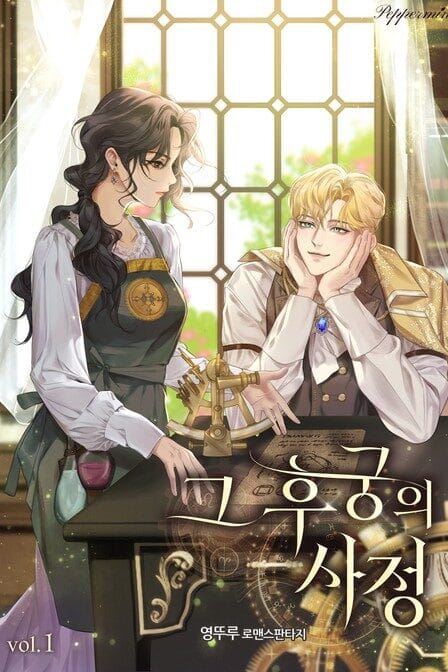
Lucia Bianchi is a talented inventor and the daughter of a wealthy merchant in the Bederon Empire. Despite her brilliance, she faces severe societal prejudice because women are barred from professional recognition in science and engineering. To survive, she works in a bookstore owned by Mr. Saper, where she designs advanced mechanical devices such as thermometers, sextants, and corn-shelling machines. However, her inventions are largely ignored by the public because of her gender, forcing her to rely on toy sales for income. She also endures an abusive home life, where her father, Cedro, and mother, Marisa, view her solely as a commodity to be married off for financial gain. Lucia has systematically repelled suitors using clever inventions and mechanical tricks, leading to her being labeled a witch or crazy woman, which results in frequent physical beatings from her father.Throughout the year, a mysterious hooded man visits the bookstore weekly, purchasing all of Lucia’s peculiar inventions. This regular customer is Emperor Aristide Savio Segrio, who has grown fond of Lucia’s ingenuity and expressive personality. He has been observing her for ten months, gradually breaking through her reserved exterior. The Emperor is known publicly as a lecherous tyrant who maintains a harem of concubines, yet he neglects his political duties in favor of collecting women. Rumors swirl that he is impotent and that the concubines are merely prisoners of passion, but the truth remains hidden.The central conflict escalates when the Emperor invites Lucia to the Imperial Ball. Seeking refuge from her mother’s pressure to accept a new suitor, Lucia hides in a restricted corridor upstairs. There, she encounters the Emperor, who reveals his true identity. In a shocking declaration, he appoints her as his next concubine. Lucia is horrified and vehemently refuses, insulted by the prospect of becoming another object for the Emperor’s pleasure. She slaps him and insults him furiously before fleeing, only to be intercepted by the Emperor in the garden.In a dramatic twist, Aristide explains that the so-called harem is actually a disguised laboratory for female researchers. He claims that because society discriminates against women in academia, he created the fiction of a harem to protect them. The current concubines are renowned professionals, including the architect Bartolo Retierre (a woman using a male pseudonym), the physician Reselda Falco, the composer Celeste Gravina, the playwright Julietta Cusano, and the botanist Dorothea Moretti. They conduct vital research that benefits the empire, shielded by the Emperor’s feared reputation. Aristide argues that this arrangement provides them with safety, funding, and freedom from societal harassment, something they could not achieve as ordinary women.Skeptical but intrigued, Lucia agrees to visit the Moonlight Palace, the location of the harem-laboratory. Upon arrival, she meets the five women, who confirm the Emperor’s story. They demonstrate that they have never been intimate with him; instead, he respects their work and provides them with resources. The women share their struggles with gender bias and explain how the title of concubine grants them legal protection and professional leverage. Valeria, the architect, explains how she uses a male alias to have her designs built, while Reselda notes that her medical knowledge is accessible only because of her status. Lucia realizes that while the premise is absurd and degrading, it is also a pragmatic solution to systemic sexism.Despite the compelling arguments, Lucia remains conflicted. She values her independence and despises the notion of being owned, even symbolically. However, the opportunity to conduct serious research in a fully equipped laboratory is unprecedented. The story concludes with Lucia standing at a crossroads, weighing her principles against the practical benefits of accepting the Emperor’s offer. Meanwhile, tensions rise as enemies from her past, including rejected suitors who hold grudges, begin to plot against her, threatening her safety both inside and outside the palace walls.

Latest Release
DateGroupRelease
2026-10-03dusk blossoms c72
2026-10-03dusk blossoms c71
2026-10-03dusk blossoms c70
2026-10-03dusk blossoms c69
2026-10-03dusk blossoms c68
2026-10-03dusk blossoms c67
2026-10-03dusk blossoms c66
2026-10-03dusk blossoms c65
2026-10-03dusk blossoms c64
2026-10-03dusk blossoms c63
2026-10-03dusk blossoms c62
2026-10-03dusk blossoms c61

Community Reviews

Rating(0 / 5.0, 38votes)
5 stars
0(0%)
4 stars
0(0%)
3 stars
0(0%)
2 stars
0(0%)
1 stars
0(0%)

Popular reviews

... Read More
Okay so let me just say—I was not prepared for how satisfying it was to watch Lucia set her own life on fire. Like literally. She spent weeks pretending to embroider and read etiquette books while secretly building smoke bombs and rigging the fireplace passages. The whole thing reads like a heist movie but make it domestic thriller. And the best part? The authors didn't even need to show her executing the plan in real time. We get the aftermath—the mansion reduced to 'grotesque' ruins, the family rummaging through ashes like ghosts, the portrait where her face has been completely burned away. That last detail got me. She literally erased herself from the family memory and walked out alive. What a flex. And then there's the Aristide thread, which I know is setting up something bigger, but the cup-phone scene between them is just too good. She drops a casual 'It's good to see you again, Your Majesty' through two tin cups and his entire personality short-circuits. 'Are you a witch?' — bro, you're talking to a girl through household objects like it's 1800s telegraph. Meanwhile she's over here already planning her escape while he's still processing that sound travels through string. The contrast is comedy gold. I also love that the escape got delayed because she says 'there's been a change in the plan' and then we cut to her actually already having escaped. The narrative itself is playing with our expectations like Lucia plays with fire. Chef's kiss.
... Read More
Let me just say upfront: the pacing in this section is masterful and I have no idea how the author pulled it off without it feeling rushed or dragged out. We start with the Lucia-Aristide conversation where she challenges him about the harem researchers. This is a heavy, philosophical scene—women's rights, systemic inequality, the limitations of performative progress. It ends on a high note: Lucia calls him a coward, he agrees, and then they part as friends, him whistling outside her bookstore. Seems resolved. Feels like a natural place to wrap up a chapter. And then BAM. Mother ambushes her for a suitor visit. No transition. No warning. Just suddenly Lucia is being led into a drawing room where a man who killed two wives is discussing her as a breeding stock. The jump from that tender, intellectual exchange with the Emperor to the visceral horror of the proposal scene is jarring in the best way. It mirrors exactly what Lucia must be feeling—her world expanded one minute (connection with Aristide, fighting for something bigger than herself) and crushed the next (back to being a commodity). Then the pacing does something else brilliant: it SLOWS DOWN during the Earl Siabon scene. Every line feels deliberate. He asks about her age. She interjects about genetics. He decides to take her. He scrubs the warts off. He pins her against the wall. She hits him with a candlestick. He leaves. The violence is compressed into a few brutal paragraphs that hit like punches. Cut to: Lucia going to her father's study. Hot tears. The newspaper crackling. Two sentences of dialogue. Another cut—Marisa in the drawing room, holding her hands. Another cut—Aristide in his study, hearing the news, storming out saying "Damn it." And then we're in the attic, where time slows again. The blankets becoming a rope. Sara smuggling the skewer. The letter arriving. Another letter arriving. And the final image: Lucia running to the window, hoping someone's there. Each scene transition acts like a door slamming shut. There's no breathing room between the emotional beats, which means the reader is constantly on high alert. By the time we reach the assassin joke at the end, my heart was still racing from the previous scenes. The author knows exactly how to control tension—expanding moments of intimacy and compression into scenes of violence. The only question that remains: will the Emperor actually come for her? Because if this pacing holds, something is about to explode.
... Read More
I'm going to be honest with you—I read the resurrection scene and just stared at the ceiling for twenty minutes. Not exaggerating. The way the author handles Lucia's emotional state throughout this entire arc is almost too good. Let me trace it: She's hiding in a storage room that's basically a closet. She's surviving. Then Sara shows up and they have this incredibly tender moment where Sara apologizes for not seeing what Lucia was going through. Tears, trembling hands, the whole thing. Lucia comforts HER instead of the other way around. That reversal broke something in me. Then her parents find her. Not with love or relief—with a poisoned smile. Marisa slapping her, saying she aged from all the abuse, Lucia's own words cutting back: "I thought we hated each other equally. But it turns out I hated you less." And then—the beating. The blood. The rain. And this line that I cannot stop hearing: "Please, let this rain dissolve my body… Then the pain will disappear too." SHE WANTS TO DISSOLVE. Not run. Not fight. Just stop existing. And then—hands. Warm hands. Someone carrying her. The blurry, disjointed consciousness where she can't tell if she's alive or dying. "The world, which had paused briefly, began moving again." That pause. That moment between death and rescue where the narrative just STOPS and then STARTS again. I felt it in my chest. And then waking up in crimson silk, realizing she's in the IMPERIAL PALACE. The whiplash from absolute darkness to this gorgeous, soft, confusing light. She doesn't even cry when Aristide tells her her parents are imprisoned. "Why don't I feel anything?" she thinks. That numbness is worse than any breakdown. Grief that won't arrive on schedule. But then—Valeria making oxtail stew because it's a special occasion. Julietta throwing an arm around her shoulder. Thea saying "It's been ages since we had a party!" These women don't know her pain, don't ask about it, and just... welcome her. The ending with the black birds gathering and flying away—did anyone else notice that? It felt like a symbol. A flock leaving, some returning to the trees. Like Lucia herself, caught between flight and staying. I'm still not okay.
... Read More
I have to talk about the dialogue in this section because honestly it's one of the things that makes this book work so well. Sara's voice is warm and slightly hesitant. She stumbles into her honesty: "I always asked why you didn't leave. That was the wrong question." She catches herself mid-thought and reorients. When she's crying, she covers her face. Her dialogue feels like a real person who's been carrying guilt and finally letting it out. Lucia's voice is the most interesting one though. It's contained. She doesn't shout or wail. Even when saying devastating things, she stays calm: "I thought we hated each other equally. But it turns out I hated you less. I just balanced things out." That's not just a line—that's a personality. Someone who's been abused so long that she measures love in deficits and thinks in terms of balance sheets. She offers herself up to be beaten like it's a farewell gift. Her voice is numb, precise, almost detached. And that's MORE terrifying than any scream. Marisa's voice shifts in real time. First, the poisonous smile and casual "It's been a while, Lucia." Then the trembling anger. Then—this is the masterpiece moment—the sudden calm when she pivots to the kidnapping narrative. Her voice goes from hot to ice-cold in one paragraph, and the author makes it feel natural. That's not easy to write. Aristide's dialogue is sparse and weighted. He doesn't say much but every word matters: "Stand upright." "You're supposed to be resting, so why bring this up—" "Enough of that. What do you want?" "Then so be it." He's a man who speaks in commands and implications. When Lucia asks to become his concubine, his response isn't emotional—it's practical. He understands what she's really asking for. Their dialogue has this unspoken layer where what they're NOT saying is as important as what they ARE saying. And Leo's single line—"Please forgive me, Miss"—before jumping off a bridge. One line. That's all he gets. But it defines him completely. A man who couldn't look his victim in the eye while helping destroy her, who chose complicity and then couldn't live with it. The concubines' dialogue at the end is almost jarringly normal. "Feel free to speak casually, okay?" "It's been ages since we had a party!" This contrast—from the blood-soaked alley to casual harem chatter—is brilliant. It shows how quickly life moves on, how the world doesn't stop for your trauma. Every character has a distinct rhythm and vocabulary. The author never lets them sound the same. That's craft.
... Read More
'The power of names is truly remarkable!' — and oh my god, is that the thesis statement of the entire passage. This whole setup is a metaphor for how society forces women into boxes so they can survive inside them. The Emperor literally had to dress up female researchers as 'concubines' because that role carried protection that 'researcher' never would. A concubine of the Emperor? Nobody touches her. A female scientist in this world? People drag her out of her house and beat her deaf. The Moonlight Palace itself is this perfect symbol—sounds decadent and corrupt, but inside it's a modest villa with peeling plaster where brilliant women eat dinner together and welcome a new member. And then there's Valeria Retierre using a male name, Riccardo Moretti hiding behind masculinity—these women had to become someone else just to be allowed to exist in their chosen fields. The lie protected them. The label kept them safe. And Lucia walking in thinking she's entering a nightmare only to find a laboratory... that reversal is everything. We're literally reading a story about how the things that sound worst can sometimes be the best things happening to you.
... Read More
The dialogue in these chapters is doing some absolutely remarkable work and I want to break down exactly why. Start with the narration itself. The author has this incredible habit of embedding worldbuilding into casual observation. "Dogs smell pleasant scents with their left nostril and unpleasant ones with their right nostril." Lucia tells her uncle this completely random fact while he's yelling at her for organizing the storage room, and he immediately pulls out his notebook to write it down. In three lines, we learn: (1) Lucia uses humor and deflection to cope with abuse, (2) Mr. Saper is secretly fascinated by knowledge despite encouraging her reading, and (3) this world has people who collect facts like other people collect books. Then there's the Emperor's voice, which is barely present but absolutely everywhere. When he says "Formal courtship must come first," after having just announced he's chosen Lucia as his next mistress—that's a line that contains multitudes. Is he genuinely following some code of conduct? Is he performing civility for the benefit of people who might be listening? Or is he establishing that even in his ownership of her, he gets to define the terms? The ambiguity is the point. And Elvia! Her dialogue is so sharply different—gossipy, dismissive, internally brutal. "There's no such thing as oppression in a marriage" is the kind of line that makes you want to throw the book across the room, and that's because the character believes it completely. She's not a villain twirling a mustache; she's a woman who has made peace with the world's cruelty by pretending it doesn't exist. "My father thinks you're strange. He says the world has improved so much, so why are you always so sensitive?" This is gaslighting dressed up as concern, and it's devastating because it's realistic. The most powerful exchange in the entire passage is nearly silent. Lucia goes upstairs, the knights grab her arm, and Aristide says: "What's going on here?" Two lines. That's it. But watch how the power shifts in those three words. The knights release her. Marisa gets escorted away. Lucia gets a seat. All from one question from one man. The author doesn't need monologues or declarations. The voice of this world is in the spaces between what people say and what they mean. And that final line—"Lucia Bianchi, you're next."—is perfect because it's so conversational. It sounds like a grocery list. It sounds like the end of the world.
See all reviews

Custom lists

See all custom Lists