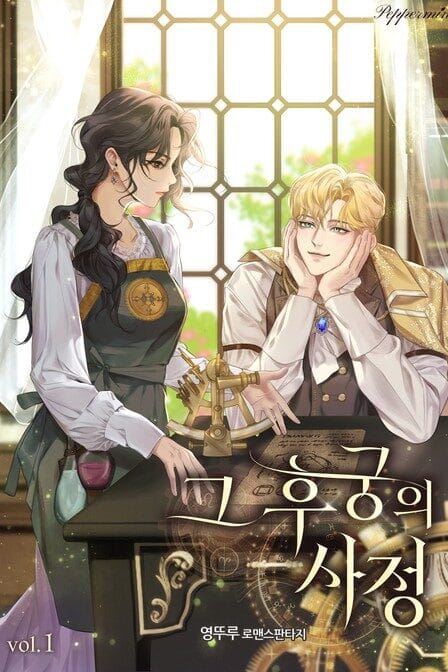
Lucia Bianchi is a talented inventor and the daughter of a wealthy merchant in the Bederon Empire. Despite her brilliance, she faces severe societal prejudice because women are barred from professional recognition in science and engineering. To survive, she works in a bookstore owned by Mr. Saper, where she designs advanced mechanical devices such as thermometers, sextants, and corn-shelling machines. However, her inventions are largely ignored by the public because of her gender, forcing her to rely on toy sales for income. She also endures an abusive home life, where her father, Cedro, and mother, Marisa, view her solely as a commodity to be married off for financial gain. Lucia has systematically repelled suitors using clever inventions and mechanical tricks, leading to her being labeled a witch or crazy woman, which results in frequent physical beatings from her father.Throughout the year, a mysterious hooded man visits the bookstore weekly, purchasing all of Lucia’s peculiar inventions. This regular customer is Emperor Aristide Savio Segrio, who has grown fond of Lucia’s ingenuity and expressive personality. He has been observing her for ten months, gradually breaking through her reserved exterior. The Emperor is known publicly as a lecherous tyrant who maintains a harem of concubines, yet he neglects his political duties in favor of collecting women. Rumors swirl that he is impotent and that the concubines are merely prisoners of passion, but the truth remains hidden.The central conflict escalates when the Emperor invites Lucia to the Imperial Ball. Seeking refuge from her mother’s pressure to accept a new suitor, Lucia hides in a restricted corridor upstairs. There, she encounters the Emperor, who reveals his true identity. In a shocking declaration, he appoints her as his next concubine. Lucia is horrified and vehemently refuses, insulted by the prospect of becoming another object for the Emperor’s pleasure. She slaps him and insults him furiously before fleeing, only to be intercepted by the Emperor in the garden.In a dramatic twist, Aristide explains that the so-called harem is actually a disguised laboratory for female researchers. He claims that because society discriminates against women in academia, he created the fiction of a harem to protect them. The current concubines are renowned professionals, including the architect Bartolo Retierre (a woman using a male pseudonym), the physician Reselda Falco, the composer Celeste Gravina, the playwright Julietta Cusano, and the botanist Dorothea Moretti. They conduct vital research that benefits the empire, shielded by the Emperor’s feared reputation. Aristide argues that this arrangement provides them with safety, funding, and freedom from societal harassment, something they could not achieve as ordinary women.Skeptical but intrigued, Lucia agrees to visit the Moonlight Palace, the location of the harem-laboratory. Upon arrival, she meets the five women, who confirm the Emperor’s story. They demonstrate that they have never been intimate with him; instead, he respects their work and provides them with resources. The women share their struggles with gender bias and explain how the title of concubine grants them legal protection and professional leverage. Valeria, the architect, explains how she uses a male alias to have her designs built, while Reselda notes that her medical knowledge is accessible only because of her status. Lucia realizes that while the premise is absurd and degrading, it is also a pragmatic solution to systemic sexism.Despite the compelling arguments, Lucia remains conflicted. She values her independence and despises the notion of being owned, even symbolically. However, the opportunity to conduct serious research in a fully equipped laboratory is unprecedented. The story concludes with Lucia standing at a crossroads, weighing her principles against the practical benefits of accepting the Emperor’s offer. Meanwhile, tensions rise as enemies from her past, including rejected suitors who hold grudges, begin to plot against her, threatening her safety both inside and outside the palace walls.