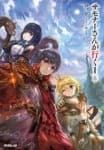
Reincarnated Sword God's Wise Knightly Life
+Add to Custom List
Genres:
Novel Info

Summary

... Read More
Ron is a trainee knight serving the Leonard Count family, the lowest-ranked member of the Dawn Knights. Despite his humble status as a commoner without a surname, he possesses extraordinary swordsmanship derived from two past lives as legendary martial artists. In his previous life as Cheong Woon, he was the Sword God of Mount Wudang, and in another, he was Jung Yeong-san, the world's strongest Hunter. After dying in mutual destruction with supreme enemies, he reincarnated into this new world. For the first decade of his second life, he repressed his abilities to live a quiet, unremarkable existence, training only enough to survive. However, during a caravan ambush ordered by the rival Viscount Rehalt with support from Marquis Calix, Ron is forced to reveal his true strength. He single-handedly defeats twenty Aura-wielding assassins using a sword domain and precise, efficient strikes, saving Count Leonard's daughter, Adelia, and the accompanying knights led by the veteran Radon Ternor.

Following the battle, Ron faces a system notification indicating the end of a tutorial and the start of a new mission titled "Raising the Count Family." The progress bar displays a negative value of -80%, suggesting the family is in severe decline compared to its historical heyday. Ron realizes that his actions and interactions directly influence this metric. Adelia, pragmatic and intelligent, recognizes Ron's value and begins engaging with him directly. She seeks his counsel on political matters, correctly identifying Viscount Rehalt as the mastermind behind the kidnapping attempt. Instead of remaining a passive guard, Ron negotiates a reward of 170 gold for saving her life, establishing a transactional rather than feudal dynamic. He also proposes innovative ideas, such as spring suspension for carriages, which Adelia sees as a potential source of revenue for the impoverished count family.

Resentment brews among the trainee knights, particularly Dane Barut, who feels overshadowed by the commoner Ron. Dane and his associates attempt to ambush Ron, but he easily defeats them in a secluded area, employing a brutal combat technique designed to inflict maximum pain without causing permanent damage or unconsciousness. This display of dominance consolidates his authority within the order, forcing the other knights to acknowledge his superiority. Ron uses this fear to secure personal guards and maintain a peaceful daily routine, prioritizing his comfort over chivalric glory. He openly criticizes the declining standards of the Dawn Knights, pointing out that their lack of talent, not just poor training, is responsible for their vulnerability.

The narrative shifts to the political machinations of the nobility. Viscount Rehalt, disappointed by the failed assassination, plans a more decisive approach involving the upcoming knight's tournament. He understands that direct conflict is risky, so he aims to challenge Count Leonard through formal channels. Meanwhile, Ron continues to navigate his dual role as a hidden powerhouse and a low-ranking servant. He maintains a careful distance from family politics while subtly influencing events to improve the count family's standing. His interactions with Adelia are marked by sharp wit and mutual respect, as she challenges his apathy and he challenges her idealism. The story establishes a tension between Ron's desire for a quiet life and the growing demands placed upon him by the declining noble house and the political threats surrounding it.

Latest Release
DateGroupRelease
2026-10-01jadescrolls c85
2026-10-01jadescrolls c84
2026-10-01jadescrolls c83
2026-10-01jadescrolls c82
2026-10-01jadescrolls c81
2026-10-01jadescrolls c80
2026-10-01jadescrolls c79
2026-10-01jadescrolls c78
2026-10-01jadescrolls c77
2026-10-01jadescrolls c76
2026-10-01jadescrolls c75
2026-10-01jadescrolls c74

Community Reviews

Rating(0 / 5.0, 33votes)
5 stars
0(0%)
4 stars
0(0%)
3 stars
0(0%)
2 stars
0(0%)
1 stars
0(0%)

Popular reviews

... Read More
I have to talk about Ron's dialogue because it's genuinely one of the most distinctive voices I've encountered. Listen to this: "Honestly, my tastes run more towards curvier, glamorous women." Said to a furious count who could literally kill him with his aura. This isn't just witty—that's a survival tactic wrapped in absurdity. The author gives Ron a voice that's equal parts sharp, self-aware, and deliberately provocative. He knows exactly what he's doing. The count's dialogue is similarly distinct. When he's angry, he's raw and unfiltered: "If there's even a scratch, I'll tear the culprits to pieces and feed them to the dogs!" No noble pretense, just paternal rage. But when he reverts to lord mode—"Explain everything"—the language becomes clipped, authoritative. Two registers for two roles, and the transitions are seamless. Adelia's voice is perhaps the most interesting. She starts as the beloved daughter and gradually transforms into the political operator. Watch how her language shifts: "My lord! I don't want to be someone who is dragged about helplessly or becomes a burden. Or do you want me to spend my whole life trapped in the family, like a bird in a cage?" That's not a spoiled noble lady talking. That's someone who understands exactly which buttons to press with her father. Every sentence is calculated, and yet it sounds genuinely emotional. The author writes her as politically astute without making her feel manipulative. The brothers' dialogue is delightfully chaotic—full of interruptions, panting, and contradictory opinions. It creates a sensory overload that mirrors the actual experience of being in that room. And Radon! His formal, measured speech contrasts perfectly with everyone else's emotional volatility. He's the narrator-anchor, the voice of reason who occasionally breaks into sardonic commentary.
... Read More
I need to talk about Count Leonard because WOW. The man goes from 'symbolizing dignity and restraint' to 'my baby was hurt I WILL END HIM' in approximately two seconds flat. That transition? No filter, no shame. And the text explicitly says "none of the vassals were surprised" because they ALL know he's a doting father. That single detail tells us more about his character than any monologue could. But here's what actually got me—when Adelia asks for a personal knight, the count's entire demeanor shifts. He's stammering. He's uncomfortable. Not because he's questioning her judgment, but because his daughter picked SOMEONE. Any father would have that reaction, and the narrative doesn't shy away from it. The contradiction between Lord Count Leonard and just... Dad Leonard is the whole story right there. And Ron! Oh my god, Ron is fascinating in this scene. He walks into that chamber and immediately senses the killing intent from the count. Most people would crumble. Instead, he deflects with humor—essentially telling the count his daughter isn't his type by claiming he prefers 'curvier, glamorous women.' What a bizarre survival instinct. But it WORKS. The count is rendered speechless. Even Adelia is internally screaming. The sibling dynamics are also delightful. The eldest pantsing in worried, the second wanting blood, the third immediately asking if she got his 'present.' They may be 'weak, clumsy, and flawed' but their love for Adelia is genuine. The text literally says so. Then there's the unspoken tension between Adelia and Ron. She chose him. After he saved her. That's a relationship seed being planted, and I am NOT okay with how subtly it's being done.
... Read More
Okay, so Ron gets home after a brutal day of training someone into submission, and what does he do? He makes instant ramen. This scene is everything. The author takes this mundane, almost silly moment—a guy with superpowers craving MSG—and turns it into the emotional core of the entire story. Look at the details: the five-meter passage with pressure-sensitive floors, the shower he built himself, the way he warms water with his aura. This isn't just worldbuilding; it's character. Every little invention, every pipe and tank, tells you that Ron is a man who survived chaos and now chooses comfort. And then the ramen arrives. "This is paradise." Sixty packs, bought with all his coins, and he's already rationing them. The contrast between the brutal outside world and this tiny sanctuary of processed noodles is so sharp it hurts. I keep thinking about how many fantasy novels would have a hero feast on roasted boar or wine, but here we get the deep, spicy scent of Ottogi ramen. It's humble. It's real. It's the most vivid scene in the book.
... Read More
There's this one scene that stood out to me way more than it probably should—the territorial meeting inside the Count's house. On paper, it's just people discussing taxes and mine development. But the details... the administrator briefing the Count before the meeting, the vassals debating, the way Count Leonard accepts opinions that match his own but never reverses once decided. This isn't a fantasy kingdom anymore. This is a functioning feudal society with real economic pressures. Fourty thousand gold needed for the mine, but they're short by ten thousand. The harvest wasn't great. Borrowing from the Zephyros merchant group creates future problems. These aren't plot devices—they're the actual gears turning behind the throne. And the way the narrator describes the Count's personality through his administrative style? 'He readily accepted opinions that matched his own, but once he'd made a decision, he rarely reversed it.' That's character revelation through governance. Brilliant. The carriage scene itself is also wonderfully confined—just two people in a small space with all this tension and awkwardness. The physical comedy of Adelia trying to slap Ron and missing, the narrator's comment about 'a true knight would never stoop to tie his laces beneath a plum tree,' it all creates this vivid, almost cinematic sense of space and movement. What I love most is how the world feels lived-in. The mines, the taxes, the merchant groups, the family politics—it all connects. This isn't a backdrop. It's a machine, and Adelia is about to try and wrench it apart.
... Read More
I need to talk about the absolute comedy gold of Ron and Adelia's dynamic in this carriage. The way Ron casually drops something like 'Frankly, I'm more into voluptuous figures' and Adelia's face turns the color of a ripe persimmon? Chef's kiss. But here's what I actually found fascinating—beneath all the blushing and splashing around, there's this really sharp power negotiation happening. Adelia literally blackmails him: 'If you don't become my personal knight, I'll tell father you groped me all over!' Can you imagine? This girl went from being all flustered to dropping a threat so calculated it made me blink. And Ron's reaction—'What outrageous words from this girl!'—he's not even mad, he's just... impressed? He knows she's right though. He needed this position anyway. The 'touching' scene was actually kind of brilliant writing. It started as a misunderstanding that could've gone so many wrong directions, but instead it became this moment where Ron reveals he can actually assess her physical potential. And his conclusion? 'You are very sma... exceptional.' The pause! The compromise! Adelia being briefly hopeful then immediately crushed again when he says she's still too late? Brutal. But also—she HAS exceptional insight. Her ability to track his sword movements shows real talent. Maybe she's not a physical powerhouse, but there's something here. Also worth noting: the narrator keeps dropping these hilarious asides. 'Cuteness can never best maturity.' I died. Progress went from -76% to -75% after this whole exchange. Little wins.
... Read More
I need to process what I just read because this hit me harder than I expected. On the surface, it's a power fantasy - underappreciated protagonist reveals hidden strength. But dig deeper and there's this incredibly sad core about loneliness and burnout. Ron is exhausted. Not physically (though he trains only during allotted hours now), but existentially. He spent years rebuilding himself after his past life memories returned, pushing his mind and body to the limit to reach his former peak. And now? He's done. He has no fuel left to keep spending himself. He wants peace. He wants to go home after duties and eat bland knight food and clean his sword in silence. That moment where he keeps wiping his blade even after it's clean - that's not just a signal to Radon. That's Ron signaling to the world: I am done performing. I am done proving myself. Give me my quiet. But here's the emotional complexity: Ron isn't heartless. He cares about the knights who died, he just won't pretend to be devastated. He treats it like "someone else's problem" because that's how he copes - with detachment. Yet he also saved the young lady and fulfilled his duty. His emotional protection mechanism is cold pragmatism, but underneath there's definitely someone who once burned out trying to be perfect. And Radon's emotional journey is equally rich. That moment of sympathy turning to indignation turning to reluctant admiration... old men like Radon have so much buried emotion they don't know how to express. The fact that he wants to discipline Ron but also feels grateful shows his internal conflict between duty and affection. As for Adelia - she's seventeen and already seeing through people. There's something bittersweet about her sitting there wondering about this commoner knight who saved her life. The unspoken tension between them is palpable, and I find myself hoping she might be the person who finally gets Ron to open up again.
See all reviews

Custom lists

See all custom Lists