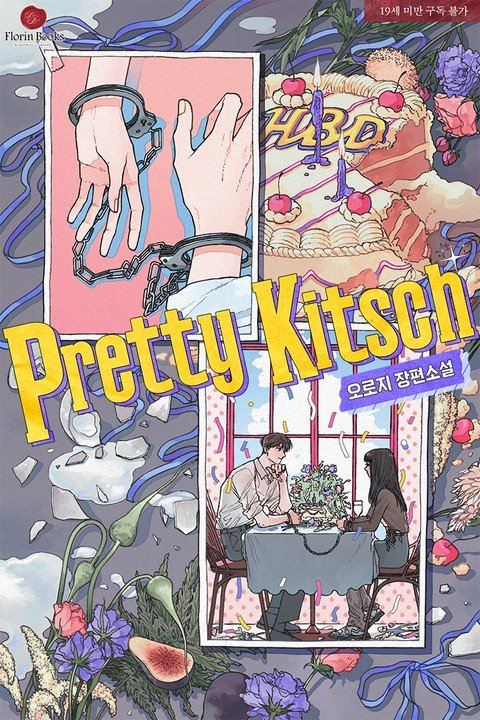
Pretty Kitsch
+Add to Custom List
Genres:
Novel Info
  • Author:
  • Status:Ongoing

Summary

... Read More
Yeo Eun-ah is a college student at Korea University who leads a life defined by poverty and exhaustion. She works multiple part-time jobs to support herself and attends classes with a singular focus on graduation and employment. Her existence is marked by shabby clothing, holey socks, and a diet of cheap food. In contrast to her struggles, Yeo Hae-jeong is a senior at the same university who appears flawless and wealthy. He is the center of attention, rumored to be the illegitimate child of a conglomerate CEO, and possesses cars, watches, and clothes of immense value. Eun-ah views him as someone entirely unrelated to her world, maintaining distance to avoid the jealousy and hostility of others who covet his status.

The story begins after a department gathering where Eun-ah, despite her reservations, attended because of the free food. She drank heavily and left the restaurant early, only to encounter Hae-jeong in a dark alley. He offered her a cigarette, and they shared a brief conversation. Overwhelmed by the alcohol and exhaustion, Eun-ah collapsed. Hae-jeong carried her to his home, claiming she agreed to come. When she awoke, she found herself tied to a bed in his luxurious house, wearing only a t-shirt with no underwear. Her memory of the events was nonexistent due to the intense intoxication.

Hae-jeong revealed that he had brought her there deliberately. He confessed his attraction to her, citing her physical attributes as the primary cause for his actions. Despite his claims of liking her, his behavior was coercive and violent. He grabbed her hair, dragged her across the floor, and locked her in a room. He subjected her to a sexual assault while she was bound and incapacitated. During the encounter, he revealed that he suffers from mysophobia, a fear of dirt and germs, which explains his cleanliness and his use of latex gloves. However, he made an exception for Eun-ah, whom he considered his first love interest.

Eun-ah attempted to resist by lying about having had previous sexual partners, hoping her perceived impurity would deter him. Hae-jeong did not believe her and continued his assault, ultimately breaking her virginity. Afterward, he treated her injuries with medical care, bandaging her wrists with surprising gentleness, which contrasted sharply with his earlier violence. He stated that he was not yet ready for penetration but intended to pursue a relationship with her.

When Eun-ah tried to leave, Hae-jeong revealed that he had fraudulently obtained a leave of absence for both of them, effectively trapping her away from her studies and work. This revelation triggered a violent outburst from Eun-ah, who destroyed furniture and decor in his pristine home. Hae-jeong watched her tantrum with a detached, almost amused expression. The narrative highlights the power imbalance between the two characters: Eun-ah is physically vulnerable and financially desperate, while Hae-jeong controls her environment and freedom through wealth and coercion.

The story progresses with Eun-ah remaining a captive in Hae-jeong's home. She experiences physical pain, emotional trauma, and anxiety about her future. Hae-jeong continues to monitor her, bringing her food and asserting his dominance while maintaining a facade of affection. Eun-ah's internal struggle centers on her desire to escape and return to her normal life, contrasted with the terrifying reality of her confinement. The narrative establishes a dark romantic thriller tone, focusing on the psychological and physical control Hae-jeong exerts over Eun-ah as she navigates this traumatic situation.

Latest Release
DateGroupRelease
2026-10-03dusk blossoms c57
2026-10-03dusk blossoms c56
2026-10-03dusk blossoms c55
2026-10-03dusk blossoms c54
2026-10-03dusk blossoms c53
2026-10-03dusk blossoms c52
2026-10-03dusk blossoms c51
2026-10-03dusk blossoms c50
2026-10-03dusk blossoms c49
2026-10-03dusk blossoms c48
2026-10-03dusk blossoms c47
2026-10-03dusk blossoms c46

Community Reviews

Rating(0 / 5.0, 32votes)
5 stars
0(0%)
4 stars
0(0%)
3 stars
0(0%)
2 stars
0(0%)
1 stars
0(0%)

Popular reviews

... Read More
Let's talk about how this author writes dialogue that cuts both ways—like, literally and figuratively. Yeo Hae-jeong's voice is chillingly calm. He says the most unhinged things with the energy of someone ordering coffee. "Preparation to penetrate you. I think it's still a bit early." Said while bandaging her forehead. "I know because I've been secretly watching you all the time." While pushing a plate of pancakes toward her. "Yeo Eun is so cute." While she's pretending to be asleep and sick in a blanket. The politeness is what makes it worse. He KNOCKS before entering her room. He asks "I'm coming in, okay?" He says "let's eat, Yeo Eun-ah" like they're having a date. This is a man who kidnaps women but still respects door etiquette. What century does he think he's living in?? Meanwhile, the protagonist's internal voice is SO sharp. Every curse word she thinks internally lands perfectly. "Crazy bastard." "Son of a b*tch." "You're really ill-mannered" (directed AT HIM after HE locked her up). The "Clean it up. This is your favorite thing to do since you have mysophobia. Right? Go ahead and do it to your heart's content." LINE THOUGHT I WOULD FAINT. That is the most petty, perfect comeback in the history of captive-narrator fiction. Their dialogue is never natural conversation—it's always power struggle. Every line is a weapon.
... Read More
The pacing in this passage is relentless, and I mean that as both praise and warning. It starts slow—dizzy, disoriented, fragmented—and then accelerates into a terrifying sprint toward escalation. The author doesn't give readers a single moment to breathe before pulling the rug out again. Let me walk through the structure because it's deliberate: We open with sensory confusion (alcohol smell, blurry memory, physical weakness). This is the setup—Eun-ah is vulnerable, lost, barely conscious. Then the waking scene hits like a truck. She opens her eyes, realizes she's half-naked, asks the wrong question at the wrong time. The pacing here is almost comedic in its bluntness—'Senior, did we sleep together?'—and that contrast with the darkness that follows is jarring. Good jarring. From there, the tempo climbs. He says he likes her. She tries to leave. He grabs her hair. She screams. He drags her. She kicks the door. She collapses. Each beat lasts longer than the last, each escalation more extreme. The thirty-minute door-kicking scene is compressed into mere paragraphs, which actually works—the summary mirrors how time distorts in panic. Then the sudden stillness: she sits, watches the clock, notices the room. That pause is the breath before the next fall. The dream sequence at the end is a structural masterstroke. It pulls us back to an earlier memory—her being carried through alleys—which recontextualizes everything. The pacing loops backward to deepen the forward terror. By the time she curls on the bed and we hear 'Let's go, dustball' echoing, the emotional whiplash is complete. The passage doesn't end—it traps you in the same room with her.
... Read More
"The spacious leather sofa, large windows, and bizarre chandelier hanging from the ceiling. It was a clean interior without any clutter, but it felt excessively unreal." I NEED to talk about this house. This isn't just a setting, this is basically the antagonist of the story. Every surface is white marble. Every corner is spotless. It's the architectural equivalent of someone with severe mysophobia—because apparently Yeo Hae-jeong has it BAD. Like, "throwing a tantrum and ruining your living room" is basically a CRIME against humanity to this man. The contrast between the luxurious, almost clinical perfection of the space and the horror of what's happening inside it is SO well done. Think about it: she's being held hostage in what could be an Architectural Digest feature. Large windows overlooking a garden (which she can't see because they're too high to jump from), a chandelier, leather furniture—the cage is GORGEOUS. The scene where she smashes everything is probably my favorite visual in this entire batch. Picture it: broken glass under slippers, soil scattered across white marble, a cracked TV falling backward, her tearing apart magazines in a fury. The author writes each sound individually—Crash! Bang! Crunch crunch—like we're hearing it in real time. And the image of Hae-jeong stepping on the glass shards afterward, with that tired expression that basically says 'when will I ever clean all this up?' is somehow both hilarious and devastating. His myophobia IS his kryptonite. Genius writing.
... Read More
'His madness made me laugh bitterly.' That line sits with me. It's not romantic—it's devastating. And that's exactly why this relationship dynamic is so compelling, even when every instinct screams that it shouldn't be. Yeo Hae-jeong is written as someone who occupies two spaces at once: the tender senior who carried her home wrapped in his clothes, calling her 'dustball' with something almost affectionate, and the man who grips her hair like a leash and locks her in a room saying, 'Let's work on making you want to do that sort of thing with me.' The duality isn't accidental—it's the core horror and attraction. He's beautiful, composed, well-dressed in pristine white loungewear. He speaks softly. He says 'I like you' like it's a confession, not a threat. And yet—his hands are violent. His words are violating. His love looks like possession. Eun-ah's response is what makes her real. She doesn't swoon. She curses. She calls him a 'creepy crazy bastard' to his face. She tries to walk away. She screams until her voice cracks. And still, he smiles. That contrast—her ferocity against his calm cruelty—creates a tension that's almost unbearable. I found myself wanting to shake her and wanting to protect her simultaneously. Their history is the ghost in this scene. 'We were quite good together,' he says, and suddenly everything shifts. Did they sleep together before? Is this consensual now twisted into non-consensual? Or is he gaslighting her into believing something never happened? The relationship here isn't just between two people—it's between who they were and who he's becoming in this moment. What I love most is that neither character is simple. He's not a cartoon villain—he genuinely seems to believe his feelings are justified. She's not a passive victim—she fights, bites, scratches, and still he drags her by the hair. The power imbalance is enormous, but so is her resistance. That friction is where the story lives.
... Read More
I need to talk about the sensory world of this book because honestly it's doing things that surprised me. The balcony scene is the kind of passage that makes me stop reading and just stare at the page. Pink cherry blossoms below, spring breeze, birds chirping — and she's lying on a sofa watching variety shows with both hands covering her mouth like a cliché girl from some rom-com. The author juxtaposes this image of leisurely domesticity against the reality that this is a gilded cage. 'Just like a rich family's wife.' Except she has no freedom, no money, no way out. The tuition debt her dad left, the forced absence from school — all of it is hanging over her like the humidity before rain. But then the period scene. The blood on the marble floor. The toilet paper makeshift solution. The smell. The sticky discomfort between her thighs. This is where the book stops being atmospheric and starts being *physical*. I could feel it. I swear to god I could feel that sticky, uncomfortable heat through the text. The author doesn't shy away from the grotesque details of bodily humiliation. And the contrast with the previous chapter — where she was covered in semen on the same cold marble floor — creates this layered texture of violation. One is sexual, the other is biological and uncontrollable. Both leave her exposed. Both happen in the same space. The house itself becomes a character: cameras watching from corners, a phone that only calls one person, a door that opens to whoever Yeo Hae-jeong decides to send. Jin-won's entrance is also visually striking — disheveled hair, languid eyes, a piercing at the corner of his mouth, and that face that 'somehow resembled Yeo Hae-jeong.' He's like a rough draft version of his cousin. The author uses physical description to do narrative heavy lifting here. I know exactly what kind of person this guy is just from three descriptive sentences.
... Read More
Let's be real about what just happened here. This isn't a romance novel turning dark—this is a fundamentally different genre now, and the stakes have shifted from 'will they end up together' to 'will she survive this emotionally and physically.' The external conflict is obvious: Yeo Hae-jeong is physically overpowering her, there's no doubt about it. But the internal conflict is where it gets devastating. She's trapped between the person who claims to like her and the person who just violated her. Every instinct is screaming at her to fight back, but she also knows he won't stop if she resists, and he's shown he's willing to go further. What does she stand to lose? Her autonomy, her sense of safety, possibly her job if this spills into their professional dynamic, and god help me, I'm worried she's going to develop some twisted attachment because of how isolation and trauma bonding work. The suspense isn't whether this will happen again—it's WHEN, and what she'll do about it. And that cliffhanger ending? It's not a romantic cliffhanger. It's a 'what happens next and how does she cope' cliffhanger. The author has burned the bridge and now we're all trapped on the other side with her. I am not okay.
See all reviews

Custom lists

See all custom Lists