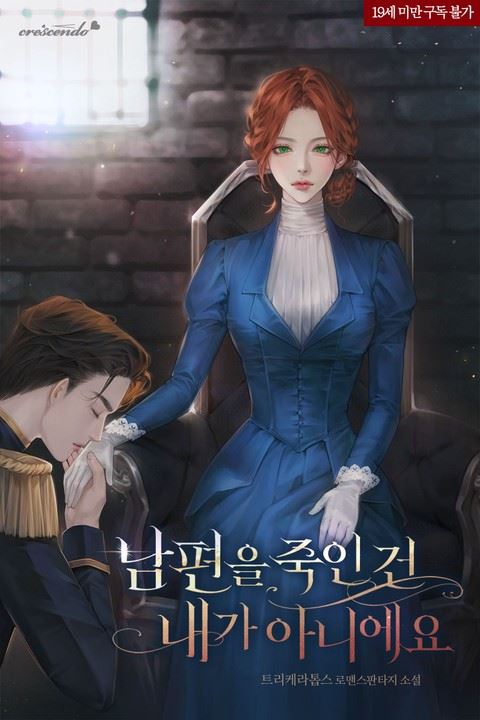
Please Marry Me, Ex-Husband
+Add to Custom List
Genres:
Novel Info
  • Author:
  • Status:Ongoing

Summary

... Read More
Asilri Bliché, the sole heiress of a prominent noble house, loses her parents in a sudden carriage accident shortly after her engagement to Khalid Renatus, the ruthless Duke known as the Blood Tyrant. Bound by her father’s dying wish, she enters a hollow marriage with Khalid, who demands no emotional reciprocity and treats her with icy indifference. Their wedding night ends in rejection, and for the next two years, Asilri remains trapped in the Renatus estate, neglected and isolated, while Khalid is away on imperial military campaigns. Exhausted and alone, she receives a letter informing her of his departure once more, with a cold warning that she must never leave the Renatus domain.Two years later, on her birthday, Asilri is assassinated in her home by a masked figure who reveals that the deaths of her parents were orchestrated by Khalid Renatus. As she bleeds out, the assassin tells her to resent Khalid for locking her in loneliness, and her final thoughts are filled with bitter resentment and a desperate wish for another chance. In that moment of death, Khalid himself appears, visibly shaken, and cradles her dying body, pledging that they will meet again.Asilri awakens to find herself back in time, exactly one year after her wedding—six months before Khalid left for the battlefield and six months before her murder. Her maid, Ria, confirms that it is their wedding anniversary. Realizing she has been given a second chance, Asilri resolves to change her fate. She intends to uncover the truth behind her parents’ deaths and escape the deadly grip of the Renatus estate. However, her plans are immediately disrupted when Khalid returns home far earlier than he did in her previous life. Finding Asilri in the garden, he embraces her desperately, revealing emotions that contrast sharply with his past cruelty. When she asks for a divorce, he initially appears to agree but then violently retracts his consent, declaring that he will never let her leave Renatus.Over the following days, Khalid’s behavior becomes increasingly erratic and possessive. He monitors her movements, forces her to share his bed under the pretext of avoiding scandal, and refuses to grant her the divorce papers she sought. Despite his oppressive control, he also displays moments of genuine concern, such as eating with her and ensuring she is properly dressed when she steps outside. Asilri, haunted by the trauma of her past life, struggles to maintain her composure. She attempts to research the circumstances surrounding her parents’ deaths but finds the official records too clean and suspiciously altered.One evening, Asilri suffers a severe panic attack when she attempts to enter her own bedroom, which is linked to the memory of her assassination. The red rose petals in the room trigger a flashback to the moment she was stabbed, causing her to collapse in terror. Khalid finds her in this state and holds her as she sobs, refusing to release her despite her pleas. He acknowledges her hatred but states that he cannot let her go. In the aftermath, Asilri falls into a deep sleep, during which she dreams of Khalid offering her his hand—a stark contrast to the betrayal she experienced in her previous life.Upon waking, Asilri finds Khalid asleep beside her, still holding her hand. When she pulls away, his expression instantly hardens, reverting to the cold duke she once despised. Undeterred by his shifting moods, Asilri retreats further into herself, focusing on her investigation. She notices that the manor’s servants have observed a change in Khalid, noting that he seems more at ease since returning. Despite her determination to escape and seek revenge, Asilri remains physically confined within the estate, bound by Khalid’s relentless grip and her own inability to fully trust his new behavior. The story ends with Asilri caught between her desire for vengeance and the confusing reality of a husband who refuses to let her go.

Latest Release
DateGroupRelease
2026-10-03dusk blossoms c53
2026-10-03dusk blossoms c52
2026-10-03dusk blossoms c51
2026-10-03dusk blossoms c50
2026-10-03dusk blossoms c49
2026-10-03dusk blossoms c48
2026-10-03dusk blossoms c47
2026-10-03dusk blossoms c46
2026-10-03dusk blossoms c45
2026-10-03dusk blossoms c44
2026-10-03dusk blossoms c43
2026-10-03dusk blossoms c42

Community Reviews

Rating(0 / 5.0, 32votes)
5 stars
0(0%)
4 stars
0(0%)
3 stars
0(0%)
2 stars
0(0%)
1 stars
0(0%)

Popular reviews

... Read More
Let's talk about the absolute mess that is Asilri and Khalid's relationship dynamics, because I have thoughts. In her past life, Asilri was the one chasing. She spent years in Renatus's shadow, clinging to the memory of one moment — Khalid taking her hand — like it was a lifeline. And what did she get? A marriage built on her own selfishness, loneliness so deep she called it 'unbearable,' and then death at the hands of an assassin while Khalid watched. The line that killed me was basically his voice in her head: 'If only it hadn't been for Khalid, I could have gone with less suffering.' He was there. He WATCHED. And now he's back and he's... confused? Guilty? Still can't figure out what he feels? Khalid is a fascinating study in emotional avoidance. His red eyes — always described as carrying some fierce, concealed emotion — are doing a lot of heavy lifting here. He holds her desperately, then immediately cold-shoulders her. He accuses her of finding another man with this aggressive jealousy that feels more like projection than suspicion. And the worst part? When she says she's going to marry someone else, his composure cracks. Not because he's sad — apparently. Because his CONTROL is threatened. Asilri's transformation from the woman who 'never once smiled at Renatus' to the one who deliberately brightens her smile at Khalid to break him? That's character growth in real time. She's not just seeking revenge; she's reclaiming agency. But here's what makes it complicated — and I love it — she still reaches for that wedding invitation. She still HOPEs he might remember. The moment his indifference crushes that hope is the moment she truly commits to leaving. Not before. The power dynamic shift is exquisite. She starts trembling, she starts crying internally, but by the end she's the one holding all the cards. And Khalid? He's the one pleading without even knowing he's pleading.
... Read More
Okay so here's the thing that completely floored me this chapter. That wedding ring. She returned it, right? Declared she wanted a divorce, kicked him out emotionally and physically. And he kept it. HE KEPT IT. And then he puts it back on her finger like nothing happened and says "proof that you are mine." I literally gasped. Like, the entire emotional architecture of their relationship just shifted under us and I wasn't ready. But what really works is how the plot keeps piling layers on top of each other instead of letting us breathe. First you've got Khalid's jealous confrontation about her defending someone else — raw, unfiltered, almost feral. Then immediately you cut to her having nightmares about having taken his hand, which is like, wait, WHAT? She's traumatized by her own choice. Then the office scene where he watches her like a hawk, disappointed when she looks away. Then the invitation arrives — a trap disguised as politeness. Then he practically stalks her to the carriage to make sure she wears the ring. Every beat escalates. Every resolution from one scene immediately becomes the setup for the next tension. The narrative doesn't rest. And I love it. It's almost suffocating in the best way.
... Read More
I need to talk about the scene where Khalid picks her up and carries her to HIS bedroom. Not hers. HIS. And he literally just lies down with her in it like this is normal husband-wife behavior. Asilri is struggling, pushing, horrified, and he just... shrugs it off like it's nothing. 'Is it strange for a husband and wife to share a bed?' He says it like he genuinely doesn't understand why this is a problem. This is the man who refused the wedding night and every intimacy after it, and now he's using duty as an excuse to force his way into her space. But here's what gutted me—the part where he sees her reddened hands from fighting and says 'You'd do well not to make a scene.' He noticed her hands were hurt. He noticed. He just chose to use it against her anyway. That's not obsession, that's calculated cruelty wrapped in the language of care. And Asilri? She stops struggling. Not because she wants to, but because she's exhausted. Because she knows fighting is pointless. Because going to her own room means facing the nightmares alone. I felt her helplessness so hard it physically hurt. The line 'Either go to your room like a good girl. Or come with me, just like this' is the most dangerous kind of ultimatum because both options are terrible for her. And yet when he finally holds her, even though she's trembling with fear, she instinctively wraps her arms around his neck. That small, involuntary gesture—her body remembering safety even as her mind screams danger—that's the most devastating moment in the entire book so far.
... Read More
The dialogue in this is SPARCE but it HITS. Like, the author could've written a thousand-word confrontation scene between Asilri and Khalid on their wedding night. Instead we get: "Let me be clear. I will not be able to meet your expectations." "Is that really what you say on the first night of marriage?" "Well. I thought it better than letting you hold onto false hope." Four lines. FOUR LINES and I felt like I'd been punched in the chest. The brevity is doing heavy lifting here — Khalid isn't just being cold, he's deliberately dismantling her hope. And that period after "Well."? Chilling. It's the pause of a man choosing his words with surgical precision. Ria's dialogue provides the only warmth, and it's used perfectly as contrast: "I'm so scatterbrained! It's already been a full year since you came to Renatus, and I still can't get used to the title!" Sweet, naive, oblivious. She has no idea her mistress is married to a ghost. That dramatic irony makes her cheerfulness ache. The gossip rumors about Khalid are woven in as quoted snippets rather than narrative description, which is a nice technique — it lets the world's perception shape his character before we even meet him directly: "They say the Duke, drenched in blood, looked nothing short of a demon." His actual spoken words are few, but when he does speak — especially to Asilri — they carry weight. The shift from formal distance ("I cannot allow you to leave Renatus") to raw desperation ("Stop, stop it. Asilri. Please, no more…") shows a man whose composed exterior cracks only for her. Even if he caused the cracking in the first place. The author's voice is restrained, almost clinical in its narration, which makes the emotional moments land harder because they're not overwrought. Every sentence earns its place.
... Read More
"I thought she had taken it off just before dying, having given up on waiting for Khalid. The fact that she was wearing it now confirmed it. She really had gone back." I need to sit down. That single detail — the wedding ring still on her finger — broke me. Because it's not just a plot device, it's a metaphor for everything that happened to her. She spent two years in that marriage feeling like nothing, and the ring was the physical proof that she was trapped. The fact that she didn't even REMEMBER taking it off shows how defeated she'd become. She just… stopped trying. Stopped caring enough to remove the symbol. And then she wakes up wearing it again. Which means she has to face the memory of every lonely night, every rejected advance, every moment she begged for warmth and got ice in return — but now with the knowledge of how it all ENDS. The most devastating emotional beat in this entire passage is probably Khalid's line: "I cannot allow you to leave Renatus. The Renatus that follows your name belongs to me." Read it once: possessive, cruel, controlling. Read it after knowing what we know about the conspiracy: protectiveness. He's not claiming her as property — he's anchoring her to something bigger than herself because he knows danger is coming and he can't be there. But he has to make her stay without telling her WHY. So he becomes the villain instead. Asilri's internal monologue at the end is where it really hits: "A man who supposedly abandoned his wife doesn't make vows about the afterlife to a dying woman." She's starting to feel the shift — that anger replacing despair, that fierce need to LIVE replacing the numb acceptance of dying. The emotional arc from "I want to die" to "I won't die pointlessly" in the span of a few paragraphs is masterful. And now? Now she's walking back into the same marriage with复仇 fire in her veins. This is going to wreck me in the best way.
... Read More
I opened this chapter ready to read. I closed it having forgotten what day it was. The pacing here is deliberately suffocating and I mean that as the highest compliment because the author understands exactly what they're doing. The chapter starts slow—Asilri at her desk, going through documents, frustration mounting. Very controlled. Very quiet. Then the rumors about the manor start swirling, and for a moment it feels like we're shifting into lighter material. Domestic drama. Gossip. But then she decides to go to her bedroom and the tempo changes instantly. One sentence and we're inside a trauma response that escalates without a single false note. The author doesn't give you air. There's no respite between the dread building and the breakdown hitting. She opens the door → darkness hits → the voice speaks → she claws at her chest → the rose petal falls → she screams → Khalid catches her. Each beat lands on the next like dominos made of glass. And then when she wakes up, instead of relief, we get Khalid holding her hand with his face buried in it. A scene that should feel tender becomes something else entirely because we know exactly what preceded it. The dream sequence in the middle is the structural centerpiece—brief, bloody, devastating. It's the chapter's pulse stopping and restarting. And that final exchange where she pushes his hand away and his eyes go cold? That's the author making you earn every emotion. No padding. No filler. Just raw, unrelenting forward momentum that somehow feels both too fast and too slow at the same time. Perfect.
See all reviews

Custom lists

See all custom Lists