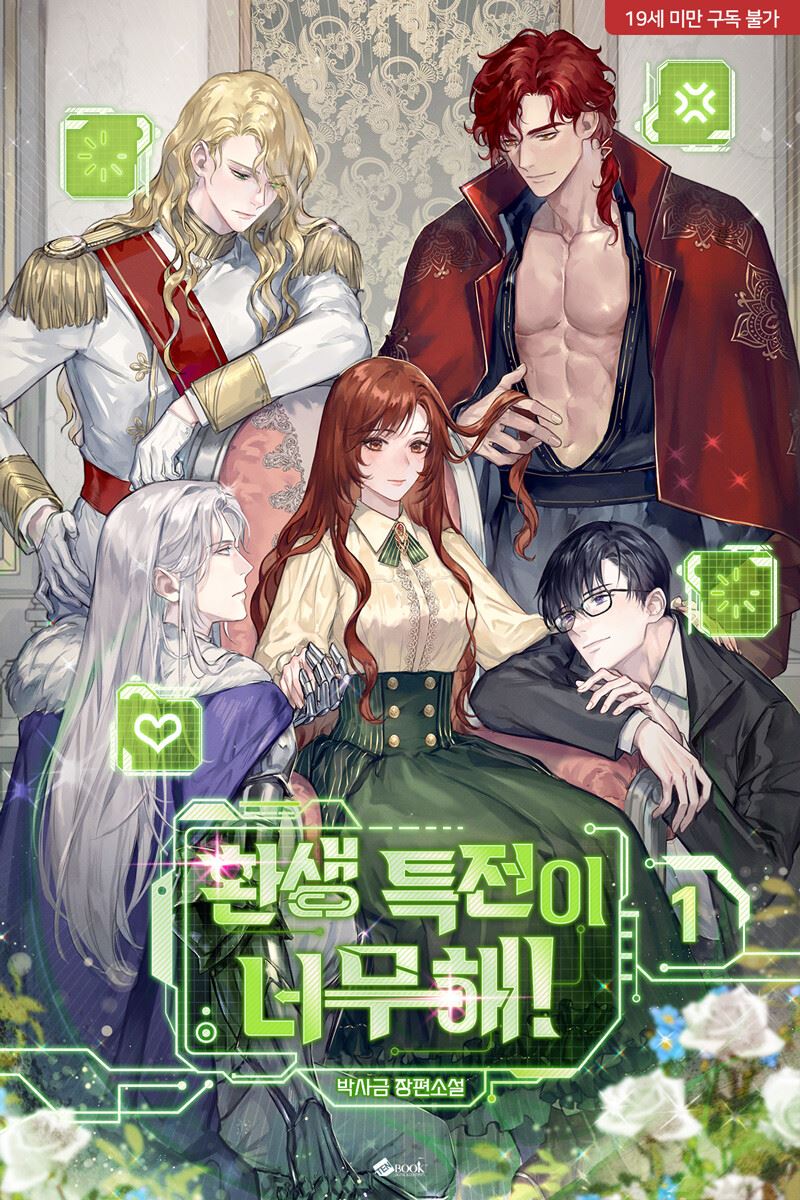
Overpowered Reincarnation Perks!
+Add to Custom List
Genres:
Novel Info

Summary

... Read More

Sung Ju-in is an ordinary twenty-six-year-old woman who dies saving a child from a subway train. Instead of an afterlife, she encounters a system window offering reincarnation as compensation for her righteous death. The system grants her a new life with a thirty-day time limit, conditional on saving one more person before her remaining lifespan expires. She wakes up in a vast, mountainous fantasy world populated by magical beasts, creatures that devour humans despite not needing food for survival. The system identifies her class as Pitiful Victim and initiates a party recruitment quest, indicating that solo survival is impossible due to the dangerous environment.

While searching for a safe starting point, Ju-in encounters Callion, a striking silver-haired magical beast hunter who is also trapped in the mountains. They form a party through the system interface, but the difficulty of all missions immediately doubles. During their journey, Ju-in is forced into combat with a massive magical beast when the shelter she hides in collapses due to a system-enforced quest. In desperation, she lets out a terrifying scream, which the system registers as acquiring the skill Scream. This ability does not harm enemies but acts as a powerful buff, doubling the movement speed of allies within range. Callion, hearing the distress, slashes the beast in half, allowing the duo to survive.

The pair continues their trek, eventually taking shelter in a rocky crevice after Callion is severely wounded defending Ju-in from a group of magical beasts. With Callion losing consciousness, the system offers Ju-in a healing skill that consumes her own life force. To save her companion, she kisses the back of his hand to activate the healing magic. The wound vanishes instantly, but Ju-in collapses from exhaustion. When she awakens, she learns from Callion that mages with such healing abilities are rare and valuable, and he urges her to keep her power secret to avoid being exploited or captured by others. This moment establishes a deep, albeit awkward, bond between them as Callion becomes protective of her secret.

Two days later, they are joined by Senes, Callion’s older brother, who arrives after receiving a distress signal. Senes is a muscular red-haired hunter with a harsh, abrasive personality who openly mocks Ju-in, calling her weak, useless, and slow. He misinterprets Ju-in’s relationship with Callion, suspecting she is his master, which leads to immediate hostility. Despite his rude demeanor, Senes possesses a culinary skill that functions as a healing ability, restoring health and removing fatigue status effects when he cooks. His arrival complicates the party dynamic, as he refuses to form a party with Ju-in until she accepts his culinary services, which she initially rejects out of pride.

The trio faces the logistical challenge of finding shelter as night approaches. The system grants Ju-in an encampment construction skill, allowing her to create a safe zone immune to monster attacks. Using this skill, they locate a cave where they can rest safely. Throughout the journey, Ju-in struggles with her role as a non-combatant support, relying on Callion for protection while using her scream to enhance his speed. Meanwhile, Callion grapples with his growing attachment to Ju-in and the moral conflict regarding her healing powers. Senes, though outwardly hostile, provides essential sustenance and combat support, creating a tense but functional team structure. The narrative follows their struggle to reach a nearby village while managing the escalating difficulties imposed by the system and the perpetual threat of magical beast attacks.

As they travel, the underlying mystery of the world and the nature of the system becomes more apparent. Ju-in’s original purpose of returning home seems distant, replaced by the immediate need to survive within the rules of this new reality. The dynamic between the three characters shifts from mistrust to reluctant cooperation, bound by the necessity of the party system and their shared survival. Callion’s protective instincts deepen, while Senes begins to acknowledge Ju-in’s utility despite his continued verbal barbs. The story establishes a foundation of survival horror mixed with fantasy adventure, centered on Ju-in’s quest to understand her fate and the systems controlling her new existence.

Latest Release
DateGroupRelease
2026-09-27citrus aurora c62
2026-09-27citrus aurora c61
2026-09-27citrus aurora c60
2026-09-27citrus aurora c59
2026-09-27citrus aurora c58
2026-09-27citrus aurora c57
2026-09-27citrus aurora c56
2026-09-27citrus aurora c55
2026-09-27citrus aurora c54
2026-09-27citrus aurora c53
2026-09-27citrus aurora c52
2026-09-27citrus aurora c51

Community Reviews

Rating(4 / 5.0, 44votes)
5 stars
13(30%)
4 stars
18(41%)
3 stars
13(30%)
2 stars
0(0%)
1 stars
0(0%)

Popular reviews

... Read More
I keep coming back to how the text describes Callion using weather and temperature imagery. He looks like a 'winter deity' even facing magical beasts. But during this scene, everything is heat — his flushed face, his glossy skin sweating, the 'sweet scent that was almost suffocating' rising from his body, the 'intense heat' of his frame pressing against hers. The symbolism is almost embarrassing obvious, and yet it works because it's tied to his fundamental nature. He's not just a guy who got lucky — he's someone whose entire identity is built around composure and restraint, and the ultimate act of intimacy here is him losing both. Ju-in notices this repeatedly: 'The man who had looked only noble even in front of fierce magical beasts, like a winter deity, now had his head buried between my legs.' The contrast isn't accidental. The author is saying that true intimacy requires the dissolution of the controlled self. There's also this recurring image of him being described as a 'beast' — not in a degrading way, but in a way that suggests something primal and honest beneath the civilized surface. And the skill window itself, with its cold mechanical language about HP and fatigue, sits in strange contrast to the organic, visceral experience happening below it. The system reduces something deeply human to numbers, but neither character cares about the numbers. That tension between the gamified world and raw human connection feels like it might be the book's central theme.
... Read More
Okay so I need to talk about this chapter because things just went COMPLETELY off the rails and I am not okay. Last chapter we had this incredibly intense scene between Ju-in and Callion, and this chapter starts with the aftermath. But then--then it flips everything on its head! I was expecting some sweet morning-after fluff, and instead we get this massive system revelation that completely changes the context of everything. The Charm skill duration revealed at the end--32 hours remaining?? That was supposed to be 2 hours!! The math alone is staggering. 'I think it was said to extend by 2 hours each time I reached climax, so the number of times I climaxed last night must have been...' I literally gasped reading this. The author doesn't even spell it out, and I don't need them to. My brain did the calculation and I nearly fell out of my chair. But what really got me is the plot twist with Senes. I thought he was just the stern older brother type, the usual 'I found you a job' trope. Then he casts [Skill: Recover by Feeding!] and I realized--he made that food himself. He's been taking care of Ju-in the entire time while pretending it was nothing. The contrast between how he talks to Ju-in ('as scrawny as you,' 'lack of common sense') and what he actually does (wakes up at dawn, finds a job, prepares food with recovery buffs) is chef's kiss. And the antique shop accountant position? Ju-in's inner monologue about becoming a 'supply management slave' had me wheezing. The author keeps the humor alive even after the most intense chapter.
... Read More
I need to just sit with what this chapter made me feel about the stakes here because it HIT different. [Time remaining: 23 days] Twenty-three. Days. That number was sitting there the whole time and I almost forgot about it in the moment but then Ju-in glances at it and everything changes. She's not just flirting with a cute knight—she's a woman who knows she's going to die in less than a month and has decided to stop holding back. The internal monologue when she unbuttons that shirt was brutal in the best way. She literally thinks about social norms, reputation, consequences—and then dismisses ALL of it because her clock is ticking. "If this were really reality, I wouldn't have come on to a man I'd only known for a few days, considering my social reputation, norms, and morals." But this isn't the modern world anymore. She's died and come back. She's in a game-like world where survival skills and system windows are real. And she's going to die in 23 days. So what does she have to lose? The stakes aren't just about whether Callion will kiss her back—the stakes are about whether she gets to feel something real before the end. Whether she lives those remaining days with some spark of passion instead of just counting them down. And Senes—don't get me started on him. The cave collapse trauma, the PTSD, the way he tried to explain it to Ju-in and she saw something genuine behind the sarcasm. He didn't mock her afterward. He went quiet. That's not nothing. Those two have some serious unresolved tension and I am HERE for it. Also the quest reward being [Charm] skill?? Ju-in is literally trying to capture a dying man's heart AND upgrade her skill set at the same time. The irony is delicious.
... Read More
There's a recurring idea underneath all this banter and system windows that I can't stop thinking about: the question of what makes someone valuable in a world that reduces people to utility. Senes measures Ju-in in combat terms — can she fight? Can she avoid monsters? Can she contribute to a party? — and finds her wanting. But the narrative keeps revealing that his metrics are wrong. Ju-in's healing ability is the most obvious example. It only activates through touch, which means it's intimate, vulnerable, risky. She's hiding it because revealing it could get her kidnapped or exploited. The very thing that could make her indispensable is also the thing that makes her safest when invisible. There's something deeply thematic about a healer who must appear useless to survive. Then there's the magic stone itself — creature cores that became useful precisely because the creatures that housed them are gone. The divine beasts that were once friendly to humans no longer exist, but their remnants sustain the living. This is a world built on the aftermath of loss, where utility emerges from extinction. Even the monsters that eat humans produce something beneficial. Nothing is purely one thing. The cooking skill named "Heal by Feeding" feels like the thesis statement of the entire passage. Healing doesn't come from combat prowess or magical combat spells — it comes from nourishment, from sharing a meal, from the domestic act of preparing food for someone else. Senes expresses care through food while wrapping it in layers of hostility, which is honestly the most realistic portrayal of emotional expression I've encountered. And Ju-in's refusal to accept the party invitation, even after the meal healed her, is a statement about autonomy. She won't trade her independence for comfort. The system offers her a deal — accept and gain protection — and she chooses to sit with her anger instead. That's character as theme.
... Read More
There's something unsettling lurking beneath the surface of this chapter. The explanation for why magical beasts devour humans — 'they say it's because they like humans' — sits uncomfortably close to predator logic dressed in affectionate language. These creatures don't eat to survive; they consume out of desire. That blurring of affection and consumption as a theme keeps echoing. Callion is described with almost religious purity — white hair, statue-like perfection, holy knight energy — yet he's barred from entering the castle, the one place that should represent safety and belonging. His exclusion from the very institution that protects humans suggests that purity or divine appearance doesn't guarantee acceptance. There's also the repeated image of Ju-in being told to 'hide' and 'stay put like you're dead,' which the cave literally enforces when it collapses. Survival here requires obedience, but obedience is also what kills you if you stay too long. The system forces movement through threats — the shelter collapse, the beast attack — suggesting that in this world, stasis equals death. The scream skill itself is symbolic in a way that hit me off-guard: her voice, born of terror, becomes a tool of connection and rescue. Panic creates the bridge between isolated individuals.
... Read More
I need to talk about Callion's introduction because the author really committed to painting him as this almost inhuman figure. The text compares him to 'a statue' — snow-white hair, clear blue eyes, flawless fair face, moving 'like a snowflake dancing on ice.' But what's interesting is the contrast between his holy knight appearance and his actual role as an unaffiliated wanderer who can't enter the castle. That detail about the castle gates being closed to him is worldbuilding done through implication. We don't get an exposition dump about social hierarchy, but suddenly we're wondering what kind of world excludes someone who looks like a divine champion from entering its safest location. And then there's the magical beast description — 'as big as a house, covered entirely in what looked like black yarn' but actually 'thousands of living worms.' That shift from textile imagery to biological horror is visceral. The cave itself is a solid example of functional setting design: spacious enough to feel safe initially, deep enough to hide danger, and then literally collapsing when the system demands it. The world feels alive because the environment actively works against the protagonist's comfort at every turn.
See all reviews

Custom lists

See all custom Lists