My Amazing WeChat is Connected to the Three Realms
+Add to Custom List
Novel Info

Summary

... Read More

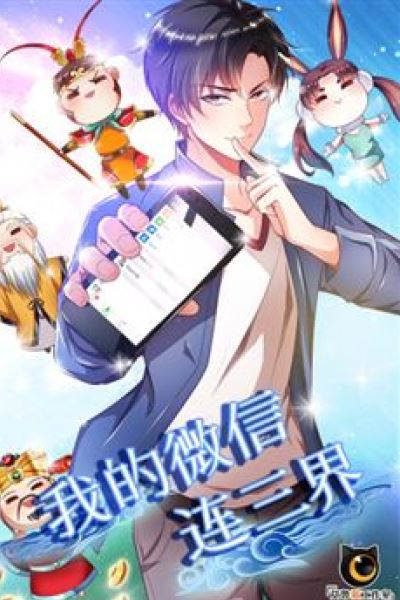
Lin Hai is a financially struggling university student at Jiang Nan University whose life unravels when his girlfriend, Wang Ting, breaks up with him. She reveals her relationship was purely transactional and abandons him for a wealthier classmate. Heartbroken and isolated in his dormitory, Lin Hai accepts a routine WeChat update that grants him entry into the High Heaven Trading Circle, a group chat populated by deities from Chinese mythology, including Lord Lao Zi, the Monkey King, and Erlang Shen. Initially believing it to be a prank, Lin Hai receives a red envelope containing one merit point and forms a friendship with Yu Tu, the Jade Rabbit, who trades a magical singing technique called the Moon Palace Fairy's Song in exchange for his single point.

The supernatural abilities manifest immediately when Lin Hai uses the singing technique to save Liu Xin Yue, the campus beauty and a fellow music student, from harassment by a local gangster at a bar. His performance captivates the audience and shocks his former peers. This event draws the attention of Hu Wei, a wealthy and arrogant member of the university elite, who challenges Lin Hai to a singing competition with a bet of one hundred thousand yuan. Lin Hai wins decisively, humiliating Hu Wei and his followers, and subsequently uses the money to pay off the mounting hospital bills for Liu Xin Yue’s father, who lies in a vegetative state following a car accident caused by exhaustion while rushing to support his daughter.

Desperate to save Liu Xin Yue’s father, Lin Hai turns to the gods in the chat for medical solutions. He trades items from the mortal realm, such as carrots, to purchase spiritual pills from the deities. The Monkey King gifts him the Heaven's Eye Magic, which proves to be unreliable in social situations, and later provides a Rejuvenation Pill. However, Lin Hai discovers that these celestial medicines are ineffective on mortals due to their low cultivation levels. Lord Lao Zi offers a solution but demands ten thousand merit points, a sum far beyond Lin Hai's current capacity. To bridge this gap, Lin Hai trades a Clear Heart Pill he acquired from a red packet to Mo Li Qing, a deity preparing for a breakthrough. Mo Li Qing pays the remaining balance with an original painting by the famous mortal artist Tang Bo Hu, titled Hundred Noble Ladies at Night.

Recognizing the immense monetary value of the painting, Lin Hai visits an antique district with his friend Liu Liang to sell it. This transaction provides him with the capital needed to improve his mundane life while he continues to seek a method to wake Liu Xin Yue’s father. Meanwhile, Lin Hai’s relationships shift significantly; he enters a pseudo-romantic arrangement with Liu Xin Yue to protect her from Hu Wei’s further harassment, a dynamic that evolves as they grow closer. He also encounters Baldie Qiang, a local thug he previously humiliated, who, impressed by Lin Hai’s display of strength after consuming a Resurrection Pill, attempts to become his disciple. Lin Hai struggles to manage these new, chaotic alliances while navigating the increasingly complex intersection of his mundane university life and his hidden connections to the celestial realm.

The narrative establishes a dual trajectory for Lin Hai. On one hand, he is integrating into the social and romantic dynamics of his university environment, gaining fame as the "Song King" online and facing ongoing conflicts with rivals like Hu Wei and Zhao Lei. On the other hand, he is leveraging his access to divine knowledge and artifacts to alter his fate, trading modern goods for ancient treasures. The story moves forward as Lin Hai seeks to accumulate more merit points and valuable items from the High Heaven Trading Circle, aiming not only to save Liu Xin Yue’s father but also to establish himself as a powerful figure who can bridge the gap between the mortal world and the heavens.

Latest Release
DateGroupRelease
2026-10-01melreads c198
2026-10-01melreads c197
2026-10-01melreads c196
2026-10-01melreads c195
2026-10-01melreads c194
2026-10-01melreads c193
2026-10-01melreads c192
2026-10-01melreads c191
2026-10-01melreads c190
2026-10-01melreads c189
2026-10-01melreads c188
2026-10-01melreads c187

Community Reviews

Rating(4 / 5.0, 41votes)
5 stars
13(32%)
4 stars
16(39%)
3 stars
12(29%)
2 stars
0(0%)
1 stars
0(0%)

Popular reviews

... Read More
I can't stop laughing about the Golden Flower Medicine Boy arc. This guy hits Lin Hai with a 10% success rate like that's normal, and Lin Hai's reaction—"Are you messing with me?"—is so relatable. Then the boy casually drops a solution that requires an item costing exactly 600 Merit Points, which is... coincidentally exactly what Lin Hai just earned. The audacity. And the Dragon King doesn't even pretend to negotiate. It's such a smooth scam wrapped in bureaucracy. But honestly, it works for the story because it strips Lin Hai down again, reminding us he's still mortal-adjacent in a world of immortal dealers. That moment when he sends everything over and comes back to zero—"And just like that, he was back to square one"—had me groaning. The painting subplot feels like a slow-burn mystery thread that's barely simmering. He sees the girl blink once at Wangu Antiques, then nothing when he uses Heavenly Eye later. Is the painting alive? Is it a trap? Or is it setting up a major quest item? And then the homecoming trigger: Song Qin's call about Yunyun refusing school. This is the emotional spine that snaps everything forward. The shopping segment is pure wish-fulfillment payoff, but the Bald Qiang encounter ties it back to Lin Hai's established underworld credibility. Everything's converging toward the family resolution arc.
... Read More
I can't stop thinking about the training room scene. It's like the author staged this entire confrontation like a movie set and I was front row. You've got the crowd of love-struck female students screaming at Liu Jun, the air thick with that campus energy where everyone's performative and competitive. Liu Jun smirking back at Lin Hai, thinking he's won before he's even opened his mouth. And then Lin Hai just... ignoring him. Whispering and laughing with Liu Xin Yue while Liu Jun gets more and more frustrated. That visual alone - him deliberately not engaging, treating Liu Jun like background noise - is such a powerful character moment. When Liu Jun sings 'One Plum Blossom,' the description hits different: [full of emotion, this masterpiece of the little brother]. You can feel the crowd swooning. The atmosphere shifts from casual to electric. And then Lin Hai says he wants to sing 'Rainbow' and the whole room goes quiet. That transition - from raucous cheering to reverent silence - is pure cinematic direction. The hospital scene though? That's a different kind of intensity. Doctor Wang Yong's office, the fluorescent lighting probably, Zhao Fang clutching his sleeve begging for two more days, his beady eyes sliding to Liu Xin Yue inappropriately. The author doesn't describe the room explicitly but you can SEE it. The cold professionalism masking corruption. And then Lin Hai walks in like a storm, throws a hundred thousand yuan card at the doctor's face, and suddenly the power dynamic flips so hard. Even the WeChat group at the end has this weird, liminal quality - gods selling lightning beads and discussing vegetative states in emoji-laden chat. It's such a bizarre tonal shift from the emotional hospital scene but somehow it works.
... Read More
Okay so I need to talk about how this whole chapter sequence just... escalates? Like Lin Hai goes from flexing a Land Rover on campus to running into some mysterious cultivation-type old man with glowing auras, then gets merit points for doing a good deed, and by the end he's walking into his house with a bag of cash to face his evil aunt. The narrative compression is actually wild. There's no breather between scenes. One minute he's bantering with Bald Qiang over car prices, the next he's using his Heavenly Eye and discovering this old man has both Bloodlust and Righteous Aura wrapped around each other. That's a detail the author doesn't just drop and forget — this guy is clearly important. And then immediately pivoting to the hometown return with the aunt confrontation. The plot doesn't coast on anything; it just keeps threading new information into every moment. What struck me most was how the merit system got introduced almost casually through the good deed reward, but it's clearly a major mechanic that's gonna matter later. The chapter ends on one of those classic cliffhangers — Lin Hai walking back out with the black plastic bag — you know he's about to settle the debt and shut his aunt down, but the satisfaction is in the anticipation. Also loved the red packet joke early on, missing it by seconds because someone else grabbed it first. Small beat but it made me laugh out loud.
... Read More
Let me just say this outright: the Baldie Qiang arc in these chapters is one of the funniest things I've read in a web novel and I need everyone to understand why it works so well structurally. Act one: Lin Hai encounters Baldie Qiang and almost gets caught. He talks his way out using pure charisma and logic. Relief. Act two: He gets the Resurrection Pill from Yu Tu, his powers evolve, he feels invincible. High point. Act three: Confrontation with Zhao Lei and Wang Ting. He humiliates them both. Catharsis. Act four: Baldie Qiang sees the fight, drops to his knees, begs to be his disciple. Chaos. And then the pacing doesn't STOP. It keeps going. And going. Lin Hai tries every possible way to get rid of him — refusing outright, telling him to go home, sending him away with an assignment — and Baldie Qiang just... doesn't leave. The scene escalates from manageable annoyance to full existential crisis for our protagonist. The last exchange is pure gold: "Don't call me Master." "All right, Master." "You piece of shit! Didn't I say not to call me Master!?!?" "Yes, Master, I understand. I won't call, Master." The author uses repetition as a structural device here, and it's hilarious because each iteration raises the stakes of Lin Hai's frustration while keeping the scene moving forward. This is comedy writing with real discipline. And the transition from the Wang Ting/Zhao Lei dramatic confrontation directly into the Baldie Qiang comedy without any pause or chapter break? Chef's kiss. The tonal whiplash is intentional and it works.
... Read More
There's something deeply symbolic about the entire singing competition arc, and I think the author is building something bigger than just a campus rivalry. First, the songs themselves matter. Liu Jun picks 'One Plum Blossom' - a song about solitude, endurance through winter, blossoming against odds. It's almost painfully ironic given that he's about to be completely defeated. Then Lin Hai chooses 'Rainbow' - [That you more beautiful than the rainbow] - a song about finding light after darkness, about love that persists. The contrast between these two songs mirrors the contrast between these two characters. Liu Jun performs for validation; Lin Hai performs for connection. The hundred thousand yuan is also significant. It represents Lin Hai's unexpected power - he comes in as nobody, a poor student according to Hu Wei's assumptions, but he walks away with enough money to save a life. Money as agency. Money as weapon. Money as the thing that flips every power dynamic in that hospital room. And then there's the WeChat group with the gods. Li Jing and Ne Zha haggling over merit points, Lei Gong selling lightning beads, Chang Er being clueless - this is such a weird juxtaposition against Liu Xin Yue's very human suffering. The divine beings are treating life-and-death matters like a marketplace, which either satirizes how we commodify everything or suggests that maybe, just maybe, these supernatural forces actually care in their own strange way. Xiao Hutu Xian asking for medicine for vegetative states - that message to the group feels like a prayer. A desperate, modern prayer sent into the digital void hoping someone, somewhere, might answer.
... Read More
There's this scene after the fight where everyone's eating and it's one of those moments that's equal parts awkward and powerful. The villagers are sitting there, whispering, eyes darting toward Lin Hai's table like they're watching a coronation. The usual loud voices are gone. That silence is doing more work than any action scene in these chapters. I keep coming back to the visual contrast the author sets up. On one side you've got the police cars and the Passat, authorities that have been corrupt for years suddenly rendered powerless. On the other side, Lin Hai's Land Rover—his actual vehicle, not borrowed status—pulling up to give Old Xiao a ride while the mayor is left standing there offering open doors like a desperate butler. The imagery of Xiao Qing Shan literally refusing Huang Bo's car with that cold "this old man can't afford it" line? That's not just dialogue, that's a whole power dynamic visualized in one gesture. The town itself feels like a character here. Lancheng, with its corruption, its ladder factories, its police station run by someone's relative—it's a small place where everyone knows everyone's business, and that's exactly what makes the fall of the Sun siblings so public and so humiliating. This isn't a private reckoning. It's a town spectacle.
See all reviews

Custom lists

See all custom Lists