Summary

... Read More

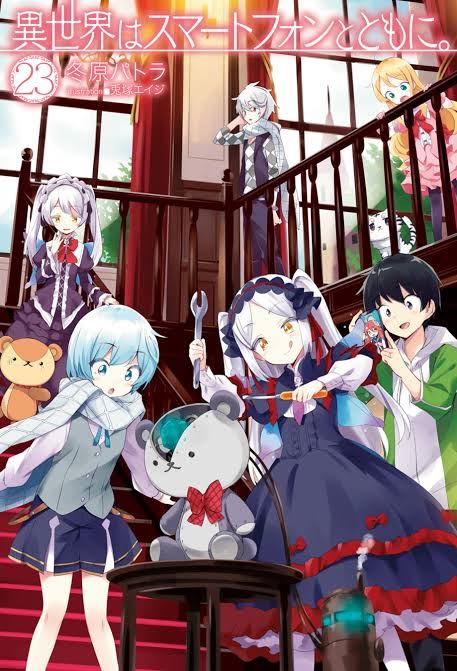
Touya Misumi, known as the Grand Duke of Brunhild, is a powerful individual who possesses divinity and serves as a mediator between nations in both the Eastern and Western Continents. He lives with his nine wives, including Yumina, Linze, Elze, Yae, Lu, Hilda, Leen, Sue, and Sakura, while serving as the protector of the Kingdom of Brunhild. His wives hold various titles, with most also being Grand Duchesses or high-ranking knights within Brunhild. Touya has introduced modern technology, such as mass-produced smartphones and internet-based services, to this fantasy world, creating significant societal shifts and diplomatic advantages for his nation.

The narrative begins when Ririel Reem Refreese, the First Princess of the Refreese Empire, secretly summons Touya and his close friends Yumina and Linze. She is extremely distressed because her father, the Emperor of Refreese, confiscated her smartphone after catching her using it during an important ceremony. The phone contains the unfinished draft of her popular romance novels written under the pen name Rif Riffris. Her father has set a condition for returning it: she must attend a formal matchmaking party to find a husband, which she vehemently opposes due to her traumatic past involving a fiancé who abandoned her for another woman. Touya agrees to help her, first by retrieving the phone using teleportation magic, and then by negotiating with the Emperor to hold a masquerade ball instead. This event is designed to be a joint matchmaking party connecting nobles from the Eastern Continent with bachelors from the Western Continent, utilizing masks to hide identities and reduce the pressure of social status.

Touya takes on the role of organizer, crafting specialized masks that inhibit facial recognition and include voice changers to ensure anonymity. He also coordinates the attendance of knights and dignitaries from Brunhild, preparing them in formal attire and etiquette. The event becomes a significant diplomatic gathering, bringing together kings, emperors, and nobles from multiple nations, including the Demon Kingdom of Xenoahs. During the preparations, Touya meets the Demon Lord and his sons, Faron and Fares, who are Sakura's half-brothers. The Demon Lord expresses his desire for his son to marry well, while Sakura maintains a cold but polite distance from her estranged family.

On the night of the masquerade, the atmosphere is initially festive. Touya observes the proceedings from a balcony with other monarchs, including the King of Linea and various beastmen kings. They watch as young nobles attempt to find partners, though the muscular kings become more interested in a brawl breaking out between two young men over a romantic rivalry. Touya is distracted from the romantic pursuits when he receives a message from his kunoichi agent, Shizuku, reporting a suspicious individual. Upon investigation with Elze, Sakura, and Shizuku, they discover that the suspicious woman is not human but a Simulacrum Model, a rare type of golem designed to mimic humans perfectly. Sakura, utilizing her super hearing, detects no heartbeat from the figure, confirming it is an artificial construct.

Touya uses his Divine Sight to verify the golem's nature and sketches the face beneath its mask. He reveals to the gathered leaders, including the Emperor of Gardio and the Pope of Ramissh, that the woman is Imelda Tryus, a noble from the Gardio Empire. However, the real Imelda Tryus is missing. It is hypothesized that the golem replaced the real noble as part of a conspiracy, possibly orchestrated by the Tryus family or a third party, to infiltrate the high-level political gathering. The presence of a deceptive golem among royalty poses a severe security threat and a potential assassination risk, shifting the tone of the story from a lighthearted social event to a tense political thriller.

The discovery forces Touya and the attending monarchs to decide how to handle the situation discreetly without causing panic or ruining the diplomatic relations established during the party. Touya must balance his role as a host and mediator with his duty to protect his allies and maintain security. The unresolved identity of the mastermind behind the golem and the fate of the real Imelda Tryus create a looming conflict that threatens to escalate beyond the ballroom. Meanwhile, Princess Ririel continues to struggle with the matchmaking process, eventually encountering a masked man who rescues her from harassment, adding a personal subplot to the larger political intrigue. The story concludes with the realization that the masquerade, intended to foster peace and union, has instead become a stage for espionage and hidden dangers.

Latest Release
DateGroupRelease
2026-09-26knoxt c5
2026-09-26knoxt c4
2026-09-26knoxt c3
2026-09-26knoxt c2
2026-09-26knoxt c1

Community Reviews

Rating(4 / 5.0, 58votes)
5 stars
20(34%)
4 stars
17(29%)
3 stars
20(34%)
2 stars
1(2%)
1 stars
0(0%)

Popular reviews

... Read More
Can we talk about how the author just casually deposited a entire golem taxonomy into the middle of a tense scene and made it READ like page-turning information rather than textbook exposition? Because normally, this is where I'd click away. You know the move—protagonist discovers something weird, and suddenly we're treated to three paragraphs of “And so, in this world, there exist creatures called golems, divided into five types…” I've seen it done poorly so many times it's become a meme. The “information dump” is the bane of light novel pacing. But here? Here it WORKS. And I think it's because the protagonist isn't just dumping lore for the reader's benefit. He's actively classifying what he's seeing IN REAL TIME. This is his thought process. He's trying to understand what he's discovered, and the taxonomy is the framework he uses to make sense of it. The information isn't decoration—it's diagnostic. And notice how tight the pacing stays. After the reveal, he doesn't linger in shock. He immediately moves to action: confirms with Elze, sketches the face, teleports to report to the Emperor. The worldbuilding exists inside the momentum, not against it. The structure of this section is actually brilliant: reveal → explanation → implication → action → complication. Each beat pushes the next forward, and there's almost no breathing room. By the time we're done with the golem classification, we're already in a diplomatic standoff between two emperors with no clear resolution in sight. And then it ends on “Hey, darling.” That line is everything. It's intimate, it's urgent, and it's completely unpredictable after the bureaucratic tension that preceded it. The author could've ended on a dramatic declaration or a looming threat. Instead, they ended on what sounds like the beginning of something personal. It's the narrative equivalent of a breath held too long finally being released.
... Read More
Okay so this whole sequence where Touya suggests overwriting Imelda's master authority before tying her up is actually such a smart move on his part, and it makes it even more painful when it fails. Elluka was the one who should've seen the trap, but you know what, even she admitted it was a mistake. The thing that gets me though is how this reveals the author's confidence in building tension through reversals. We go from "we have a plan" to "we've walked right into their countermeasure" without any major plot armor saving them. The Q-Crystal reveal at the end basically just recontextualizes everything—if the only clue they had to the mastermind was on that golem, and it's gone now, the stakes just skyrocketed for whatever comes next. That cliffhanger feeling of "oh no, we're deeper in the hole" is masterful pacing.
... Read More
Dr. Babylon saying "I am also very interested in seeing what kind of oppai simulacrum gollems like her has too" is such a distinct voice—equal parts creepy, clinical, and matter-of-fact. She doesn't even realize she's being inappropriate, which makes her somehow worse (or funnier?) than someone who'd openly leer. Then Elluka's deadpan delivery of "Kora, Regina-chan. Don't tease the newlyweds too much" cuts through the chaos perfectly. And Lucrecion just mumbling to himself while trying not to listen—that's the kind of small character detail that makes dialogue feel real rather than performed. The narrator Touya has this escalating frustration in his internal monologue that builds naturally across the scene. His "Stop telling us every single damn thing, goddamn it!" is the perfect exasperated mid-point scream. Every character has a recognizable mouthfeel when they speak, which is honestly rare.
... Read More
There's this recurring motif of masks—literal and figurative—that I can't stop thinking about. Everyone at the party is wearing one, including our protagonists. The husband uses Mirage to make Elze and Sakura look more subdued, which is both practical and symbolic. They're hiding their true appearances, their true relationship status, trying to move through this space unseen. But masks don't just conceal—they reveal. The suspicious woman Shizuku spots is wearing a mask too, but her movements are 'too pretty,' 'repeating a fixed movement over and over again.' Her disguise is imperfect, not because of her face, but because her behavior doesn't match a real person's rhythm. And then there's the ultimate reveal: Sakura can't hear a heartbeat from her. A woman without a heart, literally. The symbolism is almost too perfect—this figure is hollow inside, performing humanity without feeling it. Meanwhile, our heroes wear masks but have beating hearts, genuine connections, real emotions. The party itself is a symbol of society—people performing roles, hiding intentions, judging by appearances. Yet within that performance, real bonds form. Elze's fear of being discovered, Sakura's protective clinging, Shizuku's dedication to gathering information despite personal risk—they're all acting, but their motivations are authentic. The husband's Divine Sight sees through physical disguises to reveal truth, but maybe the deeper truth is about who has a heart versus who's just going through the motions. That suspicious woman might be a zombie, a construct, something without humanity—but she's moving, talking, laughing like a person. What does that say about authenticity? Are our masked heroes more human than an unmasked pretender? The text leaves this ambiguous in the best way.
... Read More
The dialogue in this chapter is genuinely excellent and I want to talk about why. Faron sounds like an energetic action hero who took one too many shonen protagonist courses—"This is the first time we've met in person, but it's me, Faron, your elder brother!" Complete with the pose description. He's loud, proud, and completely unaware how he comes across. Fares is his opposite—measured, polite, using honorifics and formal language even when apologizing for things he didn't personally do. "I humbly ask you for the forgiveness"—this guy sounds like he was raised by diplomats. Sakura? Brutally direct. No filter, no social padding. "You seem like an idiot, though." Period. The narration itself deserves praise too. Those bracketed asides like "[Bruh, I can't even imagine having 9 wives. Lol]" give the whole piece this modern, self-aware voice that somehow fits the fantasy setting without breaking immersion. It's the literary equivalent of a commentator reacting live to the story. And the Demon Lord's dialogue perfectly captures someone who is simultaneously powerful and pathetic—he demands attention, gets ignored, then whines about it. Three lines and you know exactly who this character is.
... Read More
This chapter is a masterclass in tonal whiplash done right. You start off with the most elegant, slow-burn atmosphere imaginable—gentle melody flowing, people in formal wear, masks on, champagne clinking, everything giving high-society romantic comedy vibes. The prose is leisurely, almost languid. Cloud is wandering around, observing, making small talk. It feels like a chapter that could sit comfortably in a slice-of-life fantasy. And then just when you've settled into that rhythm, BOOM—the kings retreat to the balcony like gossiping aunties, healers are posted in the courtyard, and suddenly two masked young men are locked in a glare that's about to turn into a duel. The shift is so abrupt but somehow perfectly earned. The author plants all these tiny breadcrumbs along the way—those healers on standby, the kings exchanging knowing glances, the line about it being 'about time it starts.' Reading it again, every detail snaps into place, but on first read? You're just as confused as Cloud. That's good pacing. It keeps you engaged because even the POV character doesn't fully understand what's happening, so you're reading along discovering things with him. The chapter also manages multiple mini-scenes seamlessly: the dance hall floor, the balcony conversation, the courtyard confrontation. Each transition feels natural because Cloud is literally moving through the space. The ending cuts off mid-sentence which is classic web novel pacing—right when the stakes escalate, you get dropped. I will absolutely be clicking next chapter immediately.
See all reviews

Custom lists

See all custom Lists