Summary

... Read More

Jiang Qingmi transmigrates into a novel, inhabiting the body of a minor character who was the male lead's ex-girlfriend. The original character accepted two million yuan to leave the male lead, Qing Yanshen, after discovering she was pregnant. Jiang Qingmi wakes up with no memories of the original host and finds herself in a dilapidated situation with a two-year-old daughter, Jiang Tuantuan, and only three thousand yuan to her name. Believing the novel's plot dictates that the male lead will eventually claim paternity and pay child support when the child turns five, she decides to secure the money early. She travels to Beicheng, expecting to find the domineering CEO at his luxurious estate, Qingcheng Bay. Instead, she arrives at a noisy construction site where signs indicate the future location of the wealthy district is still under development.

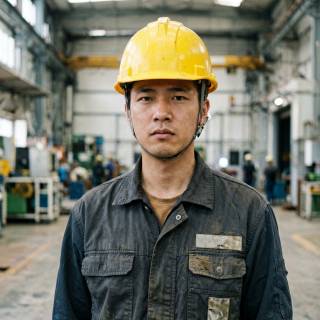
At the site, Jiang Qingmi encounters a man named Qing Yanshen who shares the male lead's name, age, and birthday but works as a laborer. He has suffered a head injury and lost his memory, living in a crowded dormitory with other workers. Initially convinced this is a coincidence, Jiang Qingmi is stunned when the man insists the child is his, citing her physical resemblance to him. Despite her skepticism, the uncanny similarities and his persistent, gentle demeanor begin to erode her certainty. He offers to cover their expenses and arrange a paternity test, though he lacks the funds at the moment. Jiang Qingmi, unable to endure hardship, accepts his help, and they share a meal at a modest restaurant where he displays unexpected domestic skills and attentiveness.

Qing Yanshen rents a small apartment for Jiang Qingmi and Tuantuan, dreaming of a family life together, but Jiang Qingmi maintains emotional distance, insisting they are merely strangers bound by a potential biological link. She refuses to let him live with them, fearing further heartbreak if he turns out not to be the father. Meanwhile, Qing Yanshen experiences vivid dreams of his past, revealing that he and Jiang Qingmi knew each other since childhood and shared a deep connection before his amnesia. These memories suggest their relationship was far more significant than the brief romantic encounter described in the novel. Jiang Qingmi, unaware of these dreams, focuses on finding a way to earn money. She reconnects with Li Lanyan, a former coworker of the original host, who teaches her to knit handmade wool products.

Jiang Qingmi begins selling knitted baby shoes at an underground market, finding success and a sense of independence. Qing Yanshen supports her efforts, helping with the stall and caring for Tuantuan. As they spend more time together, a domestic routine forms, blurring the lines between their arranged proximity and genuine affection. Jiang Qingmi falls ill from overwork, and Qing Yanshen tends to her, further deepening their bond. The narrative shifts from a simple quest for child support to a complex exploration of identity, memory, and found family. Jiang Qingmi must reconcile her knowledge of the novel's plot with the reality of a man who is kind, hardworking, and seemingly devoted, while Qing Yanshen struggles to recover his past and understand the woman who has reentered his life.

The central conflict revolves around the paternity test and the discrepancy between the novel's portrayal of Qing Yanshen as a cold CEO and the man Jiang Qingmi now knows. As Jiang Qingmi earns money and gains confidence, she begins to question whether she should continue waiting for the original plot to unfold or embrace the new life she has inadvertently built. The story moves toward a resolution where the truth of their past and the results of the test will determine their future, challenging the predetermined fate of the novel.

Novel Items

More
Document
Qing Yanshen's identification card that confirmed his identity when he woke up at the foot of a mountain. The name on it is Qing Yanshen. Jiang Qingmi only caught a glimpse and did not notice the full name.
Document
A paternity test that Wei Ying carried in her bag, which proved Shi Jianchuan was Shi Qi's biological son. This document saved Shi Jianchuan's life when Shi Qi was about to beat him to death at the abandoned warehouse.
Item
Held by Jiang Tuantuan throughout the chapter. The baby perks up at the mention of food while holding it.
Props
A new toy car that Xiao Xigua wished for. Wang Xin and Zhang Na Na promised to buy him one after filming.
Item
Two toys that were in Lei Zhen's bag but he hadn't prepared specifically for his own sons since he didn't know he had two sons. He planned to buy something for them the next day.
Item
Qing Yanshen went to buy these for Jiang Qingmi after she ate until she was stuffed and could barely walk. He claimed he was going to buy them but actually left the room upset.
Latest Release
DateGroupRelease
2026-08-11shanghai fantasy c13
2026-08-11shanghai fantasy c12
2026-08-11shanghai fantasy c11
2026-08-11shanghai fantasy c10
2026-08-11shanghai fantasy c9
2026-08-11shanghai fantasy c8
2026-08-11shanghai fantasy c7
2026-08-11shanghai fantasy c6
2026-08-11shanghai fantasy c5
2026-08-11shanghai fantasy c4
2026-08-11shanghai fantasy c3
2026-08-11shanghai fantasy c2

Community Reviews

Rating(4 / 5.0, 26votes)
5 stars
9(35%)
4 stars
9(35%)
3 stars
8(31%)
2 stars
0(0%)
1 stars
0(0%)

Popular reviews

... Read More
Okay so this dream sequence had me absolutely shook. Qing Yanshen falls into that darkness again—the same falling motif from earlier chapters—and this time it's not just a nightmare, it's a MEMORY. The author is playing with this really clever structure where his lost memories are bleeding through in fragments. And what's the first one he recovers? A moment with Jiang Qingmi from their youth, where she's already showing that fierce, protective energy. She's basically telling him to come with her to Beicheng, and he grabs her clothes the exact same way he's grabbing at her now in the present. That parallel hit me like a truck. Then the plot twist within the twist: Jiang Qingmi ALSO lost her memory. She's not some gold-digger taking advantage of his condition—she's just as confused and adrift. This completely reframes their entire dynamic. And then cutting to the Qing family estate with Qing Minghong and Qing Chen... the father mentions he never released Yanshen's photos to protect him, but Qing Chen is already acting suspicious. Two months missing, surgery coming up, and this half-brother who suddenly started working seriously at the company? The plot threads are tightening like a noose. I love how the underground market scene with Li Lanyan feels almost mundane compared to the high-stakes family drama, but it's actually setting up something bigger—Qingmi making connections, trying to survive, while the real danger is closing in from the other direction.
... Read More
I have to say, the worldbuilding in these chapters is quietly phenomenal and I don't think it gets enough credit. This isn't some glamorous fantasy city or a polished modern metropolis — it's Beicheng, and it feels lived in. Li Lanyan's rental with its plain cement floor that's kept spotlessly clean, the two bedrooms and living room, the smell of stir-fried cauliflower and braised fish filling the air. You can literally smell that meal. I'm not being dramatic. The underground mall scene is another highlight. The 50-yuan stall fee, the QR code for WeChat payments, the price sign handwritten beside rows of tiny wool shoes — this is a world where the economy is tangible and small. Jiang Qingmi calculating in real time: thirty pairs at 80 yuan each equals 2,400 yuan a week. That's not plot convenience, that's a woman doing actual math to survive. The detail about winter being the profitable season and summer being dead for yarn products? That's the kind of specific, practical worldbuilding that makes fiction feel like it could be your neighbor's life. And the temperature dropping in October, the night wind carrying a slight chill on the way home — these sensory details aren't decoration, they're the texture of the story. Beicheng has weather. It has seasons that affect commerce and mood. The rain on the day of the stall, the crowd thinning by afternoon, buying groceries on the way back — it's all so grounded. What strikes me most is how the settings mirror the characters' emotional states. Li Lanyan's modest but warm home reflects her practical optimism. The underground mall's bustling energy mirrors Jiang Qingmi's first taste of independence. And their tiny apartment, with Qing Yanshen silently mopping and wiping tables, transforms from a bare space into something that almost looks like home. The world isn't just a backdrop here — it's an active participant in the story.
... Read More
Let me just talk about the atmosphere in these chapters because the author really knows how to paint a scene without trying too hard. The emergency room with its bright lights making people dizzy, the steady beeping of machines, the smell of disinfectant—that's the first layer. Cold, clinical, terrifying. But then you shift to the hospital room where Qing Yanshen is sitting crookedly on a folding chair, elbow on his knee, forehead pressed against his palm, dark circles under his eyes. And Tuantuan is curled up on another folding chair, her chubby face swollen around the eyes from crying. This isn't a luxurious setting. It's cramped, uncomfortable, temporary. And yet it becomes the most intimate space in the entire novel. The feeding scene is where the worldbuilding really shines. A thermos of millet porridge, a disposable spoon, the soft dripping of the IV, the quiet sound of swallowing. These tiny sensory details make the scene feel incredibly real. You can smell the porridge. You can hear the room. The author doesn't need grand descriptions—the power is in the specificity. 'He fed her slowly, only scooping another spoonful after confirming she wasn't uncomfortable.' That single detail tells you everything about who this man is becoming.
... Read More
Okay so I need to talk about the cooking scene because it genuinely wrecked me. You know those moments in novels where everything just clicks and you're sitting there like 'no way this is this wholesome' — that's exactly what happened when Qing Yanshen came home early and said 'I'll cook. You rest for a while.' Like. He just rolled up his sleeves and took over the kitchen while she knitted and the baby played and it was the most domestic, normal, devastatingly sweet thing I've read in months. And the detail about him watching her eat the whole time, his hand under the table tightening because he was so excited she liked his food — that's not just romance, that's someone who has clearly been starving for something real and is terrified of messing it up. The line 'A long-lost feeling, as if he had experienced it before, resurfaced in his body' gave me chills. He's not just playing house, he's remembering something he thought was gone forever. Jiang Qingmi eating three bowls of rice and praising every single dish — 'Qing Yanshen, you should open a restaurant' — she's just so genuinely happy and it's infectious. And then the next day she pushes herself too hard and gets a fever. Of course she does. That's the pattern with these characters, isn't it? They find warmth and immediately try to earn it by exhausting themselves. She couldn't even get out of bed when the fever hit, and Tuantuan was wiping her forehead with a handkerchief like her mother always does for her. That image just — I can't. The fever scene at the end where she's lying there thinking about how Qing Yanshen already took a day off yesterday and wondering if she's treating him like a workhorse? That's the moment I knew this story understood something real about how people in fragile situations behave. They don't know how to just receive kindness. They feel like they have to pay for it in advance.
... Read More
'If they kissed…' Jiang Qingmi froze. Her face instantly heated up and turned red. OH MY GOD. I literally screamed at my phone. This woman is fighting for her life, has an IV in her hand, throat on fire, and her brain goes straight to—his lips? She's been so guarded, so careful with him, building walls brick by brick, and then in the most vulnerable moment of her life, when he's feeding her porridge like some domestic dream, her mind betrays her completely. And the best part? He notices. He notices her blushing and actually remembers what his coworkers told him: 'If a woman usually interacts with you naturally, but suddenly blushes at a certain moment, it means she has started to notice you.' He thinks he's overthinking it. He thinks he's reading too much into it. But he's not wrong. Neither of them is wrong about anything, and that's what makes this CP chemistry absolutely electric. Then Tuantuan wakes up and says 'When mommy is sick, Tuantuan is not happy' with her little brows furrowed looking adorably fierce. The family unit is forming in the most organic way possible and I can't breathe. This isn't forced romance—it's two people who keep choosing each other even when they don't fully understand why, and a child who just wants her mommy to feel better. The emotional core of this story is so strong I could cry.
... Read More
The structure of these chapters is honestly masterful and I need to unpack why. We open with Qing Yanshen alone in bed, scrolling through her social media, looking at a photo he took by accident. Solitude. Then the dream sequence drops us into their past—youthful, hopeful, full of possibility. The pacing here is slow and dreamy, almost hypnotic. He's falling through darkness and then suddenly he's on grass with sunlight. The transition is seamless because it's how memory works. Then—BAM—he's awake and immediately acting on that emotional impulse, carrying a table, buying breakfast, showing up at her door. The energy shifts from contemplative to kinetic. He's trying to rebuild something and he's doing it through actions, not words. Then Jiang Qingmi shuts him down. The tension spikes. She reveals her memory loss. The ground shifts beneath both of them. And just when you think the chapter is going to be this intimate domestic drama, the author CUTS to the Qing family mansion. Crystal chandeliers, Italian marble, a father with partially white hair who's planning surgery in two months, and a brother who's clearly hiding something. The pacing here is sharp and clipped—short dialogue, quick exchanges, that final sneer from Qing Chen. It goes from warm and messy to cold and calculated in one paragraph. The underground market scene in between acts as a breather, but even that has tension—Jiang Qingmi trying to figure out how to survive, making connections, and Li Lanyan's casual acceptance of their relationship. The author never lets you settle. Every time you think you understand the story, it pivots.
See all reviews

Characters

See all characters

Custom lists

Oops…There is nothing here.