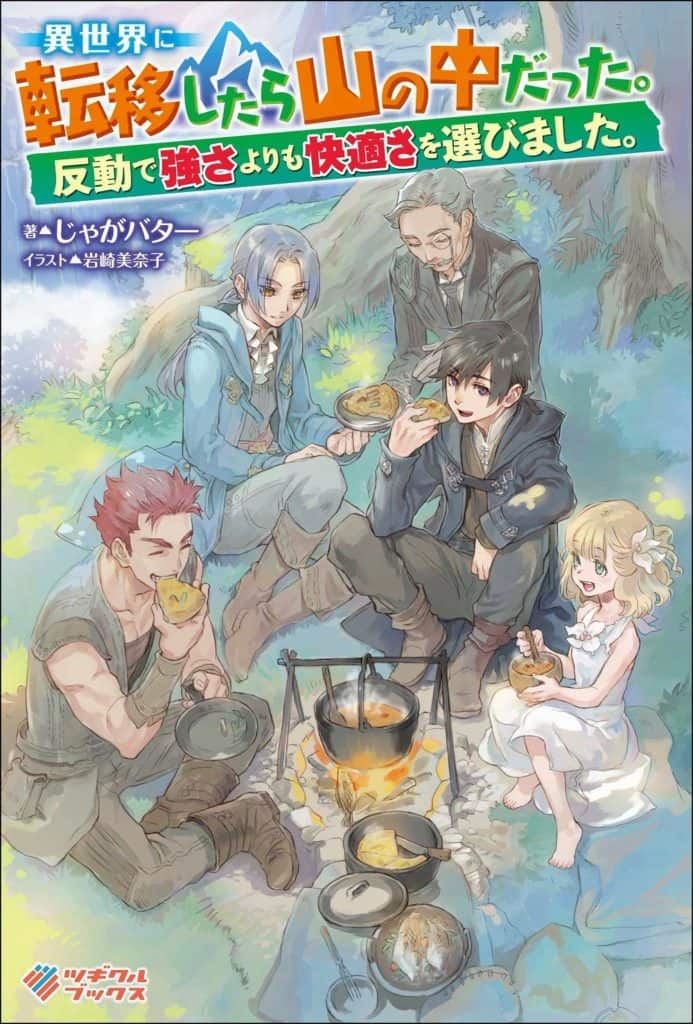
I Got Transferred in the Middle of a Mountain
Novel Info

Summary

... Read More

Jin, a high school student accustomed to living under the demanding control of his older sister Haruka, finds himself unexpectedly transported to a mountainous island after turning around during a trip to watch fireworks. Stripped of his family and friends, he is forced to survive alone in an unfamiliar wilderness. Equipped only with a cooler, a picnic sheet, and survival knowledge gleaned from television programs, Jin struggles to secure basic necessities such as fire, water, and shelter. He eventually discovers that the island is surrounded by ocean with no visible landmasses, confirming his isolation. As he builds a rudimentary shelter and learns to fish and forage, he remains trapped until a chaotic spiritual event occurs.

During his stay, a sphere of light appears and reveals that Jin was caught in a failed hero summoning ritual intended to save another world from destruction. The summoning was meant to bring heroes who were near death, but due to a glitch, Jin, who was not dying, was also pulled in. The deity responsible for the mistake is powerless and apologizes profusely. Soon after, seven distinct deities appear before Jin. These deities, each governing different aspects such as fire, earth, water, and light, are weakened by the botched ritual but still possess enough power to grant abilities. They offer Jin a choice: he can select one of them as his guardian deity to receive specific powers, or he can distribute his remaining lifespan among all of them to gain a broader array of skills.

Jin, whose primary desire is to escape his sister's oppressive influence and live a quiet, comfortable life, declines the role of hero entirely. He chooses to divide his power among the deities, requesting abilities that will ensure his safety and ease of living. He receives skills such as Magical Talent, Manufacturing Ability, Complete Cookery, Storage, Teleport, Search, Appraisal, Mental Resistance, Languages, Release, Cut Ties, and notably, Hero Slayer. The latter is a direct response to his wish to avoid his sister. The deities also create a "Safe and Cozy House" for him—a fully furnished mansion with modern amenities like running water, heating, and a well-stocked pantry—located in a remote, peaceful province far from where his sister and the other summoned individuals will end up. He also adopts Riche, a blind, powerless puppy who is actually a degraded deity seeking to recover by attaching himself to Jin.

After cutting all emotional and spiritual ties with his sister and the ball of light, Jin teleports to his new home. He settles into a life of solitude, enjoying meals prepared with ingredients from his infinite storage and exploring his surroundings. To understand the local customs and avoid suspicion, he visits the nearby city of Canum, registering as an adventurer. He encounters various guild members, including a brash silver-rank adventurer named Dean and a bureaucratic sibling pair, Amille and Kaina. Disliking the drama associated with sibling dynamics due to his traumatic past with Haruka, Jin distances himself from them. He begins hunting monster rabbits and other beasts in the magical forest, using his sword and magic to easily defeat them. He sells the monster parts through the Commerce Guild to earn money and learn about the world's economy.

Jin continues to explore the capabilities granted to him, such as using Appraisal to identify edible plants and safe food sources. He discovers that monsters crystallize into magic stones upon death, which have value in this world. His life remains solitary and peaceful, focused on self-improvement and enjoyment of his new freedom. He travels to the royal capital to purchase books and supplies, meeting a guide named Leon along the way. Throughout these experiences, Jin maintains his goal of staying hidden and avoiding any connection to the hero narrative that his sister is presumably entering. He uses his Teleport skill to commute between his isolated estate and the cities for supplies, ensuring he remains unattached to any political or social structures.

The story establishes Jin as a transmigrator who rejected the typical isekai trope of becoming a celebrated hero. Instead, he leverages his unique situation to build a comfortable, anonymous existence. His interactions with the deities and the local society highlight his desire for autonomy and his resistance to manipulation. As he gains more experience in combat and trade, he prepares for a long life in this new world, content with his independence and the protective boundaries he has established around his home and identity.

Latest Release
DateGroupRelease
2026-10-01light novels translations c546
2026-10-01light novels translations c545
2026-10-01light novels translations c544
2026-10-01light novels translations c543
2026-10-01light novels translations c542
2026-10-01light novels translations c541
2026-10-01light novels translations c540
2026-10-01light novels translations c539
2026-10-01light novels translations c538
2026-10-01light novels translations c537
2026-10-01light novels translations c536
2026-10-01light novels translations c535

Community Reviews

Rating(4.3 / 5.0, 34votes)
5 stars
15(44%)
4 stars
14(41%)
3 stars
5(15%)
2 stars
0(0%)
1 stars
0(0%)

Popular reviews

... Read More
The dialogue in this section is genuinely funny because these deities don't all sound the same. Van is blunt — 'Too late.' Three words and you know he's not wasting breath on diplomacy. Ludere is poetic and measured. Khadar is the mediator type, the one who says 'You don't want to be involved with the hero?' like he's genuinely curious. But the real star is Mischt. 'He's on the verge of losing his power, right〜, he was super confident before, though!' The tilde, the casual tone, the complete lack of filter — this character vibrates off the page. And Haralfa's response, barely acknowledging Riche's fall from grace while simultaneously being the most glamorous of the bunch? Chef's kiss. The ball of light's voice is equally distinct — flustered, defensive, pathetic. 'P-please wait, it was an accident!' versus the calm, almost bored tone of everyone else treating it like background noise. The power dynamics are communicated entirely through who gets interrupted and who doesn't. And the protagonist's internal monologue has this perfect deadpan rhythm: 'Nope, it's so your fault, alright.' 'Shut up, light puff.' This is someone who has developed sarcasm as a coping mechanism and it shows in every line.
... Read More
Okay, let's talk about the ONE emotionally charged moment in this batch because honestly, it carried the whole thing for me. The protagonist walking out of the Adventurer's Guild after saying "I'm also withdrawing my request." That right there. That is the thesis statement of the entire arc. The protagonist is dealing with Dean, Amille, and Kaina — this chaotic sibling energy, the sister being all pouty and needy, the brother being soft, the guild staff looking at him like he's some kind of wedge. And the protagonist just... clocked it. Saw the family drama playing out, felt that familiar discomfort rising up, and made the choice that so many of us have wanted to make but didn't have the courage for: they walked away. No explanation needed. No dramatic confrontation. Just "I'm out." And the internal narration afterward? "I won't bite the bullet for human relationships anymore! Not obligated to put up with it!" CHILLS. Actual chills. This is a person who has been betrayed, hurt, probably manipulated in past lives — in this world AND the last one — and is now drawing a line. The fact that the author framed it as a personal victory rather than something sad or lonely is what makes it hit so hard. Meanwhile, the domestic scenes with Riche — petting the dog, the dog's tear stains gone, sinking into sleep — those quiet moments of safety are the emotional counterweight. The protagonist has built a life where they are genuinely protected. Riche being healthy, the iron grills on the windows, the house. It's not romantic love, but it's something almost more important here: the capacity to trust again. When the protagonist says "nobody could possibly hurt me here," that's not arrogance — that's someone who finally feels safe, and it made me weirdly emotional.
... Read More
Okay so this 'smokescreen house' rental is honestly the single smartest move the protagonist has made this entire arc. Think about it — they need a place to brew potions without standing out, and instead of just randomly buying property (which would make everyone suspicious in a city where newbies can't even buy houses for 5-10 years), they find this weird narrow eel-bed-shaped house literally fused to the city wall. The whole setup is almost comedic: ground floor is just gates because the road had to stay open, upper floors are stuck to the wall, and the interior is like, two meters wide at most. It's basically perfect camouflage. But here's what really got me — the middleman and the Commerce Guild literally read the situation when they said 'It's tough to be handsome, eh.' I literally laughed out loud. That line captures the whole tone of this story. It's not trying to be serious; it's a person just trying to do their thing in a world that keeps throwing obstacles at them, and most of the time they just… work around it. The Pink Head subplot is also doing a lot of narrative heavy lifting here. On the surface it's just comic relief — this obsessive guild member following them around — but it's also creating genuine stakes. The protagonist can't casually shop for supplies, can't set up operations freely, and knows they're being watched. That's real tension wrapped in something that reads like a rom-com misunderstanding. And Dean showing up? That's a classic setup-for-future-conflict move. He's asking for a favor (getting Kaina off the hook), but he's also clearly a capable fighter and someone who might become relevant later. I'm already expecting this to come back around somehow.
... Read More
You know what I love most about this book? The voice. This narrator doesn't just tell a story—they COMMENT on everything like a super chill Japanese person who accidentally got isekai'd and is just... making the best of it. Listen to this gem: "I did Appraisal on the sausages and found C. botulinum, but it'd be 'fine as long as it's grilled well', apparently." THAT is the voice. That's the tone. Unfazed horror wrapped in casual acceptance. Or: "The children of a well-dressed family bought some black sugar. I was the only one who thought the setup was retro, though; people use those equipment everyday." This is such a specific, relatable observation. The protagonist notices things we'd all notice but rarely articulate. The dialogue with NPCs is minimal but functional—gatekeepers asking weird questions, guild tellers giving straightforward info. But it's the INTERNAL monologue that carries the whole experience. When they describe the magic stone: "I imagined it would be the size of a ping pong ball, but it was way smaller than that." The self-deprecating humor, the understated reactions, the way they occasionally question their own assumptions—"Was it normal to think that way?"—this voice makes even mundane activities feel entertaining. The author clearly understands that in a first-person isekai, the narrator's personality IS the story's personality, and this one delivers consistently.
... Read More
Okay so let me just say — the naming arc is genuinely one of my favorite stretches in the whole book. It's not just fluff, it's where we start to really see how this world's magic actually works under the hood. The spirits come swarming, Ludere explains the rules in about three sentences, Mischt drops this lovely aside about spirits choosing to be named by people they like, and then Jean just… starts ticking off "Red 1, Green 1, Yellow 1." No fanfare, no dramatic music, just a kid doing a mundane task with an absurd number of beings lining up. And that's what makes it work. The scene reads like paperwork with magical consequences, which is somehow way more compelling than another big battle. Then you've got the Ash subplot simmering quietly. She's been unconscious for days, right? And Jean checks on her, changes her water, fluffs Az the bird — tiny gestures, almost invisible against the bigger plot, but they accumulate. Mischt's "oh my, it's a tough spot for a maiden" line is the kind of thing that will absolutely come back to bite someone later. I have a feeling about that. Like, the author is planting seeds here and we're supposed to forget them until chapter fifty when everything collapses. And then the bathtub arc hits out of nowhere. Jean goes from spiritual naming ceremony to literally commissioning clawfoot bathtubs for nobles through a middleman because apparently that's how you avoid your sister's intel network. The commercial guild arrangement, the 10% royalty for three years, the enamel coating discovery — this is worldbuilding that sneaks up on you. By the time I realized Jean was building an economic foothold instead of just getting stronger, I was already invested. Also the neighboring country request? Yeah, that's definitely Lude's friends. I'm not even sorry I guessed that.
... Read More
So I need to talk about something that surprised me about the pacing here, because on the surface this batch looks like a series of chores and errands. Checking street food with Appraisal. Planted a grapevine. Grinding wheat. Fighting rabbits. Selling them. Getting a business license. Going on an eating tour. It reads like a slice-of-life Isekai checklist, right? But the author is doing something clever with the rhythm. Every segment alternates between high-focus activity and low-key recovery. You get the tension of Appraising whether that sausage will give you botulism — which is genuinely funny and oddly stressful — and then you cut to the peaceful image of roots appearing in a blink of an eye, the grapevine trellis forming. Then the mundane satisfaction of wheat grinding, followed by a walk through the forest where the【Appraisal】skill reveals all sorts of little details about acorns and mushrooms and plum trees. The forest scene is where the pacing really earns its keep. The【Search】ability detecting rabbits one by one — "normal rabbit, normal rabbit, normal rabbit" — builds this weird rhythm, almost like a heartbeat. Then the Playboy logo observation about rabbit fertility. This is the author letting the reader breathe before ramping up again with the first real combat encounter. The rabbit fight itself is brief and efficient — sword swing, game over — and that's the point. The pacing mirrors the protagonist's mindset: competent, unhurried, in control. Even the Commerce Guild bureaucracy moves smoothly. The assessment, the payment, the license — no dragged-out drama, just functional and satisfying. The ending with the eating tour is perfect structure too. After all that efficiency and productivity, the protagonist gets to just... wander and eat. It's the reward the chapter earns. And the abrupt cut to the next section keeps you wanting more without feeling cheated.
See all reviews

Custom lists

See all custom Lists