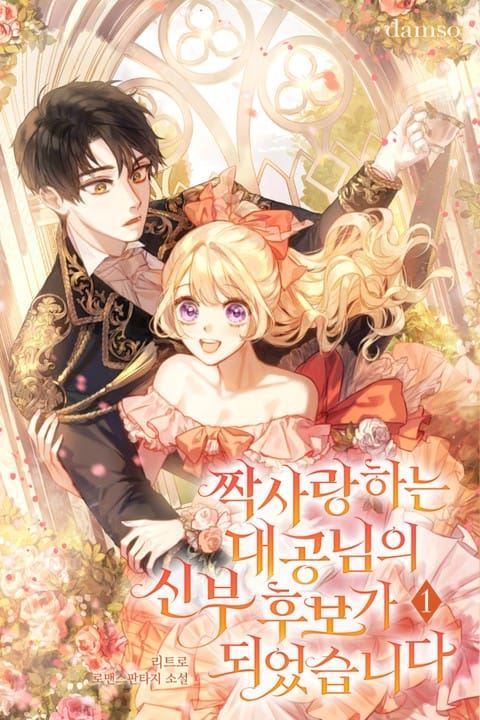
I Became a Bride Candidate for the Grand Duke I Secretly Loved
+Add to Custom List
Novel Info
  • Author:
  • Status:Ongoing

Summary

... Read More

Elena Bellacita, a noblewoman from the Marquisate of Bellacita, has harbored a silent, five-year devotion to Prince Helio, the current Grand Duke of Castia. He was the only person who showed her kindness during a period when she was isolated by society. When an imperial decree mandating the recruitment of candidates for the Grand Duchess is issued by her brother-in-law, Emperor Kailus, Elena sees it as her destined opportunity. Ignoring the Grand Duke’s known declaration of celibacy and his aloof nature, she travels three days and nights to his residence, armed with the official document. Upon her arrival, Helio reacts with cold disdain, having been completely unaware of the recruitment until the imperial envoy delivers the mandatory order. He attempts to dismiss her immediately, crumpling the decree and telling her to leave, but Elena firmly refuses, citing the three-month cohabitation clause written in the imperial mandate. She insists on staying until the selection period concludes, regardless of his objections.

Helio, baffled by her audacity, allows her to stay under the condition that she keep to herself. However, Elena’s determination is unwavering. She attempts various strategies to break the ice, including waiting for him at breakfast and suggesting outings, but Helio consistently avoids her or rebuffs her advances with sharp, cutting remarks. Feeling that conventional approaches are failing, Elena visits a mysterious antique shop and purchases a book titled "The Book of Love Spells" for five million krang. Upon reading it, she discovers it is not a magical tome but a dating guide containing psychological tactics such as the Rule of Smiles and the Rule of the Carotid Artery. She decides to apply these techniques to win Helio’s affection, starting with excessive smiling and exaggerated physical gestures during a late lunch. Her efforts result in a comedic misunderstanding where Helio believes she has a stiff neck, but he ultimately agrees to continue seeing her, albeit with continued skepticism about her motives.

Elena’s journey is complicated by the arrival of Diana, the daughter of the powerful Roiza Ducal Family, who arrives as the second candidate for Grand Duchess. Diana is described as the empire’s greatest beauty, possessing a radiant presence that instantly commands attention. When Elena discovers Diana’s arrival, she feels a deep sense of insecurity, realizing she cannot compete with Diana’s status and looks. In a twist of fate, Elena accidentally tumbles into the drawing room while eavesdropping on a conversation between Helio and Diana. Instead of hostility, Diana greets Elena warmly and unexpectedly asks to be friends, revealing she has no romantic interest in Helio and only came because of her father’s pressure. Diana admits she has no female friends and sees Elena as a potential confidante, leaving Elena confused and unsettled by the lack of traditional rivalry.

Meanwhile, Helio’s perspective begins to shift. He recalls Elena’s bold declaration that she likes him for himself, not for his title, and finds himself intrigued by her persistence. During a sparring session at the training grounds, Elena witnesses Helio fighting two commanders simultaneously. Misinterpreting the scene as a bullying incident, she loudly cheers for Helio and confronts the knights, only to learn later that the duel was a friendly handicap match. Helio is surprised by her genuine concern and her willingness to stand by him despite public perception. This incident marks a subtle change in his attitude; he begins to notice her more often and even smiles faintly when thinking of her. The story follows Elena’s continued efforts to navigate life in the Grand Duke’s mansion, dealing with both Helio’s icy exterior and the overwhelming presence of Diana, while Helio slowly comes to terms with his growing curiosity about the determined young woman who refused to give up on him.

Latest Release
DateGroupRelease
2026-10-03dusk blossoms c125
2026-10-03dusk blossoms c124
2026-10-03dusk blossoms c123
2026-10-03dusk blossoms c122
2026-10-03dusk blossoms c121
2026-10-03dusk blossoms c120
2026-10-03dusk blossoms c119
2026-10-03dusk blossoms c118
2026-10-03dusk blossoms c117
2026-10-03dusk blossoms c116
2026-10-03dusk blossoms c115
2026-10-03dusk blossoms c114

Community Reviews

Rating(0 / 5.0, 30votes)
5 stars
0(0%)
4 stars
0(0%)
3 stars
0(0%)
2 stars
0(0%)
1 stars
0(0%)

Popular reviews

... Read More
The dialogue in this batch is genuinely excellent and I want to highlight why. Elena's voice is immediate and unfiltered—she doesn't filter herself through politeness or noble decorum. When she confronts the knights, it's raw and sharp: "Stop laughing, all of you. You call yourselves knights, yet you attack two-on-one? That's just too cowardly!" There's no noblesse oblige performance here, just genuine outrage. And then her private thoughts afterward—"I had seen it with my own eyes—what misunderstanding could there possibly be?"—that's the voice of someone who trusts her own judgment absolutely, which makes her realization that she was WRONG even more powerful. Helio's dialogue is the complete opposite—measured, restrained, almost clinical. "I think you might be misunderstanding something." Just four words. He doesn't explode, he doesn't get dramatic, he just states a fact. And later with Dean: "Stop spouting nonsense." Quick, reflexive, no explanation needed. His voice is all edges and deflection because that's how he's survived. But Dean? Dean is the BEST. He's the comic relief with sharp observation skills. "You're smiling." "Did something good happen?" He reads Helio like a book and gently provokes him. Their exchange about the documents and the lady candidate is perfectly calibrated—Dean testing boundaries, Helio reacting defensively, and Dean knowing EXACTLY what he's dealing with. The narrative voice itself is also doing a lot of work, alternating between Elena's passionate interiority and Helio's restrained physicality. The shift from her external action to his internal chaos is seamless.
... Read More
There's something really interesting happening with the theme of innocence in this batch, and I can't stop thinking about it. Diana is presented as the epitome of innocence — she doesn't understand romantic love, she's uncomfortable around men, she's surrounded by admirers but completely oblivious to their feelings. And yet, her innocence is actually a form of power. It disarms people. Elena drops all her defenses. The Grand Duke cooperates with her. She walks into rooms and everyone softens around her. But Elena is the one with REAL feelings — genuine, complicated, vulnerable romantic attraction — and she's the one who feels exposed. "As if she were the only one standing bare." There's a delicious irony here: the person who understands love least holds all the cards, while the person who understands it most is at a disadvantage. Then we have Bianca, whose entire personality is the opposite of innocence. She's aware, calculating, entitled, and loud. And yet the Grand Duke shuts her down with two sentences. Her aggression is meaningless against someone who simply doesn't play by the same social rules. And Adelina — the fragile, delicate one who faints dramatically. Is she genuinely innocent, or is her delicacy another performance? The author deliberately leaves this ambiguous. "It triggered a protective instinct, so to speak. The type of woman people often described as someone they wanted to protect — surely, that was someone like her." But the narration itself sounds almost suspicious, as if even the narrator isn't sure whether to trust this image. The book seems to be asking: in a world where marriage is competition, which form of femininity wins? The innocent one? The aggressive one? Or the seemingly fragile one? I have questions.
... Read More
The atmosphere in these chapters is unexpectedly rich for what could have been simple rom-com fodder. Let me start with the kitchen scene — it's vivid and chaotic in the best way. Late evening, the kitchen lights coming back on after everyone else has left, Gordon the head chef losing his mind over 40 grams of sugar versus 55 grams, the meringue not coming together, the batter overflowing because she filled the pan too high. Every sensory detail is there: the heat of the oven, the sting of strawberries cutting her finger, the burns on her hands. You can literally see the blood mixing with the cake decorating process. It's almost comically disastrous, but it feels real. Then there's the contrast of the birthday gifts arriving — multiple carriages, a scroll so long it drags on the floor, weapons enough to arm the entire Knight Order, jewels, artworks. The sheer visual spectacle of imperial generosity is almost overwhelming. And the servants? Completely unfazed. They've seen this every year. Only Elena stands there slack-jawed. But the most haunting scene is the one that doesn't have any special effects at all — the revelation that the Grand Duke has never had a birthday party. Not once. The Empire doesn't legally recognize concubines, so when he was born, nobody welcomed him. While the Crown Prince gets lavish balls every year, he got nothing. The author describes this not with melodrama but with quiet matter-of-factness, which somehow makes it hit harder. Bianca's scene is equally telling — the spilled tea soaking into a thick carpet, her angry teacup shattering against a distant table. You feel the opulence and the pettiness simultaneously. The world feels lived-in because even the antagonists have texture. And that final image — Elena standing in front of the Grand Duke's office door on his birthday, small strawberry cake in hand, heart pounding — is pure cinematic. The dim hallway, the closed door, the moment of hesitation before she knocks. I could see this as a film frame.
... Read More
Okay can we talk about how this entire chapter is basically a comedic interlude sandwiched between heavy emotional moments and it works SO well? The narrative just... stops. We go from this devastating rejection scene to 'young lady, is something troubling you?' and suddenly we're in full rom-com mode. She's experimenting with makeup, Anne is being earnest and terrible at it, Dean is giving her pity looks—this is peak chaos energy and I loved every second of it. The pacing here is brilliant because it gives the reader a breath. After the weight of Chapter 14, where she confesses and gets crushed, we get an entire chapter of her failing upward. The makeup scenes are genuinely funny. 'Three-dimensional' is the most refined insult she could come up with and I'm dead. But what I really appreciate is how the author uses humor to reveal character. We learn that she's willing to change herself for him—that she actually believes if she just looks different enough, maybe he'll see her differently. That's not just comedy, that's tragic underneath. And then—the training grounds scene in 1.6. The transition from domestic comedy to something almost violent and emotional. The knights screaming, the Grand Duke fighting two commanders alone, everyone jeering at him except her. The pacing shift from 'how do I look in this makeup' to 'I need to save him with my voice' is jarring in the best way. The author understands that comedy and drama aren't opposites—they're tools. One makes the other hit harder. The lighter the middle, the more the ending lands.
... Read More
Oh my god. Bianca Botter. I HATE her. I love her. I can't stop thinking about her. She arrived with SIX SERVANTS despite the Emperor's explicit decree saying candidates must come alone, and she made a scene at the doorstep like a total brat. And honestly? She's the most interesting character in this batch by a mile. "Why must everyone be sent back?" she demands, and you can just SEE the entitlement radiating off her. Her backstory is classic spoiled nobility — youngest daughter in a family where daughters are rare, showered with affection by multiple older brothers and doting parents, rich golden hair matching the Imperial Family's lineage. She believes the world owes her everything because of who she is. But here's what makes her genuinely threatening as a rival: she's not stupid. She's just arrogant, and there's a difference. The scene where the Grand Duke appears and she immediately goes from fire-breathing dragon to meek as a lamb? That shows she understands power when she sees it. She wasn't bluffing earlier — she genuinely thought she could bully her way through. And that's scarier than a competent villain. Then she opens the tea party by declaring, "I don't think there's anyone here who loves the Grand Duke as much as I do. So, I hope you'll all give up." IN THE FIRST MINUTE. That is either supreme confidence or supreme ignorance, and I can't tell which. Elena's response — "Forcing others to give you the answer you want is what's truly impolite" — was perfect. But the stakes just went up dramatically. And Adelina Montes fainting? Classic move or genuine weakness? I need to know what her deal is. This competition just got significantly more dangerous.
... Read More
The dialogue writing here is genuinely strong and I want to highlight why. Elena's voice is immediate and endearing. When she's recounting the princess carry incident to Anne, she can't stop herself — "Uhuuhuuh" literally escapes her lips. She's so caught up in the rom-com moment that she doesn't even notice she's narrating it for what sounds like the hundredth time. Her excitement is transparent and unguarded: "Can you just let me finish?" and "I feel like I've heard this story a hundred times already." You immediately understand this woman who wears her heart on her sleeve. Dean is the perfect foil — dry, cautious, deeply concerned but expressing it through practical warnings rather than sentiment. "I told you not to do anything, but you've planned something, haven't you?" That line does triple duty: it shows he knows her, he's worried about her, and he's already seen through her plan. And then his shift when he realizes she genuinely wants to give the Grand Duke a birthday — "No, please make it so. If it weren't for you, His Grace would never experience something like a birthday cake in his lifetime." That's not just plot progression, that's character revelation through dialogue. Gordon is comedic gold. "Ahhh! How could you just pour it in like that?" repeated with variations like a tragic soundtrack to Elena's baking disaster. His exasperation is infectious. Anne provides the deadpan counterpoint — "I'd find being carried even more embarrassing" and the whole princess carry conversation where she genuinely doesn't understand the appeal. It's funny but also subtly hints at her own loneliness. Bianca's dialogue is sharp and venomous but also reveals her desperation: "I'll write a letter. Father will do something about it." She's not just mean — she's terrified of losing control. The narrative voice itself has a light, warm tone that never takes itself too seriously but still handles emotional beats with genuine feeling. The humor never undercuts the drama, and the drama never smothers the humor.
See all reviews

Custom lists

See all custom Lists