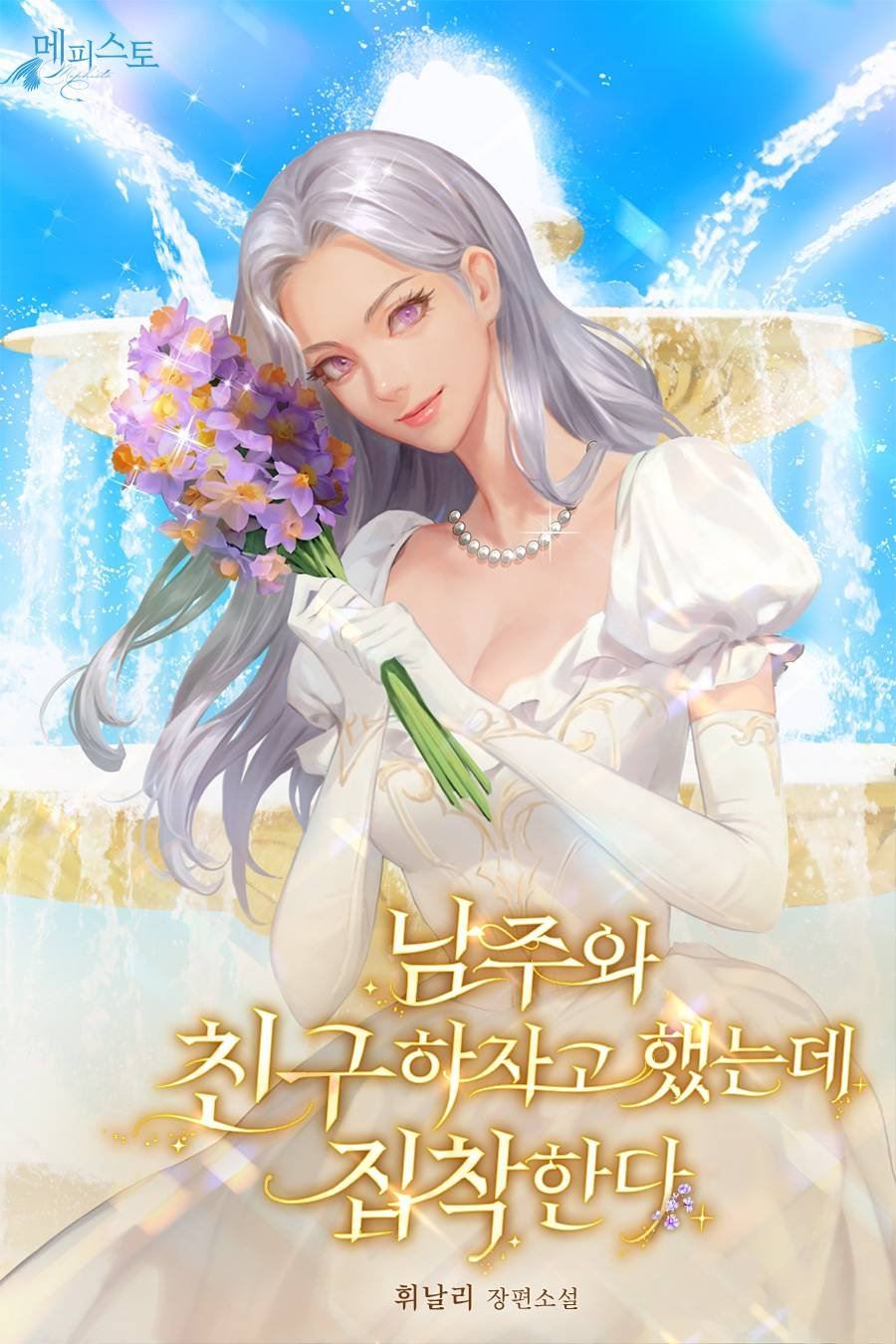
I Asked the Male Lead to Be Friends but He Became Obsessed
+Add to Custom List
Genres:
Novel Info
  • Author:
  • Status:Ongoing

Summary

... Read More

A woman from a mundane, impoverished reality finds herself inexplicably transported into the body of Roseline Hanevar, a terminal villainess in the novel "Even Flowers Obsess Over You." Roseline was destined to die after falsely accusing the male lead, Nicaine, of being a dark mage devotee, only to be killed by him in self-defense. The protagonist, armed with knowledge of the original plot, immediately recognizes her dire situation. Roseline suffers from a cursed illness that kills her if she speaks its name, and she has only months to live. The only cure requires a rare pale violet narcissus growing in Nicaine’s heavily fortified secret garden, along with salt and pine-leaf fairy tears already present in her residence.

Nicaine, a cold and distrustful nobleman whose parents were killed by Tupefer, devotees of the dark mage, initially threatens the protagonist with his sword upon hearing her accidental confession of love. However, when she claims to know the location of the dark mage’s hideout, he spares her life to extract information. The protagonist collapses from her illness shortly after, leading to her transfer into Roseline’s body. Upon waking, she is embraced by Haser, Roseline’s deeply caring brother, whose devotion to his sibling becomes a crucial emotional anchor. Realizing she cannot return to her bleak former life, she resolves to survive by curing her illness and avoiding her canonical death.

To gain access to the secret garden, the protagonist decides she must become friends with Nicaine. She attends the Hollein Social Club in Haser’s place, using her knowledge of the plot to expose Haedrox Selvain, a Tupefer infiltrator who had previously framed Roseline in the original story. By revealing Haedrox’s treachery and announcing her intention to cease her obsessive pursuit of Nicaine, she shifts public perception and earns a measure of respect from the nobility. Nicaine remains suspicious of her sudden change in behavior and her precise knowledge of dark magic secrets, but he allows their interactions to continue.

The protagonist and Nicaine form an uneasy alliance after she leads him to an abandoned temple where Tupefer gather. There, they narrowly avoid detection by enemy agents while retrieving a violet cloth containing evidence of dark magic rituals. During this encounter, Nicaine heals a minor wound she sustains, signaling a slight thaw in their relationship, though he remains guarded. Back at the Hanevar residence, the protagonist confronts Marsel, a false friend who had been exploiting Roseline’s obsession with Nicaine for financial gain. She cuts off Marsel’s funding and expels her, asserting her independence and restructuring the household dynamics.

As the story progresses, the Tupefer grow concerned about the protagonist’s interference, noting that her actions have disrupted their original plans. They discuss the pale violet narcissus, which holds power to restore the dark mage’s strength, and consider how to handle the threat she poses. Meanwhile, the protagonist discovers Roseline’s diary, revealing that the original owner willingly invited her into this world to escape her suffering, adding a layer of mystery to her reincarnation. The protagonist learns that a poisoned arrow intended for Nicaine at an upcoming gala will kill him if he is not careful. Determined to save him and solidify their friendship, she prepares to intercept the assassination attempt, fully aware of the dangers involved.

The narrative establishes a delicate balance between political intrigue, magical threats, and romantic development. The protagonist must navigate the hostile world of nobility while managing her deteriorating health. Her survival depends on outsmarting the Tupefer, earning Nicaine’s genuine trust, and obtaining the rare flower before time runs out. The original story’s events are increasingly diverging due to her interventions, creating new uncertainties about whether she can alter her fate or if she remains bound to the novel’s tragic ending.

Latest Release
DateGroupRelease
2026-10-03dusk blossoms c25
2026-10-03dusk blossoms c24
2026-10-03dusk blossoms c23
2026-10-03dusk blossoms c22
2026-10-03dusk blossoms c21
2026-10-03dusk blossoms c20
2026-10-03dusk blossoms c19
2026-10-03dusk blossoms c18
2026-10-03dusk blossoms c17
2026-10-03dusk blossoms c16
2026-10-03dusk blossoms c15
2026-10-03dusk blossoms c14

Community Reviews

Rating(0 / 5.0, 36votes)
5 stars
0(0%)
4 stars
0(0%)
3 stars
0(0%)
2 stars
0(0%)
1 stars
0(0%)

Popular reviews

... Read More
Okay can we just appreciate how GOOD the dialogue is in this chapter? Because the bearded man saying things like 'We are people who have worked here since the time of the late Count Hanevar, out of deep respect for him' and then immediately trying to MAKE Roseline greet THEM first? The audacity is unreal and I respect it. Roseline's response though—"As far as I know, nobility does not bow to commoners. Am I wrong?"—that line. Short. Sharp. Absolute dismissal wrapped in a question. She doesn't yell, she doesn't get emotional. She just lays down the law in a way that makes the bearded man freeze. That's not just good dialogue, that's CHARACTER THROUGH DIALOGUE. You can tell everything about Roseline's growth in that one exchange. And then the way she uses their own logic against them: "Would a court see it that way? Would a court say it's all perfectly natural for a commoner to demand a noble bow first, and to defy the rightful owner of a mine?" She FLIPS the power dynamic with words alone. No physical threat, no raised voice. Just precision strikes. But honestly? The best dialogue moments are between Nicaine and Roseline. His lines are always clipped, almost minimal, but they carry so much weight: "You were hit by a poisoned arrow today and barely regained consciousness. And you came here?" "Someone nearly died because of me, and just when I think she's survived, she's left the hospital and ended up here. How am I supposed to be at ease?" Every sentence sounds like Nicaine. Cold on the surface, but underneath there's this current of genuine care that he refuses to name directly. And the author trusts the reader to understand it without spelling it out. That's skilled writing.
... Read More
The pacing in these chapters is absolutely vicious and I love it. Let me trace the escalation for you because it's not accidental. We START with Roseline dealing with those bowing servants—low stakes, almost quiet. Then she gets the existential dread hit about Roseline dying in the original novel. Boom. Time pressure established. Then she moves to the club scene which is basically a one-act play: enter, get challenged, drop the Haedrox bomb, watch him flee, gain the room's favor, and then NICINE appears. From there it's relentless. He questions her about the Tupefer. She gives him the palace info. He doesn't believe her. She tries to explain the secret door. He shuts her down. She declares she's done with him. Her heart attacks. He kneels. He asks what she wants. She says friends. Three seconds of silence. Then—CUT TO HER RETURNING HOME, getting the painting, dealing with the doormen who now bow to her, and finally the CHEMETA REVEAL in the last lines. The author doesn't let you BREATHE between beats. Every scene ends with either new information or a shifted power dynamic. And that last line about the key being with her? That's a cliffhanger disguised as a throwaway detail. I am going to lose my mind waiting for the next batch.
... Read More
The stakes in this passage are INSANE and the author ramps them up like a freight train. Let me break down what Roseline is walking into: Externally, she's dealing with the Tupefer — a clandestine organization that commits murder, practices dark magic, and has an abandoned temple full of experiments. Haedrox Selvain is dead because he got too close. And now Roseline's name appears on a note in his corpse's hand. She's not just a bystander anymore; she's in the crosshairs. Internally, she's fighting her own mortality. Her body is failing her — the pain comes more frequently now. Every decision she makes is against a ticking clock. She needs to earn Nicaine's trust before she dies, but getting close to him means walking into the very danger that killed her original self. The gala represents the convergence of all these conflicts. The poisoned arrow at eight o'clock, the clock tower, the number eight as a symbol of infinity — this isn't just an assassination attempt, it's loaded with meaning. Roseline plans to take the arrow meant for Nicaine. That's not bravery, that's desperation. She's gambling her life on a single act of sacrifice because small gestures won't change his mind. And then there's Nicaine himself — suspicious, dangerous, and apparently tracking the Tupefer through their own traces. The fact that HE suspects Roseline of being Tupefer flips the entire conflict. She's trying to save the man who might already see her as the enemy. The dramatic irony is suffocating in the best way. Every scene builds tension because we know Roseline is walking toward danger while everyone around her has their own agendas. I was literally holding my breath.
... Read More
Let me just say—when I first saw this underground gathering of nobles discussed Tupefer while drinking and smoking to a soft piano melody, I expected something generic. Fantasy crime den vibes, you know? Standard evil meeting place. BUT the author went and made it feel so LIVED IN. The tobacco scent mixing with the piano. The round tables. The way the men look at Roseline like she doesn't belong there. It's not just a backdrop—it's a character in itself. These are well-dressed nobles who've built a whole hidden world where they debate the state of their kingdom while casually discussing murder and conspiracy. And then Roseline walks in wearing whatever she woke up in and the culture clash is EVERYTHING. But the scene that really stuck with me is the transition. She leaves the club, steps into the cool night breeze, and for a moment just stands there uncertain. Then she goes back to the residence—which feels so different, so cold and proper—and immediately the maid Chesha is trembling before even speaking to her. The world feels REAL because every location has its own temperature, its own rules, its own threats. The club is loud and smoky and dangerous in a predictable way. The residence is quiet and orderly and dangerous in a completely different way. And somewhere in the middle of all this, the Grand Council Chamber—the heart of the kingdom's power—is revealed to be the dark mage's actual hideout. The world is LARGER than I thought.
... Read More
The sensory details in this section are doing SO much heavy lifting. Let me start with the restaurant scene because honestly it's one of my favorite moments in the whole book. The manager greeting her warmly after the oyster incident, offering her Nicaine's reserved seat, treating her to a meal—it paints this whole picture of a social ecosystem where reputation travels fast and kindness has currency. The jasmine tea, the stir-fried rice (ropelou!), the way the seat is positioned so other diners won't disturb her—these tiny details make the world feel lived-in. Then there's the tulips. Yellow. Bright. Drawing the eye. 'The bright yellow drew the eye naturally'—that line alone sets the whole mood. It's this garishly cheerful object sitting in a room full of complicated subtext. But the scene that really stays with me is Poenin appearing 'in a vivid floral dress' like some kind of walking contradiction—colorful and warm on the outside, venomous underneath. And then the ending with all those carriages from dress shops surrounding the residence, and the narrator looking at herself in the mirror: silver hair, violet eyes, deep blue dress. It's such a striking visual transformation. Roseline used to wear different colors, and now she's dressing dark and understated. The mirror moment is basically a visual metaphor for who she's becoming vs who she was pretending to be.
... Read More
Let's be real — the author is playing 4D chess and I am here for it. First, the obvious twist: Roseline has transmigrated and knows the original story. But the genius is how the author layers reversals on top of reversals. The Marsel situation alone has three turns. First, we think Roseline is just standing up for herself. Then Marsel reveals the gala invitation — and suddenly Roseline has a date with Nicaine. But wait, Roseline says she doesn't need the charm. Marsel interprets this as Roseline going anyway. It's a misdirection that makes you question: is Roseline still playing the game or has she truly changed? Then Haedrox Selvain is DEAD. And Roseline's name was on a piece of paper in his hand. This is the scene that made me sit up straight. In the original novel, the Tupefer and the dark mage were AFTER Nicaine. But now the plot has shifted — Roseline's presence in this timeline has changed everything. The dark magic ritual using her name suggests someone is trying to harm her, or perhaps use her as a conduit. And the deepest twist? The Tupefer themselves are discussing Roseline's changed behavior with visible alarm. They're scrambling because her actions are dismantling their plans. Roseline isn't just surviving — she's actively disrupting the antagonist's storyline. But the real hook is the gala. The poisoned arrow at eight o'clock. The pale violet narcissus that can "summon evil through the purest of forces." Every detail from the original novel is coming true, but Roseline's choices are creating ripples. And the ending — Nicaine suspecting Roseline IS Tupefer? That's a plot bomb that changes everything. How do you prove your innocence to a man who thinks you're the enemy?
See all reviews

Custom lists

See all custom Lists