Summary

... Read More

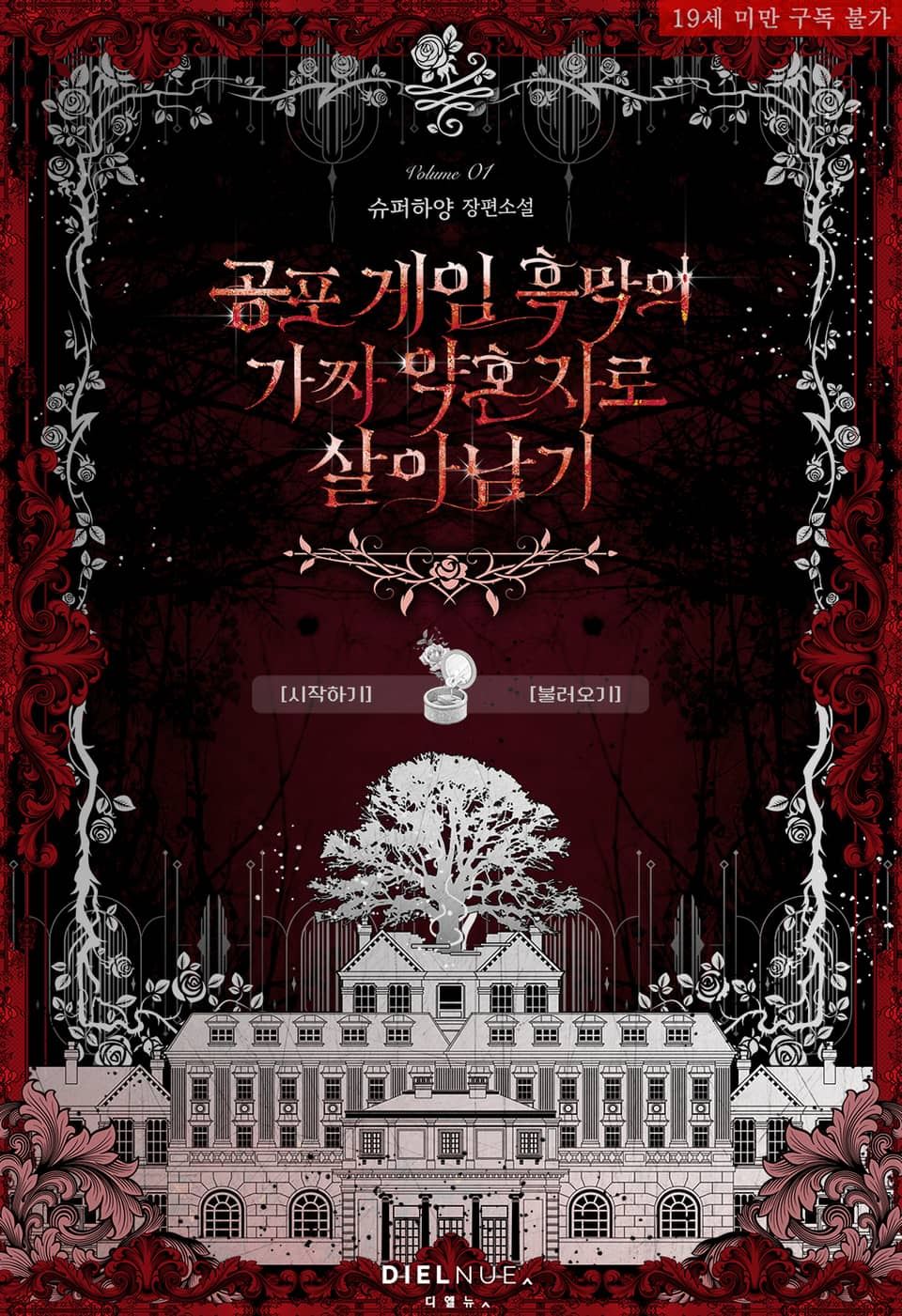
Cynthia is an ordinary office worker who leads a stressful, mundane life in a small studio apartment. Her only escape is playing video games, and she has a particular fondness for 'Coffin of the White Rose,' a notoriously difficult pixel-art horror game known for its brutal death scenes and an unpatched ending bug that caused it to lose popularity. When the developers release a major update claiming to fix bugs and lower difficulty, Cynthia applies to become a beta tester. Late one night, after enduring another demanding workday, she launches the game. As the loading screen completes, she loses consciousness.

Cynthia awakens inside a wooden wardrobe within the game world, transmigrated as Cynthia Obel, the illegitimate daughter of the ruined Count Obel family. The system confirms her identity and provides a status window, but there is no option to log out. She is trapped in Wincastle Manor, the setting of the horror game, where the final boss, Duke Segleninde Wincastle, is holding a banquet to lure victims. The original game required the protagonist to collect hints and evade deadly traps to escape. Now physically present in this reality, Cynthia realizes the sheer terror of the situation. The manor doors are locked, and the windows are unbreakable. She is forced to follow quest prompts, as her body moves involuntarily when she attempts to flee.

Her first major encounter is with the villain himself, Segleninde, whom she finds asleep in a dressing room. A system prompt forces her to choose how to wake him; she selects the option to kiss him. Upon waking, Segleninde is not the polite, manipulative noble from the game’s early narrative. Instead, he is rude, brutish, and immediately hostile, accusing her of molesting him. However, before he can harm her, screams erupt from the banquet hall. The game’s massacre begins, but unlike the original plot, Segleninde is unaware of what is happening. He reveals that he has lost his memories, retaining only fragmented concepts of who he is. When asked about their relationship, Cynthia lies, claiming they are engaged. The system accepts this, and Segleninde agrees to cooperate with her in exchange for her help in recovering his memories.

The two return to the dressing room to use it as a base. They discover that the update has changed the game mechanics significantly. The Harvesters, monstrous creatures that patrol the halls, now cover the entire first floor, making movement extremely dangerous. They are trapped in the room for hours, surviving on a packet of biscuits. During this time, Cynthia learns that Segleninde’s personality is far more abrasive than his in-game portrayal suggested. He is arrogant, lacks manners, and frequently mocks her fear. Despite this, he remains by her side, seemingly bound by their agreement.

As hunger becomes critical, Segleninde decides to leave the room to find food. Cynthia follows him out cautiously, only to witness something impossible. Segleninde confronts a Harvester in the hallway and destroys it with his bare hands, tearing the creature apart. This contradicts the game’s lore, where such creatures were immune to physical damage and could only be evaded. Covered in black slime, Segleninde returns to the dressing room, throwing the severed head of the creature at Cynthia. She is left shocked, realizing that the game’s rules have shifted dramatically. With the villain now an ally who possesses the power to kill the enemies, Cynthia must navigate this altered reality to find a way out of the manor and hopefully return to her own world.

Latest Release
DateGroupRelease
2026-09-27citrus aurora c202
2026-09-27citrus aurora c201
2026-09-27citrus aurora c200
2026-09-27citrus aurora c199
2026-09-27citrus aurora c198
2026-09-27citrus aurora c197
2026-09-27citrus aurora c196
2026-09-27citrus aurora c195
2026-09-27citrus aurora c194
2026-09-27citrus aurora c193
2026-09-27citrus aurora c192
2026-09-27citrus aurora c191

Community Reviews

Rating(0 / 5.0, 43votes)
5 stars
0(0%)
4 stars
0(0%)
3 stars
0(0%)
2 stars
0(0%)
1 stars
0(0%)

Popular reviews

... Read More
The pacing in this section is genuinely masterful. It opens at maximum volume — Cynthia snapping, screaming, kicking, unleashing everything she's been holding in. The prose matches that energy with short, punchy dialogue and rapid-fire exchanges. You can feel the adrenaline. Then, immediately after she runs out of steam and slumps to the floor, the author deliberately slows everything down. The transition is almost surgical — from chaos to exhaustion to quiet observation. The scene with the item merchant is a perfect tempo breaker. It gives us a chance to breathe, to learn about the world's economy, to see Segleninde's wealth revealed in a mundane transaction. It's low stakes compared to the earlier explosion, which makes it feel natural rather than jarring. And then the rat taming ramps things back up — but in a different way. It's not emotional intensity; it's procedural intensity. We're watching Cynthia execute a plan, test it, and see it work. The pacing here is deliberate and satisfying, like watching a machine click into place. The chapter ends on a note that's almost comedically anticlimactic — entering an apparently empty kitchen. After all that tension, the Butcher Cooks aren't even there. It's a minor letdown, but it serves a purpose: it resets the board for the next confrontation. The author understands that you can't maintain maximum tension forever, and that strategic valleys make the next peaks hit harder. One structural choice I really appreciate: the shift from Cynthia's external journey (navigating the mansion) to her internal journey (building confidence, asserting herself). These two threads are perfectly interwoven — every step forward in the physical space is matched by a step forward emotionally. That's tight writing.
... Read More
Let me just say — when Cynthia saw those weird glitched choices, I literally screamed. Like, come on! [ N!#@#$5o?^%@S1]? What even IS that? But honestly, it worked so well for the tension. The whole setup where she has to pick Option 2 ('We're lovers. We're engaged to be married.') even though her internal monologue was basically 'System, you are my enemy. You bastard.' had me laughing out loud AND holding my breath at the same time. What really blew me away was how quickly everything shifted. One moment the duke is this terrifying, sword-wielding monster, and the next he's sitting beside Cynthia saying 'I have no idea what's going on.' And then THE REVEAL — his amnesia. Not fake amnesia, not acting, but actually gone. All those years of being this cold, calculating predator, and suddenly he doesn't even remember if they knew each other. Cynthia's manipulation here is both brilliant and terrifying. She literally gaslights a literal monster into becoming her bodyguard by inventing a romance backstory. And the funniest part? She's narrating her own scheme in real-time while doing it. 'This was what she'd wanted, but he went along with it far more smoothly than expected.' Meanwhile I'm over here like 'Ma'am, you just married yourself to a man-eating Duke and you're negotiating terms?!' Also — can we talk about how she learned his real name is 'Segleninde' at the exact same moment the system glitched? The universe was GIVING HER CHEAT CODES. I swear the author is watching us and laughing.
... Read More
The dialogue in this passage is absolutely razor-sharp. Cynthia's voice is distinctive and consistent — she goes from formally polite to brutally honest in a single sentence, and the shift is jarring in the best way. Her outburst reads like a real person finally losing it after holding it together for too long. The raw, unfiltered quality of her insults ('pretty face but your mouth belongs in a sewer') feels authentic, not written. She's not being clever; she's being furious. Segleninde's responses are a masterclass in understated characterization. He barely says anything, but every line tells us who he is. 'You're pretty good at cursing' — that's not a threat, it's genuine praise from someone who has probably never received honest feedback in his life. 'I was getting tired of seeing you force yourself to be polite' — this is the most emotionally intelligent thing he says all chapter, and he delivers it completely flat, like he's commenting on the weather. The gap between his words and their meaning is where the comedy lives. Their exchange about fearlessness is peak dialogue. 'At least you have a good eye' followed by Cynthia's internal monologue about how pathetic he is — it's a full personality reveal in three lines. And the rat taming banter? 'Cut the sarcasm' 'I'm complimenting you' — this is the kind of back-and-forth that makes me want to reread passages out loud. The author clearly enjoys writing these two bantering, and it shows. The item merchant's 'Heeheehee' is a nice contrast — she's essentially a comic relief NPC whose grotesque dialogue style sets her apart from the human characters. It's a small detail but it makes the world feel lived-in.
... Read More
Let's talk about stakes because this section is a masterclass in escalating dread. We start with Cynthia having a plan. She knows the game. She knows the pre-update layout. She's confident. She takes Segleninde's arm, she smiles, she's ready. And then the story quietly undermines every single one of her assumptions. The Harvesters don't follow their old routes. The dresssing room that was supposed to be a safe rest point becomes a tomb. The biscuits run out. Her body—already weakened by the transmigration and the mansion's effects—starts failing her. The hunger scene is where the stakes become viscerally real. 'One meal a day—if it could even be called a meal—on tiny portions.' She's counting crumbs. Forty hours. She's lying on a sofa clutching her stomach, too weak to think straight, and the reader feels every second of that desperation. This isn't 'oh no I might die' anymore. This is 'I am actively dying and I can't do anything about it.' And then Segleninde solves it by walking out the door. Not with a plan. Not with tactics. Just... walking out. 'I'm going out for a bit. Don't wander around and get lost and start crying while I'm gone.' The casual cruelty is almost funny except it's NOT funny because we're terrified he's going to die and leave her alone in that room forever. What makes this sequence so tense is the sound design. Onitsuka never shows us the fight directly. We only hear it through the door: 'The sound of something being ripped apart. A heavy thud, something slamming. The sound of things breaking, smashing.' Each sound is a question mark. Is he okay? Is he hurting? Is he— And then his laugh. 'Hahaha!' The same laugh Cynthia heard when she was fleeing from him in the game. The laugh of the predator. The laugh of the villain. Except now it's coming from INSIDE the mansion, and she's the one on the receiving end. When he returns, the tension doesn't relieve—it amplifies. The Harvester's head rolling toward her. Those blood-drained eyeballs staring up. Cynthia's mind going blank, her body trembling, her worst fears confirmed: yes, he is a monster, yes, he kills things like this, yes, she is dangerously close to the thing that murdered hundreds of protagonists in the original game. But here's the thing—the stakes just got MORE complicated, not less. Before, the conflict was simple: survive the mansion, escape with Segleninde. Now? She has to survive the mansion AND survive Segleninde. The external threat and the internal threat have merged into one beautiful, terrifying package. And honestly? That's infinitely more interesting than just running from monsters. She's not just fighting for her life anymore. She's fighting to understand who this boy is, whether he's truly her ally, and whether she can trust the person holding the sword that keeps killing the things trying to kill her.
... Read More
There's a recurring image that won't leave my head: the original Cynthia Obel was raised 'as a docile doll through something close to abusive education and punishment.' A doll. Something ornamental. Something without agency. And now, the transmigration has given Cynthia a new body — one that still has the ghost of the original girl's traumas etched into its muscles. The crimson hair is striking. Blood-orange. Almost like her very appearance is a warning label. And then there's the Duke himself — a monster who 'could slice, grind, tear, and crush people all with his bare hands.' But he's also described in beautiful, almost romantic terms: silver hair glowing under chandeliers, sleeping peacefully while death waits outside the door. He's the ultimate predatory aristocrat — gorgeous on the surface, monstrous underneath. The game itself is structured the same way: beautiful Baroque settings hiding a slaughterhouse. Cynthia's father tried to 'restore the family fortunes' by selling his daughter. The Duke hosts banquets to lure victims. Both are men using hospitality as a weapon. The old world of nobility and manners is just a pretty wrapping around something rotten. The most powerful symbol though? The locked door. Every exit is blocked. The game won't let her leave. Is this about fate? About the inescapability of trauma? Or just about horror game logic? Probably all three.
... Read More
Count Obel's dialogue is genuinely remarkable. Just listen to this guy: 'Don't forget, I put off my promise with Marquis Bevins for this meeting. If you waste even a single opportunity I've given you, you'll have to repay it until your flesh rots away in the dirt after you're dead.' Bro. You're a gambling-addicted nobleman trying to sell your daughter to a duke. You don't need to add THEATRE to it. But it works. It immediately tells us everything about this man — he's cruel, dramatic, and deeply insecure about his own failures because he's projecting them onto his daughter. And then there's the system messages. 'Wake him with a kiss. Smooch!' The game is clearly not taking this seriously, or maybe it's being sarcastic. The tonal whiplash between the grotesque horror and the almost comical quest mechanics is wild. Melissa's dialogue is understated but effective. She says things like 'Master is looking for you. What are you doing here?' with that nervous energy, and her silent observations ('Melissa watched her leave with anxious eyes') say so much without any words at all. The maid knows something is wrong but can't quite articulate what. Cynthia's internal monologue is where the real voice shines though — sarcastic, panicked, sometimes hilarious ('If only her hands would move, Cynthia felt like she'd want to cover her face and cry').
See all reviews

Custom lists

See all custom Lists