Himekishi ga Classmate! - Reviews

Himekishi ga Classmate!
+Add to Custom List
Sort
Add review
... Read More
The conflict in these early chapters is layered like an onion, and I mean that in the best way. On the surface, it's a classic hero-vs-villain battle: the Princess Knight storms the dark magician's lair to stop him. Standard fantasy setup. But then you peel it back and there's SO much more happening. Tooru isn't just some generic evil overlord—he's a reincarnated high school kid who was completely powerless and invisible, and now he's chosen to wield the most morally questionable power available to him. The 'conflict' isn't just external; it's existential. He's fighting for agency, for significance, for the right to matter in a world that never let him matter before. And Kirika? She's torn. Her oath as a Princess Knight demands she stop him, but the person beneath the title is someone who once shared a classroom with him, and who is now looking at her with those haunted, hollow eyes and speaking words that sound almost like a plea. The stakes keep rising too. First it's just 'who wins this fight,' then it becomes 'will she arrest him or let him go,' and by the end of Chapter 2, it's something deeper—what happens when the hero realizes the villain was never the monster she assumed he was? The suspense is maintained brilliantly because we know both characters are capable and neither will back down easily. Every exchange raises the question: can they resolve this without destroying each other?
... Read More
I need to talk about how this sequence completely redefined what's at stake in the story, because before these chapters I thought the conflict was mainly about survival and leveling up. But Palmyra's defeat changed everything. See, Palmyra wasn't just some random enemy. She was introduced as a noble demoness with authority, someone who could make or break Tooru's situation. When she offered to 'grant him pleasures,' it felt like a power play - she was testing him, trying to establish dominance through invitation. The reader thinks, 'okay this is a negotiation between rivals.' Then it all collapses. The stakes shift from external conflict (will Tooru survive?) to internal conflict (what does it mean to truly control another sentient being?). When the Devil's Pledge activates and Tooru realizes he holds her life force in his hands, the power imbalance becomes almost comically absolute. She can't die without his permission. She can't lie to him. Her body moves independently of her will. This isn't just defeat - it's existential erasure. What made this scene work for me wasn't the sexual violence itself but the psychological warfare underneath it. Every question Tooru asks is designed to break her narrative, not just her body. Asking if she's a virgin forces her to confront a part of herself she thought was private. Asking about self-pleasure forces her to verbalize something she's never admitted, even to herself. The questions are weapons more effective than any magic. And the escalation to group participation raises the stakes further. This isn't just Tooru vs. Palmyra anymore - it's one woman against four people who now share a power dynamic she can't escape. Amelia's line about this being a 'welcoming party' for senior slaves is chilling because it implies this is just the beginning of a system, not a one-time event. I'm left wondering what happens when Palmyra's mind eventually catches up to her body's submission. Right now her body obeys but her mind rages. What happens when those two start diverging permanently? That's the real tension I want to explore.
... Read More
There's this recurring question hanging over the entire chapter and I can't shake it: what does freedom actually mean when you're already trapped? The protagonist keeps insisting he won't be bound by others anymore, that he'll choose his own path in this second life. But he's simultaneously the one holding magical chains around women who still have genuine feelings and personalities. The symbolism here is almost too on-the-nose—Sierra trapped in a dimensional bubble, Palmyra offering freedom through submission to a higher power, Kirika pouting because she's enjoying a normal conversation while magically compelled to serve. Even the rainbow pillar is interesting: rainbow = freedom, hope, variety—but it's also a prison. The dimension barrier isn't hurting Sierra physically but it IS isolating her from the world. That's basically every enslaved person's existence in metaphor form. And then Palmyra's offer reframes everything: she's not asking him to be a slave, she's asking him to be a collaborator. To trade one chain for another and call it glory. The protagonist's refusal isn't just plot progression—it's the chapter's moral argument. He won't participate in that system even though he benefits from it. Whether he's actually freed or just renegotiating his position in the hierarchy is the question this story hasn't answered yet and I need to know
... Read More
Yeah I know this isn't exactly a romance novel and I'm not going to pretend it is, but let me tell you about the emotional beats that actually landed. The scene where Kirika says 'Am I also part of such a thing?'—referring to the protagonist's desire to monopolize his belongings—hit different. It's this moment where she's simultaneously aware that she's his slave AND testing whether there's any space for her as a person in his worldview. And his answer 'naturally'—it's possessive, sure, but it's also the closest thing to reassurance he's going to get. That tension between care and control is what makes the emotional texture here complicated instead of flat. Then there's Nina crying about Sierra. Real grief from a character who's been magically conditioned to obey. The fact that her 'natural sentiments' survive the enchantment says something powerful about her as a person underneath whatever spell is holding her. And the protagonist himself—he's not some heartless villain here. When Nana crashes down all dented and apologizes, he reassures her. He cares about his 'loyal slaves' not as objects but as people he's invested in. That nuance is what keeps me reading instead of just skimming past the problematic bits.
... Read More
This chapter has some genuinely striking visual moments that I can't stop thinking about. The rainbow pillar of light in the center of a dusty guild house, trapping Sierra inside—it's this surreal image that doesn't match the dark forest setting at all. Like someone took a crayon drawing and stuck it in a gothic novel. And then Palmyra descending from the ceiling surrounded by purple distorted magic? The color contrast alone (rainbow vs purple) tells you everything about who holds power in that room. But what I really love is how the world-building creeps in during action beats instead of info-dumps. You learn about the seven ranking stages of the devil family through Nina's panicked explanation mid-investigation. You learn about dimension magic through the visual of a phone losing signal—the protagonist's own analogy. Even the golem Nana getting dragged through purple space by a girl half her size says more about power scaling than any stat sheet could. The dark forest atmosphere, the guild house as a false safe space, the contrast between the domestic meal scene and this sudden supernatural confrontation—all of it builds a world that feels lived-in rather than constructed.
... Read More
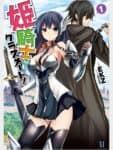
Let's talk about Tooru and Kirika because their dynamic is honestly one of the most interesting things in this opening. In their old life, they were literally the most opposite people imaginable—he was the background character nobody noticed, and she was THE Himeno Kirika, top of the class, student council member, most beautiful girl in school. Their only interaction was handing her booklets. Barely ten words exchanged in an entire year of high school. And now? Now they're enemies, but the way they talk to each other? It's electric. Not because of romance—not yet, anyway—but because it's the first TIME they've ever really had a conversation. Tooru's defensive, bitter, lashing out with that laugh when she says he's changed, like he can't handle her looking at him with anything other than contempt. But Kirika? She's not just some generic hero here. She's clearly brilliant—she anticipated his class, researched countermeasures, and came prepared. The fact that her voice 'reverberated with sadness' when she realized who he was, instead of pure disgust or anger, says everything. She's grieving the person he could've been. And Tooru notices. He always notices, because that's what invisible people do—they watch everyone else and absorb everything. His accusation that she 'can't possibly understand how I feel' because she's been 'blessed since the moment she was born' cuts deep, and I think even he regrets saying it a second later. That's the thing about their relationship: every line of dialogue is a scalpel. They're cutting each other open without even trying.
... Read More
Okay so I need to talk about Kirika because honestly she stole every scene she was in and I am not mad about it. The moment Palmyra tried to turn her, you could see the calculation happening behind those eyes. Most people would've hesitated, maybe wavered for a second—and I get why, it's tempting right? Freedom from this whole mess, no more running, no more fighting. But Kirika just... looked at Tooru, took one silent beat, and said no. Not dramatic, not preachy, just straight-up refused a demon noble because honor isn't something you negotiate away. And the way she followed it up with "Don't look down on me, I am a Princess Knight"—chills. Actual chills. It wasn't just stubbornness, it was identity. She chose loyalty over comfort, and she did it while literally being overwhelmed in battle. That's not a plot device, that's a character who knows exactly who she is. But here's what really got me—when Tooru goes full unhinged afterward and starts slapping Palmyra around with... well, you know—and Kirika just watches with what the text literally calls "scornful eyes"? She doesn't flinch. She doesn't approve. She just... observes. That's such a rich character moment because it shows she's seen her master do morally questionable things before and she's still standing beside him. Not because she agrees with everything, but because their bond exists outside of that. It's complicated and messy and I love it.
... Read More
I need to talk about what this chapter is actually doing beneath all the explicit content because the symbolism is way more deliberate than it first appears. The central image — five girls lined up, hips thrust out, arranged like offerings — is essentially a visual representation of absolute ownership. But here is the thing that makes it interesting: Tooru isn't just claiming their bodies. He is claiming their sensations, their nervous systems, their pleasure pathways. The spirit-link ability that lets him share sensory input between the slaves turns intimacy into a literal network. His body becomes a hub. Their experiences flow through him. That is not just domination — that is infrastructure. And then there is Kirika, the one left out. She is the only one who cannot access the shared pleasure network. She is wearing full knight armor, literally encased in steel while the others are vulnerable and open. The armor that should protect her actually isolates her. That is such a sharp symbolic choice — the thing that makes her strong is the thing that cuts her off from connection. Her blush and thigh-rubbing aren't just arousal, they are the visual representation of someone who belongs in the group but has been structurally excluded from it. Palmyra is another layer. Her goth-loli dress and rose-themed frills constantly signal her status as the highest-ranking slave who refuses to accept her position. Every slap on her ass is both punishment and integration — a forced acknowledgment that no matter how much she protests she is now part of the system. The masochism angle the narrator points out is basically the theme in miniature: resistance gets metabolized into compliance, and the story treats that as natural rather than tragic.
... Read More
'A gloomy light shines from the deepest part of the cave.' That one sentence set the entire visual tone for me. I could literally see this scene—dim, flickering light pushing back the darkness, the silhouette of a boy sitting cross-legged on a rough-hewn stone throne, surrounded by women with hollow, blank-eyed stares who call him 'Master/my lord.' It's cinematic in a way that's hard to pull off in prose, but the author nails it. The cave isn't just a random battleground; it's HIS space, something he's built and shaped, which tells you volumes about who he is now versus who he was. The contrast with Kirika's entrance is gorgeous—glittering armor, blue mantle, a sword held high, her voice ringing with righteous authority. She's all brightness and formality crashing into his darkness and chaos. What I love about this worldbuilding is how little exposition we get and how much we absorb through action. We learn about the Slavemancer class, about magical resistance, about dungeon-crawling adventurer parties, about a kingdom that sends elite knights on solo missions—all of it woven naturally into the fight scene rather than dumped in a info-dump. The world feels lived-in and coherent. And the fact that Tooru's been operating long enough to build traps, enslave multiple adventurers, and maintain a secret lair suggests this world has enough depth and mystery for a proper adventure. Honestly, I want to explore this cave more. The atmosphere is thick and compelling.
... Read More
I need to talk about Kirika because the author really didn't prepare me for how much I'd care about her loving stew. Here's this Princess Knight, this incredibly dignified figure who's supposed to be serious and composed, and she just... gets caught up in food banter like a normal person. She pouts when she realizes she's enjoying a casual conversation with the guy who enslaves her. That detail actually destroyed me a little. It's this tiny crack in the armor where she wants to stay a slave but also wants the normalcy she's never had. And then there's Nina—she's clearly the smartest one in the room, pulling enchantment tricks right under everyone's nose, and she's the one who panics when Sierra might be dead. Her concern feels real despite the slavery dynamic. That's the thing that keeps nagging at me: these are people who've been enslaved but they still have individual personalities, rivalries (Nina vs Amelia cooking), fears, preferences. They're not just plot devices with different hair colors. Palmyra noticing this variety and specifically wanting the Slavemancer class because of how his magic interacts with intelligent life—even the golem—shows she's observant in a way that's kind of terrifying.
... Read More
I am still recovering from the structure of this chapter because the author just absolutely weaponized a flashback in the most satisfying way possible. Let me walk through why this works so well. You've got the party getting absolutely crushed—Palmyra's magic raining down, shields cracking, Kirika barely holding the line. The tension is at its peak and you're genuinely worried they're about to lose everything. Then Tooru says "Hmm if you were to ask if I had something... yes I do have something up my sleeves" and the narrative IMMEDIATELY cuts to "For that we need to go back in time, let me reminisce the course of events." Boom. You're yanked backward and suddenly you're watching the plan unfold from the beginning, and every tiny detail you almost dismissed hits completely different the second time. The bath scene callback? The genius. You read it going "oh that's a weird detail" and then twenty minutes later it becomes THE critical mechanic that wins the entire fight. That's not just good pacing, that's architectural-level writing. And then the reveal itself—Tooru standing there with his pants down as a distraction while Nina teleports his... product... directly onto Palmyra's face—is absolutely deranged. The pacing of that reveal is perfect because it goes from absurd comedy to genuine tactical brilliance in the same paragraph. You're laughing and then you're immediately impressed and then you're horrified and then you're impressed again. The chapter doesn't let you settle into any single emotional register and that's exactly what keeps you turning pages. No dragging, no filler, just relentless escalation.
... Read More
The dialogue in this chapter is doing some serious heavy lifting and I want to talk about how differently these characters sound. Palmyra's speech is this weird mix of ancient formalness and casual sadism—'Kufufufu' followed by genuine threats wrapped in polite invitations. She uses plural pronouns for herself ('we decided') which, as the author's note says, is intentional to show her majestic self-perception. It works. You can hear her voice even without the tags. Then there's Nina with her glasses-and-galaxy-energy vibe versus Kirika's more restrained, occasionally self-deprecating tone ('I laughed at myself in self-ridicule'). The protagonist's narration has this clinical detachment when he's analyzing magic systems—comparing his slave connection to a phone losing signal is peak strategist energy—but he gets genuinely warm when talking to his slaves individually. And Amelia barely says anything except to cook and fight, which is honestly the most realistic character type ever. The banter between Nina and Kirika during the meal scene—Kirika complimenting the food, Nina being modest but pleased, Kirika getting flustered when she's caught enjoying normal conversation—this is the best dialogue in the whole chapter. It feels unscripted, like you're eavesdropping.

Leave a comment

You must be logged in to leave comments. or
