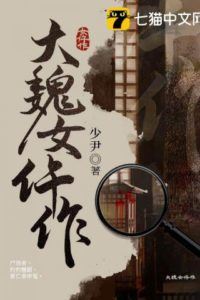
Female Coroner of Great Wei
Novel Info
  • Author:
  • 少尹
  • Status:Ongoing

Summary

... Read More

Jin Shu is a twenty-two-year-old forensic expert in the Great Wei dynasty who possesses the rare ability to communicate with the dead, a skill known as corpse whispering. Although she is a woman, she disguises herself as a man to serve as a coroner for the Dingzhou magistrate’s office, a secret known only to her adoptive brother, Jin Rong, and her mentor, Magistrate Liu Cheng’an. Jin Shu raised Jin Rong after saving his pregnant mother from bandits six years prior, and she lives a quiet life dedicated to her work and her brother’s education. Her peaceful existence is disrupted when Prince Jing, Li Jin, arrives in Dingzhou under the guise of sightseeing but is actually investigating a murder. A young courtesan named Xiao Li has been found drowned in a well in Peach Blossom Valley, and the local authorities are struggling to identify the victim or solve the case before the prince’s arrival.

Li Jin, the former God of War who now oversees the Six Gates Bureau, recognizes Jin Shu’s talent and insists on her assistance. During the investigation, Li Jin discovers Jin Shu’s true gender when he ties her wrists to demonstrate a binding technique and notices her delicate bone structure and lack of an Adam’s apple. Rather than exposing her, he keeps her secret, recognizing her value as an investigator. He forces Jin Shu to accompany him to the capital by leveraging her financial desperation; after Li Jin deliberately runs up a massive bill at an expensive restaurant, Jin Shu is left with insurmountable debt. Li Jin offers to forgive the debt in exchange for her service in the Six Gates Bureau, a position that would allow her to earn a high salary and send Jin Rong to a prestigious academy in the capital. Jin Shu reluctantly accepts the deal, and the trio travels north to the capital, stopping in Linyang along the way.

In Linyang, the group encounters another murder case involving three beggars: a blind man, a lame man, and a mentally impaired man who is now dead. The local magistrate, Yang An, has arrested the two disabled suspects and is using torture to extract confessions, claiming they killed their companion. Jin Shu performs an autopsy on the corpse and determines that the time of death is much older than the magistrate’s report suggests and that the victim suffered a skull fracture before being strangled. She reconstructs the crime scene by simulating the strangulation on Magistrate Yang An, proving that the killer must have approached from behind with a thin rope. Li Jin, meanwhile, gathers intelligence from the local market and discovers that the three beggars were part of a gang where the blind man and the lame man exploited the mentally impaired victim.

The investigation reveals that Magistrate Yang An is corrupt and incompetent, having arrested innocent people to close the case quickly. Yang An attempts to bribe and seduce Li Jin with a banquet and a performance by his daughter, but Li Jin remains unmoved. In a desperate move, Yang An’s daughter attempts to climb down from the roof using silk, but Li Jin anticipates the trap and has Zhou Zheng intercept her. Li Jin spends the night in Jin Shu’s quarters to avoid Yang An’s schemes, causing tension and awkwardness between the two. Jin Shu continues to work diligently, uncovering clues that point to the blind man and the lame man as the killers, though the motive remains unclear. Li Jin reveals that he already knows who the killer is but is waiting to uncover the full motive. The story follows their collaborative efforts to solve the Linyang case while navigating the political dangers of the Six Gates Bureau and the hidden secrets of Jin Shu’s past, including the mysterious circumstances surrounding her parents’ death and her connection to the royal family.

Latest Release
DateGroupRelease
2026-08-11shanghai fantasy c28
2026-08-11shanghai fantasy c27
2026-08-11shanghai fantasy c26
2026-08-11shanghai fantasy c25
2026-08-11shanghai fantasy c24
2026-08-11shanghai fantasy c23
2026-08-11shanghai fantasy c22
2026-08-11shanghai fantasy c21
2026-08-11shanghai fantasy c20
2026-08-11shanghai fantasy c19
2026-08-11shanghai fantasy c18
2026-08-11shanghai fantasy c17

Community Reviews

Rating(4.5 / 5.0, 6votes)
5 stars
3(50%)
4 stars
3(50%)
3 stars
0(0%)
2 stars
0(0%)
1 stars
0(0%)

Popular reviews

... Read More
I need to talk about Zhou Zheng because this man is quietly the most perceptive person in the entire story and nobody gives him enough credit. When Li Jin asks him 'you're quite fond of Master Jin, aren't you?' — Zhou Zheng's internal monologue is RIGHT THERE. It's not romantic. It's ADMIRATION. He respects anyone who can assist the prince. That's it. And yet Li Jin, who literally pulled Jin Shu out of Dingzhou, who brought her to this case, who should be the one receiving her gratitude and closeness — Li Jin is the one standing there getting irritated watching Jin Shu and Zhou Zheng whisper together like old friends. But here's the thing that got me: Zhou Zheng is the one who actually warns Li Jin about sharing a bed with Jin Shu. 'Two men sharing a bed — if not properly explained, I fear Master Jin may be left with psychological scars.' This man is thinking THREE STEPS AHEAD while Li Jin is over here emotionally confused. Zhou Zheng understands Jin Shu's obsessive tendencies, her dislike of sharing living space, the importance of protecting this talent. He's basically the unsung operations manager of this entire investigation. And the dynamic between Li Jin and Jin Shu? Oh my god. The five coins scene where he deliberately pays her 'overtime' because she was upset about the restaurant bill — that's not generosity, that's HIM SETTLING A PERSONAL SCORE. His smile is described as 'so dazzling it could rival the temple's golden Buddha — so bright it made Jin Shu's eyes ache.' This man ENJOYS making her flustered. And she's stuck accepting it because now she has to work through the night. Meanwhile Jin Shu and Jin Rong — six years of her raising him, playing both mother and father, finding family after feeling like a 'rootless wanderer.' That's the emotional bedrock that makes everything else work. She's fierce because she has someone to protect.
... Read More
I need to talk about how this author controls pace because it is MASTERFUL. Let me walk through the structure. We open with Li Jin and Jin Shu at a teahouse, night falling, lanterns swaying — slow, atmospheric, almost lazy. Then they walk into the night market and the vendor starts his five-coin story. And I mean FIVE COINS. The author makes us sit through this painfully dull quarter-hour of beggar gossip alongside Jin Shu, and then Zhou Zheng and Yang An arrive to rescue us. This is deliberate. The author wants us to feel the excruciating boredom so that when the real investigation starts, the energy SHIFTs. Then — BAM — we're in the autopsy room. Jin Shu goes from exasperated bystander to 'corpse whisperer,' the voice of the dead. The pacing accelerates. She's speaking in clinical detail now: 'Male, approximately forty years old. Time of death: around twenty days ago.' Each sentence is a piece of the puzzle clicking into place. The rope demonstration with Yang An? That's the climax of the investigation sequence — practical, physical, slightly horrifying. And then the author SLAMS on the brakes. Jin Shu goes home, watches Jin Rong sleep, we get the entire snowfall backstory in Dingzhou. Six years pass in a single paragraph. The emotional beat lands, and then — sunrise. Li Jin is sleeping in her quarters. Zhou Zheng is watching from behind a pillar. The morning light, the camellia, the whispered conversation about sharing a bed. The chapter ends with Li Jin storming off to 'deal with Yang An' and Zhou Zheng dropping the bomb about the daughter falling from the roof. Cliffhanger? Absolutely. But it's earned — every beat transitioned smoothly from investigation to intimacy to danger. The only thing I'd change? Maybe the vendor scene could've been two coins shorter. But then again, suffering through that story WITH Jin Shu made her five-coin revenge payment so much more satisfying.
... Read More
I'm not even going to pretend I didn't tear up at the tiger lantern moment. Let me explain why this hit so hard. Jin Shu watches Jin Rong sleeping, places the tiger lantern on the cabinet beside his bed, and the narrative just... stops the action completely. We're in this murder investigation, there's a corrupt magistrate trying to assassinate the prince, and suddenly the story slows down to this quiet moment of a woman looking at the child she raised. The prose about that snowfall in Dingzhou — 'one that stopped her from leaving home. That night, the snow fell heavier and heavier, like threads of fate guiding a ragged woman to Jin Shu's doorstep.' I got chills. Actual chills. The idea that if she'd waited one more day, they might never have crossed paths. That a newborn's desperate will to live could transform a rootless wanderer into someone with a family. And then the fireworks. Music and dancing echoing from somewhere, golden light on her face, and she gives up her bed to Jin Rong and sleeps on a bench. Just... peacefully. After a night of autopsies and conspiracy and Yang An's trap banquet, this woman finds contentment on a wooden bench because the child she loves is sleeping soundly. The tragedy of it all — Li Mu was exiled because autopsies were forbidden, Consort Xiao was sent to the Cold Palace, and Jin Shu is the one keeping the tradition alive despite everyone telling her it invites evil spirits. She's carrying forward something that could have been lost forever. That's not just a job. That's a sacred mission. And Li Jin watching her from across the courtyard, confused about why she's closer to Zhou Zheng than to him? Yeah. That's going to hurt before it gets better.
... Read More
Let's talk about stakes because they are escalating in the most satisfying way. On the surface, this is a murder investigation — a courtesan killed twenty days ago, buried in an abandoned courtyard. The body is decomposing, the clues are scarce, and the clock is ticking. But the REAL stakes are political. Yang An isn't just a corrupt magistrate — he's actively trying to assassinate the prince. First with a seduction trap (songs, dances, incense, tea served by a woman who 'added herself to the burner'), and when that fails, with his daughter literally dropping from the roof like some twisted ninja attempt. And Li Jin? He saw it all coming. He stayed awake. He anticipated the schemes. He didn't fall for any of it. The fact that he ended up sleeping in Jin Shu's quarters not because he was trapped but because he CHOSE to stay alert and protect everyone else — that's power. That's control. But here's what makes the conflict so tense: Yang An has institutional power. He's the magistrate. He can summon performances, control access, spread superstition about coroners. Jin Shu is literally told that for 204 of the past 210 years, coroners were forbidden from dissecting corpses. She's fighting against centuries of institutional resistance every time she picks up a scalpel. And Li Jin's first decree as head of the Six Gates was to protect her right to do her job. That's not just procedural — that's personal. He's protecting the one person who can tell him the truth about Li Mu's case. The stakes are layered: solve the murder, survive the assassination attempt, protect the coroner's right to exist, clear Li Mu's name, and figure out why Yang An is so desperate to keep Li Jin distracted. Every conflict feeds the next. And Yang An still has his daughter's 'performance' as a backup plan that went wrong. What's his next move? Because he's not done yet.
... Read More
Okay so I have to talk about this lantern vendor scene because it genuinely made me laugh out loud. Five coins. That's what Li Jin drops to get the full picture of the beggar gang drama, and then he does it AGAIN when he buys the rest of the story from the guy. And Jin Shu is just walking behind him carrying a tiger lantern, fuming about how he never paid her restaurant bill but is throwing coins around like a billionaire. The contrast is everything. But here's what actually hit me — the vendor's story about the three beggars isn't just comic relief. It's the key that unlocks the whole motive. Li Jin already had most of the case figured out from the knife shopkeeper's comments, but the vendor's gossip about the beggar gang falling apart? That's the missing piece. The author is basically saying: the truth was sitting in a street market the whole time, and you only need five copper coins to hear it. What a gorgeous metaphor for how investigation works — you don't always need forensic evidence, sometimes you just need to listen to the right person at the right stall. And then the autopsy scene? Chef's kiss. Jin Shu reconstructing the murder from the corpse's injuries — the rope marks, the skull fracture, the struggle on the ground — it's so methodical and satisfying. She even uses Yang An as a live demo, which is both horrifying and hilarious. The way she explains the killing technique step by step while Yang An is literally being strangled by his own colleague? I couldn't stop reading. The plot threads are weaving together so cleanly. The trap banquet is the other big plot point. Yang An trying to seduce Li Jin with his daughter falling from the roof? That's next-level corruption. And Li Jin sleeping in Jin Shu's quarters because he had nowhere else to go after staying awake all night dealing with it? Perfect plot convenience that also sets up the whole Zhou Zheng jealousy moment. The author is playing 4D chess here.
... Read More
The visual contrast in this section is absolutely stunning and I need to unpack it. First you have the night market — stars dotted in deep blue sky, lanterns swaying in the early spring breeze, a vendor with tiger-like teeth selling handmade tiger lanterns for three copper coins. It's vibrant, warm, alive. Children running through alleys, beggars with hope in their eyes, the whole street humming with commerce and gossip. Li Jin walking through this with his fan, buying information like it's the most natural thing in the world. Then you CUT to the autopsy room. Dimly lit. Two flickering lamps. Four people standing in the gloom. The stench of a twenty-day-old corpse. Jin Shu in her face cloth and gloves, her tools sterilized over flame, the small room becoming her stage. Day or night, she works with the belief that every life once lived deserved respect. The contrast between the living market and the dead room is almost violent — and that's intentional. And then there's the morning scene. White walls and gray tiles. Birdsong. Camellia blooming in full glory. Li Jin in white fur, petals drifting before them, blue sky and white clouds above, bathed in golden morning light. Zhou Zheng and Li Jin standing in stark contrast — black and white — on a stone path. This is literally a painting. The author is so deliberate about color and light. The crime scene courtyard itself is also worth noting: one gated fence, three surrounding rooms, the main gate facing directly toward the pit where the body was buried. In an abandoned courtyard, the corpse with half a leg and half a foot exposed would've gone undiscovered. The setting itself is a clue. And Yang An's trap banquet — songs and dances, fireworks, the lead performer in lavish finery while others wore plain garments 'like stars encircling the moon.' Even the lighting of the trap is described with visual precision.
See all reviews

Characters

See all characters

Custom lists

See all custom Lists