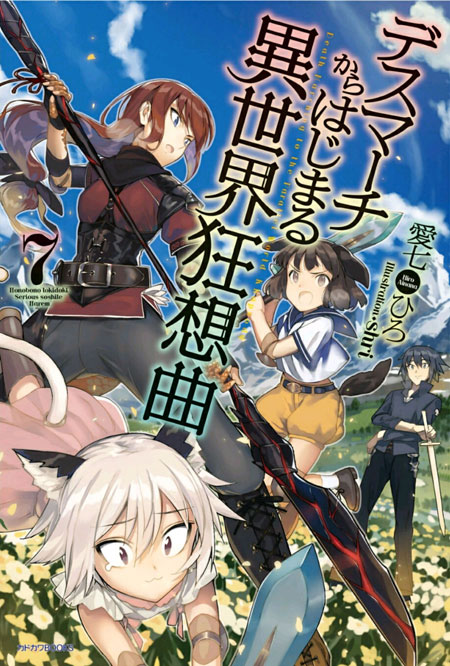
First and foremost, for those curious, this isn't an ordinary harem story. The protagonist gradually assumes a protective role towards the girls, while finding his true love beyond his close circle of friends. He's quite transparent about his feelings, which I personally appreciate. Initially, "Death March" had a rocky start, and I was disappointed with the MC's actions in some parts. However, I'm glad I persevered and stuck with it for the sake of the other characters. In the end, it was worth my time, despite some criticisms. The book shines in its diversity and intricate world-building.
The main strength of "Death March" lies in its variety. Even excellent novels can fall short in character differentiation, but this series stands out. The slice-of-life aspect is prominent, but it doesn't limit the storytelling. It avoids generic descriptions, providing engaging details that bring the characters and situations to life. For instance, instead of vague statements like "too much paperwork," the author provides specific scenarios, making the narrative more compelling.
Throughout the story, the protagonists' adventures, interactions, and exploration of different lands and cultures keep the reader engaged. There's always something happening, whether it's learning, crafting, or personal growth. The supporting characters are diverse, with well-rounded development, even if some are one-dimensional. The novel avoids clichés by having some antagonists accept defeat without resorting to typical tropes.
A spoiler follows:
- Lisa evolves from a shamed slave to a strong, independent warrior with her own code of honor, but also develops a sense of pride that can lead to arrogance. Her unwavering determination is inspiring.
- Tama and Pochi, though still children, grow and find new interests, deepening their connections with others.
- Arisa remains consistently entertaining.
- Lulu undergoes a significant transformation, gaining confidence and detachment from her past struggles, which can be both surprising and intriguing.
- Mia, while less engaging, adds a lighthearted touch with her magical abilities and occasional meddling.
- Nana's newfound maternal instincts provide depth and humor.
World-building is the novel's core, creating a vast and ancient world that feels immersive. Details are gradually revealed, making everything connected to the main character's journey meaningful. Events from before his arrival have lasting implications, and minor characters play significant roles in the story's progression, enriching the overall experience.
Several instances come to mind where foreshadowing pays off later:
- MC learns about Lisa's enslavement early on, which has a significant impact later.
- Confusion with the Hero is introduced early, but澄清 occurs much later with other similar characters.
- A seemingly insignificant item purchased at a market turns out to have a crucial role in a later plot point.
- The conflict between the local lord and kobolds is mentioned before becoming a major arc.
- The divine aspects of the world are hinted at early on and explored more thoroughly later.
In conclusion, for those seeking an immersive isekai experience with rich world-building, "Death March" is a fantastic choice. The initial chapters may be challenging, but the improvement is substantial, making it worth the investment. If you're a fan of escapism and intricate storytelling, I wholeheartedly recommend it. Just remember to push through the beginning for the full reward.