Conquest Complete, So Why Is the Affection Dropping? - Reviews

Conquest Complete, So Why Is the Affection Dropping?
+Add to Custom List
Sort
Add review
... Read More
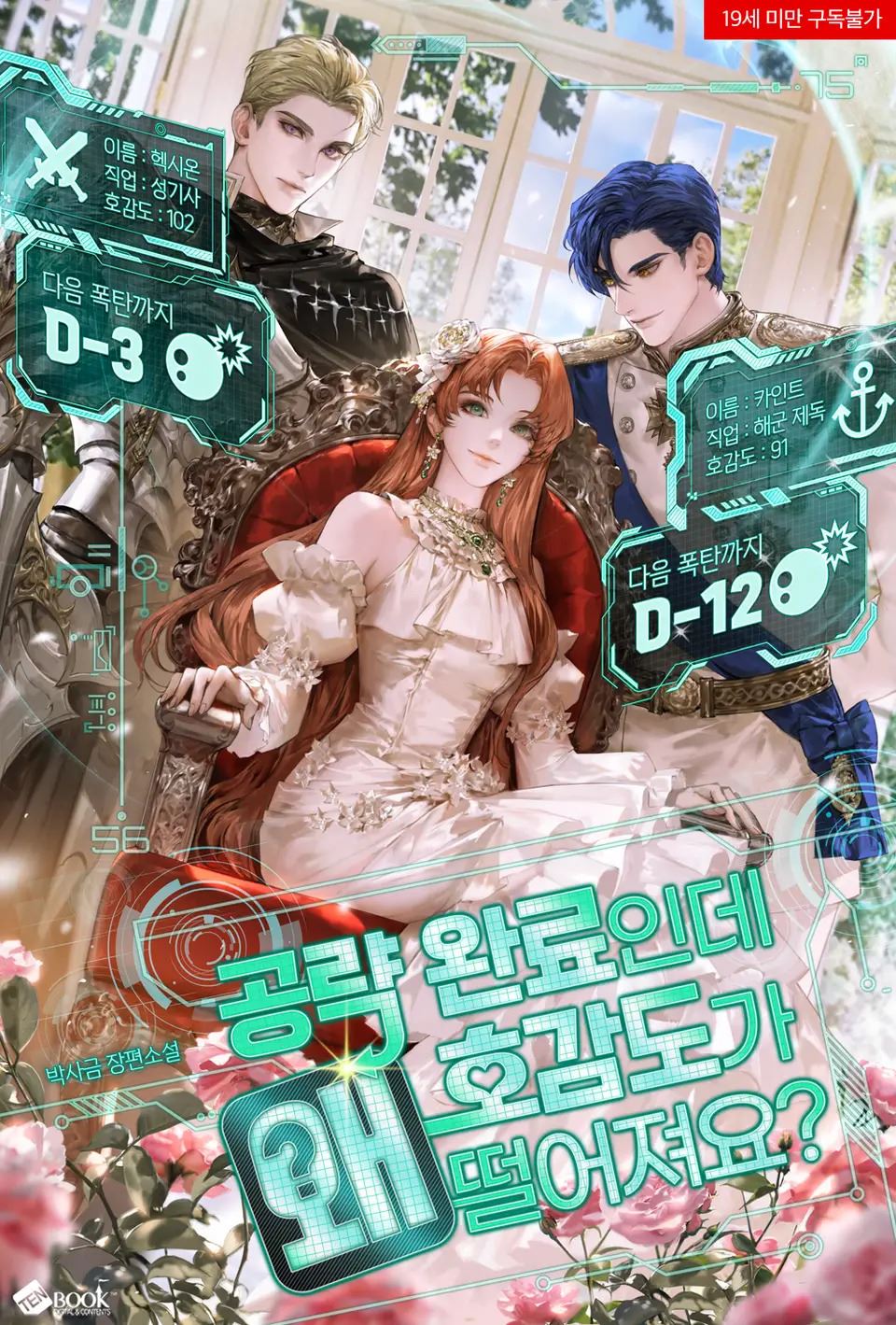
The stakes in this thing are absolutely absurd and I am HERE for it. Let's catalog what our protagonist is dealing with: Cedric will refuse treatment and never walk again if she doesn't visit him. That's self-harm as romantic blackmail and it's terrifying. Hexion is planning to HANG HIMSELF because she took three days off. Three. Days. This man has zero emotional regulation and the story treats it like a romantic inconvenience rather than a red flag the size of a billboard. Marvis has a literal countdown clock. 23:59:59 until he goes berserk, kills her, and then himself. "Death upon failure (unavoidable)" — the game UI is literally telling her she dies if she doesn't prioritize his feelings. And Kaint? He's holding a wedding proposal hostage. Accept and everyone else drops, reject and he might die. Every choice is a loss. There is no winning here. What's brilliant is how the protagonist recognizes this. She's not romantically confused — she's horrified. "Did a bug occur because I arbitrarily raised the intensity?" She's treating these men like game mechanics that suddenly gained sentience and malice. The external conflict (survive the men) mirrors the internal conflict (she wanted a chill harem life, not a psychological warfare simulation). The stakes keep escalating until the question isn't "can she get the happy ending?" but "will she survive the ending at all?"
... Read More
I need to pause and appreciate the temple description because the author did NOT come to play. The Divine Master's quarters in the innermost part, prayer room in front, knights' training grounds in back. An arch covered in WHITE ROSES. Do you understand how cinematic this is? I could literally see this in a drama. The garden being 'spacious and pleasant' tells me this is a wealthy, well-maintained religious institution—not some crumbling ruins. Then there's the East Plaza healing scene. The author drops us right into the chaos: Holy Knights lining up, priests beside them, believers waiting anxiously. And the SMELLS. 'The mixture of medicine smell, blood smell, pus smell, and the musty odor from not washing.' I'm not even kidding when I say this made me queasy reading it. The author isn't afraid to make the world feel DIRTY and REAL, not just some sanitized fantasy paradise. What I love is how the worldbuilding serves the plot. The Sacred Power system isn't just 'healing magic'—it's literally 'Judgment' that returns things to their original state. So when the man's leg doesn't heal, it's not a plot hole, it's the world's rules clicking into place. The Scales of Judgment appearing as 'tiny 0s and 1s' in the air—that detail tells me everything I need to know about how this game world operates. It's a digital system disguised as sacred power. The world feels ALIVE because every element has logic behind it.
... Read More
Let me tell you about this name that the translator actually took time to explain and it changes EVERYTHING. Shin Joo-ah. The first part, Shin Joo (신주), literally means "Divine Master" — but it also means a memorial tablet for gods and ancestors. A tablet for the DEAD. She's essentially named after something that holds the dead. This is wild symbolism layered into a dating game protagonist's name. She's the vessel containing a god, yes, but the wordplay suggests she's more like a container for something that should stay buried. Not a person, not a lover — a shrine. And then there's the whole concept of the Divine Master appearing when the world's end is near. The story keeps circling back to this idea that she's both savior and omen. Beautiful, powerful, but fundamentally inhuman in how others perceive her. The temple treats her like something to be displayed, not someone to be known. The white and gold color scheme everywhere — purity, divinity, sanctity — but it's also sterile. Cold. She's surrounded by beauty and luxury and has zero actual agency. Her "Reputation: 100" and "Relationships: None" on her status screen is honestly one of the saddest lines in the whole text. Maximum fame, zero genuine connections. She's worshipped but not loved, and that's the cruel joke the story is setting up from chapter one.
... Read More
I have to talk about how the setting shifts from dreamlike to suffocatingly real. The opening sequence is gorgeous — pure white door in total darkness (#000000, the author even specifies the hex code lol), then this vast blue sky with white clouds everywhere, this impossibly handsome man floating mid-air in a black robe. It reads like a watercolor painting. Cedric saying "I was born to meet you" with those eyes closed looking like a doll — chef's kiss aesthetic. But then she wakes up and the world gets heavier. The temple is all white and gold, sacred atmosphere, marble floors, stained glass windows casting colored light. It's beautiful but there's this underlying pressure to it, like everything pristine is also a prison. The canopy bed, the luxurious furniture — she's treated like a holy relic, not a person. The most chilling scene for me was when she walks into the High Priest's office. That deep voice that gives her chills, the tall man with his back turned by the window in elaborate white and gold robes — same design as the first game's most sadistic character. The author builds this dread so quietly. One moment she's admiring her silver hair and golden eyes in the mirror, the next she's frozen in terror. The contrast between the sacred, glittering world and the psychological horror brewing inside it is what makes this setting work.
... Read More
'Closing the Stable Door After the Horse Has Bolted!' That quest name alone made me cackle. Who gave this system permission to be this passive-aggressive? "Surprise Quest: Closing the Stable Door After the Horse Has Bolted!" — like bro, I literally just got ambushed by demon beasts and you're giving me a proverb? But honestly the real comedy gold is the internal monologue. The protagonist narrating her own life like she's simultaneously playing a game AND having an existential crisis is chef's kiss. When she thinks about the warp gate quest demanding 30 affection points she literally just swipes it away like a spam notification. "It's ridiculous enough that the quest appears right after I mentioned it" — SHE SAID THE DAMN THING OUT LOUD AND THE SYSTEM HEARD HER. The dialogue between her and Hexion is surprisingly layered too. On the surface it's flirtation-adjacent tension, but every exchange has layers. Her asking about the armor being uncomfortable isn't just being cheeky — she's genuinely testing boundaries. His responses are so clinically practical ("Winter is approaching, so you should rather be adding layers") that it's almost funnier than if he'd been flustered. The contrast between her increasingly unhinged internal thoughts and his devastatingly composed exterior? This is a comedic goldmine. And then the system just straight up applying status effects as punishment for her thoughts? That's not worldbuilding, that's PRANKING. I'm convinced the game is gaslighting the protagonist on purpose.
... Read More
The worldbuilding in this section is doing so much thematic heavy lifting. Niflheim — traditionally the Norse realm of ice and darkness — turns out to be a city of sparkling lights "like the night sky captured in a deep ocean." The name promises horror and gloom, but the reality is beauty and tranquility. This inversion runs through everything: Marvis has negative affection but acts protectively; the Divine Master is supposed to be a savior but the world's destruction is what creates her purpose; the "ancient relic" elevator is more advanced than the temple's hand-lit lamps. The system that tracks affection as a numerical value reduces human connection to a game mechanic, and Shin Joo-ah's willingness to treat Hexion's 99 points of devotion as expendable currency is the story's most damning critique of how emotional bonds get commodified. The underwater city with its floating lights and silent waters represents a world that exists beneath the surface — hidden, beautiful, and fundamentally different from the oppressive temple above. And that elevator, connecting highest and lowest floors, is a literal and metaphorical descent into truth. The ticking sound of the second hand, the cold dread of the dive, the mechanical rhythm of gears turning — every sensory detail reinforces the theme that liberation requires going down before you can go up.
... Read More
The escalation in this section is absolutely surgical. We start with the protagonist doing what amounts to light flirting — asking Hexion to remove his armor, making jokes about physical contact, getting her affection number up. It's cozy romance-game energy. Then BOOM. Demon beasts attack. Eleven dead. Thirty-one injured. Nearly half a village population decimated. What I find most interesting is how the stakes operate on two levels simultaneously. On the surface, it's a standard fantasy world-ending-threat setup — demon beasts beyond the walls, a collapsing barrier, a doomed civilization. But layered underneath is the meta-conflict of the protagonist herself. She's a person who LOVES games, who wants to collect every ending, who treats this world as entertainment. And the world is FORCING her to confront that her "game" has real consequences for real-looking people. The system itself becomes an antagonist here. Not through overt evil, but through indifference. The quest reward for preventing future deaths is... reputation points and a bonus roulette. The warp gate activation costs AFFECTION POINTS like it's trading dating currency for infrastructure. The fear status effect literally DISABLES her from enjoying a perfectly wholesome horseback ride because her thoughts were deemed inappropriate. This system isn't helping her save the world — it's manipulating her through gamification while the world actually burns around her. And Hexion stands in the middle of all this conflict as the most stable element. He's literally the one who has to protect everyone while also being the source of the protagonist's romantic tension. The man carries armor AND responsibility and doesn't complain about either. That's not just a character design choice — that's narrative function. The stakes aren't just external anymore.
... Read More
Okay so let me just say this first: the horseback scene is everything I ever wanted and I did not see it coming. Like, I thought the affection system was just a mechanic, but then Hexion lifts her onto the saddle and she leans back against his chest and feels those armored pectorals vibrating as he breathes— I SCREAMED. The way she keeps misreading the tension? The system window goes OFF the rails saying "Inappropriate response detected" when she's literally just feeling his muscles through armor?! And then it slaps her with [Status Effect: Fear] and she sits there for ten whole minutes just... unable to feel anything. The TRAGEDY of it all! She was having the time of her life and the game decided NO. But here's the thing that actually made my heart ache—she said "You'll protect me from danger, won't you, Hexion?" and his affection went from 71 to 77. He was TROUBLED. He wanted to say no because he was worried about her safety, but saying yes meant admitting he COULD protect her. The fact that he couldn't lie his way out of that is such a small moment but it says SO MUCH about him. He's already there at 77 and we haven't even had proper confessions yet. And then the worst part—the barrier scene. She's surrounded by injured people and she KNOWS they're just 0s and 1s but her heart still hurts. She's carrying the weight of being someone's savior while also just being a person who wanted a fun game. The emotional whiplash between "I want romance" and "oh god these people are suffering" is so brutal and I love it.
... Read More
The pacing here is absolutely vicious and I mean that as a compliment. Chapter 1 starts with her already transported, basically slides through the setup in a few paragraphs — got fired, played the game, woke up in the world. No dragging, no unnecessary exposition dumps. She assesses her situation, checks her status window, and within minutes we're already dealing with Hexion putting her shoes on like it's completely normal. Then the tutorial quest pops up — meet the High Priest — and suddenly we're following a golden arrow through marble corridors to the third floor. The author uses game mechanics as pacing devices brilliantly. Quest notifications create natural scene breaks and momentum. Every time she thinks she has a moment to breathe, another notification or crisis interrupts. The midnight deadline for Marvis is genius pacing — 23:59:59 ticking down creates immediate urgency. And the Kaint marriage proposal dilemma at the end? Perfect cliffhanger. Accept = lose the other three, reject = he might die. No safe option, no time to think. The author doesn't let you settle into any route before yanking the rug out. It's chaotic in the best way, like the protagonist's mental state — always one step behind whatever disaster is coming.
... Read More
"You look absolutely beautiful!" — Venom's praise felt more like a lifeline than a compliment, and that hit me hard. Joo spent time actually applying makeup for the first time since crossing over, not because vanity struck, but because this entire world had conditioned them to believe their face wasn't worth showing. The temple looked down on bodily adornment, sure, but the deeper reason was so quietly devastating: they'd convinced themselves appearance didn't matter for romance progression. They'd optimized their entire survival strategy around wit and utility, never once considering that maybe, just maybe, being seen as beautiful could open doors too. And then the universe plays the cruelest joke. All that effort to look good, all that nervous preparation, and the person they were secretly hoping might notice is staring at them with a permanent 99 affinity that doesn't mean what they want it to mean. The reputation counter ticked up 132 points from just showing up in makeup—that alone should have been euphoric. Instead, Joo feels hollow. The applause is real, the admiration is real, but none of it lands on the one face that actually matters. Then Marvis grabs them mid-crisis and the chest inspection begins—okay fine, the narration is hilarious—but underneath the comedy there's a woman being carried away from everything she's tried so hard to hold together. The temple was suffocating. The crowd was performance. Even Hexion's proximity was another script she couldn't control. And suddenly she's airborne, arms wrapped around someone who calls himself Demon Race, and for the first time in chapters she doesn't have to perform. She can just... react. "Have you fallen for me?" he asks, and I swear the reader's heart stops because NO ONE has asked Joo that without demanding something in return.
... Read More
What I love about this chapter is how it layers conflict on top of conflict on top of conflict, and none of it feels unnecessary. On the surface level, there's the physical conflict—Shin Joo falling, getting hurt, dealing with a mysterious patient. But the REAL conflict is the SYSTEM itself. Every desire, every flirtatious impulse gets blocked by these 'wholesomeness' restrictions. The stakes here aren't life or death—they're SOCIAL DEATH. Can you imagine being this close to your crush and having your own mind betray you with content filters? The emotional stakes are somehow higher than any boss battle. Then there's the moral conflict disguised as a medical case. The man claims accident, but his leg won't heal because the truth is twisted. When Shin Joo uses the Scales of Judgment, she's not just solving a mystery—she's deciding whether justice is served. The man's breakdown at the end ('Aaah...') showed me he's not a cartoon villain. He made choices, they caught up with him. There's weight there. And beneath everything? The personal stakes for Shin Joo. She's trying to survive in a game world where she can't even touch the male lead without getting flagged. Her reputation went from 100 to 219 after solving one case—that's how much she's fighting to prove herself. She said it herself: 'I should show my competent side here, even if belatedly.' That desperation to be taken seriously while simultaneously being mortified? That's the real stakes.
... Read More
I have to admit, I was not ready for this chapter to go SO HARD. It starts as pure rom-com fuel—the stair fall, the system censorship, the embarrassing chest comment—and I'm just here laughing my way through. Then BOOM. Murder mystery. A man lying about his injury, a hidden corpse, Scales of Judgment revealing the truth. The tonal whiplash was REAL but somehow it worked. The pacing between scenes is what really impressed me. Right after the most embarrassing moment of Shin Joo's life (and mine by proxy), Ris appears like a deus ex machina to interrupt. 'Ah, Shin Joo! So this is where you were!' I LOLDED. The author uses this supporting character as a perfect pressure valve—just when the tension gets too uncomfortable, WHOOSH, we're saved. Then the chapter slows down for the healing scenes. Child with fever. Elderly person. The man with the crushed leg. Each case gets its own moment but doesn't linger too long. The pacing here is like a well-conducted orchestra—quick movements for minor cases, building crescendo for the murder suspect. And that ending? 'I believe it was a shrewd judgment' with Hexion leaning in close over her shoulder? That cliffhanger had me clutching my phone. The author knows exactly when to stop.

Leave a comment

You must be logged in to leave comments. or
