Conquest Complete, So Why Is the Affection Dropping?
+Add to Custom List
Novel Info

Summary

... Read More

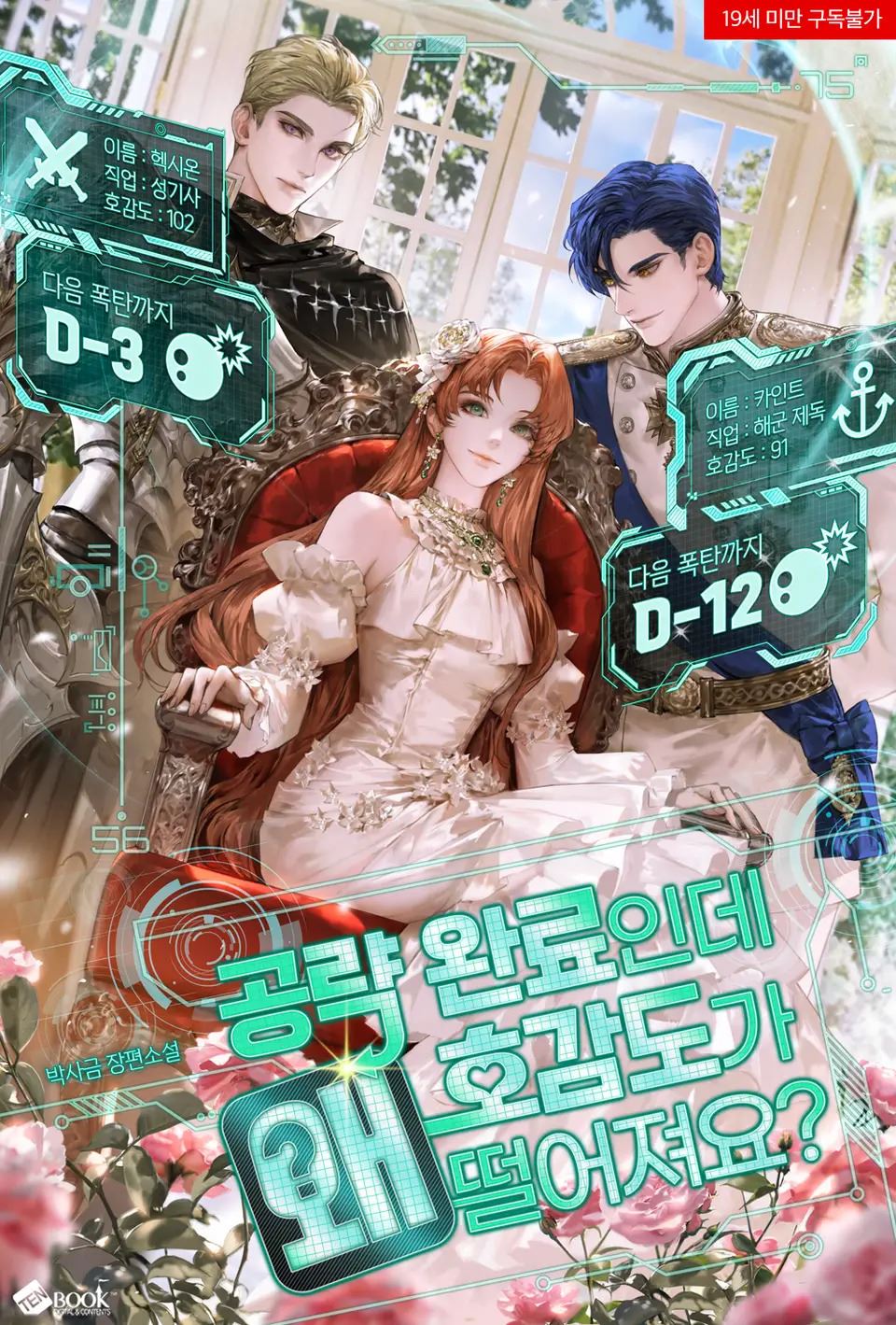
Shin Joo-ah, a twenty-four-year-old woman whose life had been consumed by female-oriented dating simulation games, found her mundane existence shattered after being subjected to a forced resignation disguised as a recommended departure. Seeking solace, she pre-ordered the preview of an all-ages sequel titled , expecting a lighthearted escape from her stressful reality. Instead of sleeping in her own bed, she awoke in a white-robed temple, inhabiting the body of the Divine Master, a vessel for God meant to save the world from destruction. The game world, however, proved to be far more complex and dangerous than the simplified romance simulator she had remembered. While the game marketed itself as family-friendly with strict censorship filters prohibiting physical contact and inappropriate dialogue, the emotional stakes were brutally high. The characters she had previously viewed as simple data points now possessed real bodies, genuine emotions, and volatile psychological states.

Her guardian knight, Hexion, initially appeared to be a stoic, virtuous protector who maintained a strict professional distance. However, his affection levels fluctuated wildly based on Shin Joo-ah’s interactions with others, revealing a deep-seated possessiveness. When Shin Joo-ah traveled to the city walls to repair damage caused by demon beasts and restored the villagers’ homes by manipulating the underlying data, she encountered Admiral Kaint, a war hero celebrated for his naval victories. The High Priest of the temple, Largo, immediately sought to exploit this encounter, using Shin Joo-ah’s divine authority to invite Kaint to the temple in an attempt to bolster the temple’s political standing against the admiral’s growing popularity. This move inadvertently triggered a crisis in her relationship with Hexion, whose affection plummeted when he perceived her engagement with Kaint as a betrayal of her duty to the temple.

The central conflict intensified as Shin Joo-ah realized that the "simultaneous conquest" mechanic she relied on was a trap. In the previous installment of the game, pursuing multiple partners led to catastrophic endings, but the sequel’s seemingly wholesome surface hid a network of deadly emotional landmines. Characters like Cedric, Hexion, and Marvis were not merely romantic interests but unstable individuals prone to self-harm, jealousy-fueled violence, and suicidal despair if neglected. The narrative shifted from a lighthearted dating sim to a survival horror scenario where maintaining the balance of affection among multiple obsessed men was a matter of life and death. Every choice carried the weight of permanent consequences, including forced death events if specific timers expired or jealousy thresholds were breached.

As Shin Joo-ah navigated these treacherous social dynamics, she discovered that the world operated on layers of hidden rules and ancient data structures. Her ability to see and manipulate the source code of reality allowed her to restore broken objects and uncover truths, but it also isolated her further from the natural order of this world. The presence of warp gates and ancient relics hinted at a deeper history that connected the current kingdom to a forgotten past. Despite the overwhelming pressure and the constant threat of emotional collapse from her suitors, Shin Joo-ah remained determined to understand the true nature of her transmigration. She sought not just to survive the immediate dangers posed by her volatile companions but to unravel the mystery of why she had been brought into this world and what role she truly played in the impending apocalypse.

The story progressed through a series of escalating crises, each forcing Shin Joo-ah to make difficult decisions that reshaped her relationships and the political landscape of the Holy City. The friction between the temple’s authority, represented by the scheming High Priest, and the military power of the Admiral created a backdrop of institutional conflict that entangled Shin Joo-ah in its center. Her attempts to maintain neutrality were consistently thwarted by the intense, often irrational demands of the men around her. The narrative explored the tension between her desire for a carefree existence and the grim reality that her every action had significant repercussions. As she delved deeper into the game’s mechanics and the characters’ backstories, Shin Joo-ah began to suspect that the true nature of the "world’s end" was far more complicated than a simple monster invasion, involving layers of divine politics and human ambition that she was only beginning to uncover.

Ultimately, the story positioned Shin Joo-ah at the intersection of divine duty and personal survival. Her journey was defined by the struggle to manage the intense, often toxic attachments of men who viewed her as their sole source of meaning and stability. The all-ages constraint of the game world added a layer of frustration and tension, as her physical desires and emotional needs were constantly checked by system enforcement, pushing her to find alternative ways to connect with and understand those around her. The narrative continued to unfold as she sought to balance the competing interests of the temple, the military, and her own heart, all while keeping her companions from destroying themselves or others in their pursuit of her attention.

Latest Release
DateGroupRelease
2026-09-27citrus aurora c99
2026-09-27citrus aurora c98
2026-09-27citrus aurora c97
2026-09-27citrus aurora c96
2026-09-27citrus aurora c95
2026-09-27citrus aurora c94
2026-09-27citrus aurora c93
2026-09-27citrus aurora c92
2026-09-27citrus aurora c91
2026-09-27citrus aurora c90
2026-09-27citrus aurora c89
2026-09-27citrus aurora c88

Community Reviews

Rating(3.8 / 5.0, 55votes)
5 stars
17(31%)
4 stars
14(25%)
3 stars
18(33%)
2 stars
6(11%)
1 stars
0(0%)

Popular reviews

... Read More
The protagonist's internal monologue is genuinely hilarious. Watch this gem: "If I was going to have a marriage ending with you, would I have done a simultaneous conquest?" Say it out loud. It's perfect. She's literally calling out the logical impossibility of her own situation with the same energy as someone pointing out that the guy who said 'I just want to be friends' clearly meant the opposite. And her reaction to the game's tonal shift? "No, but canceling the conquest is too much, isn't it?" — this woman is so done. She went in wanting a chill romance sim and got a hostage situation. Her voice when she's overwhelmed is so relatable, like your friend who took one wrong turn and now can't find the exit. The contrast with the male characters' dialogue is sharp. Cedric: "Until the end of the world, I will be with you." — dramatic, poetic, completely unhinged romantic lead energy. Hexion: "As your guard, it's only natural for me to attend to you" — formal, proper, but there's something slightly off about how devoted he is. And the High Priest's single line "Shin Joo, you've arrived" with that deep voice giving her chills — minimal dialogue, maximum threat. Her narration has this wonderful self-aware humor too, like when she thinks about long-haired men not being her type and then immediately gets bewitched anyway. "Supreme beauty can break down the walls of preference" — I laughed out loud.
... Read More
The dialogue in these chapters is sharp enough to draw blood. Marvis speaks with this infuriating casualness — "You really are rude, aren't you?" / "My name is Marvis." / "I may be arrogant and rude, but I'm not deaf." Each line lands like a small punch. He never raises his voice, never explains himself, and that restraint makes every word heavier. Shin Joo-ah's internal monologue is where the real voice lives though. Her thoughts are fast, sarcastic, self-deprecating: "What a useless and nonsensical affection description." "This is straight-up spam, really." "Single digits and double digits feel completely different!" She talks to the game system like it's a bad customer service rep. The contrast between her loud inner voice and her careful outer responses creates this brilliant tension — we always know what she actually thinks, even when she's playing it cool. And Marvis's dialogue does something remarkable: it's mostly statements, not questions. "Don't leave my side." "You better keep your lips closed." He controls conversations by refusing to ask for anything. The few lines that make him vulnerable — "Originally, I was planning to kill you" — hit harder precisely because he only offers them as casual asides.
... Read More
I need to just say this clearly: Marvis putting on that white rabbit headband is the single most devastatingly attractive thing I have read this year and I will die on this hill. The protagonist's entire internal spiral from 'ugh bunny costumes are for weirdos' to full-on 'how is a muscular man looking this good in floppy ears' was so relatable I felt attacked. And that line — 'How can a grown man, especially one with such a muscular build, look so good in a rabbit headband?' combined with the observation that 'the impact of this imbalance is breathtaking' — YES. The contrast between his dangerous demon kidnapper energy and this absurdly cute accessory is exactly the kind of sexual tension the author knows how to write. But then right after all that? He gets serious and says 'I want to leave good memories for the end. Because the world is heading toward destruction.' MY HEART. One second he's being a flirt and the next he's carrying the weight of existential dread on his shoulders like it's nothing. The whiplash is intentional and I am HERE for it. And the way Joo-ah tries to deflect with humor about alcohol solving everything, patting his back, pulling his sleeve — she's clearly flustered and trying to keep things light while also seeing this vulnerable side of him. The chemistry is not fair.
... Read More
Okay so let me unpack this whole section because it genuinely surprised me. The premise starts off reading like a typical isekai kidnap scenario — protagonist gets taken by a Demon Race figure — but then it flips on its head when Shin Joo-ah drops the bomb that she *wanted* this. She manipulated events to get captured as an escape route from the ascetic temple and from someone named Hexion. That's a genuinely clever narrative choice. Instead of a passive victim, she's been strategically engineering her own abduction. And Marvis? He sees right through it immediately. His line "Didn't you want to be kidnapped? You deliberately lured me" shows he's perceptive in a way most game antagonists aren't. The system's forced this encounter to give her a legitimate excuse to leave the temple — the game world itself is practically conspiring with her rebellion. Then there's the surprise quest [Open the Dawn Sky] which introduces another layer: she has to spend Hexion's affection as currency to activate an ancient relic skill. So the plot isn't just about escape, it's about a web of interconnected systems — affection as a resource, quests that exploit emotional bonds, and a world where the Divine Master is supposedly a savior but the mechanics suggest she's more of a pawn in everyone's designs. The pacing from kidnapping revelation to elevator repair to the question "which floor do we go to" keeps you moving without feeling rushed.
... Read More
There's a reason the ancient relic is called a Warp Gate and not just a door. The word itself implies tearing, rupture, something that bends the natural order of space. And what happens the moment it's restored? The sky doesn't open gently—it RIPS. Black mist floods in. The barrier that's kept the city safe for centuries turns out to be linked to THIS exact structure. So the gate that was supposed to connect distant places becomes the conduit for invasion. It's almost poetically cruel. Joo wanted the gate fixed because they thought it meant freedom—instant travel to the Admiral's castle, escape routes, power. What they actually unlocked was vulnerability. The very thing they hoped would give them agency becomes the thing that endangers everyone they've worked to protect. And then consider the symbolism of the gate itself: two towering pillars, scarred by time, covered in dust and vines, waiting for someone with the right skill to speak the right words and唤醒 them. "Open, Door of Dimensions." A cartoon line. A child's imitation of magic. The most powerful mechanism in the Holy City responds to the voice of someone who never asked for any of this. That's the theme right there—the unwilling protagonist whose ordinary actions reshape the world. Even the makeup Joo applies operates symbolically. It's literal surface-level transformation, a false self presented to the crowd, while underneath there's a person terrified of being truly seen by the one person who matters. The gate reveals hidden passages in geography; the makeup reveals hidden depths in identity. Both are portals of a sort, and both lead somewhere dangerous.
... Read More
The character dynamics in this section are genuinely fascinating. Marvis starts with an affection of -3, which the system describes as someone who'd deliberately stumble after watching you slip on ice — then recover smoothly and give you a thumbs up. Is he mocking you or trying to help? Nobody knows. But what's striking is how his behavior contradicts his rating. He kidnaps her, yes, but also carries her safely on a giant bird, says he plans to keep her alive rather than kill her, and shows genuine curiosity about her. He's not a straightforward villain. Then there's Hexion, who barely appears but casts a massive shadow. The narrator's description of their relationship is brutally honest: "Hexion only served me and I was the one who thoroughly enjoyed it." That admission — cold, self-aware, without remorse — tells you everything about her moral complexity. She's willing to sacrifice 30 points of Hexion's affection (from 99 down to 69) to gain 8 points of Marvis's. The math is insulting but her willingness to do it without hesitation reveals how transactional her emotional world has become. And Marvis's reaction when she fixes the elevator — "strangely dark expression" — suggests he's not happy about her being resourceful, or perhaps he's unsettled that she's using Hexion's affection as a tool. Three people orbiting each other, none of them innocent, all of them calculating.
See all reviews

Custom lists

See all custom Lists