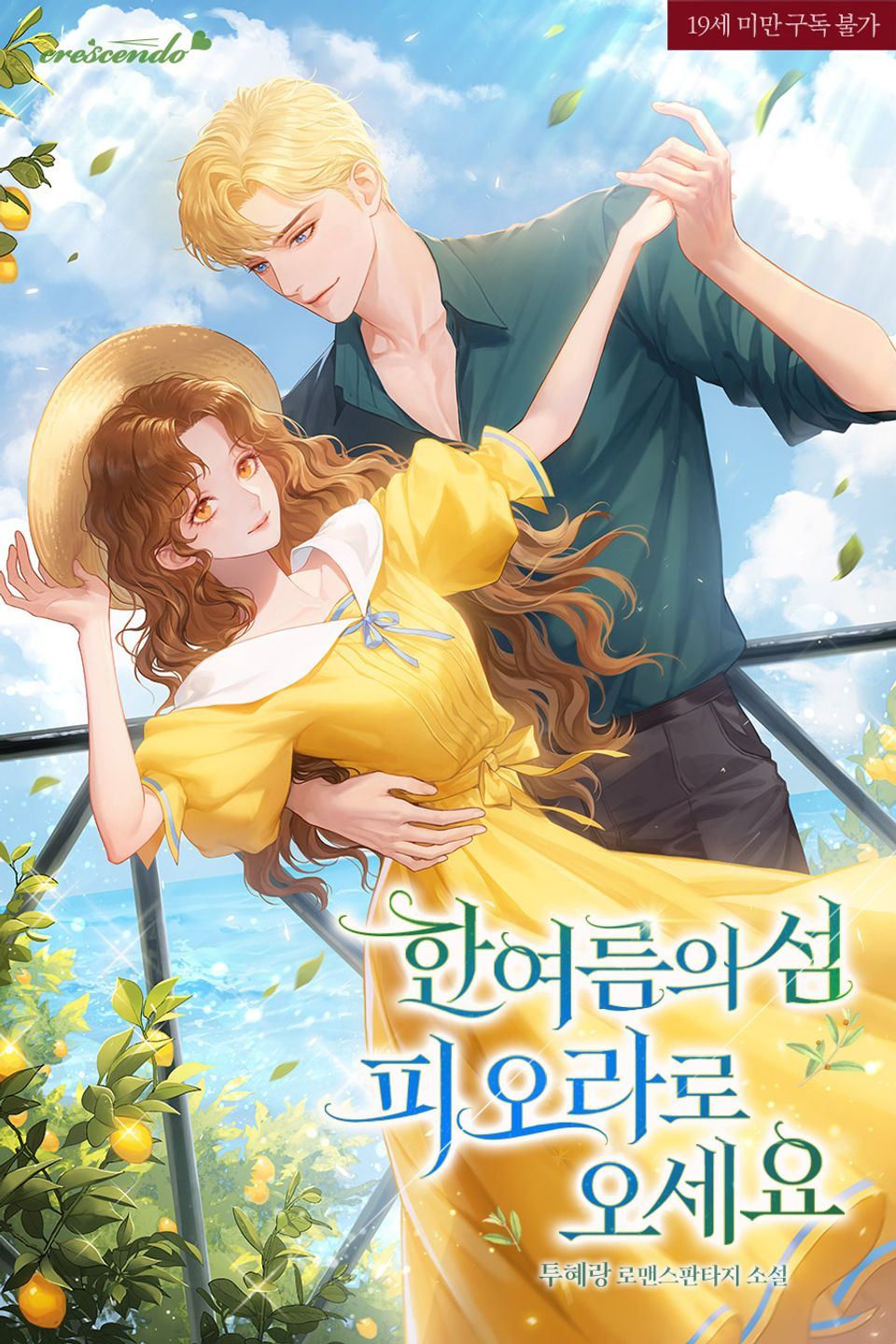
Come to Fiora, the Island of Midsummer
+Add to Custom List
Genres:
Novel Info
  • Author:
  • Status:Ongoing

Summary

... Read More

Cornelia Tottie is a twenty-something woman who works as a waitress at a restaurant named Abel on the island of Fiora. She was raised there by her guardian, Omar, after her parents died in a tragic accident. Her father had abandoned his noble lineage to marry a commoner, and Cornelia now lives a modest life, having long ago abandoned any connection to her aristocratic heritage. She is practical, hardworking, and skeptical of romantic love due to witnessing her parents unhappy marriage and subsequent demise. The story begins when Omar accuses their fish supplier, Pepe, of skimming fish from deliveries. Cornelia is tasked with tailing Pepe to catch him in the act. On her way to the harbor, she meets Julia Marinetti, a noblewoman and friend from the previous summer, who urges Cornelia to dress up because the Duke of Tesoro, the head of the most powerful family in the Kingdom of Bellavita, is arriving on the same day.

Cornelia follows Pepe and discovers he is selling fish to locals for personal profit. When she confronts him, he flees in his cart. In the chaos, Cornelia loses her hat and nearly falls, but is rescued by a stranger. This man is Luca Tesoro, the Duke himself. He is cynical about love and views marriage strictly as a tool for political and economic alliance, influenced by his parents’ arranged but respectful union. Despite his initial disdain for Fiora’s romance-centric culture, he accepts Cornelia’s offer of a carriage ride to his destination, the Acolso estate. During the ride, they discuss their differing views on marriage and class, with Cornelia expressing skepticism about unions across large social gaps. Luca drops her off near her destination before continuing to the estate where his friend, Count Silvio Scalione, resides.

Luca arrives at Acolso and finds Silvio already infatuated with Julia. Silvio is reluctant to engage in the local social circuit but is coaxed into attending a masquerade party. Meanwhile, Cornelia returns to Abel to report that Pepe has already confessed to Omar. Moved by Pepe’s reason for theft—saving money for his daughter’s piano lessons—Omar dismisses the breach of contract but encourages Cornelia to give the daughter piano lessons. Cornelia agrees, learning that the piano is available at the Acolso estate through Julia. This revelation connects her path directly to Luca and the noble circle. Shortly after, Julia asks Cornelia to serve as her ladies' maid for an upcoming masquerade, since her own maid is injured. Though reluctant due to her class insecurities, Cornelia agrees after Omar encourages her to embrace the experience.

At the masquerade, Cornelia attends with Julia and Silvio. Luca arrives late and, feeling trapped by social obligations and flattery, withdraws from the main group. He spots Cornelia alone and approaches her. They recognize each other despite the masks, bonding over their shared dissatisfaction with the shallow social atmosphere. Luca learns through casual conversation that Cornelia is the daughter of the Roti family, a newly wealthy business family, though he mishears her surname as Tottie. He is intrigued by her honesty and lack of pretense. The reunion is interrupted by Julia and Silvio, who are eager to push the pair together. Cornelia, sensing the awkwardness and fearing entanglement, prepares to leave. Luca offers her a ride home, and they share a carriage, continuing their candid conversation about the island and their worldviews.

The story establishes a slow-burning romance between two people from vastly different social standings who challenge each other’s prejudices. Cornelia struggles with her identity and her fear of repeating her parents’ mistakes, while Luca begins to question his rigid beliefs about utility and emotion. Their interactions on Fiora set the stage for a developing relationship that will test the boundaries of class and tradition in a society obsessed with romantic love.

Latest Release
DateGroupRelease
2026-10-03dusk blossoms c39
2026-10-03dusk blossoms c38
2026-10-03dusk blossoms c37
2026-10-03dusk blossoms c36
2026-10-03dusk blossoms c35
2026-10-03dusk blossoms c34
2026-10-03dusk blossoms c33
2026-10-03dusk blossoms c32
2026-10-03dusk blossoms c31
2026-10-03dusk blossoms c30
2026-10-03dusk blossoms c29
2026-10-03dusk blossoms c28

Community Reviews

Rating(0 / 5.0, 42votes)
5 stars
0(0%)
4 stars
0(0%)
3 stars
0(0%)
2 stars
0(0%)
1 stars
0(0%)

Popular reviews

... Read More
Okay so I need to talk about this moment where Luca pushes the bottle away and then deliberately looks AWAY. That small flinch of Cornelia's fingers? That's the whole chapter right there. The way she tries to hide her disappointment with that smile and dimple... ugh it made my stomach twist. And Luca, bless his tragic heart, notices it immediately but can't do anything about it because his entire framework for understanding her just collapsed. What kills me is that he's NOT a cruel person. He's not even being mean intentionally. He's just... trapped in his own logic. "I can't promise to keep it with care" - that excuse is so transparently weak that even HE knows it's weak. But he needed an out. He needed to re-establish some boundary before his curiosity pulled him in too far again. The relationship between them is so frayed here. Cornelia thought she was giving him something precious - those litomarine pebbles from the western beaches, blue like his eyes (the fact that she noticed his eye color and remembered it!). And he treated it like a liability. Meanwhile Silvio was over there laughing about how Luca got it wrong, completely missing that his friend was about to do something he'd probably regret forever. And Julia isn't even in the scene - she's off chatting with someone else, leaving Cornelia vulnerable to this exchange. That dynamic of women supporting each other while the men figure things out separately keeps showing up. I swear every time Cornelia has a real moment with Luca, Julia's somewhere nearby but not IN it, like the universe is testing whether these two can navigate their feelings without a chaperone buffering them.
... Read More
Can we just take a moment for how distinct these voices are? Because it's easy to write a group scene where everyone sounds like the same smart person in different costumes. This author doesn't do that. Silvio is the most immediately recognizable — his dramatic preamble before confessing love, the self-satisfied smirk, the way he tosses a plum while talking about romance. He's performative even when he's being sincere. "What a devoted heart. I'm nearly moved to tears." That's Luca's voice, though — sharp, sarcastic, deflecting with humor. You can hear the eye roll between the lines. Omar is different entirely. His dialogue is clipped, practical, almost gruff: "Tch, useless excuse." But then he pivots without warning to something devastatingly tender: "If you can't do what you want, it stays with you your whole life." The contrast between his rough exterior and his soft center is all in the dialogue — no narration needed to tell you he's a good man. He just is. And Julia! She bursts onto the scene like a firework. "I can't believe it." "Tell me everything." "This is too good, Cori." Her sentences are short, punchy, breathless. She doesn't pause. She jumps straight to marriage when the word "Duke" comes up. That's not just character — that's a personality vibrating at a different frequency than everyone else in the book. The one line I keep coming back to is Cornelia's quiet deflection: "Yes. But that had nothing to do with it." Said about the dress. Said about everything. Her voice is the smallest in the room, but it carries the most weight.
... Read More
Oh man, this chapter sequence is quietly doing something really clever with its plot threading. Let me just say — the whole Silvio / Julia / Luca / Duke Tesoro / Cornelia cluster is coming together in a way that feels deliberate, not coincidental. The reveal that both Silvio and the Duke are staying at the same estate, Acolso, is the kind of moment where you sit back and go "oh." Cornelia never even told Julia about giving the Duke a ride to the harbor, and then BOOM — it comes out naturally because Silvio has a piano there. That's good plot craft. The author isn't forcing coincidences; they're letting the geography of the island itself create the collisions. Then there's the Pepe subplot, which at first glance seems like filler — a side character who skimmed fish for his daughter's piano lessons. But look at how it mirrors Cornelia's own relationship with music and her father. Omar says: "Your dad was also absolutely devoted to his daughter. Wanted to give her everything she wanted." That line does so much heavy lifting in a single sentence. It ties the minor character's story back to Cornelia's emotional core without being heavy-handed. The biggest plot tension, though, lives in the silence around Duke Tesoro. He barely appears in these chapters, but his presence is everywhere — in Silvio's plans, in Julia's matchmaking dreams, in Cornelia's quiet dread. The story is setting up a romantic collision course without ever accelerating into melodrama. It's patient. Maybe too patient for some readers, but I think it's working.
... Read More
'To me, it looks closer to a sunset than to fire. Those eyes, I mean.' I literally gasped when he said that. Not because it was mean—because it was so precise and so gentle and so devastating all at once. She gave him something she'd been thinking about constantly, something she offered because she thought they had built... something. And his response tells you everything about where he actually stands. But Luca's behavior afterward? This is the good stuff. He's not cold, Cornelia notices, but he's not warm either. There's this 'certain distance, as though he were drawing a line.' He doesn't tease her about the piano anymore. When Dina praises Cornelia's playing, there's no joke coming. That's not indifference, that's deliberate withdrawal. He's punishing himself as much as her. And the chess scene at the end—I almost laughed out loud. After all this tension, after the wind and the forced proximity and the loaded silences, the moment he appears to help is pure comedy. 'That's the rook. Not the bishop.' His pained expression while watching her struggle? It's the first crack in the ice. He couldn't stay away. He had to come help. But even then, he just stands at the doorway looking conflicted, like he can't decide whether to step in or walk away. The complexity here is insane. Silvio called to say he'd stay with Julia 'indoors'—and Luca immediately snapped 'I already told her that, so stay out of it.' Protective? Jealous? Both? Cornelia is walking on eggshells the entire time, wondering if she did something wrong, and honestly, so am I.
... Read More
Can we just take a moment to appreciate how GOOD the dialogue is in this chapter? Luca's voice is so distinct—always slightly sharp, always holding something back. When he says things like "You don't need to worry about that. Nothing of the sort will happen" after she asks if he thinks she has designs on him? The way he delivers that line is just... devastating. He's trying to protect himself AND push her away at the same time. But then there's Cornelia, and her voice is so different. More vulnerable, more questioning. "Was now the time for explanations?" She's always second-guessing herself, always trying to read between the lines. I love that about her character. The author does something really clever with the subtext. Everyone is saying one thing but meaning another. When Luca talks about "managing risk" instead of admitting he's scared of falling for someone below his station—that's peak romantic comedy/drama dialogue. And the humor! "What kind of risk?" / "Emotional..." / "Political?" This back-and-forth had me CACKLING despite the angst. The author knows how to balance tears with laughs. That final exchange though—"Cori." Just one syllable, but it carries so much weight. After being all formal and distant, he finally uses her nickname and everything changes. The dialogue shifts from sharp and guarded to soft and real in one word. Also note how the chess instructions mirror their relationship: she moves without thinking, makes mistakes, doesn't understand the rules. Meanwhile he's the one explaining everything, holding all the knowledge. It's perfect metaphorical dialogue writing.
... Read More
I keep coming back to how the setting mirrors the mood. The masquerade ball—masks, jazz, champagne, those ‘middle class' women bounding out with cheerful lack of refinement—versus Luca's internal disdain. But then the author shifts us to the carriage ride under lamps, the faint yellowish light, the quiet dark outside. It's intimate, isolated, removed from the spectacle. And Fiora itself: the sea, the weather, the flora—Cornelia loves it, and Luca, despite his complaints, can't deny the scenery. The island isn't just backdrop; it's a character that draws people in, separates them, and forces proximity. That beach detail—Terrace Beach versus the quieter spots Luca prefers—tells us so much about their social worlds without a single exposition dump.
See all reviews

Custom lists

See all custom Lists