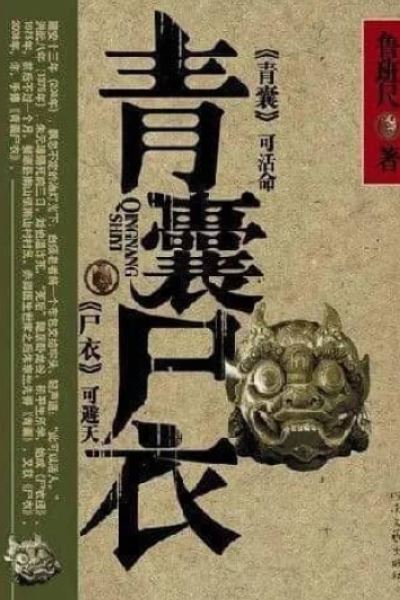
Black Shroud of Corpses
Novel Info

Summary

... Read More
In late autumn 1975, Zhu Hansheng, a twenty-year-old apprentice to his barefoot doctor father in Wuyuan, Jiangxi, discovers a government notice requiring the relocation of graves near Linggu Cave within fifteen days. His father, a practitioner of traditional medicine with hidden knowledge of Feng Shui, prepares to exhuming their ancestral remains despite the political risks associated with feudal superstitions during the Cultural Revolution.During the excavation of his great-grandfather's grave, Hansheng encounters black corpse gas, which his father identifies as a protective measure using Toad Mandrake Powder. While retrieving the bones, Hansheng notices missing hand bones and returns at night to recover them. In the grave pit, he uncovers a sealed vertical shaft known as a Golden Well beneath the coffin. Curiosity drives him to dig further, revealing a second, ancient coffin sealed with lime paste approximately two meters below the surface. Upon opening this coffin, red corpse gas escapes, but Hansheng is saved when a rare fungus called White Mountain Beard enters his nostrils, neutralizing the lethal toxin.Inside the ancient coffin lies a rosewood box containing the lost Classic of the Black Satchel, a medical text attributed to the legendary physician Hua Tuo from the Three Kingdoms period. The accompanying letter instructs the finder to practice medicine and help the world, keeping the knowledge secret. Hansheng hides the book and continues his duties. Soon after, his father is called to treat a pregnant woman who fainted near an abandoned grave. The father diagnoses a Ghost Fetus, a condition where yin energy from the grave has invaded the womb, causing prolonged and dangerous labor. Unable to cure her with conventional methods, Hansheng secretly prepares a remedy from the Classic using stagnant water from bamboo and mole crickets found near the grave of Shen Caihua, a woman who died by suicide under suspicious circumstances.Hansheng successfully delivers the baby, saving both mother and child, and begins to master the ancient medical techniques. During the relocation of the rest of his family's graves, his father reveals the existence of a Taiji Halo, an exceptionally auspicious burial site capable of producing emperors, located near Linggu Cave. While carrying an Earth Spawn found at this site, Hansheng and his father encounter Wu Daoming, a Feng Shui master from Hong Kong, and Meng Zhuqi, the local revolutionary committee chairman. Wu Daoming recognizes the Earth Spawn as a Taiji Spawn and attempts to buy it, raising suspicions about their true intentions regarding the grave relocations.The father and son flee the encounter, realizing the political and supernatural threats involved. Later, at a county market, Hansheng witnesses a girl named Lan'er begging for a cure for her mother, who suffers from Frozen People disease, a condition comparable to ALS. Remembering the Classic's prescriptions, Hansheng publicly cures the woman using a silkworm from a Wood Egg and charred hair. The successful treatment spreads rumors of a divine doctor in Wuyuan, attracting attention from powerful figures. The story concludes with Hansheng committing to his path as a healer while navigating the dangers posed by the political elite seeking the secrets of the Taiji Halo and the ancient medical legacy.

Latest Release
DateGroupRelease
2026-10-01divine dao library c20
2026-10-01divine dao library c19
2026-10-01divine dao library c18
2026-10-01divine dao library c17
2026-10-01divine dao library c16
2026-10-01divine dao library c15
2026-10-01divine dao library c14
2026-10-01divine dao library c13
2026-10-01divine dao library c12
2026-10-01divine dao library c11
2026-10-01divine dao library c10
2026-10-01divine dao library c9

Community Reviews

Rating(3.9 / 5.0, 47votes)
5 stars
15(32%)
4 stars
12(26%)
3 stars
20(43%)
2 stars
0(0%)
1 stars
0(0%)

Popular reviews

... Read More
Okay so first of all—A SANITARY BELT STRUCK BY LIGHTNING. I am not making this up. Hansheng goes on this entire quest, limping around with a stick, braving a thunderstorm, and the Holy Grail of traditional Chinese medicine is literally a tampon that got zapped by lightning. And the reason it works? Because apparently it's the dirtiest thing in the world and can cure Crying Blood Disease. My brain is still processing this. But here's what actually stuck with me: the narrative structure of this whole arc. Hansheng gets the book, meets the hermit, learns about the legend, goes on the dangerous retrieval mission, succeeds, and then immediately gets kidnapped the moment he tries to use what he found. That's some next-level author energy right there. You spend chapters building up this entire quest, investing in the tension of the thunderstorm scene, feeling hopeful that Lan'er is finally going to be saved—and then WHAM, two guys in green polyester shirts show up and drag him into a Jeep. Also the reveal that Hansheng isn't even the real miracle doctor? That's a solid twist. Meng Zhuqi's like "if the father's skills are average, how could he teach a son any real ability?"—which is also weirdly fair logic. But it raises the question: if Hansheng's knowledge came from the Black Satchel and not his dad's teaching, then what does that say about his lineage? The author is layering mysteries like an onion and I am HERE for it.
... Read More
I need to talk about Lan'er because honestly my heart hurts for her. She's a posthumous daughter. Her father was from Beijing, educated, good—and then the Wei River flooded, her mother was swept away, rescued, but the village was gone. Thick yellow silt where everything used to be. Just her mother and baby Lan'er surviving against all odds. Ten years of hunger, of wild vegetables and grain bran, and then the mother gets this strange disease and curls up like a frozen person. And Lan'er—watching her mother die slowly, watching her OWN face change and become uglier each day because of the Crying Blood Disease. Most people avoid her. She hasn't looked in a mirror in forever. So when Hansheng appears, limping with a wooden stick, she cries and says "You finally came." Not because she thinks he's handsome or charming, but because he PROMISED. He said he'd come back and she held onto that like a lifeline. The fact that she offered her body to repay him—that's not romantic, that's desperation. That's someone who has nothing left to give except themselves. And Hansheng going through all that pain, braving a thunderstorm, killing a century-old bat, just to fulfill a promise to a girl who considers herself ugly and worthless? That's the kind of devotion that makes you want to scream at the sky. Their connection isn't built on flirtation or grand gestures. It's built on a promise kept across distance and difficulty. And that hits different.
... Read More
I need to talk about the mountain scene because honestly it read like a documentary. "The rocks were jagged like wolf teeth." That single sentence does more work than half the action sequences in other books I've read this year. You can feel the sharpness. You can feel the danger. The whole sequence of Hansheng lowering himself down that slope with a rope tied to an old pine tree is so vividly rendered that I physically tensed up reading it. I found myself holding my breath when the mother rat started chewing. I actually forgot I was reading a book for a solid thirty seconds. And the setting around him — the black spotted squirrels, the red maple leaves, the waterfalls described as "flying dragons spitting out jade" — this isn't just decorative scenery. The author is building a world where nature is simultaneously beautiful and lethal. The same mountain that gives you Liquorice Root will also drop you dead if you slip. The Qing Dynasty poem about Dazhang Mountain being the "Barrier of the Three Skies" that "evenly divides the Wu and Chu Dynasty" adds this historical weight to the landscape. This mountain has been dividing things for centuries. It divides provinces. It divides people. And now it's about to divide Hansheng from whatever comes next. The inn where he wakes up is described in three sentences and somehow feels more real than most fully described rooms in other novels. Mud brick. Thatched roof. Whitewashed walls. Calligraphy scrolls. A man with a grizzled beard speaking standard northern Chinese in southern Jiangxi. It just works. This author understands that atmosphere isn't created by adjectives. It's created by the specific details that happen to be true.
... Read More
Okay so let's talk about Hansheng and his dad for a sec because their relationship is genuinely one of the most quietly moving things in this whole novel and nobody seems to be going crazy over it? On the surface it's pretty standard master-apprentice vibes, right? Dad's the gruff traditional doctor, kid's the slacker who apparently doesn't study hard enough. Classic setup. But then you get these tiny moments scattered throughout and they hit different. Like when Hansheng comes back with the mole crickets and saves that woman — first time he's actually used the Classic on his own, completely on his own judgment, no dad hovering. And his dad's reaction isn't pride or anything dramatic. It's just… tired relief. "That was close." That's it. But then immediately follows up with the lament about the family line dying out. Which is honestly kind of devastating when you think about it — the father is SO glad his daughter-in-law lives but his first thought is still about legacy and whether the lineage continues through his son. But the real moment that got me? When Hansheng says to his dad, almost offhand: "I suddenly feel that when a doctor saves a dying patient, there's an indescribable joy in his heart." And his dad just… agrees. Doesn't lecture. Doesn't push. Just accepts it. That's a whole relationship arc compressed into three lines of dialogue. Two people who clearly care about each other but express it through work and silence instead of words. And then — and this is the part that actually made me stop reading for a second — the newborn baby gives Hansheng an eerie smile as he's walking away. He doesn't see it. But the reader does. Who is that baby? Is it really the rescued child, or is it something else wearing her skin now that the ghost fetus has been driven out? Because if Shen Caihua's resentment was trying to swap the fetus, and Hansheng's medicine pushed it back… did it fully go? Or did something else take its place? I keep thinking about that smile. It wasn't described as malicious. Just eerie. Like a knowing smile. And I can't shake it.
... Read More
I don't usually notice dialogue this much but the author nailed something here. Let me just drop three lines and you'll feel it: Wu Daoming: "Isn't that a Tai Chi Earth Spawn in the young man's hand? Where did you get it? I'm willing to pay a high price for it." That's polished. Calculated. Every word is measured. This man is performing curiosity while actually interrogating. Doctor Zhu to his son: "A few days ago, the town asked us to relocate the Ancestral Graves in front of Linggu Cave. Today we saw Chairman Meng with this Feng Shui Master. There must be something fishy going on." And then immediately connecting the dots himself. This is a practical man who doesn't need fortune tellers to survive, but he's not naive either. And Hansheng to the crowd: "It can be cured." Voice so low only he can hear it, then the old man's sharp ears catch it anyway. This kid speaks sparingly but when he does, the narrative weight shifts. Lan'er: "If you can cure my Mother, I'm willing to marry you." Direct. Desperate. No performance. She's sixteen, ugly by conventional standards, and she's offering everything she has. The dialogue strips away everything unnecessary. Even the crowd reactions are distinct voices — the white-bearded old man dismissing ALS as terminal with a classical reference to Hua Tuo and Bian Que, vs. the warm-hearted Jiangxi locals who immediately gather scissors and matches. Each group has a personality.
... Read More
So I've been thinking about the mole cricket for like two days now and I genuinely believe it's the central symbol of this entire section and possibly the whole novel. Let me walk through this. First, the obvious layer: mole crickets are mentioned in the Classic of the Black Satchel as an ingredient. They live underground. They can fly briefly but mostly burrow. They're found near the crack in Shen Caihua's grave. They're what saves the pregnant woman by counteracting the Yin energy. Straightforward medicinal logic — every poison has its antidote nearby. But what if the mole cricket is also a metaphor for Hansheng himself? He's underground — literally. He's been studying buried texts, grave-robbing adjacent knowledge, things most doctors would never touch. He moves between the world of the living (his dad's practice, the village) and the world beneath it (the graves, the spirits, the hidden rules of Yin and Yang). He can surface briefly — like the mole cricket flying — but he always comes back down. And then there's Shen Caihua's story, which is basically the mole cricket narrative inverted. She was a woman who lived in the cracks of this society — no family, no voice, accused of adultery, beaten, buried in an abandoned graveyard instead of the ancestral site. Her resentment is so strong it becomes a force of nature. She can't stay buried. She tries to climb out through the crack in her grave, not as a corpse but as a Ghost Fetus trying to swap into a living womb. The Classic calls it pathology. The grandfather's generation calls it Yin energy. But underneath all that medical terminology, this is just a story about a woman who died unjustly and refuses to let it be the end. And the baby at the end — that smile. Is it the rescued baby? Or is it Shen Caihua finally getting what she wanted? Not revenge. Just… a body. A life. A chance to exist. I don't have answers. I just know this novel is way deeper than your average supernatural doctor story and it makes me uncomfortable in the best way.
See all reviews

Custom lists

See all custom Lists